ADHD Assessment Tools: A Clinician’s Guide for Adults and Children
ADHD assessment tools help you gather evidence about symptoms, developmental history, and functioning so you can make and document informed clinical decisions.


ADHD assessment tools help you gather evidence about symptoms, developmental history, and functioning so you can make and document informed clinical decisions.
ADHD assessment tools include screening questionnaires, symptom rating scales, structured interviews, and computerized measures. Adult options include the ASRS, CAARS 2, and DIVA-5. Pediatric options include Vanderbilt, Conners 4, and ADHD Rating Scale–5. No questionnaire or computerized test establishes the diagnosis by itself. A clinical evaluation must integrate the findings with history, functioning, and possible alternative explanations. [1] [2]
Key takeaways
- Choose tools by age, clinical purpose, available informants, and the instrument’s norms and access requirements.
- Use rating scales to support evaluation and follow-up. A positive screening result is a reason to investigate, not a diagnosis.
- For children, gather information from caregivers, school personnel, and the child when developmentally appropriate. For adults, assess current symptoms and evidence of childhood onset.
- Interpret disagreements and changing scores in context. Scores from different tools or forms are not automatically interchangeable.
- Document the instrument and version, informant, results, functional impact, clinical reasoning, and next steps.
What are ADHD assessment tools?
ADHD assessment tools provide structured ways to collect information during an evaluation or follow-up visit. The phrase “ADHD tests” can describe several different approaches, each answering a different clinical question.
Screening questionnaires identify people who may benefit from further evaluation. They help you decide what to explore next.
Symptom rating scales organize reports of inattentive and hyperactive-impulsive behaviors. Some also assess impairment, associated difficulties, or response patterns. Parent, teacher, self-report, and observer forms capture different perspectives.
Structured or semi-structured interviews guide a clinician through symptom examples, developmental history, and diagnostic requirements. An interview focused on ADHD still needs to sit within a broader clinical evaluation.
Performance-based and digital measures collect information about attention, response inhibition, activity, or other cognitive functions under specific testing conditions. These findings can supplement the history and clinical assessment.
CHADD’s clinical resources describe how scales and checklists gather information across informants and settings. The instrument supplies structured evidence. You determine how that evidence fits the patient’s presentation. [3]
Screening questionnaires
Identify people who may benefit from further evaluation and help you decide what to explore next.
Symptom rating scales
Organize reports of inattentive and hyperactive-impulsive behaviors across parent, teacher, self-report, and observer forms.
Structured interviews
Guide a clinician through symptom examples, developmental history, and diagnostic requirements within a broader evaluation.
Performance-based and digital measures
Collect information about attention, inhibition, or activity under specific testing conditions to supplement the clinical assessment.
How ADHD assessment differs from ADHD diagnosis
An ADHD assessment is the process of collecting and interpreting information. Diagnosis is the clinical conclusion reached when the evidence supports the relevant criteria and other explanations have been considered.
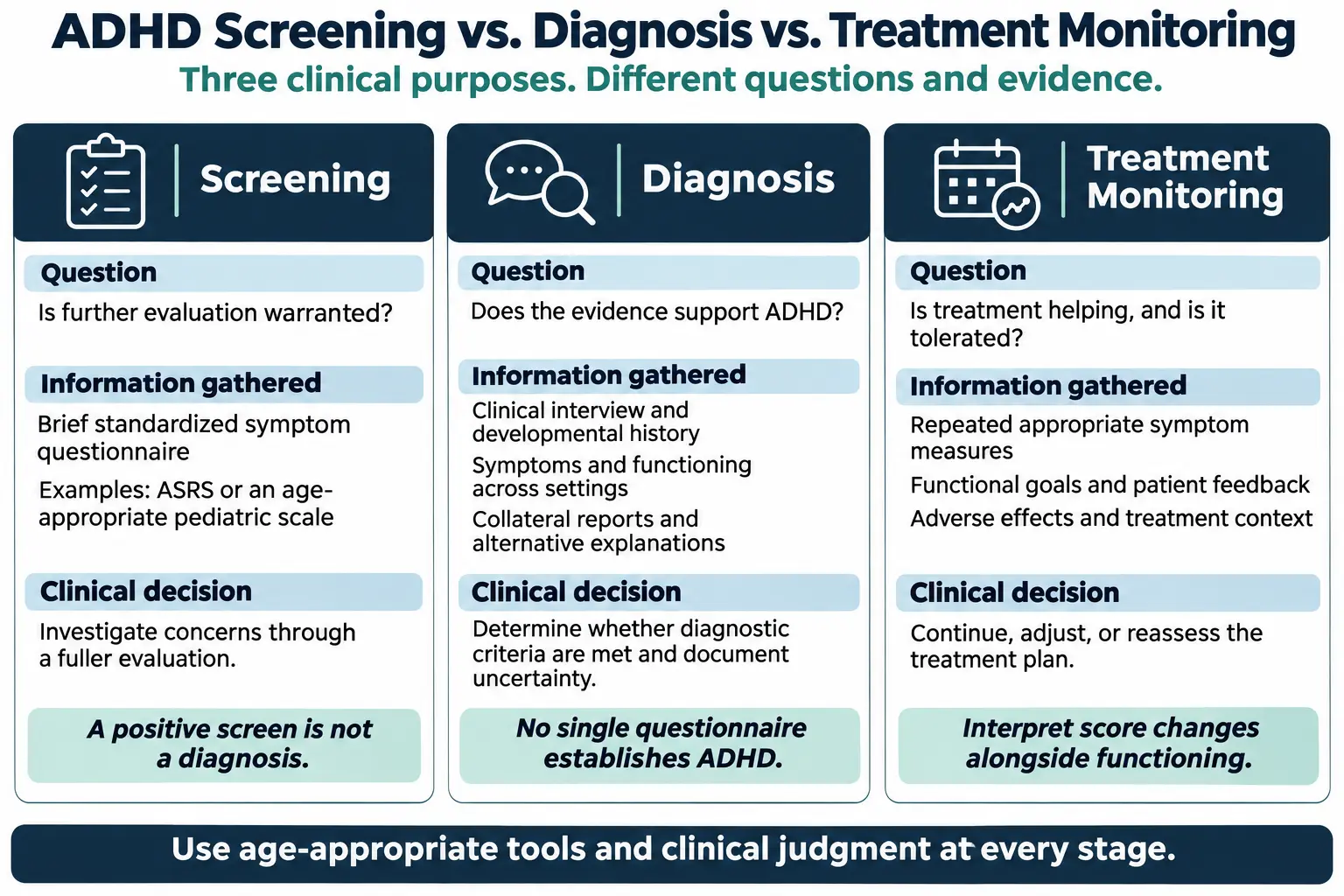
CDC emphasizes that diagnosis involves several steps and that sleep disorders, anxiety, depression, and some learning difficulties can produce similar symptoms. A high questionnaire score cannot resolve those possibilities on its own. [1]
The DSM-5-TR framework requires a persistent pattern of symptoms, evidence of childhood onset, symptoms in multiple settings, and meaningful interference with functioning. A useful summary includes:
- Six or more symptoms within the inattentive and/or hyperactive-impulsive domain for children younger than 17. The threshold is five for people 17 and older.
- Symptoms persisting for at least six months and being inconsistent with developmental level.
- Several symptoms present before age 12.
- Several symptoms occurring in two or more settings.
- Clear evidence that symptoms interfere with or reduce the quality of social, academic, or occupational functioning.
- Symptoms not better explained by another mental disorder and not occurring exclusively during a psychotic disorder.
NIMH summarizes these age thresholds and diagnostic requirements. Apply the full criteria within your clinical scope rather than treating this summary as a diagnostic checklist. [2]
Co-occurring conditions can be present alongside ADHD. Your assessment should explain which findings support ADHD, which suggest another condition, and what remains uncertain.
When impulsivity and persistent behavioral concerns complicate an adult evaluation, our guide to differentiating ADHD from antisocial personality disorder explores another differential diagnosis consideration.
Turn ADHD Assessment Results Into Clear Clinical Documentation
Get seven practical templates, worksheets, and checklists to support assessment planning, clinical reasoning, and follow-up for adults and children.
- Choose assessment tools by age, purpose, and informant.
- Document findings with a structured assessment note template.
- Explore conflicting reports with an informant discrepancy worksheet.
- Track symptoms, functional goals, and treatment tolerability over time.
- Review note completeness and payer requirements with practical checklists.
How to choose an ADHD assessment tool
Start with the question you need the tool to answer.
Match age and norms
Select an age-appropriate form and review the population used to develop its norms. A pediatric form does not become an adult instrument by changing its wording.
Define the purpose
Distinguish initial screening, detailed symptom assessment, diagnostic interviewing, and monitoring treatment response.
Identify informants
Decide whose observations can illuminate home, school, work, and relationship functioning. Obtain appropriate consent for collateral communication.
Check administration and access
Review language options, qualification requirements, scoring procedures, copyright terms, and digital-use permissions.
Plan interpretation and documentation
Decide how you will assess impairment, investigate discrepancies, and connect findings to the clinical plan.
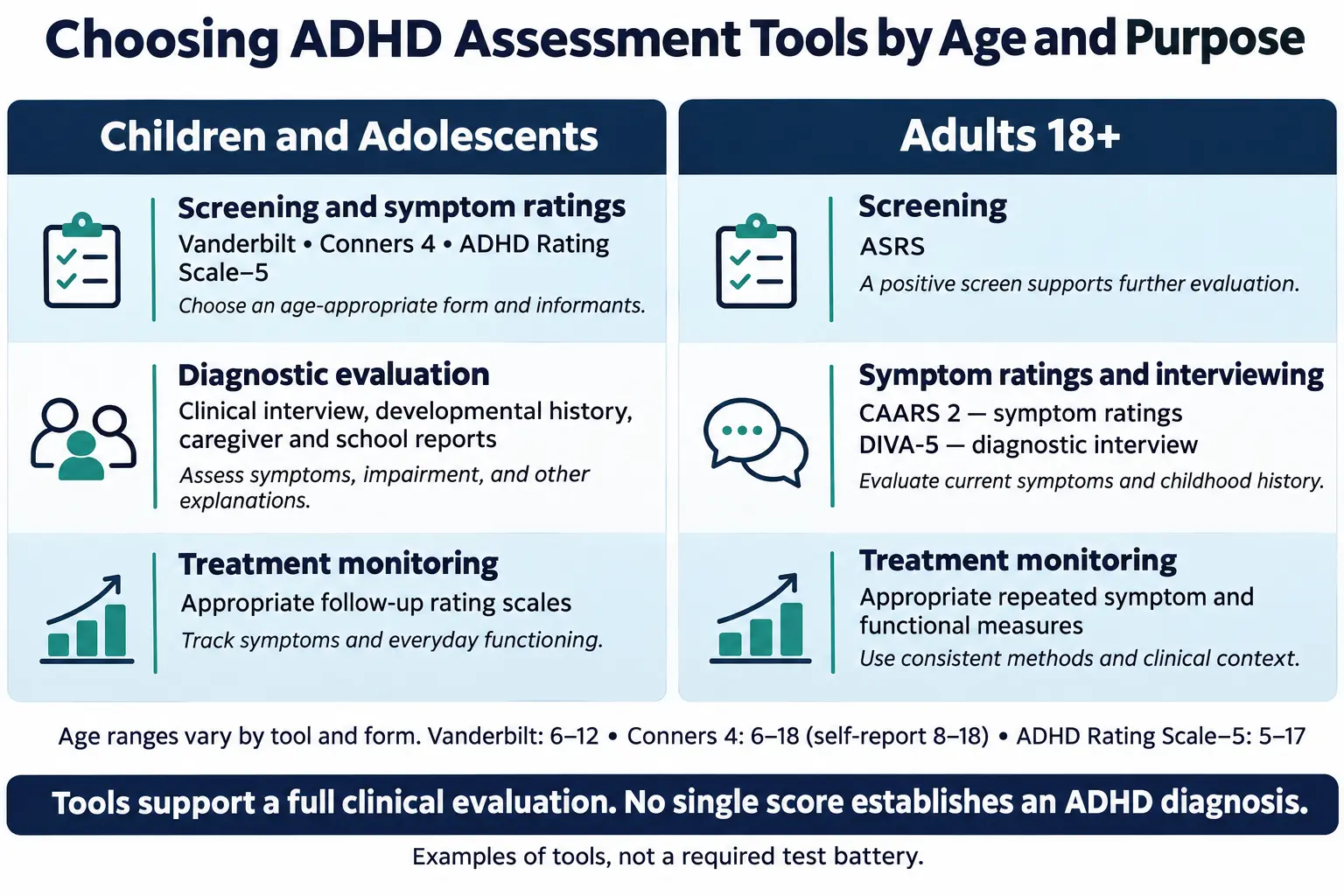
The tables below compare core options. Completion time does not include scoring, collateral review, interpretation, or documentation. Where a dependable uniform time is not provided here, plan around the selected form or interview rather than assuming a fixed duration.
Core tools by age purpose and follow up
| Tool and population | Informant and purpose | Completion planning and follow up |
|---|---|---|
| ASRS v1.1 six-question screener — Adults 18+ | Self-report — Initial screen | Brief six-item form. Follow its scoring instructions. Broader monitoring needs additional symptom and functional assessment. |
| ASRS v1.1 18-question checklist — Adults 18+ | Self-report — Current symptom inventory | More detailed than the screener. Record the version and scoring method if repeated. |
| Vanderbilt — Children 6–12 | Parent and teacher — Symptoms, performance, associated concerns | Plan time for each informant. Dedicated follow-up forms support monitoring. |
| Conners 4 — Parent/teacher 6–18, self-report 8–18 | Multiple perspectives — Symptoms and impairment | Publisher lists 1–25 minutes across forms. Choose full, short, or index form deliberately. |
| ADHD Rating Scale–5 — Ages 5–17 | Home and school reports — Symptoms and impairment | Use the appropriate child or adolescent form. Repeat comparable forms for treatment evaluation. |
| SNAP-IV — Pediatric use appropriate to selected version | Parent and teacher — Symptom ratings | Versions differ in length. Verify the selected form, applicable norms, and follow-up scoring. |
| CAARS 2 — Adults 18+ | Self and observer — Symptoms and impairment | Full 10–20 minutes, short 5–10 minutes. Use comparable forms when tracking change. |
| DIVA-5 — Adults | Clinician interview, with collateral when available — Childhood and current symptoms and impairment | About 60–90 minutes. Intended for diagnostic interviewing rather than brief routine monitoring. |
| ACDS v1.2 — Adults | Clinician interview — Structured symptom exploration | Duration varies with complexity. Check version and clinical training requirements. |
| WURS-25 — Adults recalling childhood | Retrospective self-report — Historical symptom evidence | A 25-item retrospective measure. Not a measure of current treatment response. |
Sources for table specifications and clinical roles: Harvard ASRS resources, NICHQ, MHS, Guilford, DIVA Foundation, and CHADD. 3] [[4] [5] [6] [7] [8] [9]
Access scoring and principal limitations
| Tool | Access and scoring | Principal limitation |
|---|---|---|
| ASRS v1.1 six-question screener | Free use under official citation and copyright conditions. Use its own scoring instructions. | Screening result does not establish diagnosis. |
| ASRS v1.1 18-question checklist | Official resource directs users to request permission. Do not assume the screener’s terms apply. | Additional items do not replace developmental history or differential assessment. |
| Vanderbilt | Downloadable from NICHQ. Retain copyright notices and follow current terms and scoring guidance. | Match use to the patient’s age and assess performance as well as symptoms. |
| Conners 4 and CAARS 2 | Commercial licensed tools through MHS. Check qualifications, forms, and scoring/report costs. | Elevated ratings require contextual interpretation. |
| ADHD Rating Scale–5 | Commercial Guilford publication. Follow purchaser reproduction limits and scoring instructions. | Pediatric norms should not be generalized to adults. |
| SNAP-IV | Forms are available through clinical resources. Confirm exact version and reproduction or electronic-use terms. | Different versions and scoring approaches should not be mixed. |
| DIVA-5 | Obtain through DIVA Foundation under its current access and use terms. | ADHD-focused interview does not assess all co-occurring conditions. |
| ACDS v1.2 | Confirm permission, version, and administration guidance through the official resource linked by CHADD. | Clinician expertise and broader evaluation remain necessary. |
| WURS-25 | Available through clinical resources. Confirm reproduction and digital-use permissions before adapting or embedding. | Adult recall of childhood is imperfect and requires corroboration when possible. |
Access categories describe the type of resource, not a legal determination for every use. Free clinical access does not necessarily authorize translation, modification, commercial redistribution, or EHR integration. Check current rights-holder terms before implementing a form. [4]
ADHD assessment tools for children and adolescents
Children’s symptoms and functioning can look different across home, classroom, and social situations. The AAP guideline recommends gathering reports from parents or guardians, teachers, other school personnel, and involved clinicians. Use the child’s own account when developmentally appropriate. [10]
Vanderbilt assessment scales
The NICHQ Vanderbilt Assessment Scales support evaluation in children ages 6–12. Parent and teacher forms combine ADHD symptom information with performance items and screening items for associated concerns. Initial and follow-up forms serve different purposes. [5]
Review both symptoms and functioning. An elevated symptom count without adequate contextual information should prompt further questions. Associated-condition screening items identify concerns to explore, not separate diagnoses to assign automatically.
Conners 4
Conners 4 offers parent and teacher forms for ages 6–18 and self-report forms for ages 8–18. Full, short, and ADHD Index options differ in breadth and administration time. Match the form to the clinical question and use the manual to interpret response patterns and scores. [6]
For an adolescent, self-report can add information about internal experiences and difficulties adults may not observe. It complements caregiver and school reports.
ADHD Rating Scale 5 and SNAP IV
ADHD Rating Scale–5 uses DSM-5-based home and school forms. Guilford provides separate child forms for ages 5–10 and adolescent forms for ages 11–17. The scale addresses symptoms and impairment. ADHD Rating Scale–IV is an earlier edition, so document which version was administered. [7]
SNAP-IV is another parent/teacher rating option. Identify the exact form, because abbreviated and longer versions circulate. Review the applicable scoring instructions rather than borrowing thresholds from Vanderbilt or another instrument. CHADD provides clinical links to SNAP resources. [3]
For preschool children, use developmentally appropriate assessment methods and forms. Do not assume that the age range for a school-age scale extends downward. AAP guidance addresses the additional challenges of evaluating young children. [10]
Once the evaluation informs a treatment plan, explore our ADHD intervention resources for children and adolescents for tools to support clinical care, caregiver education, and school collaboration.
Adult ADHD assessment tools
Adult evaluations need to connect current difficulties with a developmental history. Ask how symptoms affect work, education, household responsibilities, finances, relationships, and other relevant activities.
For additional guidance on recognizing presentations that warrant evaluation, review our clinical reference on identifying undiagnosed ADHD in adults.
ASRS screening and symptom checklists
The Adult ADHD Self-Report Scale v1.1 includes a six-question screener and an 18-question symptom checklist. ASRS-5 is a separate DSM-5-oriented six-question screener. Name the version rather than recording only “ASRS.”
Harvard’s official resource distinguishes their access conditions. The v1.1 six-question screener is available for free use with specified attribution and copyright requirements. The 18-question checklist and ASRS-5 have permission-request pathways. Use the correct scoring guidance for the instrument you administer. [4]
Self-report results help organize the interview. They do not establish childhood onset or determine whether symptoms are better explained by another condition.
CAARS 2
The Conners Adult ADHD Rating Scales 2nd Edition provide self-report and observer perspectives for adults 18 and older. MHS lists full, short, and ADHD Index forms with different completion times. Select the form that fits the assessment question and interpret results alongside clinical history. [8]
DIVA 5 and ACDS
DIVA-5 guides an interview about childhood and current ADHD symptoms and related impairment. DIVA 2.0 was based on earlier DSM-IV-TR criteria. The DIVA Foundation estimates about 60–90 minutes for the interview and recommends collateral history when available. It also emphasizes the need for a separate broader psychiatric assessment. [9]
The Adult ADHD Clinical Diagnostic Scale, or ACDS v1.2, is another clinician-administered option listed in professional assessment resources. Confirm version, permission, and administration guidance. Neither interview eliminates the need to evaluate alternative explanations and co-occurring conditions. [3]
Wender Utah Rating Scale
The WURS-25 asks adults to recall childhood experiences. It can supplement a developmental history, particularly when contemporaneous records are limited. Retrospective self-report does not independently verify childhood onset. Record what supports the account and what cannot be corroborated. [11]
Missing report cards or an unavailable parent do not make the history irrelevant. Document the sources you obtained, reasonable attempts to obtain collateral information, and how uncertainty affects your conclusion.
Older adult assessment
In older adults, review the fit between the instrument’s norms and the patient’s age. Investigate whether difficulties are longstanding or represent a change from previous functioning.
AAFP notes limited research in adults 60 and older. Consider the broader clinical picture, including sleep, mood, medications, medical conditions, and possible cognitive change. An adult rating scale should not settle those questions. [12]
Interpreting ADHD scores and conflicting reports
A score is evidence to interpret. Instruments may use item thresholds, subscale totals, standardized scores, or other scoring rules. Apply the manual for the exact version, form, and language. Do not treat a cutoff from one tool as interchangeable with another.
When informants disagree, explore the difference. A child may encounter different demands, supports, or routines at home and school. An adult may experience substantial effort or distress that a partner does not observe.
Your note should identify:
- Which reports differ and the situations each informant observes.
- Whether timing, treatment exposure, language, or incomplete responses may affect interpretation.
- What additional examples or collateral information would clarify the discrepancy.
- How the disagreement affects diagnostic confidence and next steps.
For example, a high parent rating and a lower teacher rating warrant investigation of classroom structure, learning demands, and observed impairment. Avoid averaging incompatible scores into a conclusion. Multi-informant assessment is valuable because the perspectives are informative in context. [10]
Measuring change at follow up
When repeating a scale, record the same instrument version and informant when feasible. Note medication timing, relevant treatment changes, and major changes in school, work, or home circumstances.
Interpret symptom change alongside functioning. A lower score is useful information, but the clinical question also includes whether the patient is meeting agreed goals and tolerating treatment. Dedicated follow-up forms, such as Vanderbilt’s, should be scored according to their own instructions. [5]
For a complementary discussion of daily coping and self-regulation, see our article on ADHD coping strategies and nonmedication approaches.
Executive function and broader assessment measures
Adjunct measures help answer questions that ADHD symptom scales leave open. Select them for a clinical reason rather than adding every available instrument.
BRIEF2 and BRIEF2A assess executive functioning in everyday life. PAR specifies ages 5–18 for BRIEF2 parent/teacher forms and 11–18 for self-report. BRIEF2A covers adults 18–99 and uses self-report and informant forms. These are commercial tools. Their ratings can inform functional understanding but do not independently establish ADHD. [13] [14]
When assessment identifies difficulties with planning, task initiation, or follow-through, our guide to executive dysfunction therapy offers strategies for translating those findings into individualized treatment goals.
Child Behavior Checklist measures broaden assessment of emotional and behavioral difficulties. ASEBA offers different age-specific forms, including CBCL/1½–5 and CBCL/6–18. Use authorized forms and scoring resources. [15]
Brown Executive Function/Attention Scales assess difficulties involving executive functioning across age-specific forms. Distinguish them from the earlier Brown Attention-Deficit Disorder Scales, or BADDS, when documenting results. These are commercial instruments with their own administration and scoring requirements. [16]
Functional and quality-of-life measures can help make treatment goals specific. Select an age-appropriate validated measure and verify its use terms. Document concrete difficulties and strengths alongside scores. Functional assessment supports clinical reasoning rather than converting a borderline symptom score into a diagnosis.
For a treatment-focused discussion of behavioral goals and progress tracking, see our overview of ABA therapy for ADHD.
Computerized ADHD tests and digital adjuncts
Continuous performance tests measure performance under structured conditions. Some systems also measure activity. These results provide another perspective, but performance on a task is not the same as functioning across everyday settings.
QbTest combines computerized testing with activity measurement. Qbtech describes use for ages 6–60 and a task lasting approximately 15–20 minutes, depending on age. Check the current device instructions and the specific product in use. [17]
Separately, UK NICE guidance supports QbTest as an option alongside standard clinical assessment for ages 6–17. It calls for more research on adult diagnostic use and on several other technologies and uses. This is a UK recommendation, not a US payer policy or a blanket statement that all adult computerized testing is prohibited. [18]
Digital platforms such as Creyos may combine cognitive tasks and questionnaires in one workflow. Evaluate the evidence for the specific protocol, population, and intended use. Vendor descriptions explain product features. Independent validation and clinical guidelines answer different questions. [19]
For continuous performance tests, virtual reality tasks, or other digital measures, ask what the result adds to the evaluation and whether it changes your plan. Record relevant testing conditions and limitations. A normal result does not settle the diagnosis, and an abnormal result does not establish ADHD by itself. Cognitive and neuropsychological testing should address an identified clinical question rather than serve as an automatic requirement for every evaluation. [20]
How to document an ADHD assessment in your EHR
An assessment note should make your reasoning understandable to another clinician. Recording a score alone leaves out the history, functional effects, and decisions that give it meaning.
Repeated manual entry also contributes to administrative burnout. A consistent documentation workflow can reduce duplication while preserving individualized clinical detail.
ADHD assessment documentation checklist
| Field | What to capture |
|---|---|
| Instrument and administration | Exact name, edition, form, language, date, mode of administration, and relevant testing conditions |
| Informant and source | Patient, caregiver, teacher, partner, records reviewed, and any limitations on collateral information |
| Results | Relevant raw or standardized scores, scoring method, response concerns, and interpretation under the instrument’s guidance |
| History and functioning | Symptom course, evidence of childhood onset, settings involved, and specific functional examples |
| Clinical reasoning | Evidence supporting ADHD, alternative explanations, co-occurring conditions, discrepancies, and unresolved questions |
| Medical necessity and plan | Reason for assessment, relationship to care decisions, diagnostic status, next steps, and follow-up measurement |
Use this structure as a workflow aid. Individualize it for the patient, service, professional scope, and applicable documentation requirements.
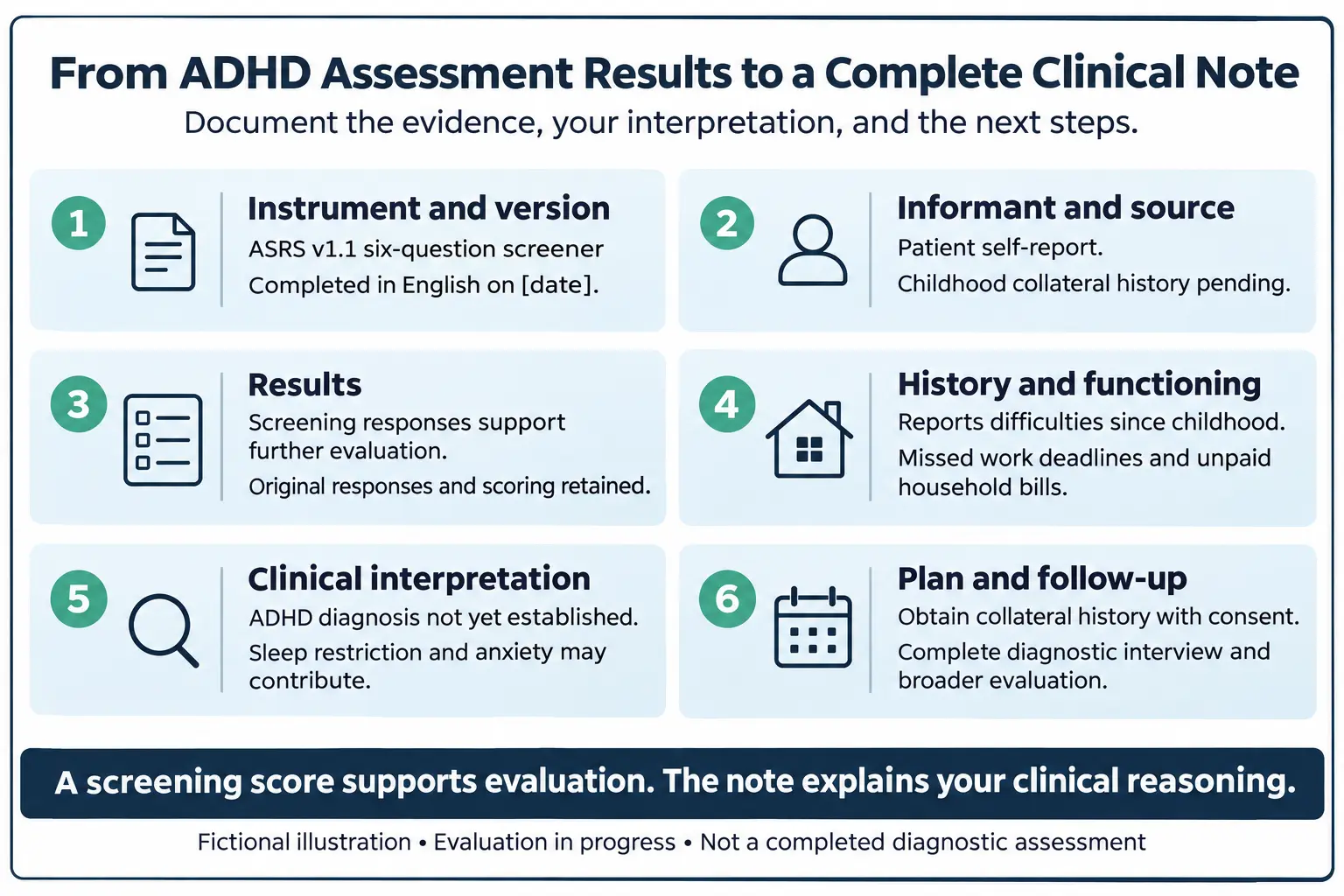
Illustrative adult ADHD assessment note
The following fictional example demonstrates documentation while an evaluation remains in progress. It is not a completed diagnostic evaluation or a universal billing template.
Illustrative adult ADHD assessment note
ASRS v1.1 six-question screener completed in English by the patient on [date]. Four items met the instrument’s item-specific screening thresholds. Results support additional evaluation. The original responses and scoring record are retained in the chart.
The patient reports longstanding organizational difficulty, missed work deadlines, and unpaid household bills. The patient describes similar difficulties before age 12. Childhood collateral information has not yet been obtained. Current examples involve work and home responsibilities.
The screening result and reported functional difficulties warrant further assessment. Sleep restriction and anxiety may contribute to inattention. The available information is insufficient to establish ADHD today. Further developmental interviewing and evaluation of alternative explanations are planned.
With appropriate consent, request available school records and collateral history. Complete a structured ADHD interview and broader clinical assessment. Review findings at the next visit and select follow-up symptom and functional measures if treatment is initiated.
Supporting the workflow with ICANotes
ICANotes includes built-in behavioral health assessment tools that help clinicians keep assessment information within the patient record. Its published ICANotes+ assessment list includes ASRS v1.1, Vanderbilt parent and teacher assessments, and Wender Utah measures. [21]
You can connect this structured assessment process with your broader psychiatric documentation workflows, including the history, clinical interpretation, treatment plan, and follow-up. Keep the distinction clear between completing an available instrument and establishing a diagnosis.
Explore ICANotes assessment and charting features to see how they fit your practice. An EHR supports the record. Your clinical reasoning explains the care.
Billing considerations for ADHD assessments
A brief standardized behavioral assessment and a comprehensive diagnostic or testing service are different services. Choose codes based on the work performed, professional qualifications, current coding guidance, and payer requirements.
CPT 96127 may be relevant to a brief standardized emotional or behavioral assessment that includes scoring and documentation. It should not be presented as the universal code for an ADHD evaluation. The cited WPS Medicare Administrative Contractor article distinguishes developmental/behavioral assessment codes from neurobehavioral and psychological/neuropsychological testing services. It is a contractor-specific reference hosted on CMS, not a national guarantee of coverage. [22]
Before submitting a claim, verify instrument eligibility, units and frequency limits, required documentation, same-day edits or bundling, applicable modifiers, and clinician eligibility with the payer. Confirm current Medicare, Medicaid, or commercial rules for your setting. Do not select a testing code simply because a visit took longer.
For additional context, review the ICANotes guide to CPT 96127 billing and documentation requirements.
The instrument supplies structured evidence. You determine how that evidence fits the patient’s presentation.
Keep assessment findings connected to the clinical record
Bring assessment results, clinical reasoning, and treatment planning into one documentation workflow with ICANotes. Start your 30-day free trial. No credit card required. Talk to us at 866-847-3590.
- Built-in ASRS, Vanderbilt, and Wender Utah scales
- Score and chart assessments in the patient record
- Connect findings to the diagnosis and treatment plan
- Track follow-up measures across visits
See how ICANotes can support your clinical workflow. Start your free 30-day trial, no credit card required.
Start Your Free 30-Day Trial
Frequently Asked Questions
What assessments are used to diagnose ADHD
What is the best ADHD screening tool
Can an online ADHD test diagnose ADHD
Which ADHD assessment tools are used for adults versus children
What if parent and teacher ADHD ratings disagree
Are computerized tests required for an ADHD diagnosis
Can ADHD rating scales track treatment response
References
- CDC — Diagnosing ADHD
- NIMH — Attention Deficit Hyperactivity Disorder What You Need to Know
- CHADD — Clinical Practice Tools
- Harvard National Comorbidity Survey — ASRS instruments and permissions
- NICHQ — Vanderbilt Assessment Scales and scoring resources
- MHS — Conners 4
- Guilford — ADHD Rating Scale 5 technical information
- MHS — CAARS 2
- DIVA Foundation — About DIVA 5
- American Academy of Pediatrics — Clinical Practice Guideline for ADHD 2019
- Ward Wender and Reimherr 1993 — Wender Utah Rating Scale original research
- AAFP — Adult ADHD Toolkit
- PAR — BRIEF2
- PAR — BRIEF2A
- ASEBA — Current CBCL forms
- Brown ADHD Clinic — Brown rating scales
- Qbtech — ADHD tests product information
- NICE — Digital technologies for assessing ADHD HTG729 recommendations
- Creyos — ADHD assessment protocol vendor description
- Johns Hopkins Psychiatry Guide — Attention Deficit Hyperactivity Disorder
- ICANotes — Assessments and default custom forms in ICANotes Plus
- WPS Medicare Administrative Contractor — Billing and Coding Psychological and Neuropsychological Testing A57481
- Google Search Central — AI features and your website
Dr. October Boyles
Dr. October Boyles is a behavioral health expert and clinical leader with extensive expertise in nursing, compliance, and healthcare operations. With a Doctor of Nursing Practice (DNP) and advanced degrees in nursing, she specializes in evidence-based practices, EHR optimization, and improving outcomes in behavioral health settings. Dr. Boyles is passionate about empowering clinicians with the tools and strategies needed to deliver high-quality, patient-centered care.