Blog > Documentation > How to Write Psychiatric Progress Notes (+ Template)
How to Write Psychiatric Progress Notes (+ Free Template)
Psychiatric progress notes help clinicians document the patient’s current status, symptoms, medication updates, interventions, risk factors, response to treatment, and plan for ongoing care. In this guide, you’ll learn what every psychiatric progress note should include, how to structure notes efficiently, and how to use a copy-ready psychiatric progress note template to support clear, compliant documentation.

Last Updated: June 30, 2026

Quick Answer
What is a psychiatric progress note?
A psychiatric progress note is a clinical record written after a patient encounter to document the reason for the visit, current symptoms, relevant history, interventions provided, medication updates, mental status findings, diagnosis, risk assessment, and plan for ongoing care. A strong psychiatric progress note should be clear, concise, individualized, and specific enough to support continuity of care, medical necessity, and compliance requirements.
Creating high-quality psychiatric progress notes is essential for delivering safe, effective, and compliant mental health care. These notes go by several names in everyday practice — psychiatric progress notes, psychiatry progress notes, psych notes, psychiatry notes, or simply psychiatric notes — but they all refer to the clinical documentation completed after a psychiatric encounter. These notes serve as a legal record, a communication tool between providers, and a foundation for clinical decision-making. But for psychiatrists and other behavioral health professionals, documentation can become a time-consuming burden — especially when juggling packed caseloads. Psychiatric progress notes are one piece of a broader mental health charting workflow that also includes treatment plans, assessments, care coordination, and billing documentation.
That’s where ICANotes comes in. As a behavioral health EHR designed specifically for psychiatrists, ICANotes simplifies the note-writing process with customizable templates, point-and-click menus, and clinically validated language. The result? You can produce thorough, defensible psychiatric notes in just minutes — with less typing, fewer errors, and better support for treatment and reimbursement.
Why Efficient Psychiatric Notes Matter
Efficient psychiatric notes help you:
-
Reduce time spent documenting
-
Improve the quality and consistency of your clinical records
-
Support better communication across providers
-
Strengthen claims for medical necessity
-
Protect your practice in audits or legal proceedings
With ICANotes, clinicians can generate rich narrative psychiatric progress notes in just minutes using a menu-driven system that aligns with best practices and documentation standards for psychiatry. You get structured prompts, clinically sound templates, and instant population of essential content — all with very little manual entry.
Video Demo: How to Write a Medication Management Progress Note in 2 Minutes
What to Include in a High-Quality Psychiatric Progress Note
To write effective psychiatric notes, it’s important to include all of the elements typically required for clinical care, insurance billing, and legal documentation. Below is a breakdown of the essential components of a comprehensive psychiatric progress note and how ICANotes helps streamline each one.
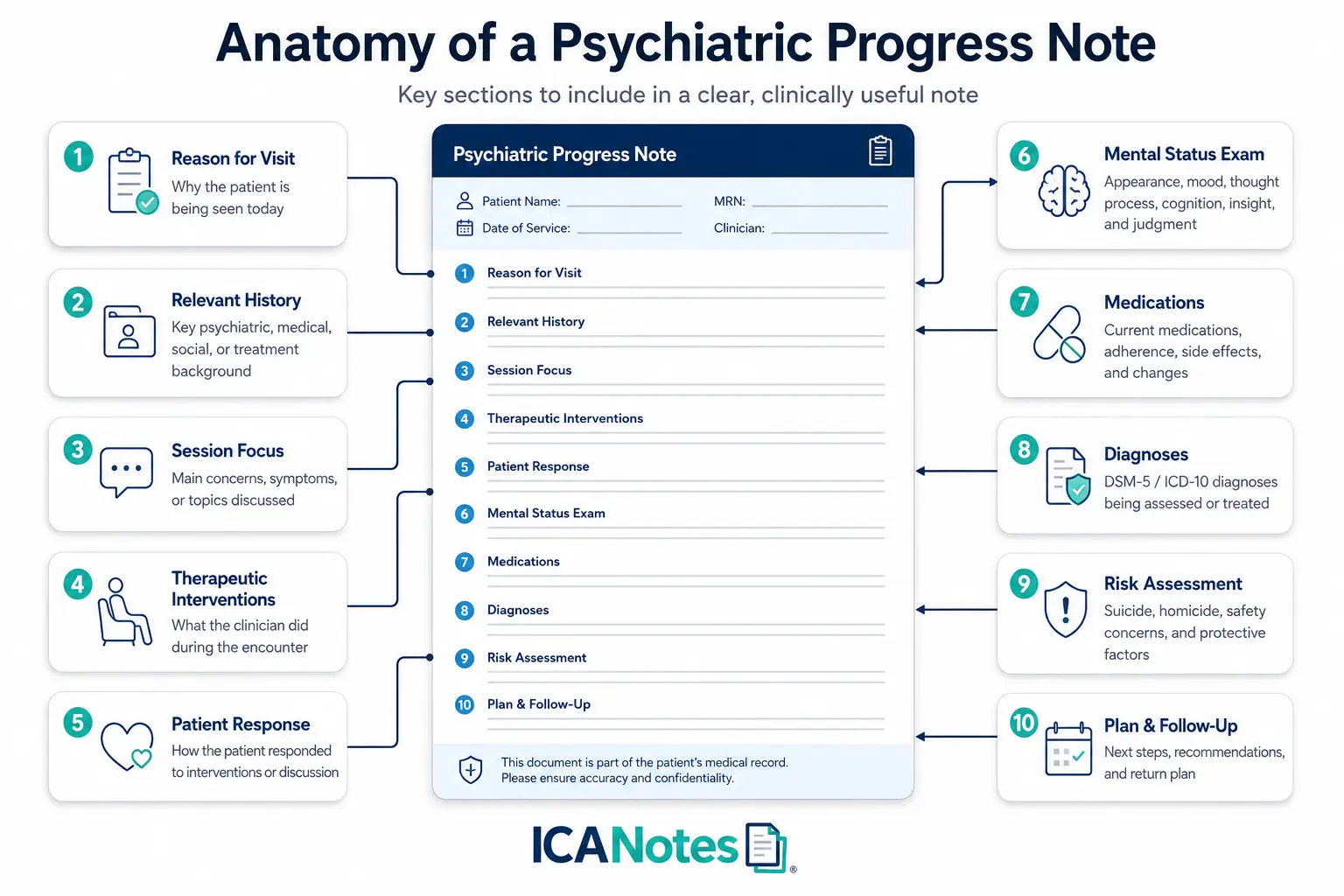
1. Current Situation / Reason for Visit
Describe how the patient’s symptoms have changed since the last visit. Has there been improvement, worsening, or no change? This section should reflect both the patient’s self-report and your clinical observations.
Detail the patient’s current status and why they are being seen today. This might include new symptoms, stressors, life events, or a follow-up on prior issues.
With ICANotes, structured prompts guide you through documenting the presenting problem, making it easy to update changes from prior sessions and highlight clinical priorities.
2. Relevant History
Include pertinent psychiatric, medical, family, and social history relevant to today’s session. This contextualizes the patient’s current functioning and guides treatment planning.
In ICANotes, prior history is easily viewable and can be pulled forward or referenced, reducing the need to retype clinical background repeatedly.
3. Verbal Content
Summarize the focus of the session from the patient’s perspective. What did they share? What concerns were discussed?
ICANotes lets you choose from structured options based on common therapeutic themes or customize narrative text to capture the unique details of each session, eliminating the need to start from scratch every time.
4. Therapeutic Interventions
Detail the specific therapeutic techniques you used during the session. This might include CBT strategies, psychoeducation, medication adjustments, or supportive listening.
ICANotes includes a comprehensive library of evidence-based interventions that can be easily inserted and customized, ensuring your psychiatry notes accurately reflect your clinical efforts.
5. Patient's Response to Interventions
Note how the patient responded to the therapeutic approaches used. Did they engage? Show insight? Resist the process?
You can quickly document engagement level and session dynamics with ICANotes' selectable phrases that reflect a range of client responses.
6. Mental Status Examination
Document your objective assessment of the patient's appearance, behavior, mood, affect, thought processes, insight, and other key mental health indicators. The MSE is a critical component in identifying psychiatric changes and informing diagnosis.
ICANotes features a structured Mental Status Exam builder, enabling you to create a complete and compliant MSE in under a minute, with checkboxes and dropdowns that auto-populate your note with clinically accurate language.
7. Medications
List all current psychiatric and medical medications, including dosage, frequency, and any adherence issues, side effects, or recent changes.
ICANotes allows you to track medications across encounters, adjust prescriptions, and document medication education or compliance in just a few clicks.
8. Diagnoses
Include the patient’s current DSM-5 or ICD diagnosis. Update it as necessary, especially if new symptoms emerge or conditions resolve.
ICANotes integrates searchable diagnostic codes and offers the ability to update diagnoses seamlessly, with justifications if needed.
9. Risk Assessment
Evaluate suicide risk, homicidal ideation, self-harm behaviors, or danger to others. Include the specific questions asked, risk factors identified, protective factors, and your clinical judgment about current risk level.
ICANotes provides a structured risk assessment module that helps ensure no critical safety question is missed and that documentation aligns with best practices and legal standards.
10. Instructions, Recommendations, and Plan
Outline the next steps in treatment, including follow-up appointments, referrals, medication changes, or homework assignments. Include measurable short-term goals and timelines when appropriate.
With ICANotes, you can document your treatment plan in alignment with insurance requirements and medical necessity standards. Progress toward goals can be easily tracked across sessions, and updates to the plan are quick to apply.
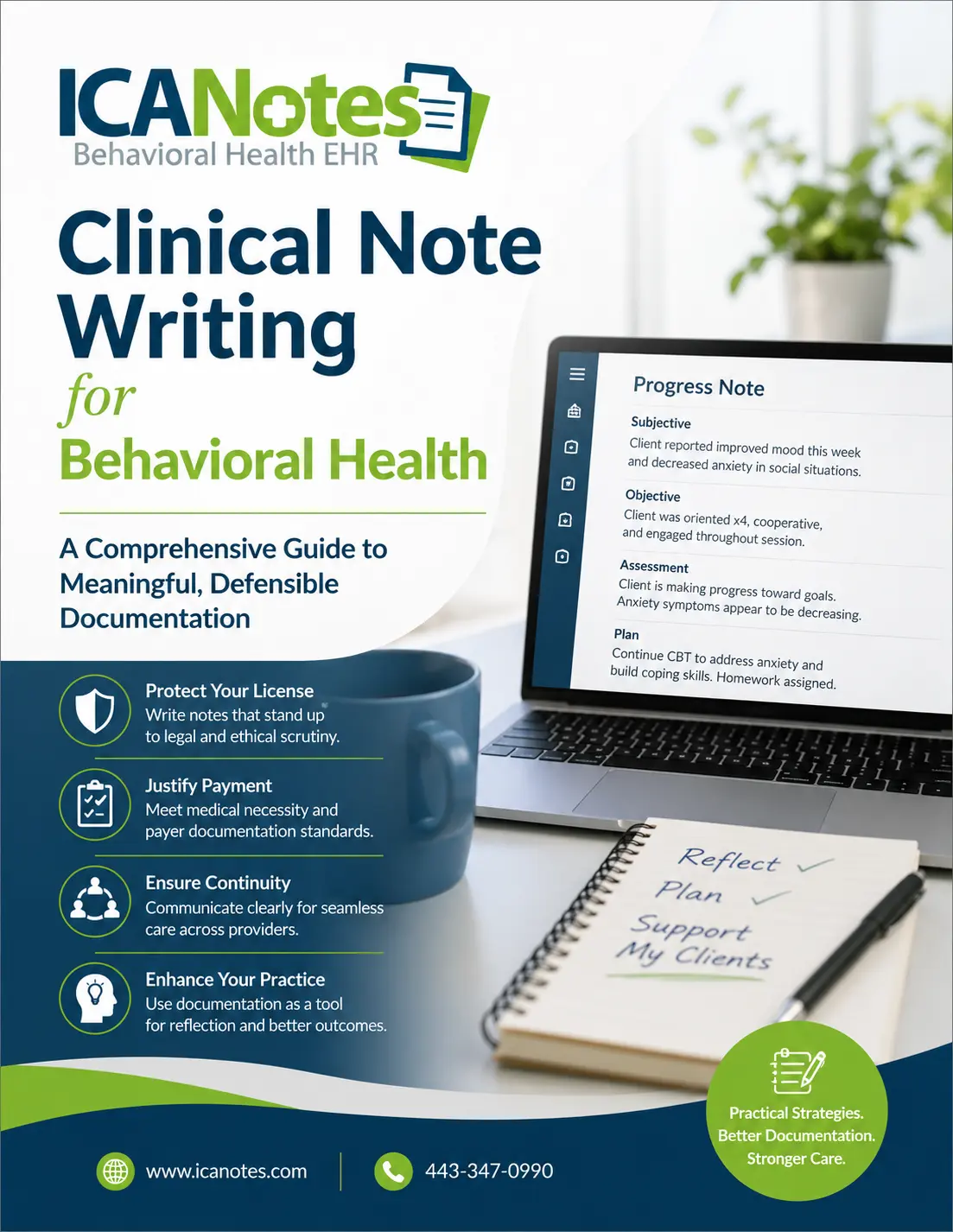
Clinical Note Writing for Mental Health
Learn how to create meaningful, compliant, and defensible documentation with practical guidance on progress notes, treatment plans, risk assessment, medical necessity, and more.
Download the Free Guide
Complete the form below for instant access.
Psychiatric Progress Note Template
A psychiatric progress note should be structured enough to support clinical continuity, medical necessity, risk documentation, and treatment planning without requiring the clinician to start from a blank page after every visit. The template below follows the key elements that should typically appear in a psychiatric progress note, including the reason for the visit, relevant history, interventions, mental status findings, medications, diagnosis, risk assessment, and plan.
Use this copy-ready structure as a starting point for your own documentation workflow. The bracketed language can be customized for medication management visits, therapy sessions, psychiatric evaluations, follow-up appointments, or other behavioral health encounters.
A strong psychiatric progress note should be specific to the patient’s presentation, not simply a completed checklist. As you adapt this template, make sure the final note clearly explains what happened during the visit, how the patient responded, what clinical decisions were made, and what should happen next.
For example, avoid vague statements such as “patient doing better” or “continue plan” without explaining the symptoms, interventions, medication considerations, risk factors, or treatment goals involved. The most useful psychiatric notes connect the patient’s current status to the care provided and the next step in treatment.
This template is intended as a general educational tool. Always tailor psychiatric documentation to the patient’s actual presentation, your clinical judgment, applicable state requirements, payer expectations, and your organization’s policies.
Psychiatric Progress Note Example
The following fictional example shows how the template above might look when completed for a routine psychiatric medication-management follow-up. This example is for educational purposes only and does not represent a real patient. Actual documentation should always reflect the patient’s presentation, clinical complexity, risk level, diagnosis, treatment plan, and applicable documentation requirements.
Common Psychiatric Note Formats: SOAP, DAP, BIRP, GIRP, and PIE
Psychiatric progress notes can be written in several different formats, depending on the provider’s discipline, practice setting, payer requirements, and documentation workflow. Some practices use a traditional medical-style structure, while others prefer a format that more directly connects the patient’s behavior, intervention, response, and treatment goals.
There is no single format that is required for every psychiatric progress note. The most important goal is to choose a structure that helps the clinician document the patient’s current status, the care provided, the clinical reasoning behind decisions, the patient’s response, and the plan for ongoing treatment.
The table below compares several common psychiatric and behavioral health note formats.
Each format can be clinically useful when applied consistently. For example, SOAP notes are familiar in medical and integrated care settings, while BIRP and GIRP notes may be helpful when the practice wants to emphasize interventions, responses, and treatment-plan progress. PIE notes may be useful when the clinician is tracking a specific problem across multiple visits.
For psychiatric documentation, the best format is usually the one that supports clear clinical decision-making without slowing the provider down. Whether you use SOAP, DAP, BIRP, GIRP, PIE, or a custom psychiatric progress note template, the note should still include the essential elements of the encounter: symptoms, relevant history, interventions, medication updates, mental status findings, diagnosis, risk assessment, and plan.
How ICANotes Makes Psychiatric Note Writing Fast, Accurate, and Compliant
Whether you're managing 10 clients or 100, ICANotes reduces your documentation time while improving the quality of your psychiatric progress notes. Here’s how:
✅ Menu-Driven Interface: Build rich, narrative notes without typing full sentences
✅ Pre-Configured Templates: Designed for psychiatry, including MSEs, med management, and therapy notes
✅ Compliant Documentation: Structured to meet payer, audit, and legal requirements
✅ Time-Saving Workflows: Notes can be completed in under 5 minutes
✅ Cloud-Based Access: Securely access and update notes from anywhere
Whether you're working in private practice or a larger clinic setting, ICANotes empowers you to spend less time on paperwork and more time on patient care. Our system helps psychiatrists and psychiatric nurse practitioners create high-quality, defensible, and efficient psychiatric progress notes—without the burnout.
Explore how ICANotes can transform your workflow by starting a free trial or by calling us at 443-357-0990.

Frequently Asked Questions About Psychiatric Progress Notes
Recent Posts




Dr. October Boyles
DNP, MSN, BSN, RN
Dr. October Boyles is a distinguished healthcare professional with extensive expertise in behavioral health, clinical leadership, and evidence-based care delivery. With a Doctor of Nursing Practice (DNP) from Aspen University and advanced degrees in nursing, she brings a depth of clinical knowledge and a passion for improving mental health care services.