Medicaid Billing for CMHCs: Codes, Rules & Denials
A practical 2026 guide to Medicaid billing codes, documentation, telehealth requirements, and denial prevention for community mental health centers.


Medicaid billing for community mental health centers runs on two layers at once: a federal layer that sets the outer boundary, and a state layer that decides what actually gets paid. Get the second layer wrong and a clinically sound session can turn into a denied claim, a corrected claim, or an appeal your billing team did not have time for this week.
Medicaid billing for community mental health centers is governed by both federal Medicaid requirements and state-specific rules. Before submitting a claim, a CMHC typically must verify eligibility, confirm provider enrollment and authorization, select the correct CPT or HCPCS code, document medical necessity and service details, apply required modifiers and place-of-service codes, and follow the member's state Medicaid or managed care billing rules. There is no single national Medicaid fee schedule or universal billing rule for CMHC behavioral health services.
Key Takeaways
- Medicaid is the largest single payer for mental health services in the United States, but reimbursement is administered through state agencies and managed care contracts rather than one national fee table.
- A CMHC and a Certified Community Behavioral Health Clinic (CCBHC) are not the same payment model. Standard CMHCs generally bill individual CPT and HCPCS services under state Medicaid or MCO rules. Participating CCBHCs are reimbursed under a state-selected prospective payment methodology, which may use daily or monthly clinic-specific rates.
- The same code can carry different units, modifiers, and eligible provider types depending on the state. Confirm every code against your state's current Medicaid manual, fee schedule, and applicable MCO guidance before billing it.
- Medicaid telehealth billing rules vary substantially by state and MCO, including place-of-service codes, modifiers, eligible delivery methods, and provider requirements.
- Prior authorization denials are a meaningful Medicaid managed care issue, but published denial statistics should not be interpreted as a CMHC behavioral health claim-denial rate.
- A defensible claim starts with a defensible note. Medical necessity, treatment plan alignment, accurate time or units, service details, and provider credentials should support what appears on the claim.
How to Bill Medicaid for Mental Health Services at a Community Mental Health Center
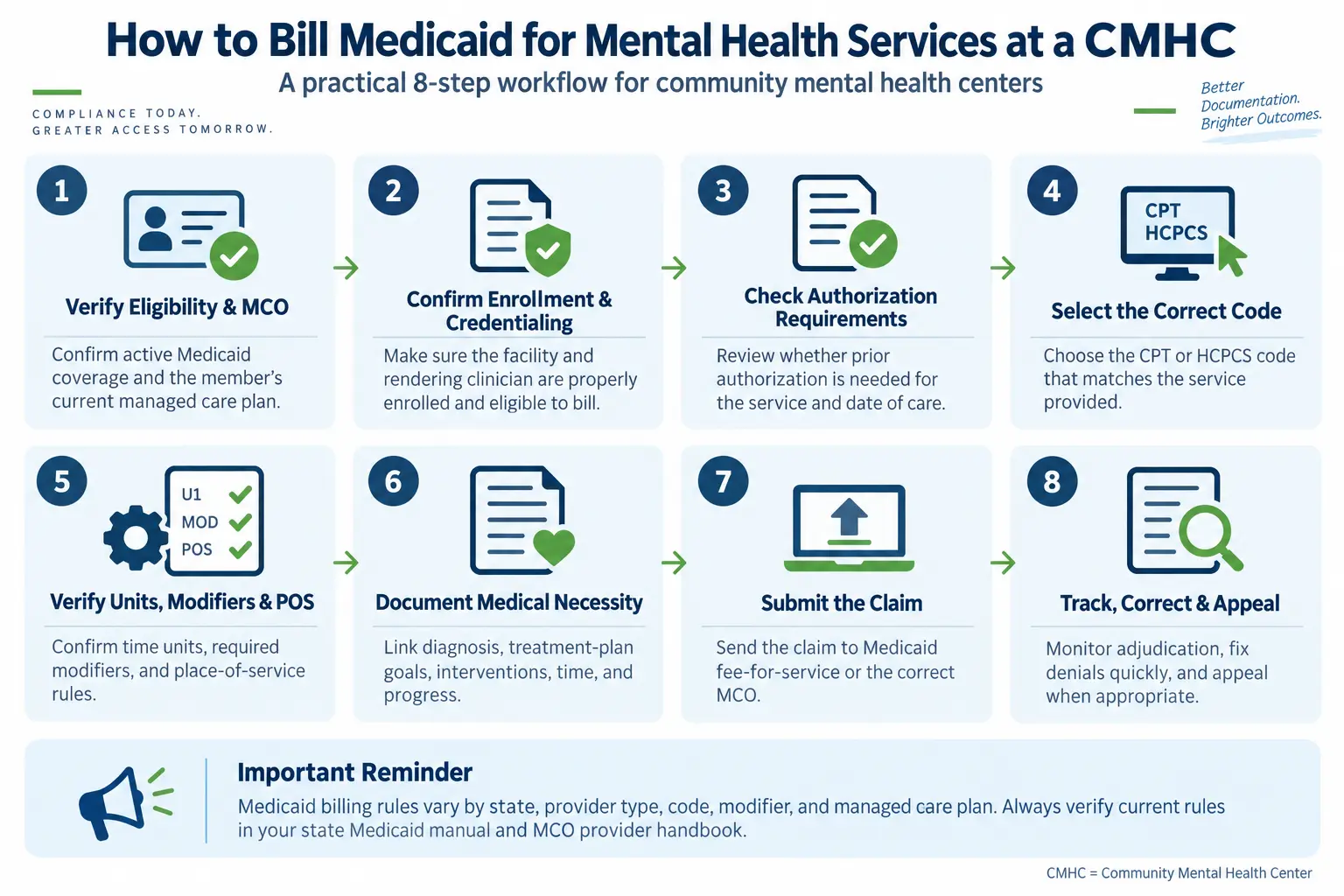
Although the exact rules vary by state and payer, a reliable CMHC Medicaid billing workflow usually follows the same sequence:
Verify eligibility and the member's current payer
Confirm active Medicaid coverage, the correct MCO when managed care applies, and whether coverage changed since the previous encounter.
Confirm facility and rendering-provider enrollment
Make sure the organization, individual clinician, NPI, taxonomy, license, supervision arrangement, and payer roster information are current.
Check prior authorization and service limits
Verify whether the service requires authorization, how many units are available, and when the authorization expires.
Select the correct CPT or HCPCS code
Use the code that accurately describes the service delivered and is covered for the provider type under the applicable state or MCO rules.
Verify units, modifiers, and place of service
Confirm timed-unit rules, clinician-type modifiers, telehealth modifiers, place-of-service requirements, and code-editing rules.
Complete documentation that supports the claim
The diagnosis, medical necessity, treatment-plan goal, intervention, duration or units, participants, response, progress, setting, and clinician signature should support the billed service.
Submit the claim through the correct channel
Follow the state Medicaid or MCO claim-form and electronic-submission requirements that apply to the service and provider type.
Track adjudication and act on denials
Review payer responses promptly, correct claim errors, and appeal when documentation and coverage support payment.
At a high level, Medicaid billing in a CMHC follows a repeatable workflow — from verifying eligibility and enrollment to documenting medical necessity and resolving denials. The visual below summarizes the process.
Download the free Medicaid Behavioral Health Billing Compliance Checklist for Community Mental Health Centers. Use it to verify enrollment, codes, modifiers, documentation, telehealth requirements, denial-prevention steps, and your own state-specific rules before a claim goes out.
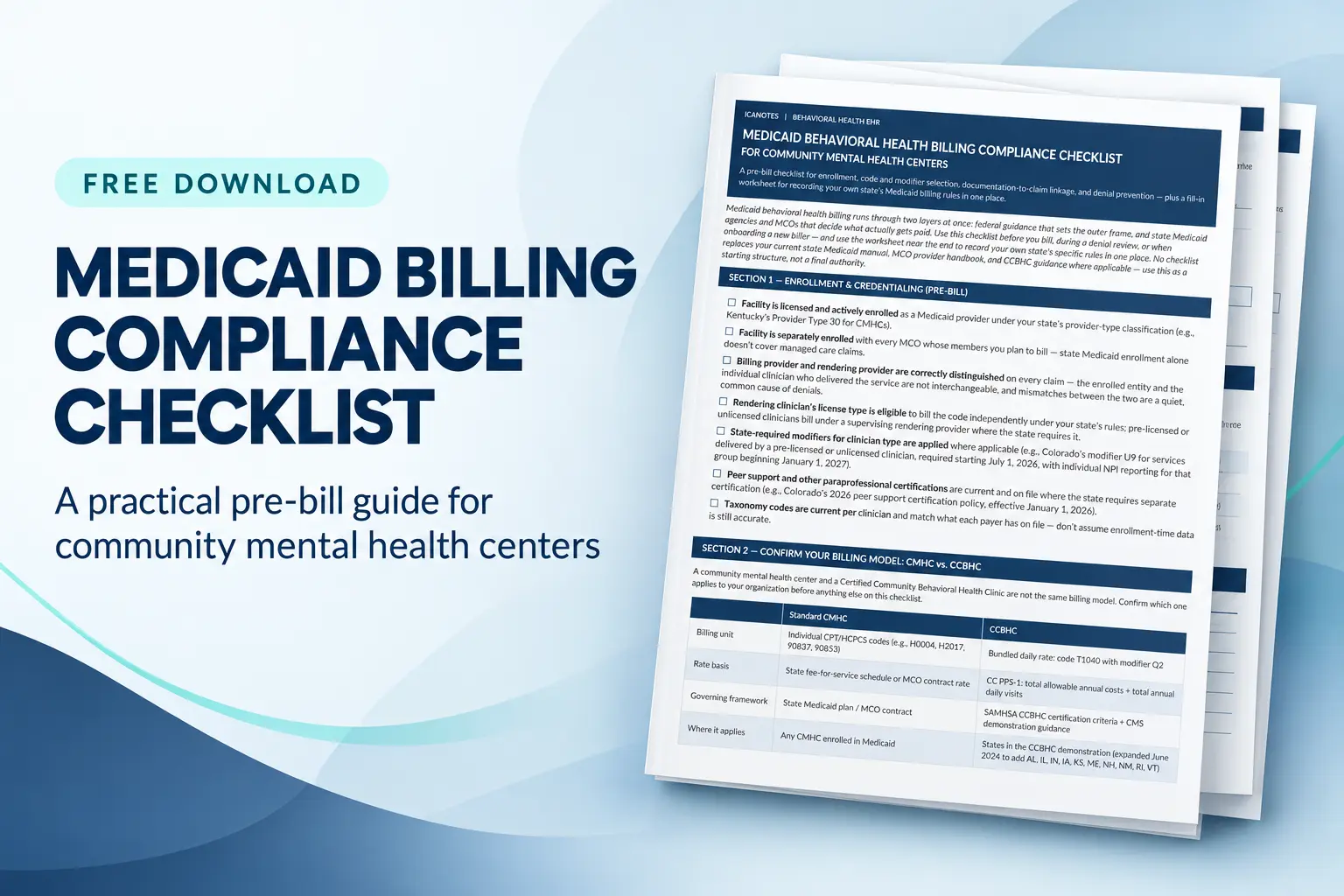
Download the Medicaid Billing Compliance Checklist
Strengthen your pre-bill review process and reduce preventable Medicaid claim denials.
- Verify enrollment, credentialing, and billing-provider details
- Review codes, modifiers, authorizations, and telehealth requirements
- Connect documentation clearly to each submitted service
- Record state Medicaid and MCO rules in one convenient worksheet
CMHC vs. CCBHC Medicaid Billing: Know Which Model Applies
Before any code selection or rate conversation makes sense, it helps to separate the terms that are often used loosely in day-to-day practice.
A community mental health center (CMHC) is a state-licensed and state-enrolled behavioral health organization that delivers outpatient and community-based services under the state Medicaid plan and, where applicable, contracted managed care organizations. A Certified Community Behavioral Health Clinic (CCBHC) is a distinct federally defined model that must meet SAMHSA certification criteria and participate under an applicable Medicaid framework.
The comparison below highlights the key differences between standard CMHC Medicaid billing and the CCBHC payment framework.
| Standard CMHC | CCBHC | Payment timing | Primary rule set | |
|---|---|---|---|---|
| Typical billing | Individual CPT/HCPCS services | Prospective payment methodology with CCBHC-specific claiming/reporting requirements | Code/service dependent | State Medicaid plan + MCO contract |
| Rate basis | State fee schedule or MCO contract | Clinic-specific PPS methodology selected by the state; may be daily or monthly | Daily or monthly depending on PPS model | CMS/SAMHSA framework + participating state |
| Federal identifiers | Varies by service/state | T1040 and Q2 are used for CCBHC demonstration claiming/reporting where required | State/model specific | CCBHC demonstration/state guidance |
The most important distinction is that CCBHC reimbursement is based on a state-selected prospective payment methodology rather than the code-by-code fee schedule approach commonly used by standard CMHCs.
CMS describes four CCBHC prospective payment methodologies. PPS-1 is a clinic-specific daily model. PPS-2 is a monthly model with outlier payments and quality bonus payments. PPS-3 adds special crisis service rates to a daily model, while PPS-4 adds special crisis service rates and outlier payments to a monthly model. The applicable state methodology — not a national one-size-fits-all rate — controls how a participating CCBHC is paid.
CMS also identifies T1040 as the Medicaid certified community behavioral health clinic service code and Q2 as the demonstration procedure or service modifier for applicable demonstration claiming. Because state implementation can differ, CCBHC organizations should follow current CMS guidance and their state Medicaid instructions together.
Federal Medicaid Rules Set the Frame; States Control the Details
Medicaid.gov identifies Medicaid as the single largest payer for mental health services in the United States. Federal Medicaid law establishes the overall program boundaries, but states retain broad authority to design benefits, provider qualifications, payment approaches, managed care arrangements, and telehealth policies within approved state plans and federal requirements.
That flexibility is why a code that pays cleanly in one state can require a different unit, modifier, provider type, or authorization rule in another. National guidance should be treated as the frame; your state Medicaid manual, fee schedule, provider bulletins, and MCO handbooks are the operational rulebook.
State fee schedules, managed care manuals, telehealth rules, provider qualifications, and CCBHC guidance change regularly. Recheck the sources that apply to your organization at least twice a year and whenever a new state or payer bulletin is issued.
Medicaid Enrollment, Credentialing, and Provider Requirements
A clinically excellent session generates no revenue if the facility or clinician is not correctly enrolled. Kentucky Medicaid, for example, classifies CMHCs under Provider Type 30 and requires a CMHC to be licensed, actively enrolled with Medicaid, and separately enrolled with the relevant MCO when managed care applies.
Billing provider and rendering provider are not interchangeable. The billing provider is the enrolled organization or entity submitting the claim; the rendering provider is the individual clinician who delivered the service. A mismatch among NPI, taxonomy, license type, supervision requirements, or payer roster data can make an otherwise valid service unpayable.
States also differ on who can independently render Medicaid-billable behavioral health services. Colorado, for example, states that pre-licensed and unlicensed professionals cannot independently deliver reimbursable behavioral health services. Beginning July 1, 2026, Colorado requires modifier U9 on services delivered by a pre-licensed or unlicensed clinician, with individual NPI reporting for that group scheduled to take effect January 1, 2027. Peer support professionals have separate certification requirements under Colorado policy.
A February 2026 Medicaid and CHIP children's behavioral health toolkit also describes Ohio's centralized credentialing initiative, which shares provider credentialing data across managed care plans. Whether or not your state offers a centralized approach, maintain an internal tracker for license renewals, payer enrollment, taxonomy, supervision status, and roster updates.
Documentation Requirements That Support Medicaid Claims
Every code on a claim is a representation that a specific service occurred and that the record supports it. CMS psychotherapy documentation guidance identifies time, therapeutic interventions, client participation, goal-oriented outcomes, and progress toward goals as important elements. State Medicaid policies can add more detailed requirements.
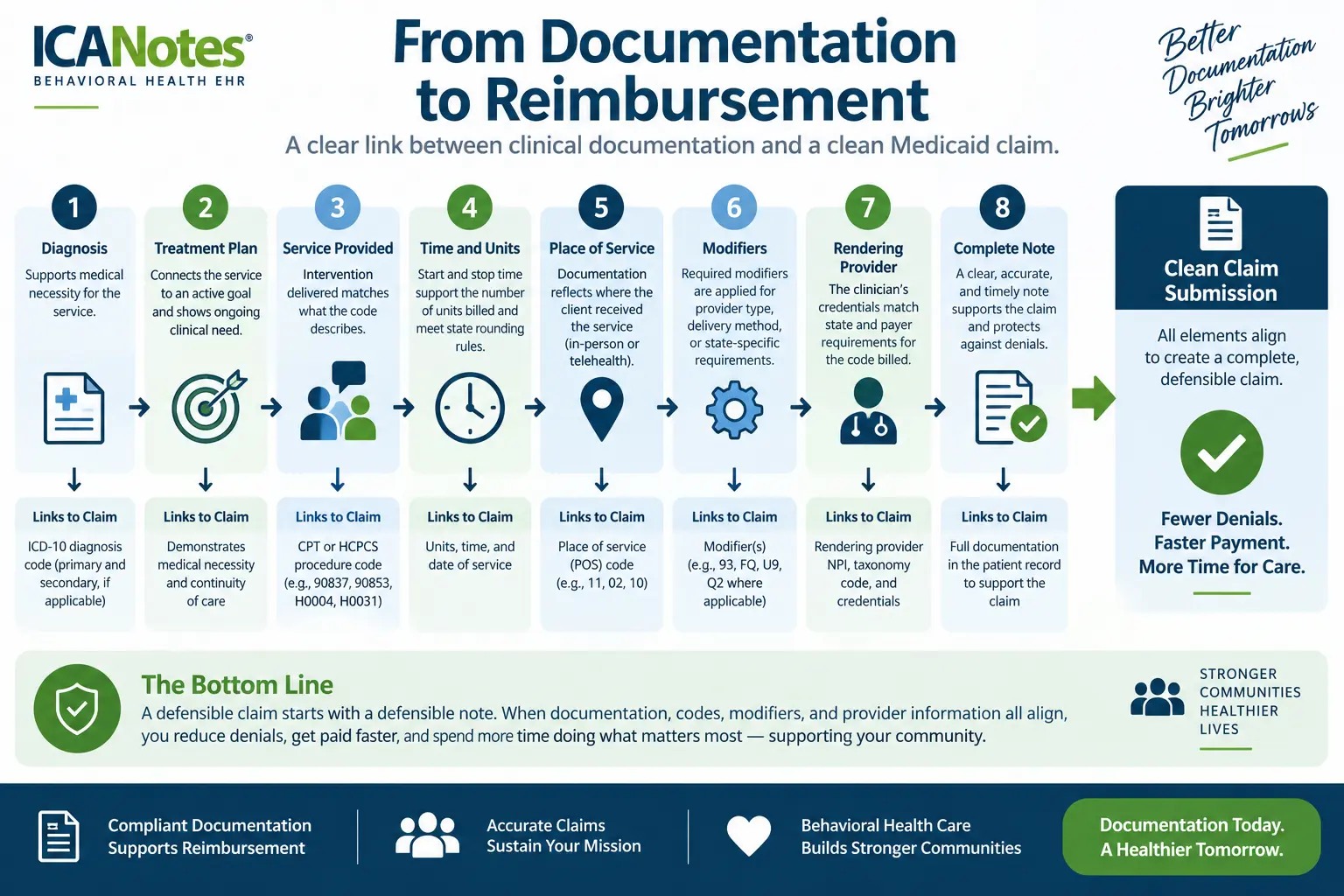
A practical documentation-to-claim chain looks like this:
- Diagnosis supports medical necessity for the service billed.
- Medical necessity connects to an active treatment-plan goal.
- The intervention delivered matches what the billed code describes.
- Time or units documented in the note support the quantity billed.
- Place of service in the record matches the claim and applicable modifier.
- Participants and modality are documented when the service requires them.
- The signing clinician's credential and supervision arrangement match payer requirements.
Each element of the clinical record supports a corresponding part of the claim. The visual below shows how those documentation details connect to Medicaid billing requirements.
When any one of these elements is missing, inconsistent, or unsupported, the claim becomes more vulnerable to denial or recoupment.
Colorado provides one state-specific illustration of the level of detail a reviewer may expect: its policy addresses date of service, start and end time or duration, setting, reason for the encounter, and a dated provider signature with qualifying credentials. Colorado also uses an 8-minute threshold for certain 15-minute timed units. That is not a universal Medicaid rule; use it only where your state or payer instructs you to do so.
Medicaid Billing Codes Used by Community Mental Health Centers
The table below is illustrative, not a national Medicaid fee schedule. Always confirm service definitions, billing units, eligible provider types, modifiers, frequency limits, and coverage in your state's current fee schedule and payer manuals.
| Code | Typical Service | Billing Unit | Who Usually Bills It | Notes |
|---|---|---|---|---|
| 90837 | Individual psychotherapy, 60 minutes | Per session | Licensed clinician | Psychotherapy code without a medical evaluation and management component. |
| 90853 | Group psychotherapy | Per session, per attending member | Licensed clinician | Attendance and individual documentation determine which members can be billed. |
| H0004 | Behavioral health counseling and therapy | Often per 15 minutes; state-defined | Varies by state | Confirm the state-specific definition, unit rules, modifiers, and eligible provider types. |
| H0031 | Mental health assessment by a non-physician | State-defined | State-qualified clinician/assessor | Definitions, units, provider qualifications, and limits vary. Verify against the state manual rather than relying on a national description. |
| H2011 | Crisis intervention / mobile crisis management | State-defined | Crisis team clinician | Coverage, unit rules, and team requirements differ by state. |
| H2015 | Comprehensive community support services | Often timed; state-defined | Case manager or support specialist | Confirm state service definition and modifier requirements. |
| H2017 | Psychosocial rehabilitation services | Often per 15 minutes; state-defined | Rehabilitation specialist | May be subject to state MUEs, authorization, and procedure-to-procedure edits. |
| T1016 | Case management | Encounter- or time-based; state-defined | Case manager | Definition and billing unit vary meaningfully by state. |
| T1040 + Q2 | CCBHC service / demonstration identifier | Used within applicable CCBHC claiming framework | CCBHC-certified clinic | Does not mean every CCBHC is paid a daily rate; payment depends on the state-selected PPS model. |
For psychotherapy, CMS identifies 90832, 90834, and 90837 as psychotherapy codes without a medical management component, 90833, 90836, and 90838 as psychotherapy add-on codes used with evaluation and management services, and 90853 as group psychotherapy. Medicaid coverage still depends on state and payer policy.
The free CMHC Medicaid Billing Compliance Checklist includes pre-bill checks for provider enrollment, code and modifier selection, documentation-to-claim linkage, telehealth, and denial prevention — plus a fill-in worksheet for recording your own state and MCO rules.
How Much Does Medicaid Pay for Mental Health Services?
There is no single national Medicaid reimbursement amount for therapy or community mental health services. Rates can vary by state, date of service, provider type, service code, managed care contract, delivery model, and other state-defined factors.
Illinois, for example, publishes date-specific community mental health fee schedules. North Carolina provides a dated illustration of how a state can change reimbursement policy: effective January 1, 2024, it moved many outpatient behavioral health services to 100 percent of the 2023 Medicare Physician Fee Schedule, with selected psychiatric diagnostic evaluation and psychological testing services set higher. Those are North Carolina policies from a specific period, not national Medicaid rates.
For CCBHCs, reimbursement is conceptually different from standard fee-for-service code-by-code payment. Participating states use one of the CCBHC prospective payment methodologies, which may operate on a daily or monthly basis and may include outlier, crisis-service, or quality-bonus provisions depending on the model. Organizations considering CCBHC certification should model the applicable state PPS methodology rather than compare a single CCBHC code with a standard CMHC fee schedule.
Medicaid Telehealth Billing Requirements
Federal Medicaid policy gives states broad flexibility to determine whether and how telehealth services are covered, which providers may furnish them, which locations qualify, and how reimbursement works. As a result, telehealth is a state policy question first—not simply a CPT or HCPCS coding question.
Because Medicaid telehealth rules are set largely at the state and plan level, modifiers, place-of-service requirements, audio-only coverage, and other billing rules can differ considerably. The snapshot below shows how requirements can vary across selected states.
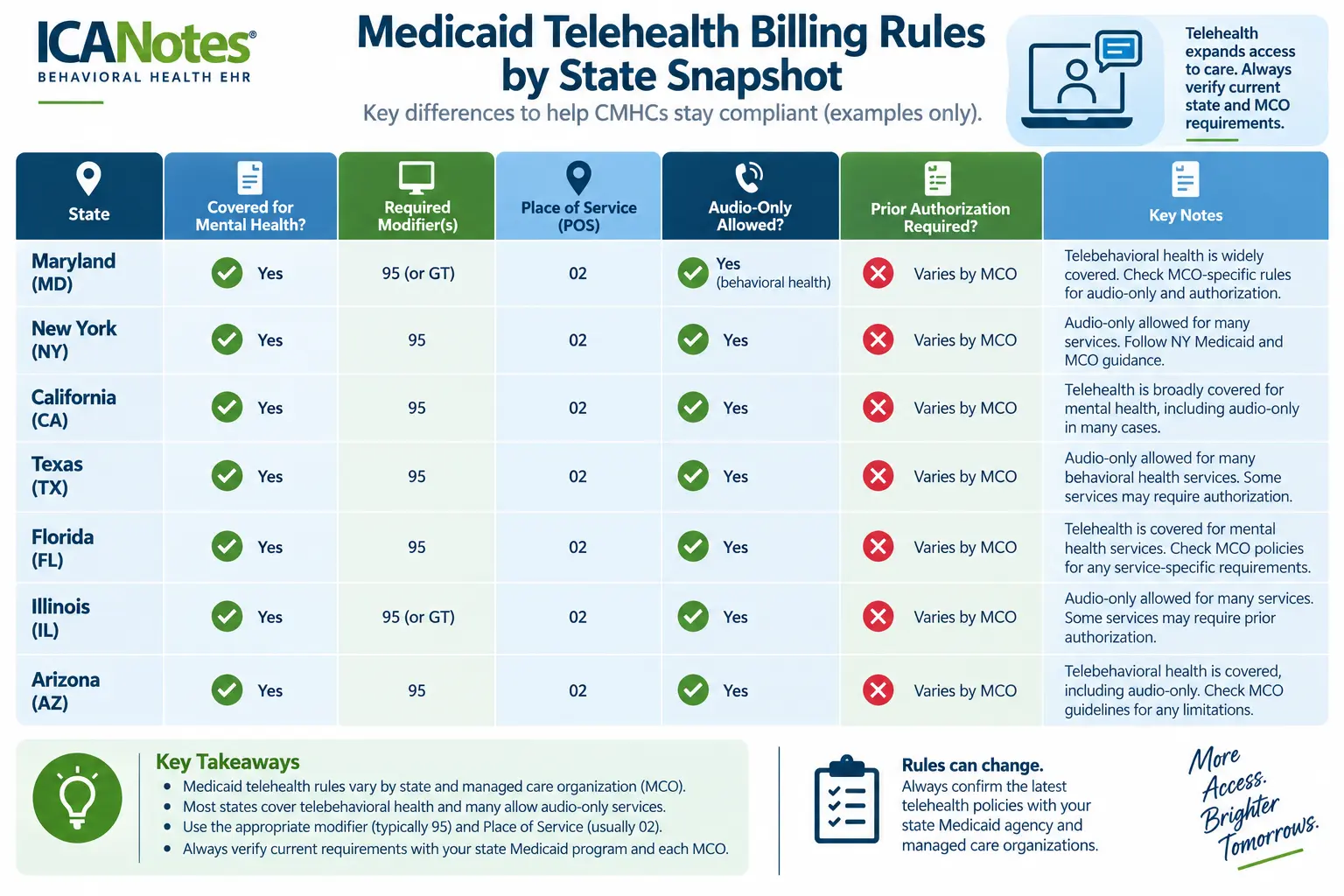
State examples shown are illustrative and may change. Always verify current requirements with the applicable state Medicaid program and managed care organization before billing.
These examples illustrate why CMHCs should treat telehealth billing as a state- and payer-specific compliance issue rather than relying on a single national rule.
Colorado
Requires place of service 02 or 10 for telehealth within the referenced behavioral health benefit; audio-only care requires modifier FQ in the first modifier position plus documentation supporting clinical appropriateness.
Arizona
Its 2026 behavioral health manual assigns GT to interactive audio-video telemedicine and GQ to asynchronous delivery in the referenced FFS context; other details depend on the applicable AHCCCS rules.
New York
Its 2026 telehealth policy manual uses place of service 02, 10, or 11 on professional claims to identify client location and directs OMH providers to use modifier 93 for eligible audio-only mental health services delivered on or after July 1, 2025.
These examples illustrate variation; they are not interchangeable. Before billing telehealth, confirm the current state manual and the member's MCO telehealth guidance.
Common Medicaid Billing Denials for CMHCs — and How to Prevent Them
Illinois managed care guidance identifies denial triggers that include incorrect diagnosis, wrong claim form, invalid taxonomy, missing or invalid modifiers, telehealth location or modifier mismatches, and duplicate corrected claims. Those are Illinois examples, but the underlying failure points are useful for building a CMHC pre-bill review process.
Several Medicaid denials trace back to a relatively small set of billing and documentation failures. The visual below summarizes the most common trouble spots and the controls that can help prevent them.
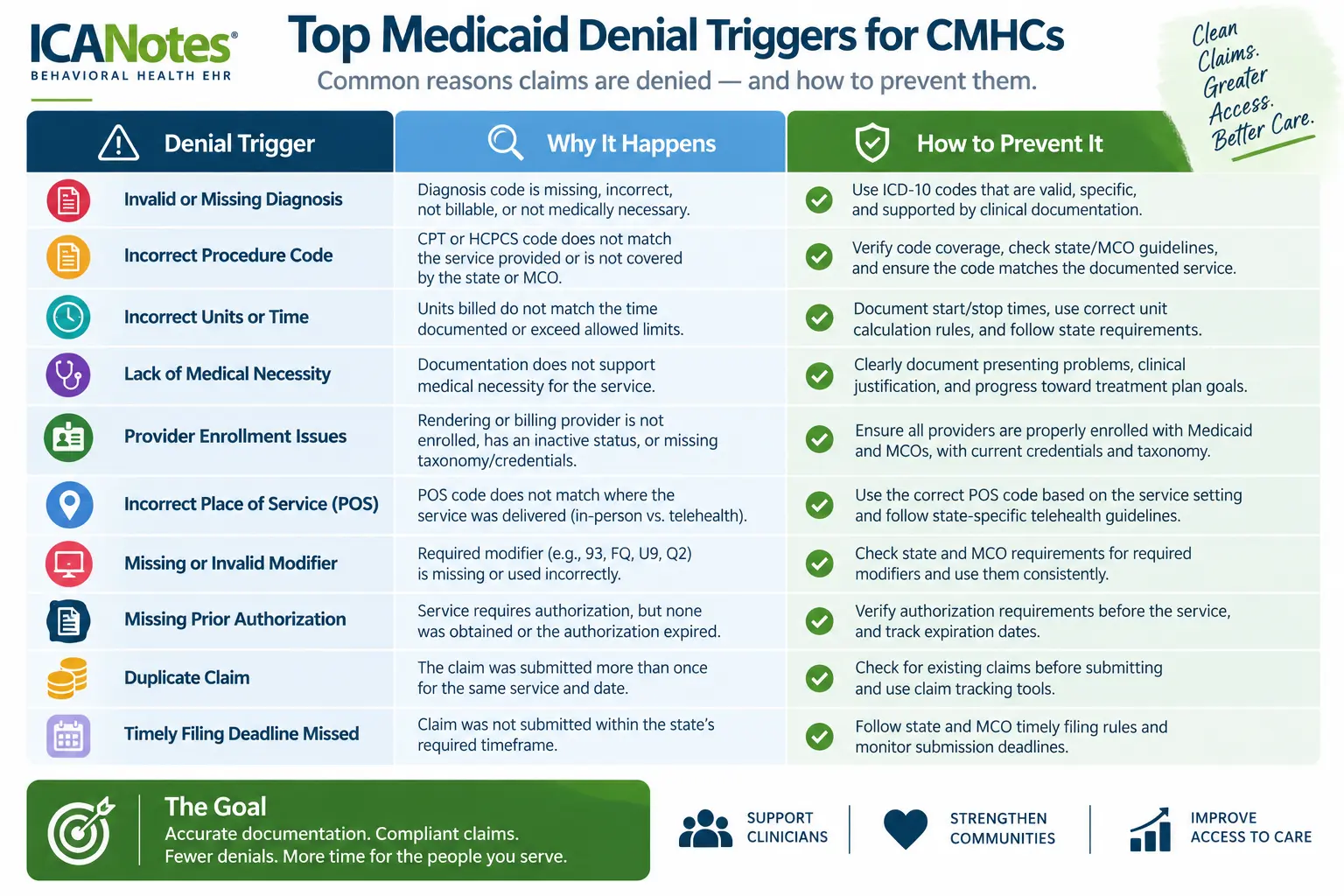
Because Medicaid rules vary by state and managed care plan, these prevention steps should be paired with the current payer-specific requirements for coding, modifiers, authorization, and timely filing.
| Where It Breaks | What Typically Goes Wrong | What Protects the Claim |
|---|---|---|
| Eligibility | Coverage lapsed or the member changed MCOs | Verify eligibility and payer assignment for the date of service. |
| Enrollment and taxonomy | Rendering provider is not enrolled or claim taxonomy does not match payer data | Cross-check NPI, taxonomy, licensure, and payer roster information. |
| Diagnosis and medical necessity | Diagnosis or treatment-plan context does not support the service billed | Tie the service to a current diagnosis, medical necessity, and active treatment-plan goal. |
| Modifier and place of service | Modifier or POS does not match state/payer rules | Confirm both against current payer guidance before submission. |
| Units and time | Documented time does not support the billed quantity | Document actual time or units according to the rule that applies to the code and payer. |
| Authorization | Authorization expired, was not obtained, or did not include enough units | Track authorization windows, units, and renewal dates. |
| Timely filing | Claim is submitted after the payer deadline | Maintain a payer-specific claim-submission calendar. |
| Duplicate billing | Corrected claims or overlapping services are submitted more than once | Track corrected claims and review code-editing rules before resubmission. |
An HHS Office of Inspector General review, as analyzed by MACPAC, found that Medicaid managed care plans denied 12.5% of prior authorization requests compared with 5.7% for Medicare Advantage plans, and that only 11.2% of Medicaid managed care denials in the analysis were appealed. These figures describe prior authorization decisions across Medicaid managed care and should not be interpreted as a CMHC behavioral health claim-denial rate.
Use the free CMHC Medicaid Billing Compliance Checklist to review the same failure points discussed above — from enrollment and taxonomy to modifiers, documentation, telehealth, and timely filing. The included state-rules worksheet gives your billing team one place to record the Medicaid and MCO requirements that apply to your organization.
Medicaid Appeals and Timely Filing
Appeal processes and filing deadlines are state- and MCO-specific. Kentucky provides one example: fee-for-service appeals require specified documentation and are handled differently from claims billed to an MCO. Kentucky also publishes distinct timely filing rules for standard claims, retroactive eligibility, and situations in which Medicare was billed first.
The operational lesson is broader than any one state: build a payer-specific claims and appeals calendar before a denial arrives. Track initial filing deadlines, corrected-claim windows, authorization renewal dates, appeal deadlines, and documentation requirements for each Medicaid payer your CMHC accepts.
State Medicaid Billing Examples: Use Them as Examples, Not Universal Rules
Washington
The state's Mental Health Services Billing Guide covers coding, provider taxonomy, documentation, telemedicine, professional and institutional claims, and specialized mental health services.
Illinois
HFS publishes date-specific community mental health fee schedules, while managed care plans may publish their own operational billing tips and denial guidance.
Kentucky
CMHCs are identified as Provider Type 30 and follow state-specific enrollment, coding, filing, and appeal rules.
Colorado
Behavioral health policies and the State Behavioral Health Services Billing Manual address credentialing, telehealth, time documentation, modifiers, and provider qualifications.
New York
State Medicaid and OMH guidance provide current rules for telehealth billing, managed care, and behavioral health services.
Arizona
AHCCCS manuals define behavioral health billing and telehealth requirements for applicable programs.
North Carolina
Medicaid bulletins document service-specific rate policy changes and should be read with the applicable fee schedules and provider guidance.
How to Keep Medicaid Billing Rules Current
Medicaid behavioral health billing rules are not static. A manual you relied on in January can be replaced, supplemented, or clarified during the year. Put a standing item on your billing team's calendar to recheck your state Medicaid manual, fee schedule, MCO provider handbooks, CCBHC guidance if it applies, and telehealth modifier lists at least twice a year—and immediately after a rate or policy bulletin is issued.
For this article, every state-specific example should retain its state and date context. The same principle should guide internal policies and training materials: record the source, effective date, and last-reviewed date next to operational billing rules.
Documentation Errors Often Become Billing Errors
A behavioral health EHR cannot determine every state Medicaid rule for you, but it can reduce billing risk created by incomplete or disconnected documentation. Missing time, treatment-plan misalignment, incomplete group attendance, provider-credential mismatches, and unsupported units can all weaken a claim before it reaches the payer.
ICANotes is designed around structured behavioral health documentation and integrated practice workflows. Menu-driven templates can help clinicians capture required clinical details consistently, group therapy workflows can connect individual attendance to documentation and billing, and integrated billing tools can carry diagnosis, treatment-plan, and service information forward into the claim workflow. Organizations still need to configure processes around their own state Medicaid and MCO requirements, but stronger documentation-to-claim linkage can reduce preventable administrative rework.
See How ICANotes Supports CMHC Documentation and Billing
ICANotes combines menu-driven behavioral health documentation with integrated practice management and billing workflows. Start a free 30-day trial with no credit card required to see how structured documentation can support cleaner, more consistent claims.
- Menu-driven notes capture CPT/HCPCS-ready details
- Carry diagnosis and medical necessity into claims
- Link group attendance to documentation and billing
- Flag credential and unit gaps before submission
See how ICANotes can support your CMHC workflows. Start your free 30-day trial, no credit card required.
Start Your Free 30-Day Trial
Frequently Asked Questions
How much does Medicaid pay for therapy at a CMHC?
Who can bill Medicaid for mental health services at a CMHC?
Is a CCBHC billed the same way as a standard CMHC?
What information should a Medicaid behavioral health progress note include?
What causes Medicaid behavioral health claims to be denied?
Is H0031 the same as CPT 90791?
Are Medicare collaborative care codes like 99492 billable under Medicaid?
What is the 8-minute rule, and does it apply to Medicaid behavioral health billing?
How do I bill a telehealth behavioral health visit under Medicaid?
References
- Medicaid.gov, Behavioral Health Services: https://www.medicaid.gov/medicaid/benefits/behavioral-health-services
- Medicaid.gov, CCBHC Demonstration: https://www.medicaid.gov/medicaid/financial-management/certified-community-behavioral-health-clinic-ccbhc-demonstration
- CMS / Medicaid.gov, CCBHC Billing Codes: https://www.medicaid.gov/medicaid/financial-management/certified-community-behavioral-health-clinic-ccbhc-demonstration/ccbhc-billing-codes
- CMS / Medicaid.gov, CCBHC Prospective Payment System and Quality Bonus Payments: https://www.medicaid.gov/medicaid/financial-management/certified-community-behavioral-health-clinic-ccbhc-demonstration/prospective-payment-system-pps-quality-bonus-payments-qbps
- CMS, Updated CCBHC PPS Guidance (February 2024): https://www.medicaid.gov/medicaid/financial-management/downloads/updated-ccbh-pps-guidance-02152024.pdf
- Medicaid.gov, Telehealth: https://www.medicaid.gov/medicaid/benefits/telehealth
- Colorado HCPF, Behavioral Health Policies: https://hcpf.colorado.gov/bh-policies
- Colorado HCPF, State Behavioral Health Services Billing Manual (April 2026): https://hcpf.colorado.gov/sites/hcpf/files/APRIL%202026%20SBHS%20Billing%20Manual.pdf
- Arizona AHCCCS, FFS Provider Manual, Chapter 19, Behavioral Health (May 2026): https://www.azahcccs.gov/PlansProviders/Downloads/FFSProviderManual/FFS_Chap19BehavioralHealth.pdf
- New York State Department of Health, Medicaid Telehealth Policy Manual, Version 2026-V2: https://www.health.ny.gov/health_care/medicaid/redesign/telehealth/docs/provider_manual.pdf
- CMS, Medicare Coverage Database, Psychotherapy Documentation Article: https://www.cms.gov/medicare-coverage-database/view/article.aspx?articleid=59723&ver=3
- Kentucky Cabinet for Health and Family Services, Community Mental Health Centers, Provider Type 30: https://chfs.ky.gov/agencies/dms/dpo/bpb/Pages/cmhc.aspx
- Illinois YouthCare, Behavioral Health Billing Quick Tips: https://www.ilyouthcare.com/newsroom/behavioral-health-billing-quick-tips.html
- Illinois HFS, Community Mental Health Providers: https://hfs.illinois.gov/medicalproviders/medicaidreimbursement/cmhp.html
- NC Medicaid, Behavioral Health Services Rate Increases: https://medicaid.ncdhhs.gov/blog/2023/11/15/nc-medicaid-behavioral-health-services-rate-increases
- HHS Office of Inspector General, Evaluation Report OEI-02-23-00540: https://oig.hhs.gov/documents/evaluation/11233/OEI-02-23-00540.pdf
- MACPAC, Denials and Appeals in Medicaid Managed Care: https://www.macpac.gov/wp-content/uploads/2024/03/Chapter-2-Denials-and-Appeals-in-Medicaid-Managed-Care.pdf.accreport.pdf
- SAMHSA, CCBHC Certification Criteria Summary of Changes: https://www.samhsa.gov/sites/default/files/ccbhc-certification-criteria-summary-of-changes.pdf
- Medicaid.gov, State Medicaid and CHIP Behavioral Health EPSDT Toolkit (February 2026): https://www.medicaid.gov/federal-policy-guidance/downloads/state-medicaid-chip-bh-epsdt.pdf
Dr. October Boyles
Dr. October Boyles is a behavioral health expert and clinical leader with extensive expertise in nursing, compliance, and healthcare operations. With a Doctor of Nursing Practice (DNP) and advanced degrees in nursing, she specializes in evidence-based practices, EHR optimization, and improving outcomes in behavioral health settings. Dr. Boyles is passionate about empowering clinicians with the tools and strategies needed to deliver high-quality, patient-centered care.