90785 CPT Code: When to Use Interactive Complexity in Behavioral Health
A plain-language guide to when interactive complexity applies, how to document it, and the billing mistakes to avoid.

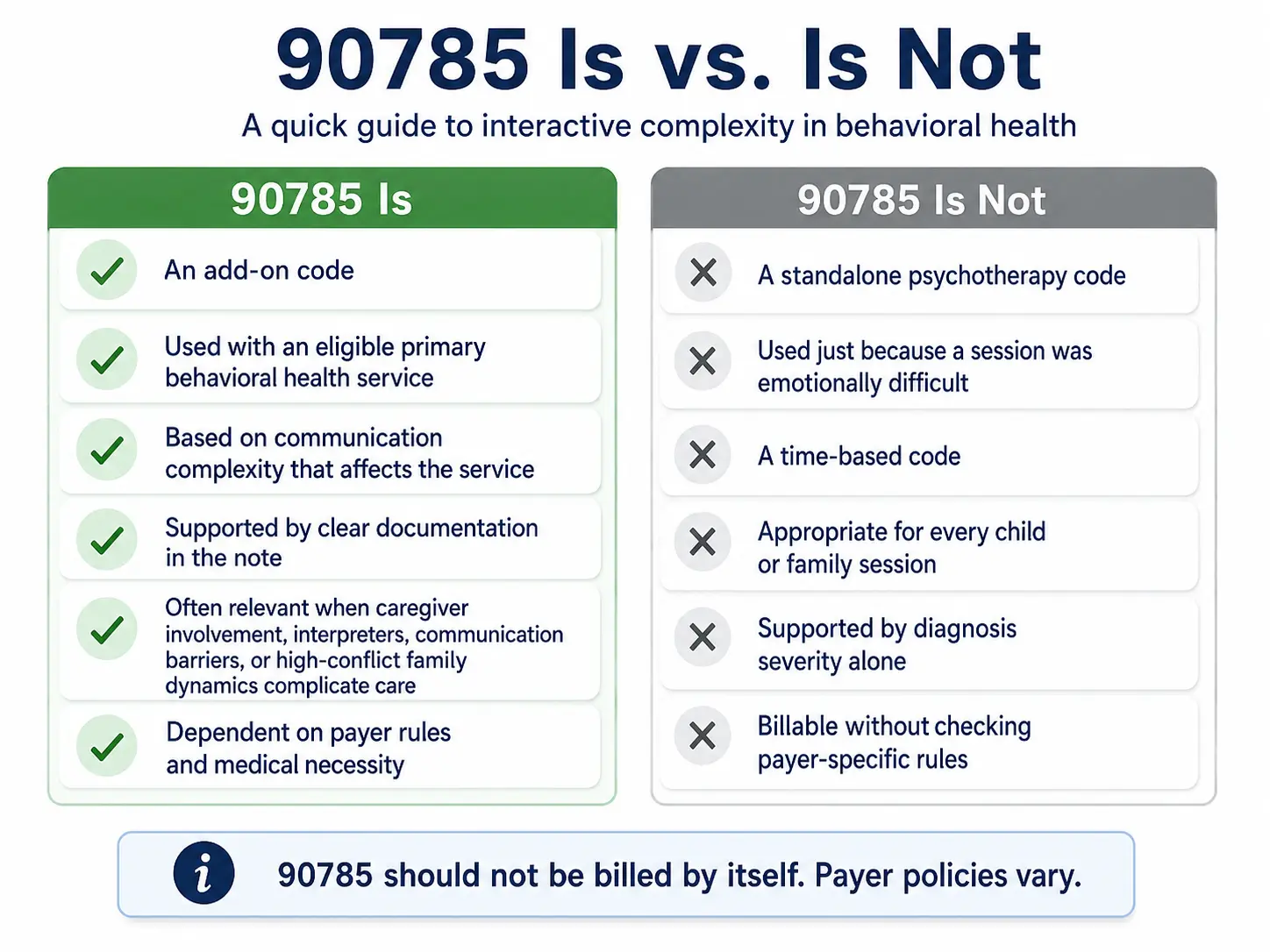
CPT code 90785 is an add-on code used when a behavioral health service involves interactive complexity, such as communication barriers, caregiver involvement, emotional or behavioral escalation, mandated reporting concerns, or legally involved third parties. It is not used simply because a session was difficult, longer than expected, or clinically intense. For behavioral health clinicians, the key is documenting what made communication more complex, how it affected the service, and why the additional complexity was clinically necessary.
Key takeaways
- 90785 is an add-on code, not a standalone psychotherapy or evaluation code.
- It applies when specific communication factors make a behavioral health service more complex — not just when a session is hard.
- Qualifying situations generally involve young children or clients with limited communication, high-conflict caregiver involvement, mandated reporting or safety-related disclosures, or interpreter and communication-assistance needs.
- A difficult or emotionally intense session alone does not justify 90785.
- Documentation should name the communication factor, who was involved, how it affected the service, and what the clinician did in response.
- Payer policies and claim edits vary — confirm coverage and combination rules before billing.
CPT code 90785 is an add-on code used when a behavioral health service involves interactive complexity — communication factors like caregiver involvement, mandated reporting, interpreter use, or maladaptive communication among participants that complicate delivery of care.
90785 is not used simply because a session was difficult, ran long, or felt clinically intense. For behavioral health clinicians, the key to appropriate use is documentation: what specifically made communication more complex, how it affected the service, and why the added complexity was clinically necessary.
CPT codes are maintained and copyrighted by the American Medical Association. This article explains the clinical and documentation concepts behind interactive complexity in plain language — it is not a substitute for the CPT manual, your payer contracts, or coding guidance from a certified coder. Confirm current billing rules with your payers before submitting claims.
What Is CPT Code 90785?
CPT code 90785 (interactive complexity) is an add-on code reported alongside certain psychiatric diagnostic evaluation, psychotherapy, and group or family psychotherapy services when specific communication factors are present. It is never billed by itself, and it does not replace the primary psychotherapy or evaluation code — it signals that the communication involved in delivering that service was more complex than a typical encounter.
In behavioral health, interactive complexity generally refers to factors that make communication during the service more complicated than usual — not factors that make the clinical content more difficult. The complexity has to be clinically relevant, and it needs to be documented clearly in the session note.
A few things worth understanding up front:
- It is not billed by itself — it always accompanies an eligible primary service.
- It does not replace or upgrade the primary psychotherapy or evaluation code.
- It reflects communication complexity, not additional clinical difficulty or extra time.
- It is especially relevant in behavioral health, where treatment often involves caregivers, schools, courts, minors, interpreters, or safety concerns.
Document Interactive Complexity With Confidence
Get the free checklist to help you:
- Recognize when the 90785 CPT code may apply
- Meet key 90785 documentation requirements
- Describe how communication factors affected the service
- Adapt sample language to reflect the encounter
- Verify eligible psychotherapy add-on code combinations
- Avoid common interactive complexity billing mistakes
When Should Behavioral Health Clinicians Use 90785?
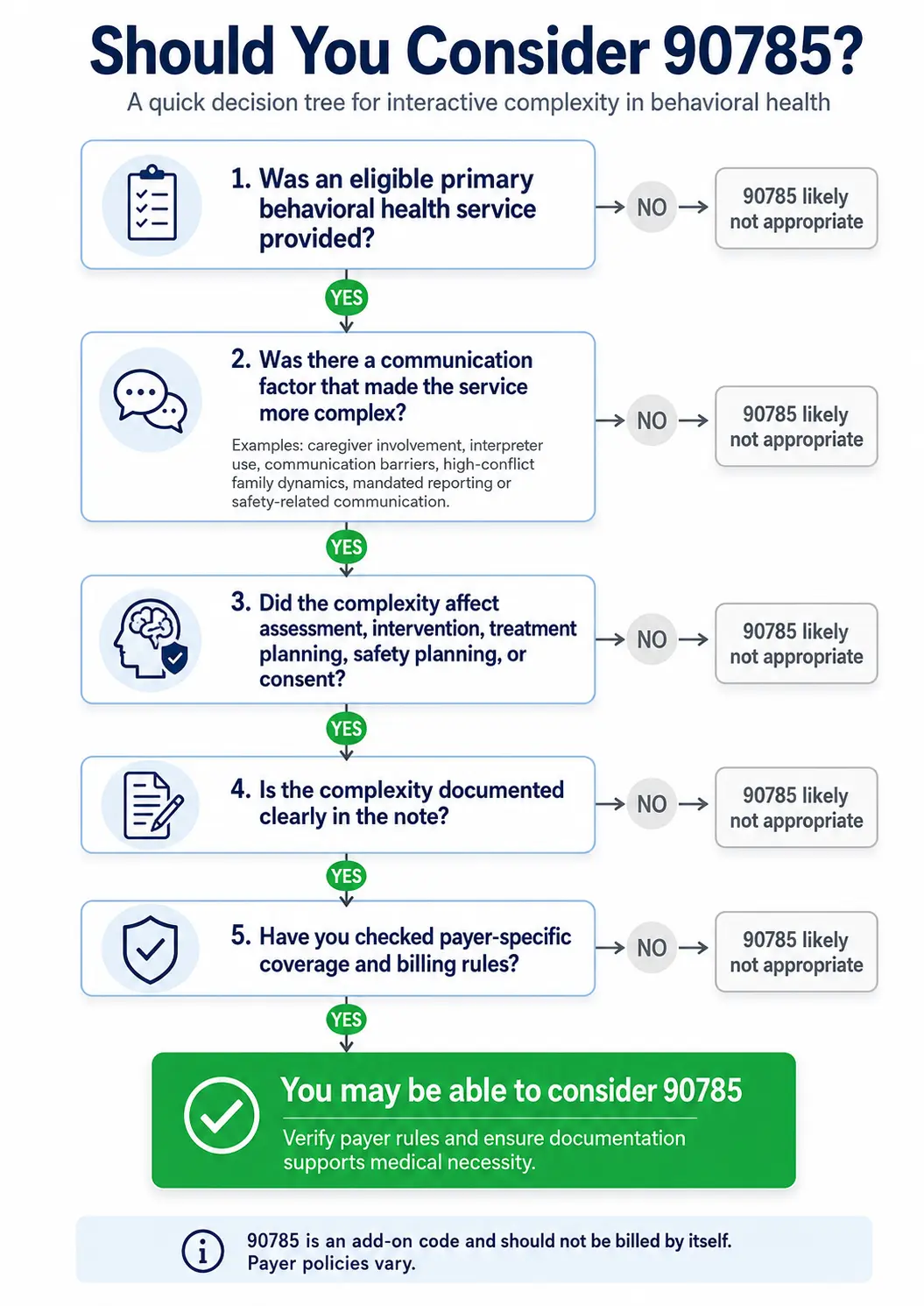
Clinicians may consider CPT code 90785 when a behavioral health encounter involves communication factors that significantly complicate the service — such as caregiver participation, emotional or behavioral dysregulation, interpreter use, mandated reporting, or involvement of schools, courts, guardians, or other third parties. It should not be used simply because the session was long, stressful, or clinically complex. The note needs to show what made communication more complex and how that affected the service.
90785 Is an Add-On Code, Not a Standalone Service
Because 90785 is an add-on code, it can only be reported in conjunction with an eligible primary behavioral health service — never on its own. Per CMS billing and coding guidance for psychiatry and psychology services, interactive complexity represents communication difficulty during the visit, not additional time or heightened clinical severity.
A few billing-structure points worth knowing:
- 90785 must be paired with an eligible primary service, such as a psychiatric diagnostic evaluation, individual psychotherapy, or group psychotherapy code.
- It should not be reported with psychotherapy for crisis codes (90839, 90840), or with an evaluation and management (E/M) service when no psychotherapy service is also reported on the same date.
- Group psychotherapy (90853) can be reported with interactive complexity when clinically indicated.
- It is not a catch-all code for “hard sessions” — it represents a specific, documentable communication factor.
- Payers may apply different claim edits, coverage rules, and documentation expectations, so confirm current combination rules with your payer before billing.
Common Situations Where 90785 May Apply
Medicare's psychiatry and psychology billing and coding guidelines identify four specific communication difficulties that can support use of interactive complexity. In behavioral health practice, these tend to surface in a handful of recurring clinical scenarios.
Sessions Involving Young Children or Clients With Limited Communication
This scenario maps to the use of play equipment, physical devices, an interpreter, or a translator to overcome significant communication barriers. Examples include:
- A child cannot reliably describe symptoms, risk, or recent events.
- The clinician relies heavily on caregiver interpretation to complete the assessment.
- Play-based or developmentally modified communication is required to engage the client.
- A client's cognitive, developmental, or communication limitations affect the interaction.
Name the specific communication limitation, who assisted (caregiver, interpreter), and how the clinician adapted the assessment or intervention as a result.
High-Conflict Family or Caregiver Participation
This scenario reflects two of the four qualifying factors: the need to manage maladaptive communication among participants (high anxiety, high reactivity, repeated questions, or disagreement), and caregiver emotions or behavior that interfere with implementing the treatment plan. Examples include:
- Divorced or separated parents disagree about treatment during the session.
- Guardian involvement complicates consent, history-taking, or treatment planning.
- Family members participate in a way that requires active clinical management.
- Caregiver conflict interferes with assessment or intervention.
Describe the specific caregiver dynamic and how it affected clinical communication, treatment planning, or safety decisions — not just that the family was “in conflict.”
Mandated Reporting or Safety-Related Communication
This aligns with the CMS factor covering evidence or disclosure of a sentinel event and a mandated report to a third party, where the clinician initiates discussion of the event or report with the patient and other visit participants. Examples include:
- Suspected abuse or neglect requires careful, structured communication during the session.
- Safety planning involves guardians, protective services, school staff, or other parties.
- The clinician manages disclosure, risk communication, and third-party notification within the encounter.
Record the safety or risk issue, the communication required, the parties involved, and the clinical impact.
Use of an Interpreter or Communication Assistance
This is the clearest match to the fourth CMS factor — use of an interpreter or translator to overcome a significant language barrier. Examples include:
- An interpreter is needed for the client, the caregiver, or both.
- A communication barrier affects the assessment or intervention.
- The clinician must account for translation lag, cultural nuance, or communication delays during the visit.
Include the interpreter's role, the specific language barrier, and how the added communication complexity affected the service.
Legal, School, or Agency Involvement
Behavioral health treatment often involves parties beyond the client and clinician — a pattern CMS guidance recognizes directly, noting that interactive complexity commonly applies to patients who have others legally responsible for their care, or who require the involvement of third parties such as child welfare agencies, parole or probation officers, or schools. Examples include:
- Court-ordered treatment with reporting requirements.
- Child welfare involvement in treatment planning or safety decisions.
- School personnel participating in treatment planning.
- Probation officers, residential staff, or case managers taking part in the session.
Identify the third party, their role in the encounter, and why their involvement made the clinical interaction more complex.
Examples of When 90785 May Be Appropriate
- A clinician conducts a psychiatric diagnostic evaluation for a 6-year-old and relies on the caregiver to describe symptom history because the child cannot reliably self-report.
- A therapy session for an adolescent involves a school counselor joining by phone to coordinate a safety plan after a disclosure of self-harm.
- A family therapy session requires the clinician to actively de-escalate and redirect two caregivers who disagree sharply about the treatment approach.
- A psychotherapy session uses a certified interpreter because the client and clinician do not share a common language.
- A clinician discloses a mandated report of suspected neglect to a caregiver during the session and manages the caregiver's reaction as part of the visit.
| Scenario | Why 90785 May Apply |
|---|---|
| A child therapy session requires caregiver participation because the child cannot reliably report symptoms. | Communication is developmentally limited and requires caregiver mediation. |
| A family session involves high-conflict divorced parents disagreeing about treatment goals. | Clinician must manage communication barriers affecting treatment planning. |
| A session requires an interpreter for the client and caregiver. | Language barriers complicate communication and service delivery. |
| A clinician must address suspected abuse and coordinate communication with a guardian or agency. | Mandated reporting/safety communication increases interaction complexity. |
| A client with severe agitation requires repeated redirection and caregiver involvement to complete the session. | Behavioral dysregulation meaningfully affects communication and intervention. |
Examples of When 90785 Is Usually Not Appropriate
- A session runs long or feels emotionally intense, but no specific communication barrier, caregiver interference, mandated report, or interpreter need was present.
- A client has a complex diagnosis or high acuity, but communication during the session was straightforward.
- A routine child or family session proceeds without any of the four qualifying communication factors — the client's age or family structure alone does not qualify the visit.
- A clinician bills 90785 as a default add-on for every session with a particular population, rather than evaluating each encounter individually.
| Scenario | Why It May Not Support 90785 |
|---|---|
| The client cried throughout the session but communication remained clear. | Emotional intensity alone is not necessarily interactive complexity. |
| The session ran long. | 90785 is not a time-based add-on code. |
| The case is diagnostically complex. | Diagnostic complexity alone does not equal interactive complexity. |
| The clinician completed extra paperwork after the visit. | Administrative burden alone does not support 90785. |
| The client has trauma history but no communication complexity occurred during the session. | Clinical severity alone is not enough. |
What Should Clinicians Document When Billing 90785?
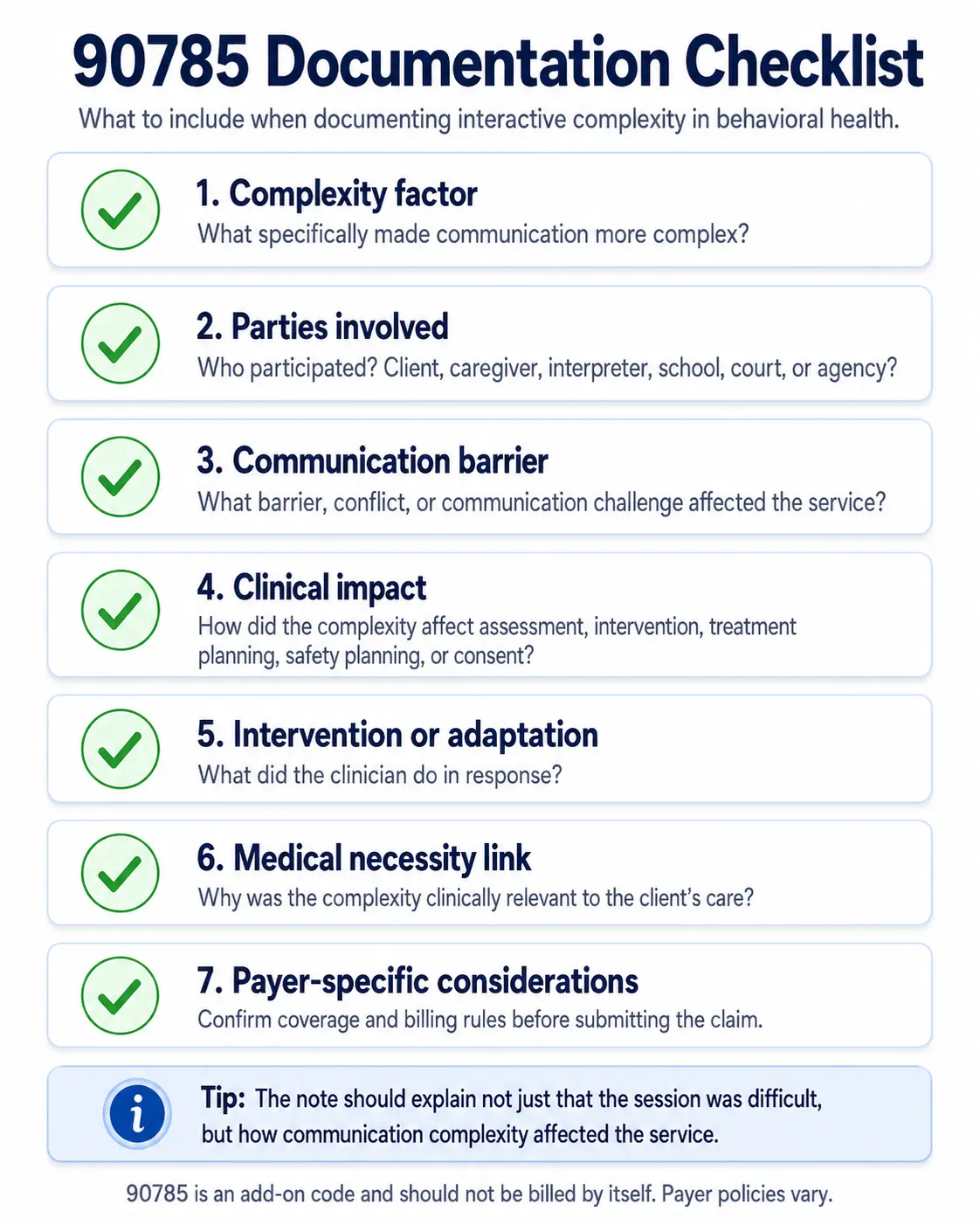
Strong documentation is what separates defensible use of 90785 from a claim that invites payer scrutiny. At minimum, the note should address:
The interactive complexity factor
What specifically made communication more complex during this encounter.
Who was involved
Client, guardian, caregiver, interpreter, school, agency, court, case manager, or other third party.
How it affected the service
Whether it changed assessment, intervention, safety planning, consent, treatment planning, or clinical decision-making.
What the clinician did in response
Redirection, developmentally appropriate communication, caregiver mediation, interpreter-supported assessment, safety coordination, or mandated reporting.
Why it was clinically necessary
Tying the added complexity back to the client's care, not just noting that the session was difficult.
Sample 90785 Documentation Language
The examples below illustrate how each qualifying factor might be described in a note. They are educational starting points, not templates to copy verbatim — documentation should always reflect what actually happened in the specific encounter.
Child Therapy Example
“Interactive complexity was present due to the client's developmental level and limited ability to independently describe symptoms and recent behavioral incidents. Caregiver participation was required to clarify symptom frequency, safety concerns, and treatment response. Clinician used developmentally appropriate questions and caregiver-supported communication to complete assessment and intervention.”
Family Conflict Example
“Interactive complexity was present due to high-conflict caregiver communication that affected treatment planning and required active clinical facilitation. Clinician redirected discussion, clarified treatment goals, and supported communication between caregivers to maintain focus on the client's clinical needs.”
Interpreter Example
“Interactive complexity was present due to language barriers requiring interpreter-supported communication with the client and caregiver. Clinician adapted pacing, confirmed understanding, and used interpreter assistance to complete symptom assessment, intervention, and follow-up planning.”
Mandated Reporting / Safety Example
“Interactive complexity was present due to safety-related communication involving the client, caregiver, and required reporting considerations. Clinician assessed risk, communicated safety concerns, reviewed next steps with the caregiver, and documented actions taken to support client safety.”
90785 vs. Other Behavioral Health CPT Codes
| Code | What It Represents | Can Include 90785? |
|---|---|---|
| 90791 / 90792 | Psychiatric diagnostic evaluation (without/with medical services) | Yes, when interactive complexity is present |
| 90832, 90834, 90837 | Individual psychotherapy (without E/M) | Yes, but i90785 reflects added communication complexity, not longer session time |
| 90833, 90836, 90838 | Psychotherapy add-on to an E/M service | Yes, when interactive complexity is present |
| 90846 / 90847 | Family psychotherapy (without/with patient present) | May apply when interactive complexity is present (family involvement alone does not automatically justify 90785); confirm current payer edits |
| 90853 | Group psychotherapy | Yes, when clinically indicated (group setting alone does not automatically justify 90785) |
| 90839 / 90840 | Psychotherapy for crisis (first 60 min / each additional 30 min) | No — reported alone, not with 90785 |
| E/M codes alone (no psychotherapy billed) | Evaluation and management service | No — 90785 requires a psychotherapy service on the same date |
This table reflects general Medicare billing and coding guidance for psychiatry and psychology services. Combination rules can vary by payer and change over time — verify current edits against your payer contracts and the CPT manual before submitting claims.
Common 90785 Billing Mistakes
Billing 90785 for Every Child or Family Session
Not every child or family session includes interactive complexity. The note needs to show why communication was unusually complex in this specific encounter.
Using 90785 Because the Session Was Difficult
Clinical difficulty, emotional intensity, or a challenging diagnosis does not, by itself, support the code. The complexity has to be about communication, not content.
Failing to Identify the Communication Barrier
Documentation that simply states “interactive complexity present” without naming the specific barrier is unlikely to hold up under payer review.
Leaving Out the Clinical Impact
The note should show how the complexity affected assessment, treatment, safety planning, or communication — not just that a complicating factor existed.
Assuming All Payers Cover 90785 the Same Way
Payer policies, covered code combinations, and documentation expectations vary. Check payer-specific rules, contracts, and claim history rather than assuming Medicare guidance applies uniformly.
How EHR Documentation Can Support Accurate 90785 Billing
Defensible use of 90785 comes down to documentation that clearly connects a communication factor to its clinical impact — which is easier when your clinical documentation and billing workflow are built to work together rather than as separate systems.
ICANotes is an EHR built specifically for behavioral health, and several parts of the platform are relevant to documenting interactive complexity well:
- Diagnosis-driven treatment planning connects the diagnosis to goals, interventions, and progress notes, so a documented safety concern or caregiver dynamic carries forward into future sessions rather than getting lost between notes.
- Progress note formats — including SOAP, BIRP, DAP, GIRP, and PIRP — support structured narrative fields where clinicians can describe who was involved in a session and how it affected care, rather than relying on a single free-text box.
- Built-in outcome assessments, including the C-SSRS for suicide risk, help clinicians document safety-related findings that may accompany a mandated-reporting scenario.
- CPT and ICD-10 code support, with automatic E/M coding based on documentation, helps keep the codes on a claim aligned with what the note actually describes.
- Integrated billing — including clearinghouse claim scrubbing and CMS-1500 form support — connects the documented service directly to the claim, reducing the manual re-entry that can introduce mismatches.
None of this changes payer policy or guarantees reimbursement — that still depends on your documentation, your payer contracts, and the clinical facts of each encounter. What a connected EHR can do is make it easier for the note to capture the specific communication factor, its clinical impact, and your response to it, all in one place.
Document interactive complexity with confidence
See how ICANotes connects documentation, treatment planning, and billing in one behavioral health EHR — so your notes clearly support codes like 90785. Start your free trial today.
- Notes completed in under 3 minutes
- 30-day free trial, no credit card required
- HIPAA compliant and ONC Cures certified
- Live support from behavioral health specialists
Frequently Asked Questions About CPT Code 90785
Can 90785 be billed by itself?
Can therapists use 90785 for child therapy?
Can 90785 be used with family therapy?
Is 90785 based on session length?
Does a crisis session automatically qualify for 90785?
What documentation supports 90785?
Does 90785 apply to telehealth sessions?
Dr. October Boyles
Dr. October Boyles is a behavioral health expert and clinical leader with extensive expertise in nursing, compliance, and healthcare operations. With a Doctor of Nursing Practice (DNP) and advanced degrees in nursing, she specializes in evidence-based practices, EHR optimization, and improving outcomes in behavioral health settings. Dr. Boyles is passionate about empowering clinicians with the tools and strategies needed to deliver high-quality, patient-centered care.
Sources
- Centers for Medicare & Medicaid Services. Local Coverage Article: Billing and Coding: Psychiatry and Psychology Services (A57520 / L34616).
- American Medical Association / AAPC Codify. CPT® Code 90785 — Interactive Complexity Psychiatry Services and Procedures.
This article is for educational purposes only and does not constitute billing, coding, legal, or compliance advice. CPT codes and descriptions are copyright the American Medical Association. Payer policies vary and change; confirm current billing requirements with your payers, your compliance team, or a certified coder before submitting claims.