Blog > Treatment Strategies > Active Listening in Therapy: 15 Techniques & Examples
Active Listening in Therapy: 15 Techniques, Examples, and Clinical Applications
Active listening in therapy is one of the most essential clinical skills for building trust, strengthening the therapeutic alliance, and improving assessment accuracy. This guide explores the active listening definition, core principles, and evidence-informed techniques therapists can use to help clients feel heard, understood, and emotionally safe. You’ll learn practical active listening techniques, review real therapy dialogue examples, explore common barriers that interfere with listening, and discover exercises clinicians can use to improve their therapeutic presence and communication skills.


Last Updated: May 19, 2026


What You'll Learn
- The clinical definition of active listening and how it differs from empathy and reflective listening
- Why active listening is foundational to the therapeutic alliance and effective treatment outcomes
- 15 practical active listening techniques therapists can use during sessions
- Real-world active listening examples and sample therapist responses
- How nonverbal communication impacts therapeutic presence and client trust
- Common barriers that interfere with effective listening in therapy
- Exercises and supervision strategies to strengthen active listening skills
- How active listening supports trauma-informed, culturally responsive, and client-centered care
- Evidence-based perspectives on active listening in psychology and psychotherapy
- Ways to improve emotional attunement, validation, and session engagement with clients
Contents
- Why Active Listening Matters in Therapy
- Core Principles of Active Listening
- 15 Active Listening Techniques for Therapy Sessions
- Active Listening Examples in Therapy Dialogue
- Barriers to Active Listening in Therapy
- 3 Clinical Exercises to Improve Active Listening
- Reducing the Friction that Pulls Clinicians Away from Active Listening
- FAQ: Active Listening in Therapy
If you ask seasoned clinicians to name the single most important skill in their work, many will land on the same answer: the ability to truly listen. Active listening in therapy is the foundation upon which assessment, formulation, and intervention all rest. It signals to clients that they are seen, heard, and taken seriously — often for the first time in a long time.
Beyond its relational power, active listening is a structured clinical skill. It can be defined, taught, observed, and refined. Decades of research on the therapeutic alliance — consistently one of the strongest predictors of engagement and retention in psychotherapy — point back to the listening behaviors that build it.
This guide is written for behavioral health clinicians who want a practical, structured reference. We’ll cover the active listening definition, why it matters in clinical work, 15 specific active listening techniques with example language you can use in your next session, common barriers, exercises for skill-building, and answers to the most frequently asked questions about active listening in psychology and therapy.
What is Active Listening? (Active Listening Definition)
What Is Active Listening in Therapy?
Active listening in therapy is a clinical communication skill in which the therapist fully attends to a client’s verbal and nonverbal cues, reflects both content and emotion, suspends judgment, and checks for understanding to help the client feel heard, understood, and emotionally safe.
The most widely cited active listening definition comes from Carl Rogers and Richard Farson, who in 1957 described it as a way of listening that requires the listener to “get inside the speaker,” grasping not only the words but the feeling and meaning behind them, and reflecting that understanding back.
In a clinical context, active listening involves four interlocking behaviors:
- Attending fully to verbal and nonverbal cues — words, tone, pacing, posture, facial expression, and pauses
- Reflecting both content and emotion — restating what was said and naming the feeling underneath it
- Suspending judgment — temporarily setting aside your own evaluations, hypotheses, and advice
- Demonstrating empathy through responses — communicating your understanding in language the client can verify
Active listening in psychology is sometimes contrasted with “passive” or “absorptive” listening, where the listener takes in information silently. Active listening is participatory: the therapist’s responses are themselves interventions that shape what the client says next.
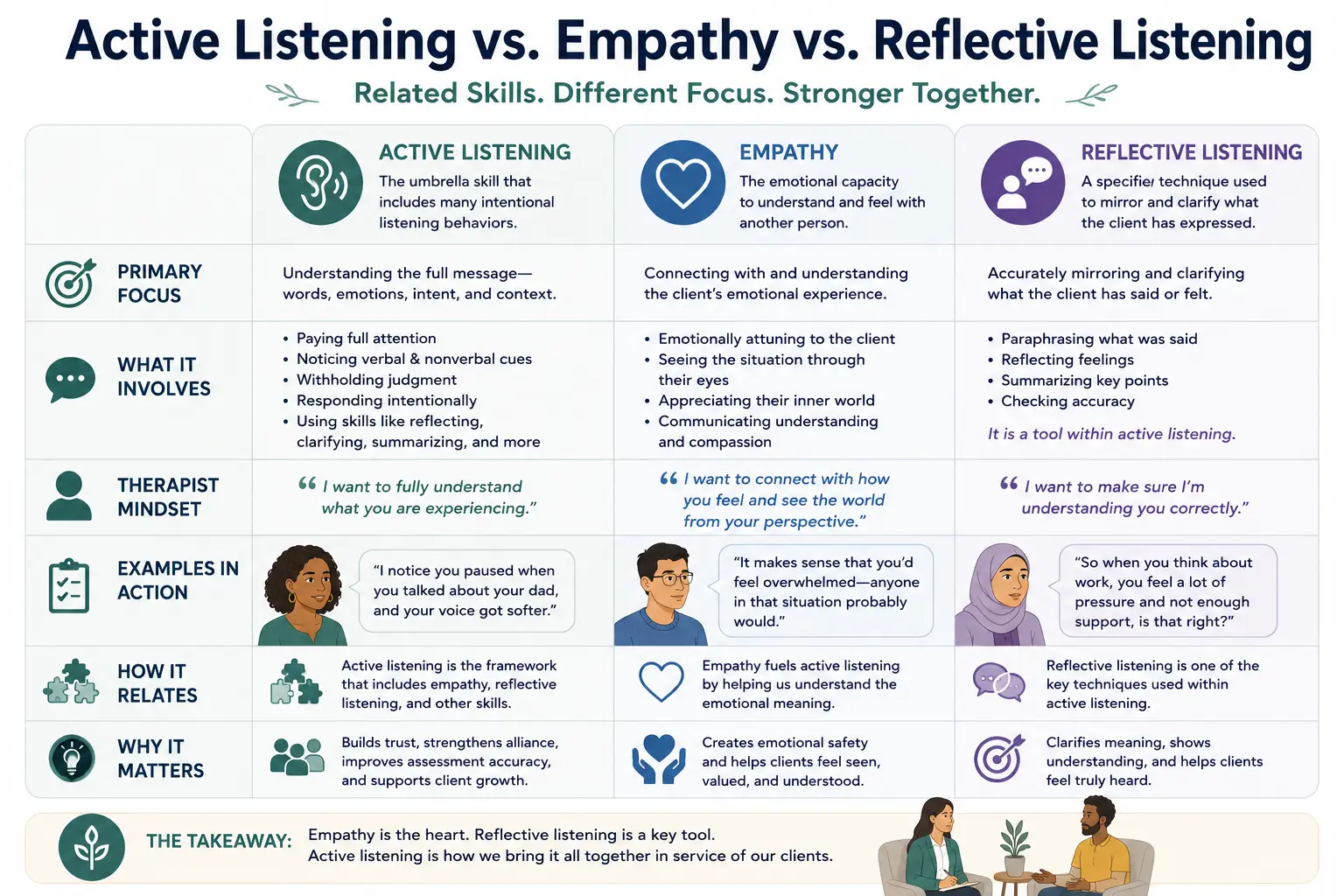
It is worth distinguishing active listening from related but separate constructs. Empathy is the internal experience of taking in another person’s emotional reality. Active listening is one of the primary ways empathy is expressed and verified out loud. Reflective listening is a narrower term that usually refers specifically to paraphrasing and reflecting feelings — it sits inside the broader category of active listening.
Why Active Listening Matters in Therapy
Active listening is not a “soft skill.” It is one of the foundational counseling skills and therapeutic skills clinicians rely on to build trust, improve assessment accuracy, and strengthen the therapeutic alliance throughout treatment. It is a high-leverage clinical behavior with measurable effects on the work.
- It builds the therapeutic alliance. Meta-analyses by Norcross, Wampold, and others consistently identify the working alliance — the bond, agreement on goals, and agreement on tasks between therapist and client — as one of the most robust common factors across modalities. Active listening is the primary behavioral channel through which the bond is established.
- It enhances client safety and openness. Clients who feel heard disclose more, more accurately, and earlier in treatment. This is particularly important in trauma-informed work, with marginalized populations who may have been dismissed in prior care, and with clients presenting with shame, suicidality, or substance use.
- It improves assessment accuracy. A client who feels rushed, interrupted, or judged tends to give surface answers. A client who feels actively listened to is more likely to volunteer the contradictions, ambivalence, and context that lead to better formulation and a more accurate diagnosis.
- It supports emotional regulation. Being accurately reflected — having a feeling named by another person — is itself co-regulating. For clients with limited interoceptive awareness or alexithymic features, the therapist’s reflections function as a vocabulary lesson for their inner life.
- It supports client self-discovery. When the therapist reflects rather than directs, clients often hear their own statements differently. Insight frequently emerges not from the therapist’s interpretation, but from the client’s reaction to having their words mirrored back.
Core Principles of Active Listening
Three principles underlie every technique that follows.
- Listen for total meaning. Total meaning includes content (what happened, who said what), emotion (what the client felt then and feels now), and meaning (what the experience signifies about self, others, or the world). Skilled clinicians track all three layers in parallel.
- Reflect feelings accurately. Naming a feeling too strongly can feel intrusive; naming it too weakly can feel dismissive. Aim for the client’s own register. If they say “annoyed,” don’t escalate to “enraged.” If they say “destroyed,” don’t soften to “a little down.”
- Attend to nonverbal communication. Body posture, facial expression, breath, eye contact, and pacing carry information that words alone do not. Nonverbal cues frequently reveal incongruence — the client who says “I’m fine” while their jaw tightens — and offer some of the richest material for reflection.

Download the Active Listening Toolkit
Get 15 active listening techniques, session phrases, a self-audit worksheet, and peer practice scripts designed for behavioral health clinicians.
15 Active Listening Techniques for Therapy Sessions
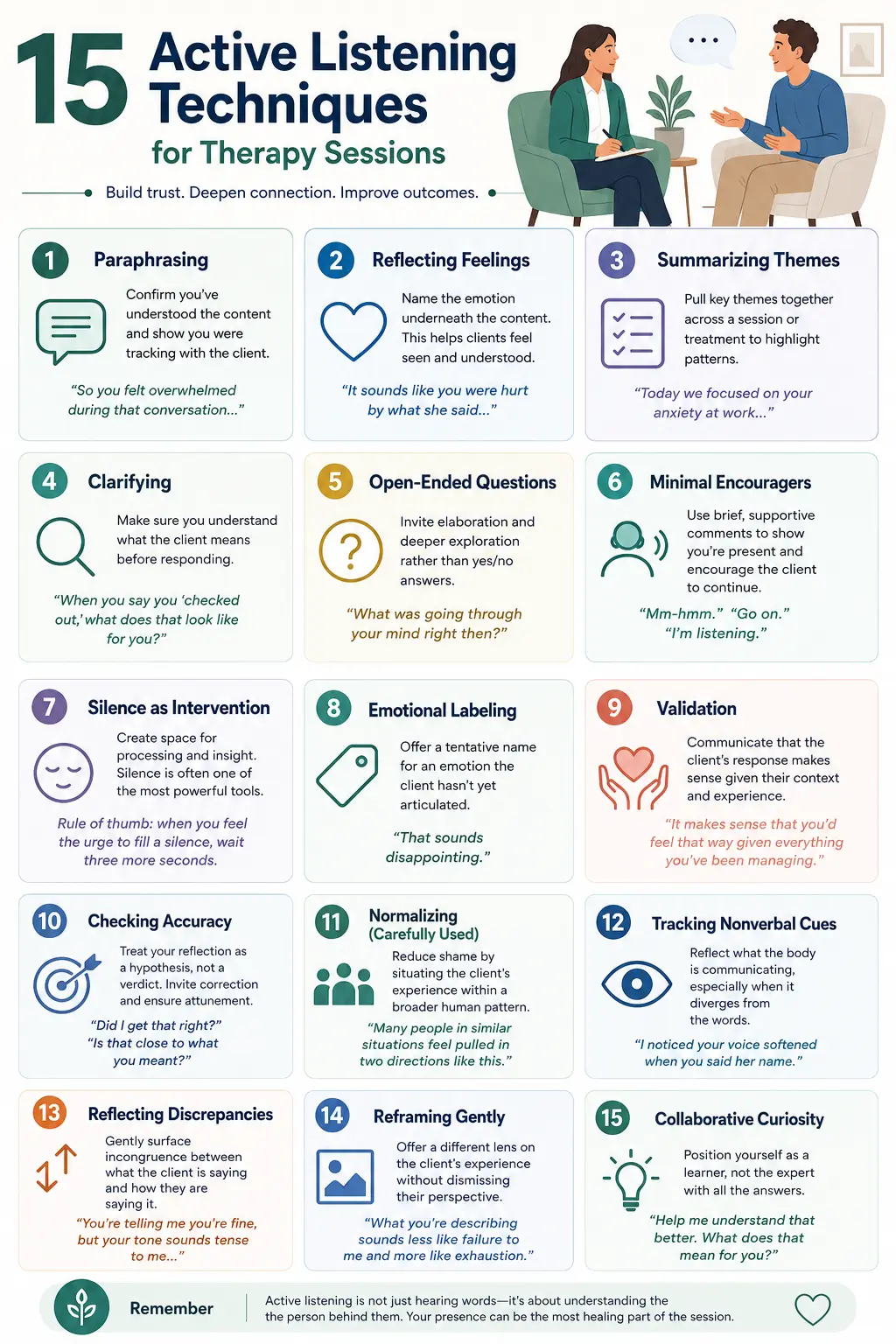
Below are 15 active listening techniques with purposes and example language. Use them as a working repertoire — not a script — and notice which ones come naturally and which require deliberate practice.
1. Paraphrasing
Purpose: Confirm you’ve understood the content of what the client said and signal you were tracking with them.
Client: “By the time the meeting was over, I just couldn’t engage with anyone the rest of the day.”
Therapist: “So you felt overwhelmed during that conversation, and it carried into the rest of the day.”
2. Reflecting Feelings
Purpose: Name the emotion underneath the content. This is one of the most powerful active listening examples in clinical work.
Therapist: “It sounds like you were hurt by what she said, not just frustrated.”
3. Summarizing Themes
Purpose: Pull threads together across a session or across treatment to highlight a pattern.
Therapist: “Today we focused on your anxiety at work and how it connects to the self-doubt you’ve been describing for a few weeks now.”
4. Clarifying
Purpose: Make sure you understand what a client means before you respond. Especially important when clients use idiosyncratic language.
Therapist: “When you say you ‘checked out,’ what does that look like for you in the moment?”
5. Open-Ended Questions
Purpose: Invite elaboration rather than yes/no answers. Open-ended questions widen the field of what the client can tell you.
Therapist: “What was going through your mind right at that moment?”
6. Minimal Encouragers
Purpose: Communicate “I’m with you, keep going” without redirecting the client.
Therapist: “Mm-hmm.” “Go on.” “I’m listening.”
7. Silence as Intervention
Purpose: Create space for processing, emotion, and self-discovery. Silence is one of the most underused active listening techniques and often the most clinically productive.
A useful rule of thumb: when you feel the urge to fill a silence, wait three more seconds.
8. Emotional Labeling
Purpose: Offer a tentative name for an emotion the client has not yet articulated.
Therapist: “That sounds disappointing.”
9. Validation
Purpose: Communicate that the client’s response makes sense given their context — without endorsing every behavior.
Therapist: “It makes sense that you’d feel that way given everything you’ve been managing.”
10. Checking Accuracy
Purpose: Treat your reflection as a hypothesis, not a verdict. This invites correction and protects against misattunement.
Therapist: “Did I get that right?” “Is that close to what you meant?”
11. Normalizing Carefully
Purpose: Reduce shame by situating the client’s experience within a broader human pattern. Use sparingly — overuse can feel dismissive.
Therapist: “Many people in similar situations feel pulled in two directions like this.”
12. Tracking Nonverbal Cues
Purpose: Reflect what the body is communicating, especially when it diverges from the words.
Therapist: “I noticed your voice softened when you said her name.”
13. Reflecting Discrepancies
Purpose: Gently surface incongruence between what a client is saying and how they are saying it.
Therapist: “You’re telling me you’re fine, but your tone sounds tense to me. I want to make sure I’m tracking with you.”
14. Reframing Gently
Purpose: Offer a different lens on the client’s experience without dismissing their original framing.
Therapist: “What you’re describing sounds less like failure to me and more like exhaustion.”
15. Collaborative Curiosity
Purpose: Position yourself as a learner, not an expert holding the answer. Particularly valuable in culturally responsive and trauma-informed care.
Therapist: “Help me understand that better. What does that mean for you?”
Active Listening Examples in Therapy Dialogue
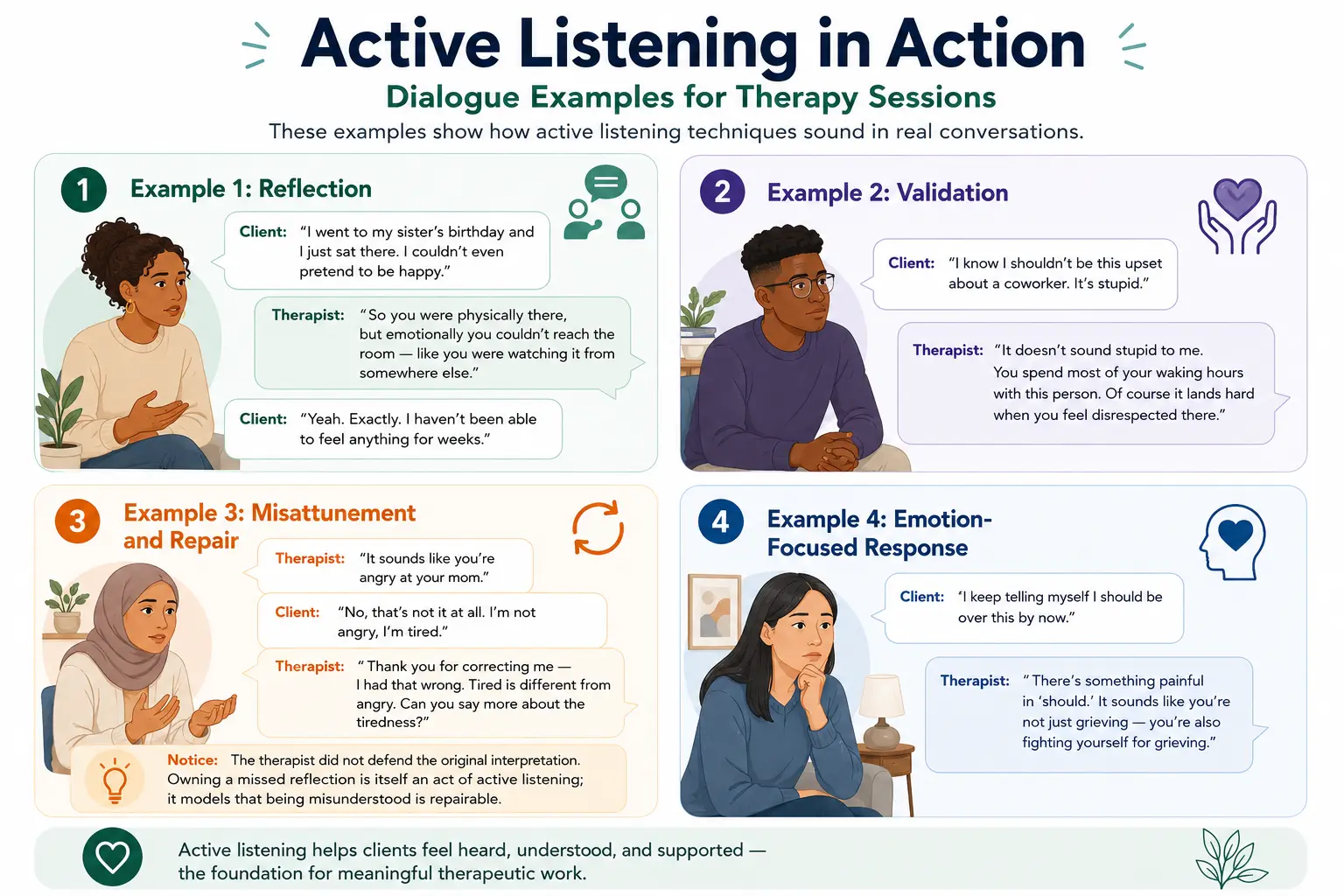
The techniques above show up most clearly in extended dialogue. The four short exchanges below illustrate reflection, validation, repair after misattunement, and emotion-focused responding.
Example 1: Reflection
Client: “I went to my sister’s birthday and I just sat there. I couldn’t even pretend to be happy.”
Therapist: “So you were physically there, but emotionally you couldn’t reach the room — like you were watching it from somewhere else.”
Client: “Yeah. Exactly. I haven’t been able to feel anything for weeks.”
Example 2: Validation
Client: “I know I shouldn’t be this upset about a coworker. It’s stupid.”
Therapist: “It doesn’t sound stupid to me. You spend most of your waking hours with this person. Of course it lands hard when you feel disrespected there.”
Example 3: Misattunement and Repair
Therapist: “It sounds like you’re angry at your mom.”
Client: “No, that’s not it at all. I’m not angry, I’m tired.”
Therapist: “Thank you for correcting me — I had that wrong. Tired is different from angry. Can you say more about the tiredness?”
Notice the therapist did not defend the original interpretation. Owning a missed reflection is itself an act of active listening; it models that being misunderstood is repairable.
Example 4: Emotion-Focused Response
Client: “I keep telling myself I should be over this by now.”
Therapist: “There’s something painful in ‘should.’ It sounds like you’re not just grieving — you’re also fighting yourself for grieving.”
The examples below show how active listening techniques sound in real therapy conversations. Notice how therapists use reflection, validation, emotional attunement, and repair to help clients feel understood and emotionally safe.
Non-Verbal Active Listening Skills
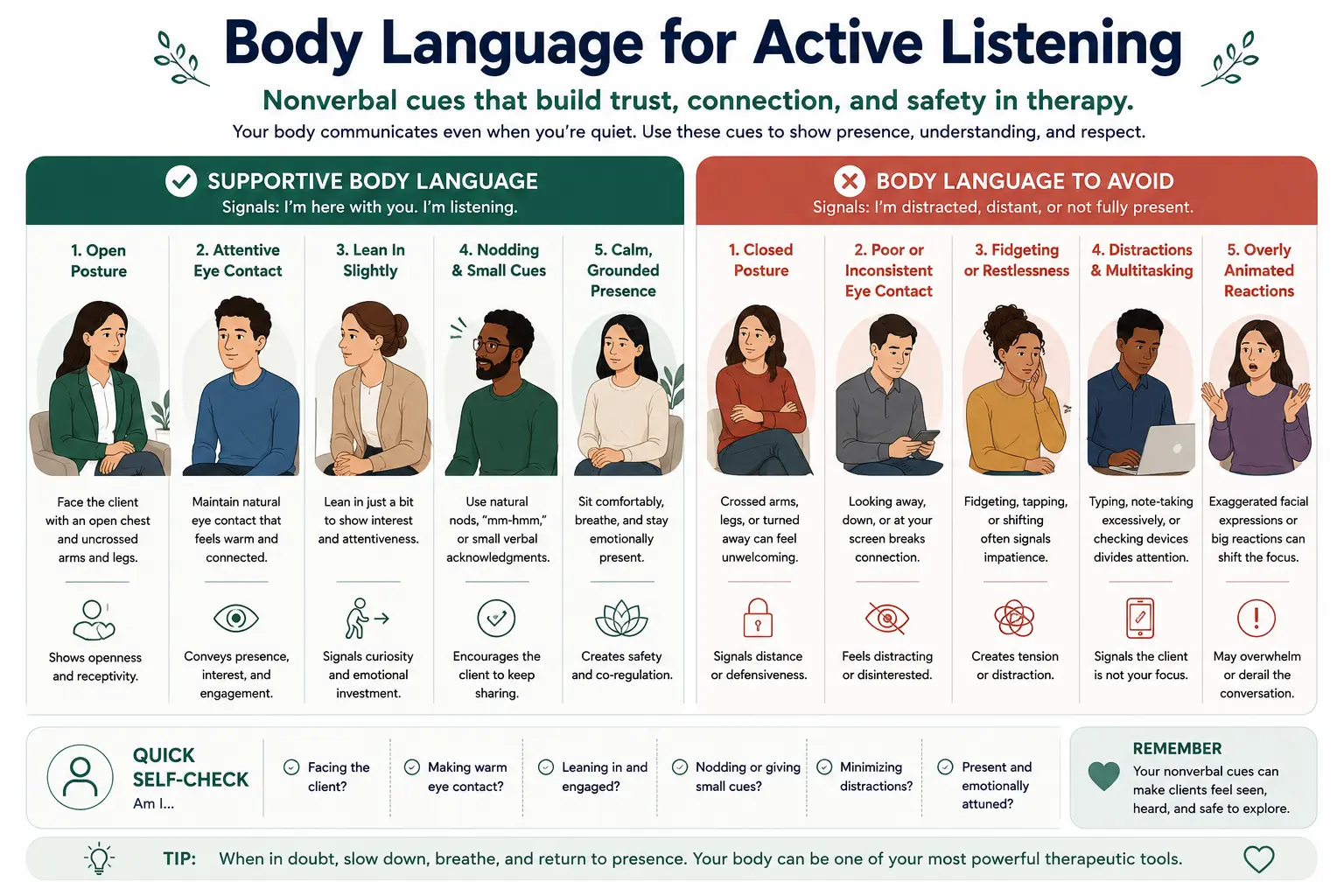
Words are only part of what clients receive from you. Your body is communicating constantly, and skilled active listening in therapy includes the deliberate management of nonverbal channels.
- Eye contact — maintained but not fixed; calibrated to the client’s culture and comfort level. Many clients find sustained eye contact intrusive when discussing shame or trauma; intermittent contact often works better.
- Open posture — uncrossed arms, torso slightly forward, hands visible. A closed posture reads as guarded even when you don’t intend it.
- Nods and facial expressions — congruent with what the client is sharing. A neutral or pleasant face during a description of trauma can read as dismissive.
- Regulated tone — pace your own voice slightly slower and quieter than the client’s. This both communicates calm and helps regulate the room.
- Appropriate physical distance — close enough to feel present, far enough to feel safe. In telehealth, the corollary is camera framing, lighting, and minimizing background distraction.
- Stillness — minimize fidgeting, note-taking flurries, and screen-checking. Stillness signals “you have my full attention.”
Barriers to Active Listening in Therapy
Even experienced clinicians fall into predictable patterns that interrupt active listening. Naming them is the first step to noticing them in real time.
- Jumping to problem-solving. The urge to fix is strong, especially with distressed clients. Premature problem-solving short-circuits the client’s own process and can feel dismissive of the emotional reality they’re trying to communicate.
- Internal judgments. Silent evaluations — “she’s being unreasonable,” “this is avoidance” — pull your attention away from the client and into your own commentary. Over time, the client feels the distance even if you never say it.
- Over-interpreting. Reaching for a theoretical formulation (attachment style, defense mechanism, schema) before the client has finished telling the story. Interpretation has its place; it should follow listening, not replace it.
- Interrupting. Even well-intentioned interruptions (“Let me make sure I have this right…”) can derail a client mid-feeling. Silence and minimal encouragers usually serve better.
- Reassuring too quickly. “It’s going to be okay” delivered before the client has finished feeling not-okay reads as a request to stop feeling. False reassurance damages trust.
- Suggesting solutions prematurely. Closely related to problem-solving but worth naming separately: clients are often not asking for advice when they describe a problem. They are asking to be understood.
- Listener fatigue. Active listening is cognitively demanding. Back-to-back sessions, full caseloads, and documentation burden all degrade the quality of attention you can bring. Caseload management, breaks between sessions, and a sustainable documentation workflow are part of how clinicians protect their listening capacity.
3 Clinical Exercises to Improve Active Listening
These exercises work well in individual practice, peer consultation, or supervision.
Reflect-Only Practice
Pair with a colleague. For 10 minutes, the speaker shares anything on their mind. The listener may only paraphrase, reflect feelings, summarize, or check accuracy — no questions, no advice, no self-disclosure. Switch roles. Most clinicians find this surprisingly difficult, and surprisingly clarifying about which active listening techniques they default to and which they avoid.
Mindful Listening Drill
During an actual session (or a recording), track your internal reactions in real time: the urge to interrupt, the formulation forming in your head, the emotion the client is evoking in you. Don’t suppress them; just notice. After the session, journal briefly on what pulled your attention away from the client. Over weeks, patterns emerge.
Session Recording Review
When ethically permissible — with informed consent, in line with your jurisdiction’s regulations, and with appropriate HIPAA-aligned safeguards for storage — review a recording of one of your own sessions. Time how long the client spoke versus how long you spoke. Count interruptions. Note how often you reflected feelings versus offered content paraphrases. Most clinicians are humbled by this exercise and learn more from it than from any reading.
Improving Active Listening as a Therapist
Skill-building is a long game. The clinicians who get markedly better at active listening tend to combine deliberate practice with consistent feedback.
- Slow down your speech rate. Faster speech communicates urgency. Slower, more deliberate pacing creates space for the client’s nervous system to settle, and signals that you are not in a hurry.
- Increase your tolerance for silence. Silence is uncomfortable for most therapists for the first few seconds — and it is precisely in those seconds that clients often arrive at something important. Build tolerance gradually.
- Seek supervision feedback specifically on listening behaviors. Generic supervision rarely surfaces listening habits. Ask your supervisor to listen for specific behaviors — interruptions, premature reassurance, advice-giving — rather than for case formulation.
- Practice mindfulness outside the session. A regular mindfulness practice strengthens the meta-cognitive muscle you rely on every time you notice yourself drifting in session.
- Review your own session transcripts. Where ethically permissible, transcripts surface patterns that are invisible in the moment.
- Protect your attentional capacity. Active listening degrades when you are exhausted, hungry, dysregulated, or buried in administrative work. The clinical research on burnout consistently links documentation burden and caseload size to declines in empathic engagement. Reducing the friction of charting, billing, and compliance work is not a side issue — it is part of preserving the conditions for good listening.
Reducing the Friction That Pulls Clinicians Away from Listening
One of the biggest barriers to active listening is not a lack of empathy or clinical skill — it’s cognitive overload. Therapists are often expected to hold emotional presence during sessions while simultaneously thinking about documentation requirements, billing rules, treatment plan deadlines, compliance standards, prior authorizations, and the growing administrative burden that follows them home after hours.
That constant background pressure fragments attention.
The clinicians who listen most effectively are often the clinicians whose systems create the least friction around charting, billing, and compliance work.
That’s one reason behavioral-health-specific systems matter.
Unlike generalized medical EHRs, ICANotes was built around the actual workflow of behavioral health clinicians. The platform is designed to reduce the mental load associated with documentation and practice management so clinicians can spend less of the session thinking about paperwork — and more of it fully present with clients.
- Faster Behavioral Health Documentation — Specialty-built note templates and structured workflows help clinicians complete documentation efficiently without sacrificing clinical quality or narrative flexibility.
- Built-In Compliance Support — ICANotes helps support documentation consistency with tools designed around behavioral health workflows, treatment planning, and payer expectations.
- Integrated Billing Workflows — Integrated billing and practice management tools reduce the need to juggle multiple disconnected systems, helping clinicians and organizations streamline administrative tasks.
The goal is not to replace clinical presence with technology. The goal is to reduce the administrative drag that competes with it — so therapists can devote more cognitive and emotional bandwidth to listening, attunement, and therapeutic connection.
In behavioral health, the quality of listening matters. Systems that reduce documentation burden and operational friction can help protect the attention clinicians need to do that work well.
Frequently Asked Questions About Active Listening in Therapy
Active listening in therapy is a structured clinical skill in which the therapist attends fully to a client’s verbal and nonverbal communication, reflects both content and emotion back to the client, suspends judgment, and verifies understanding. It is one of the primary behavioral channels through which empathy is expressed and the therapeutic alliance is built.
Common active listening examples include paraphrasing (“So you felt overwhelmed during that conversation”), reflecting feelings (“It sounds like you were hurt, not just frustrated”), checking accuracy (“Did I get that right?”), validating (“It makes sense that you’d feel that way”), and tracking nonverbal cues (“I noticed your voice softened when you said that”).
Empathy is an internal experience of taking in another person’s emotional reality. Active listening is one of the main ways empathy is expressed, verified, and made useful in clinical work. You can have empathy without communicating it; active listening is how the client knows it is there.
Active listening is not itself a treatment, but it is one of the primary behavioral components of the therapeutic alliance — and the alliance is one of the most robust common factors associated with engagement, retention, and reported satisfaction across modalities. Clinicians should not promise specific outcomes from listening alone, but the research base strongly supports its centrality to effective psychotherapy.
Therapists train active listening through coursework on basic counseling microskills, role-play with feedback, supervised clinical practice, session recording review (where ethically permissible), peer consultation, and reflective practice such as mindful listening drills and reflect-only exercises with a colleague.
The four main components of active listening are: attending fully to verbal and nonverbal cues; reflecting content and emotion back to the speaker; suspending judgment and personal evaluation; and demonstrating empathy through responses the speaker can verify and correct.
Common barriers include jumping to problem-solving, internal judgments about the client, over-interpreting before the story is finished, interrupting, reassuring too quickly, suggesting solutions prematurely, and listener fatigue from heavy caseloads or administrative overload.
Active listening is grounded in the person-centered tradition pioneered by Carl Rogers and supported by decades of common-factors research linking the therapeutic alliance to engagement and treatment retention. While “active listening” is rarely studied as a standalone intervention, its core components — empathic reflection, validation, and accurate understanding — appear consistently in evidence-based protocols including motivational interviewing, dialectical behavior therapy, and emotion-focused therapy.
Practical between-session practice includes reflect-only exercises with a peer, mindful listening drills during everyday conversations, brief journaling on what pulled your attention in your last session, and reviewing your own session recordings or transcripts where ethically permitted.
Recent Posts





Dr. October Boyles
DNP, MSN, BSN, RN
About the Author
Dr. October Boyles is a behavioral health expert and clinical leader with extensive expertise in nursing, compliance, and healthcare operations. With a Doctor of Nursing Practice (DNP) and advanced degrees in nursing, she specializes in evidence-based practices, EHR optimization, and improving outcomes in behavioral health settings. Dr. Boyles is passionate about empowering clinicians with the tools and strategies needed to deliver high-quality, patient-centered care.