Blog > Treatment Strategies > 12 Effective Couples Therapy Activities for Stronger Relationships

12 Couples Therapy Activities and Exercises for Better Communication

Couples therapy activities give clinicians practical, structured ways to help partners improve communication, rebuild trust, reduce defensiveness, and strengthen emotional connection. From active listening and conflict repair exercises to attachment-focused and CBT-informed interventions, these couples therapy exercises can be used in-session or assigned as homework to reinforce healthier relationship patterns between visits. In this guide, you’ll find 12 evidence-informed couples counseling activities designed to support trust-building, emotional safety, conflict resolution, and long-term relationship growth for couples in outpatient or telehealth settings.

Gemini_Generated_Image_67wtof67wtof67wt

Last Updated: May 11, 2026

fav (10)

What You'll Learn

  • How to use structured couples therapy activities to improve communication and emotional safety
  • Couples therapy exercises that help reduce defensiveness and prevent conflict escalation
  • Trust-building interventions for couples recovering from repeated conflict or relationship injuries
  • CBT-, attachment-, and Gottman-informed couples counseling activities clinicians can use in session or as homework
  • Telehealth-friendly relationship exercises that adapt well to virtual therapy settings
  • Ways to facilitate repair attempts, active listening, emotional validation, and perspective-taking
  • How to document couples therapy interventions, homework assignments, and treatment progress effectively
  • Practical strategies for helping couples build healthier communication patterns between sessions

Trust and communication sit at the core of every healthy relationship — and at the center of effective couples therapy. When trust erodes, couples often fall into predictable cycles: defensiveness spikes, emotional withdrawal deepens, and conflict repeats without resolution.

Structured couples therapy activities give clinicians a reliable framework for interrupting these cycles. Rather than open-ended conversation that can quickly become reactive, structured couples counseling activities provide a defined process — one that slows interaction, builds emotional safety, and gives both partners a shared experience of being heard. Structured activities work best when paired with broader strategies for conducting effective couples therapy sessions that balance emotional safety with accountability.

This guide covers 12 evidence-informed couples therapy exercises you can use in-session or assign as between-session practice. Each activity includes a clinical goal, step-by-step instructions, processing questions to deepen insight, and safety considerations for high-conflict or avoidant partners. Clinicians can strengthen outcomes by aligning these exercises with clearly defined couples therapy treatment goals tailored to each relationship's needs.

What Are Couples Therapy Activities?

Couples therapy activities are structured exercises therapists use to help partners improve communication, rebuild trust, strengthen emotional connection, and resolve conflict more effectively. These couples therapy exercises may be used during sessions or assigned as homework to reinforce healthier relationship patterns between visits.
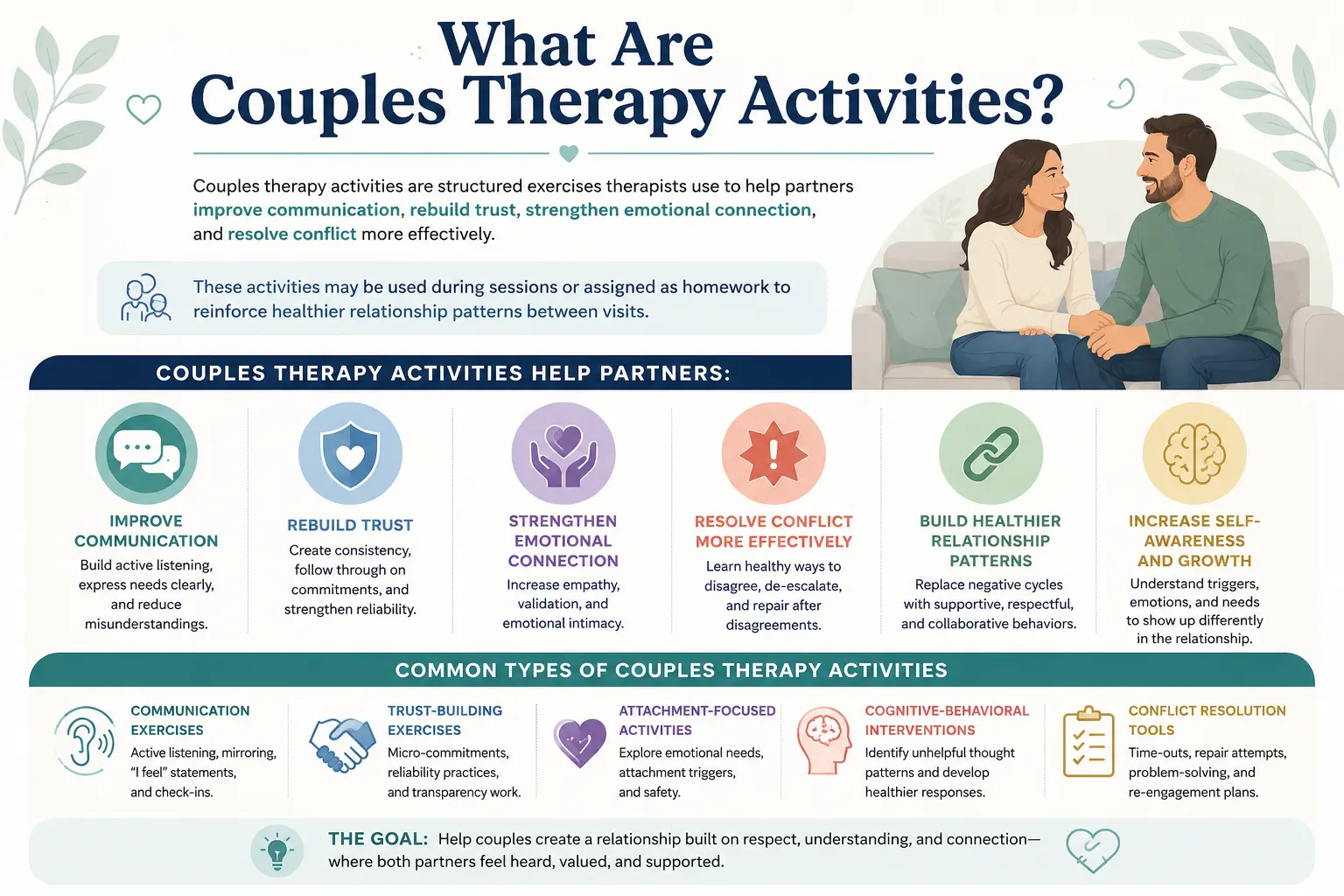
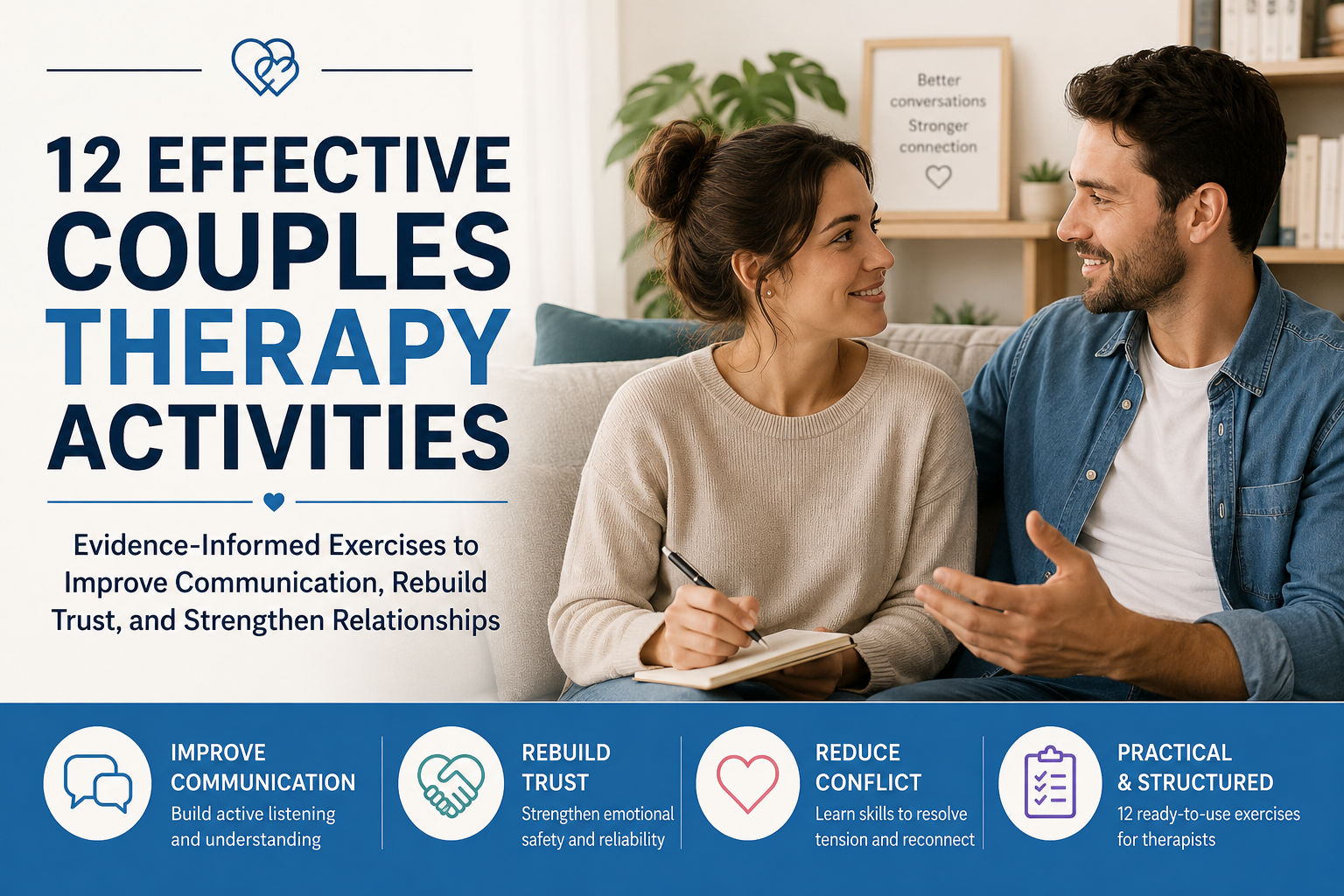
Infographic explaining couples therapy activities that improve communication, rebuild trust, strengthen emotional connection, and resolve conflict

Why Trust and Communication Matter in Couples Therapy

Trust rarely collapses all at once. It erodes gradually — through missed commitments, poor repair after conflict, and a growing sense that one’s partner isn’t reliably “there.” In couples presenting for therapy, low trust commonly shows up as:

  • Hypervigilance and defensiveness
  • Emotional shutdown or stonewalling
  • Repeated arguments that cycle back to the same unresolved injury
  • Difficulty accepting repair attempts

Structured couples therapy exercises address trust indirectly but powerfully — by creating repeated experiences of being heard, validated, and responded to predictably. When partners experience small moments of attunement within a structured exercise, the nervous system registers safety, and openness becomes possible. Many of these communication exercises can also help couples navigating desire discrepancy in couples therapy by improving emotional safety and connection.

How Therapists Use Couples Therapy Exercises in Session and At Home

Each of the 12 couples counseling activities below is designed to be flexible. You can introduce them in-session, assign them as homework, or use them in a hybrid format where partners begin the exercise in session and continue it at home.

Every activity in this guide includes:

  • Goal — the clinical objective the exercise targets
  • Steps — clear, sequenced instructions for facilitating the exercise
  • Processing Questions — prompts to deepen reflection and consolidate insight after the exercise
  • Clinical Considerations — guidance on contraindications, adaptations for telehealth, and managing partner reactivity

Free Clinician Resource

Download the Couples Therapy Activity Cards

Get a printable deck of evidence-informed couples therapy activities designed to help clinicians improve communication, rebuild trust, strengthen emotional safety, and support healthier conflict resolution in couples counseling sessions.

12 ready-to-use couples therapy exercises clinicians can implement immediately
Includes goals, prompts, processing questions, and clinical considerations
Perfect for in-session interventions, therapy homework, and treatment planning
Couples Therapy Activity Cards free download for clinicians

Get Instant Access

Complete the form below to download the free activity cards.

This field is for validation purposes and should be left unchanged.
Name(Required)
This field is hidden when viewing the form

12 Couples Therapy Exercises and Counseling Activities
Activity 1

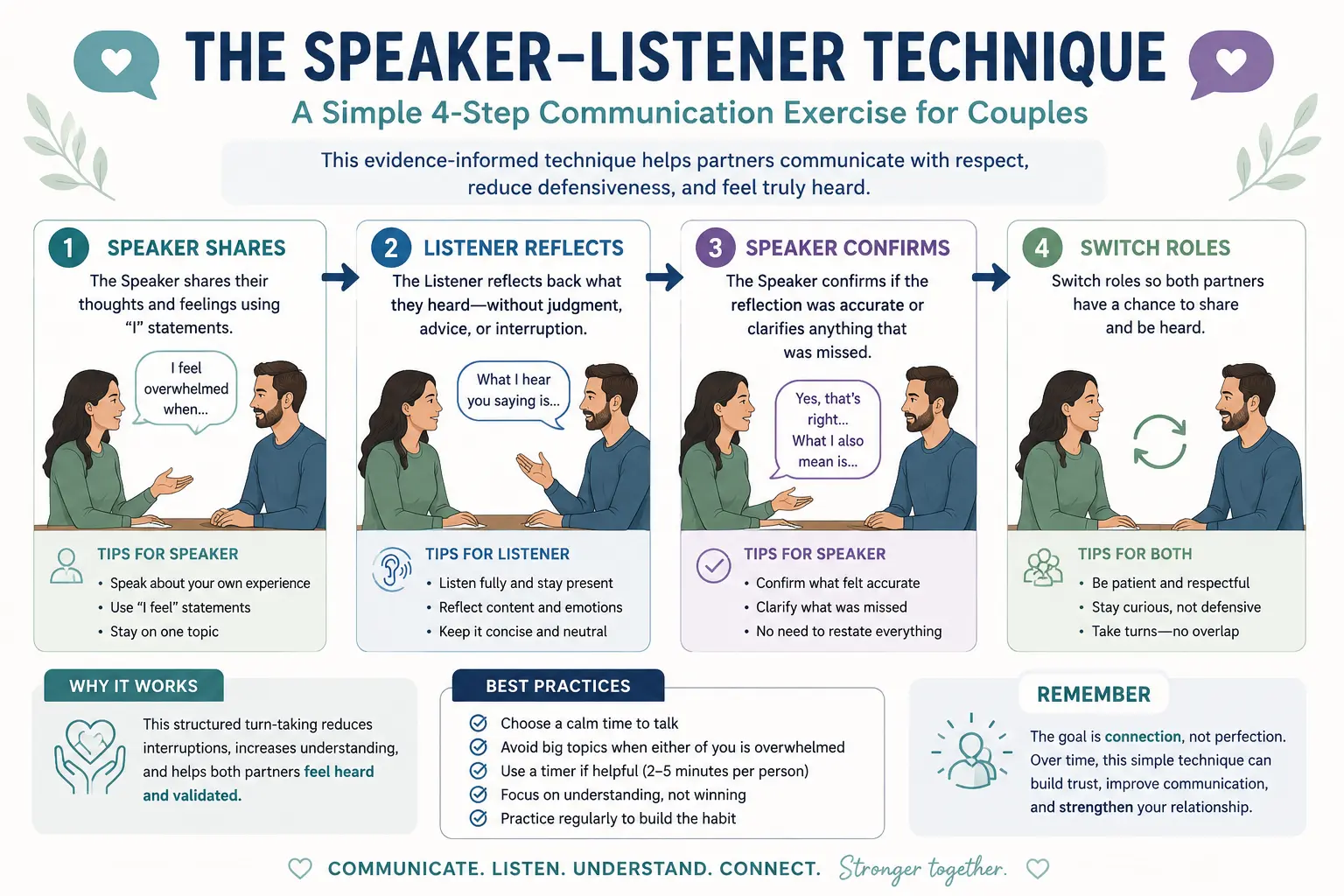
Speaker–Listener Technique for Active Listening

Goal Improve active listening, reduce defensiveness, and create healthier communication patterns between partners.
Best For: Couples experiencing repeated communication breakdowns, defensiveness, escalation, or difficulty feeling heard during conflict

The Speaker–Listener Technique is one of the most effective couples therapy activities for improving communication and reducing reactive conflict patterns. By slowing conversations down and assigning clear communication roles, this exercise helps partners feel heard before responding. Rooted in PREP (Prevention and Relationship Enhancement Program) research, the Speaker-Listener technique gives each partner a defined role during difficult conversations, reducing the likelihood of simultaneous reacting.

Steps
  1. Designate one partner as the Speaker and the other as the Listener. Use a physical object (card, pen, or token) to represent the “floor.”
  2. The Speaker shares one concern or feeling at a time using first-person language.
  3. The Listener reflects back what they heard before responding, focusing on understanding rather than defending or correcting.
  4. The Listener asks: “Did I get that right? Is there more?”
  5. Switch roles once the Speaker confirms they feel understood.
Processing Questions
  • What was it like to speak without interruption?
  • Listener: when did you feel tempted to defend yourself? What helped you stay present?
  • Did anything about your partner’s perspective surprise you?
Clinical Considerations

Avoid using this exercise with couples in acute escalation or where emotional safety has not yet been established. For telehealth sessions, clinicians can use virtual cues or turn-taking signals to reinforce structure and reduce interruptions. If one partner consistently struggles to listen, this may indicate window of tolerance issues worth exploring individually.

Infographic showing the Speaker-Listener Technique for couples therapy to improve communication, active listening, and conflict resolution
Activity 2

Uninterrupted Listening Exercise (3-5 minutes)

Goal Increase emotional validation, improve listening skills, and help partners feel heard without interruption.
Best For: Couples who interrupt frequently, struggle with emotional validation, or become reactive during difficult conversations

Uninterrupted Listening is a structured couples therapy exercise designed to slow conversations down and create emotional safety. By allowing one partner to speak without interruption, couples practice staying present, listening reflectively, and reducing reactive communication patterns. This exercises is a simpler version of the Speaker-Listener Technique, and is ideal for couples earlier in treatment or those who struggle with structured roles.

Steps
  1. Set a timer for 3–5 minutes, adjusting shorter for high-conflict couples if needed.
  2. Partner A speaks without interruption using the prompt: “Something I’ve been wanting you to understand about me is...”
  3. The listening partner maintains eye contact and avoids interrupting, correcting, or defending.
  4. Once the timer ends, the Listener reflects the emotional meaning of what they heard back to their partner rather than focusing only on details.
  5. Repeat the exercise with Partner B.
Processing Questions
  • What was it like to speak without being interrupted?
  • Listener: what thoughts or reactions came up while you listened?
  • Did you notice anything about your partner’s emotions that you had not fully heard before?
Clinical Considerations

Some couples may initially experience discomfort with silence or structured turn-taking. Normalize this reaction and provide psychoeducation about emotional regulation and active listening. For telehealth sessions, muting the listening partner can help reinforce the exercise structure and reduce interruptions.

Activity 3

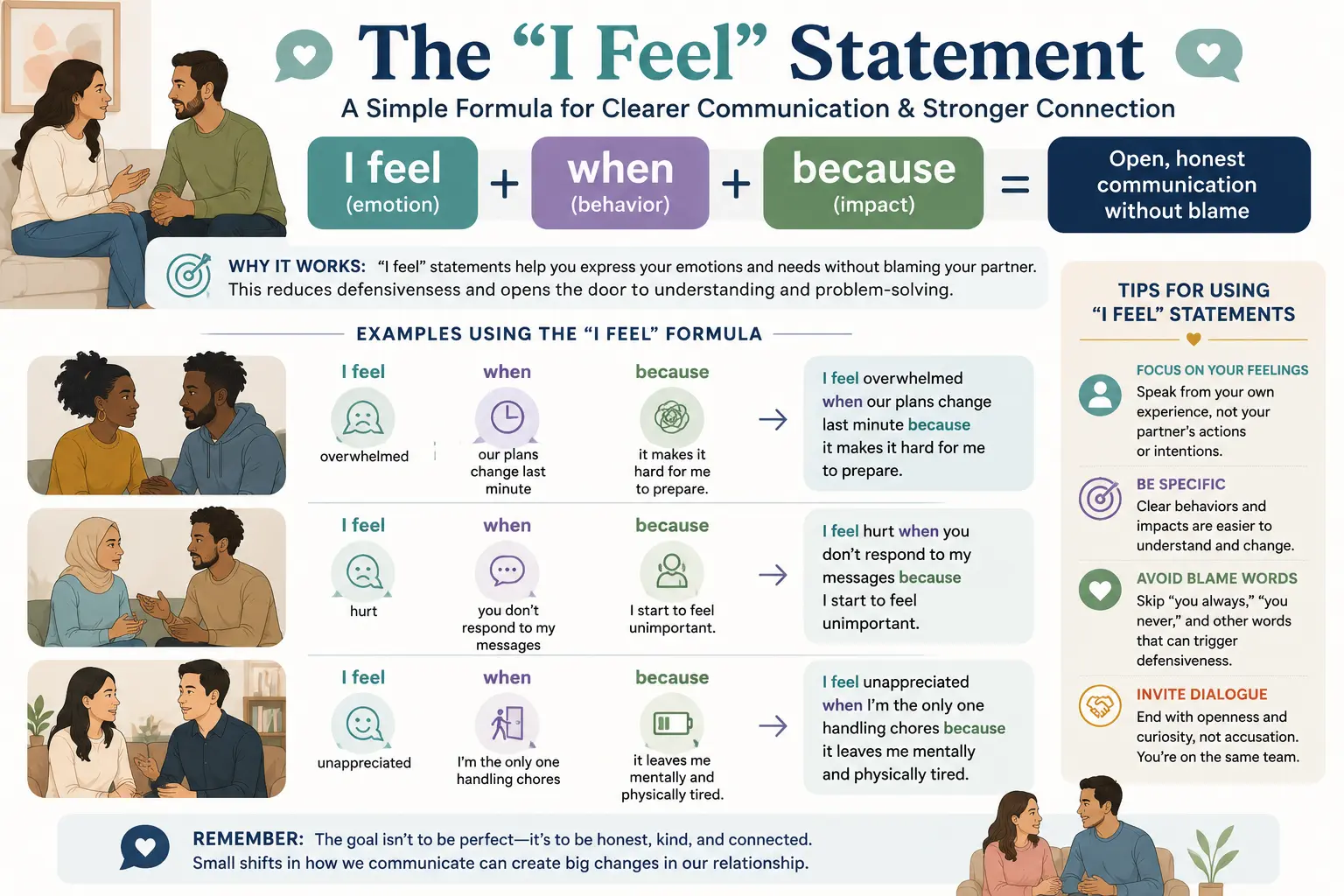
“I Feel” Statement Exercise for Couples

Goal Reduce blame, improve emotional expression, and strengthen communication during difficult conversations.
Best For: Couples caught in criticism-defensiveness cycles, emotionally reactive conversations, or difficulty expressing vulnerable emotions

The “I Feel” Statement Exercise is one of the most widely used couples therapy exercises for improving communication and reducing defensiveness. By shifting away from blame-based language, partners learn to express emotions more clearly while increasing emotional safety and empathy within the relationship. The “I Feel” exercise teaches partners to communicate distress without activating their partner’s protective response.

Steps
  1. Introduce the communication formula: “I feel [emotion] when [specific behavior] because [impact on me].”
  2. Ask each partner to identify one recurring frustration or emotionally difficult interaction.
  3. Coach each partner to write or verbally practice one “I Feel” statement before sharing it aloud with their partner.
  4. Coach partners to remove blaming or accusatory language and focus on emotions and impact instead.
  5. After each statement, have the listening partner reflect the emotion they heard (not the behavior) back to their partner.
Processing Questions
  • Was it difficult to identify the emotion beneath the frustration? What got in the way?
  • How did it feel to hear your partner express emotion without blame?
  • What might change if you used this communication structure more consistently at home?
Clinical Considerations

Many clients initially default to statements such as “I feel like you...” which often contain criticism rather than emotion. Redirect gently toward naming feelings directly. Clinicians may also find it helpful to use a feelings wheel or emotion chart for couples who struggle with emotional identification or vulnerability. Validate when partners attempt the exercise even imperfectly; behavior change happens through approximation.

Infographic teaching couples how to use “I Feel” statements to improve communication, reduce defensiveness, and express emotions more effectively
Activity 4

Mirroring Technique for Couples

Goal Reduce misinterpretation, slow reactive conversations, and help partners confirm understanding before responding.
Best For: Couples who misread each other’s intentions, escalate quickly, or struggle to feel accurately understood during conflict

The Mirroring Technique is a structured couples therapy exercise that helps partners slow down and reflect what they heard before responding. This communication activity can reduce assumptions, clarify emotional meaning, and create more productive conversations when partners feel misunderstood. Drawn from Imago Relationship Therapy, the mirroring technique creates a structured dialogue in which the receiving partner reflects back verbatim (or closely paraphrased) what they heard — before responding. This reduces the distortion that occurs when partners are simultaneously reactive.

Steps
  1. Partner A shares one concern, feeling, or request in one to two sentences.
  2. Partner B mirrors what they heard by saying: “What I heard you say is...”
  3. Partner A confirms accuracy or gently corrects the reflection by saying: “Almost — what I meant was...”
  4. Repeat until Partner A confirms they feel understood.
  5. Partner B then responds, and Partner A mirrors back what they heard.
Processing Questions
  • What was it like to hear your words reflected back?
  • Were there moments when your partner heard something different than what you intended?
  • How might mirroring change the way you handle difficult conversations at home?
Clinical Considerations

Mirroring may feel awkward or scripted at first, so normalize the discomfort and frame it as a skill-building exercise rather than a natural conversation style. When partners’ reflections reveal a significant gap in understanding, clinicians can use that discrepancy therapeutically to explore assumptions, emotional triggers, and communication patterns.

Activity 5

Role Reversal Exercise for Perspective-Taking

Goal Build empathy, strengthen perspective-taking, and help partners better understand each other’s emotional experience.
Best For: Couples stuck in recurring conflict patterns, rigid positions, or difficulty understanding each other’s perspective

The Role Reversal Exercise helps couples step outside their own position and briefly speak from their partner’s point of view. This couples therapy activity can increase empathy, reduce defensiveness, and reveal emotional needs that may be hidden beneath repeated conflict.

Steps
  1. Identify a recurring conflict or disagreement the couple feels stuck in.
  2. Ask Partner A to speak from Partner B’s perspective, using their partner’s words, concerns, and emotional position as accurately as possible.
  3. Partner B listens and offers feedback using prompts such as: “The part that felt accurate was...” and “The part that wasn’t quite right was...”
  4. Debrief what each partner noticed about the experience.
  5. Repeat the exercise with roles reversed.
Processing Questions
  • What was most difficult about speaking from your partner’s perspective?
  • Did anything shift in your understanding of your partner’s perspective?
  • How did it feel to hear your own position reflected back by your partner?
Clinical Considerations

This exercise can be emotionally intense and should be used only when both partners have enough regulation capacity to engage safely. Avoid role reversal when there are active domestic violence concerns, significant power imbalances, or unresolved trauma responses that may make the activity destabilizing.

Activity 6

Repair Attempt Builder

Goal Strengthen conflict recovery skills and help partners reconnect after tension, misunderstanding, or emotional escalation.
Best For: Couples who struggle to de-escalate conflict, reconnect after arguments, or recognize each other’s attempts to repair

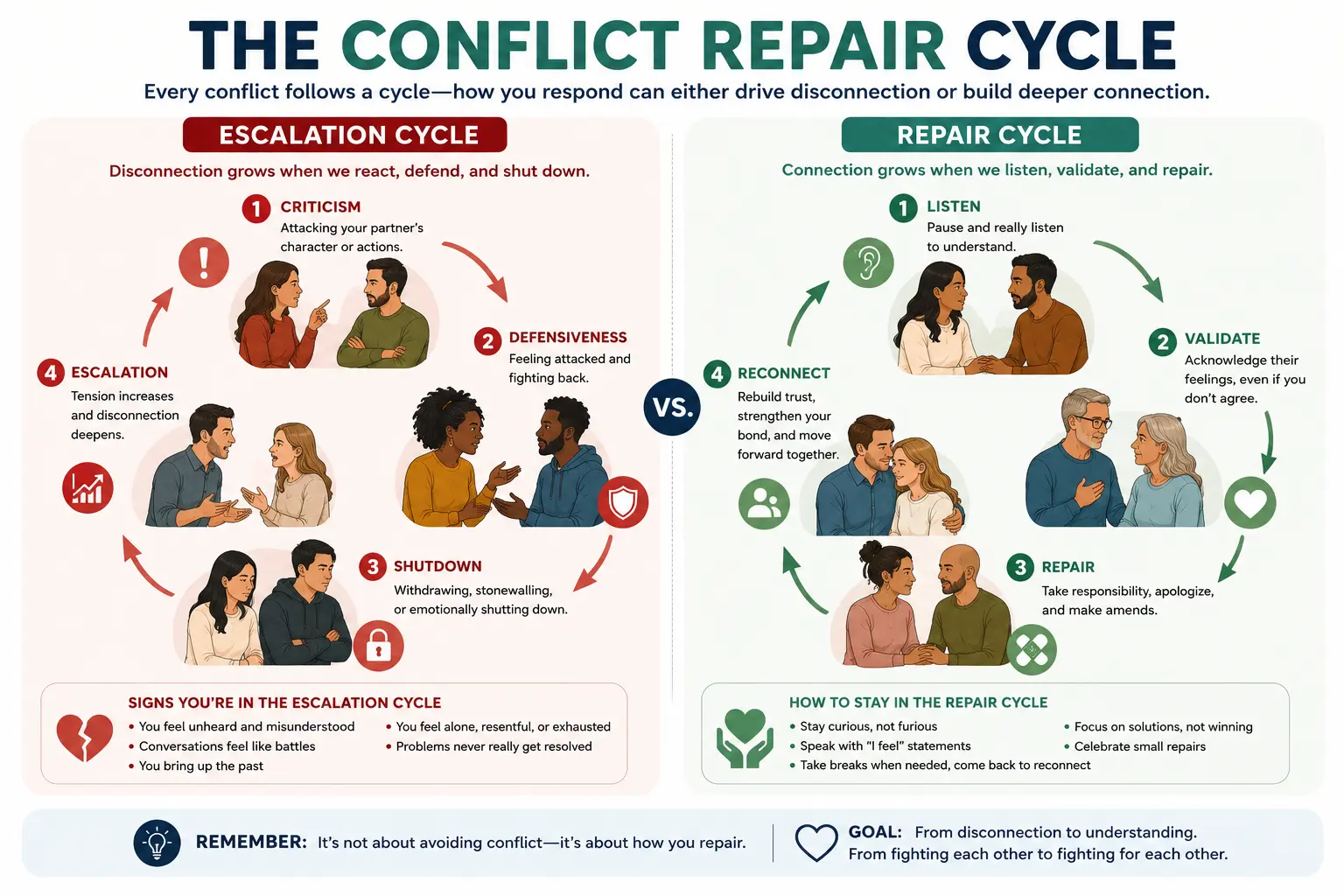
Gottman research identifies repair attempts — verbal or behavioral cues that de-escalate conflict — as a key predictor of relationship satisfaction. The Repair Attempt Builder helps couples create simple, authentic phrases or gestures they can use to interrupt conflict and signal a desire to reconnect. This couples therapy activity supports healthier conflict resolution by helping partners recognize repair attempts before disagreements become more intense.

Steps
  1. Introduce the concept of repair attempts as verbal or behavioral signals that communicate: “I want to pause, reconnect, or lower the intensity.”
  2. Ask the couple to brainstorm 3–5 repair phrases or gestures that feel natural and realistic for their relationship.
  3. Examples may include: “I’m getting flooded — can we take 20 minutes?” or “I love you, and I want us to handle this differently.”
  4. Have partners write down their agreed-upon repair attempts and practice saying them aloud in session.
  5. Assign homework: use at least one repair attempt the next time tension begins to rise.
Processing Questions
  • Which repair attempts felt most natural or believable? Which felt awkward?
  • Have you missed or rejected a partner’s repair attempt in the past? What got in the way?
  • What would it mean to successfully repair after a conflict, even a small one?
Clinical Considerations

Repair attempts work best when they are co-created by the couple rather than prescribed by the clinician. Follow up in later sessions by asking whether either partner used a repair attempt, how it was received, and what made repair easier or harder in the moment.

Infographic comparing the escalation cycle and conflict repair cycle in couples therapy to improve communication and emotional connection
Activity 7

Time-Out Exercise for Conflict De-Escalation

Goal Prevent escalation, support emotional regulation, and create a clear plan for returning to difficult conversations safely.
Best For: Couples who become flooded, escalate quickly, pursue-withdraw during conflict, or need a safer way to pause and re-engage

Flooding — the physiological state of overwhelm during conflict — prevents productive communication. A Time-Out and Re-Engagement Plan gives couples a structured way to pause conflict before it becomes overwhelming. This couples therapy exercise helps partners recognize flooding, take space for regulation, and return to the conversation with a clear agreement rather than using distance as avoidance.

Steps
  1. Explain flooding and how physiological overwhelm can make productive conflict resolution difficult.
  2. Help the couple choose a clear time-out signal, phrase, or gesture that either partner can use when escalation begins.
  3. Define the length of the break, typically 20–30 minutes, and identify what each partner will do to regulate during that time.
  4. Agree on how the couple will re-engage after the break, including who initiates the return and what phrase they will use.
  5. Document the plan and have each partner acknowledge it.
  6. Role-play initiating the time-out and returning to the conversation so the plan feels familiar before the next conflict.
Processing Questions
  • How has it gone in the past when you tried to “take a break” without a plan?
  • What helps each of you calm your body during conflict?
  • What signals that you are ready to return to the conversation?
Clinical Considerations

Emphasize that a time-out is not avoidance; it is emotional regulation in service of returning to the conversation. Partners with attachment-related fears may experience the pause as abandonment, so clinicians should help the couple create a specific re-engagement agreement and revisit the plan across sessions.

Activity 8

Trust-Building Exercise Using Micro-Commitments

Goal Rebuild trust through small, specific, observable commitments that strengthen reliability over time.
Best For: Couples working on trust repair, follow-through, emotional reliability, or rebuilding safety after repeated disappointments

After trust has been damaged, large gestures rarely repair it. The Trust Continuum exercise helps couples rebuild reliability through micro-commitments: small, specific, and verifiable promises that each partner can follow through on consistently. Rather than relying on broad promises, this couples therapy activity focuses on observable behaviors that gradually strengthen trust and emotional safety.

Steps
  1. Introduce the idea that trust is rebuilt through consistent, predictable follow-through rather than grand gestures or vague promises.
  2. Ask each partner to identify one small, concrete commitment they can complete within the next week. It should be observable, not abstract (e.g., "I will text when I leave work," not "I will be more present.")
  3. Make sure each commitment is observable, specific, and fully within that partner’s control.
  4. Have partners share their commitments with each other and clarify what successful follow-through will look like.
  5. At the next session, review whether each commitment was kept, what got in the way, and how the receiving partner experienced the follow-through.
Processing Questions
  • What made you choose that particular commitment?
  • What was it like to follow through, or to notice that follow-through was difficult?
  • How did it feel to receive a small, kept promise from your partner?
Clinical Considerations

Keep commitments small, realistic, and verifiable. Avoid abstract goals such as “be more present” unless they are translated into specific behaviors. This exercise works best over multiple sessions — track commitments and outcomes as part of the clinical record. For severe trust injuries, such as infidelity or repeated boundary violations, introduce this exercise after emotional stabilization and use it as part of a broader trust-repair plan.

Activity 9

Gratitude Exercise for Couples

Goal Increase positive sentiment, appreciation, and emotional connection through consistent, specific gratitude.
Best For: Couples experiencing disconnection, negativity bias, low appreciation, or a pattern of focusing primarily on problems

Gottman’s research on the “magic ratio” (5:1 positive to negative interactions) underscores the importance of consistent positive engagement. The Daily Gratitude Exchange helps couples intentionally notice and name positive behaviors that may otherwise go unrecognized. This couples therapy activity can build the magic ratio deliberately to strengthen emotional connection, increase appreciation, and support a healthier relational climate alongside deeper conflict repair work.

Steps
  1. Explain that distressed couples often become more attuned to negative interactions than positive ones. Deliberate gratitude shifts this pattern.
  2. Ask each partner to identify one specific, observable behavior they appreciate in their partner — something observable and behavioral, not generic. (“I appreciated that you made coffee this morning without being asked” rather than “You’re thoughtful.”)
  3. Have each partner share their appreciation aloud while the other partner listens without minimizing or deflecting.
  4. Assign the exchange as a daily homework practice between sessions.
Processing Questions
  • What was it like to express appreciation out loud?
  • What was it like to receive appreciation from your partner? Did anything get in the way of receiving it fully?
  • What might change in your relationship if this became a daily habit?
Clinical Considerations

Highly distressed couples may struggle to identify genuine appreciations at first, so start small and coach for specificity (even noticing neutral behaviors can be a starting point). This exercise should complement, not replace, conflict repair, accountability, or deeper therapeutic work when significant injuries are present.

Activity 10

Weekly Relationship Check-In

Goal Prevent conflict buildup, improve communication consistency, and help couples address concerns before they escalate.
Best For: Couples who avoid difficult conversations, wait until conflict becomes urgent, or need a structured weekly communication ritual

Many couples wait until tensions reach a breaking point before having difficult conversations. The Weekly Relationship Check-In gives couples a predictable format for staying connected and addressing concerns before they turn into larger conflicts. This couples therapy activity helps partners practice appreciation, emotional expression, and specific requests in a lower-pressure setting.

Steps
  1. Establish a consistent weekly time for the check-in, ideally the same day and time each week for 20–30 minutes.
  2. Begin with appreciations: each partner shares one specific thing they appreciated about the other during the week.
  3. Move to concerns: each partner shares one concern using “I Feel” language rather than blame or criticism.
  4. End with requests: each partner makes one specific, positive request for the coming week.
  5. Set ground rules: no phones, no multitasking, and pause the check-in if the conversation begins to escalate.
Processing Questions
  • What feels different about raising a concern during a structured check-in versus during conflict?
  • What made the check-in easier or harder than expected?
  • How might this format help you address concerns before they become urgent?
Clinical Considerations

Encourage couples to protect the check-in as a scheduled ritual rather than an optional conversation. The first few attempts may feel scripted, so normalize the awkwardness and encourage several weeks of practice. For telehealth, clinicians can facilitate a practice check-in during session before assigning it as homework.

Activity 11

Attachment-Based Couples Therapy Exercise

Goal Help partners identify attachment triggers, primary emotions, unmet needs, and reactive patterns beneath conflict.
Best For: Couples stuck in recurring emotional triggers, pursue-withdraw cycles, shutdown, defensiveness, or attachment-related conflict patterns

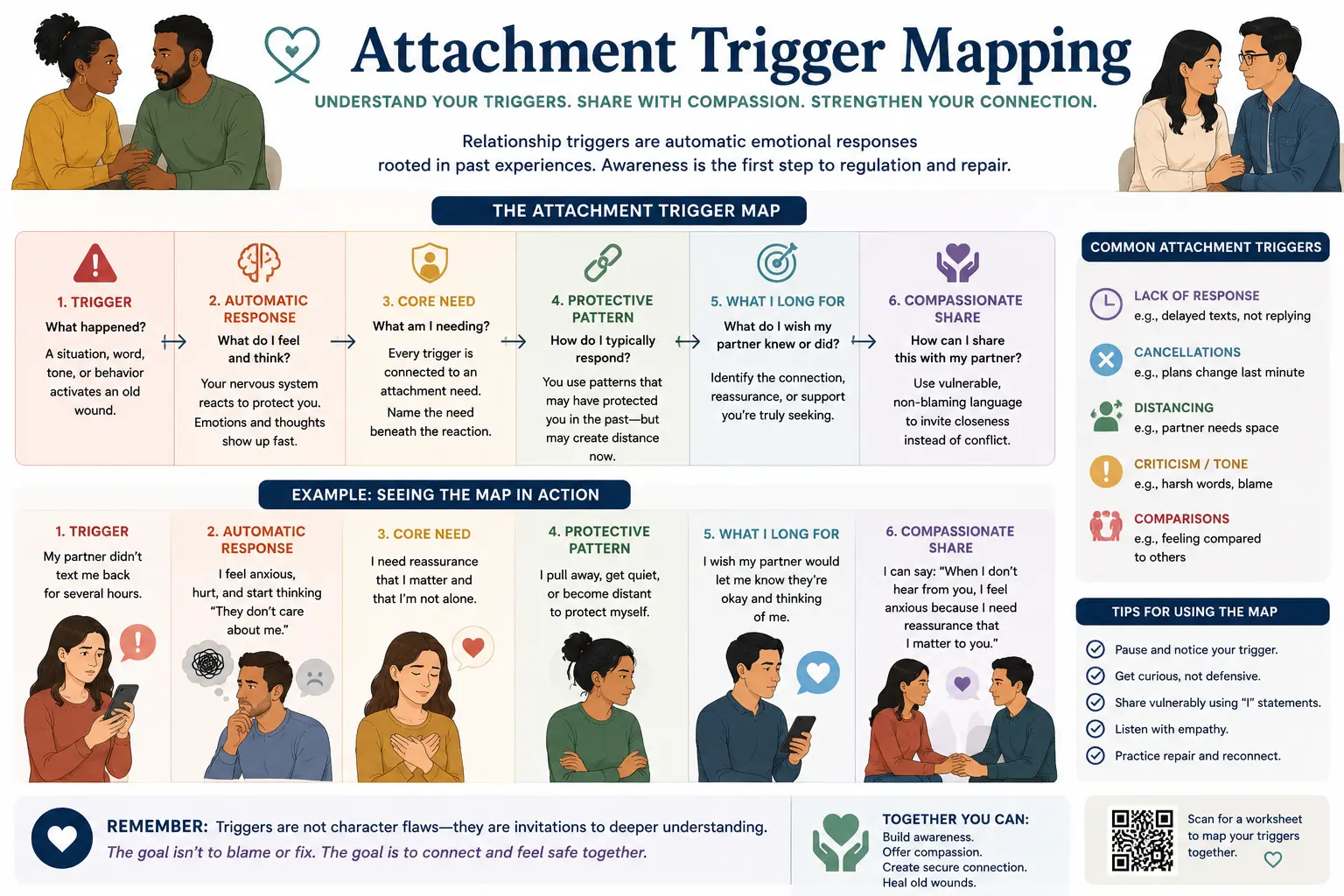
Most surface conflict in couples is driven by unmet attachment needs. Attachment Trigger Mapping helps couples look beneath surface conflict to identify the primary emotions (fear, shame, or grief) and unmet attachment needs driving reactive behavior. This couples therapy activity can help partners understand each other’s vulnerability more clearly and respond with greater empathy during difficult moments. Exercises that focus on attachment needs and emotional responsiveness are commonly used in emotionally focused couples therapy to help partners better understand underlying vulnerability.

Steps
  1. Introduce the difference between secondary emotions, such as anger or withdrawal, and primary emotions, such as fear, shame, grief, or longing.
  2. Choose a recent conflict and ask each partner: “What was the surface reaction you had?” and then, “What was underneath that?” to identify the trigger that started the emotional reaction.
  3. Map the sequence: trigger → secondary response → primary emotion → unmet need.
  4. Invite each partner to share their map while the other listens and reflects what they heard.
  5. Use the identified unmet needs to inform communication goals, repair strategies, and future treatment planning.
Processing Questions
  • What was it like to identify the emotion beneath your reaction?
  • How does your partner’s primary emotion feel different from their surface reaction?
  • What does your partner need when they are triggered, and what gets in the way of meeting that need?
Clinical Considerations

This exercise requires emotional regulation capacity and should not be introduced when dysregulation is high. Partners with trauma histories may need grounding support or somatic cues to access primary emotions safely. Use the completed trigger map to guide treatment planning and future repair work.

Attachment trigger mapping infographic showing how couples identify triggers, emotional reactions, unmet needs, and attachment patterns in therapy
Activity 12

CBT Thought–Feeling–Behavior Exercise

Goal Help couples identify assumptions, challenge unhelpful interpretations, and choose healthier responses during conflict.
Best For: Couples who make quick negative assumptions, misinterpret each other’s behavior, or repeat thought-driven conflict cycles

CBT-informed interventions help couples recognize that their interpretations of their partner’s behavior — not just the behavior itself — drive emotional and behavioral responses. The CBT Thought–Feeling–Behavior Exercise helps couples slow down the automatic interpretations that often drive conflict. By separating observable facts from thoughts, emotions, and behavioral responses, partners can recognize how assumptions shape reactions and create opportunities for more flexible communication.

Steps
  1. Choose a recent conflict and ask Partner A to describe only the observable facts of what happened.
  2. Ask Partner A to identify the thought or interpretation they had about what the situation meant.
  3. Have Partner A name the feeling that followed and the behavior or response that came next.
  4. Map this in a Thought–Feeling–Behavior sequence.
  5. Gently examine the interpretation by asking: “Is there another possible explanation?” or “What evidence supports or challenges that thought?”
  6. Repeat the sequence with Partner B, then discuss how recognizing the thought step can create space for a different response.
Processing Questions
  • Was it difficult to separate facts from interpretations?
  • What automatic thoughts showed up most quickly during the conflict?
  • What might you do differently if you noticed the thought before acting on it?
Clinical Considerations

This exercise works best with couples who have enough self-reflection capacity to examine thoughts without using the process to criticize each other. If either partner is highly concrete or alexithymic, simpler exercises may be more appropriate. Facilitate Partner B’s input carefully so the focus remains on perspective expansion, not proving one partner wrong. As homework, ask each partner to track one thought–feeling–behavior sequence during the week.

Couples Therapy Activities Couples Can Practice At Home

Therapy gains are consolidated between sessions. Clinicians can support generalization by assigning structured home practices. The following four activities translate well to independent use:

  • Structured weekly check-in (Activity 10): same day, same time, using the appreciations/concerns/requests format.
  • Daily appreciation exchange (Activity 9): one specific, behavioral appreciation per day.
  • "I Feel" statement practice (Activity 3): commit to using one "I Feel" statement per week when raising a concern.
  • Rehearse the time-out plan when calm (Activity 7): review and role-play the plan periodically — not only when conflict arises.

Remind couples that between-session practice is where skill development happens. In-session work lays the groundwork; home practice builds the neural pathways.

How to Document Couples Therapy Interventions and Progress Notes

Clear, structured documentation supports continuity of care, demonstrates clinical decision-making, and protects clinicians from liability. For couples therapy specifically, session notes should capture:

  • Presenting issue: the primary concern or conflict the couple brought to the session
  • Intervention used: the specific activity or technique introduced, and in what format (in-session demonstration, psychoeducation, practice)
  • Partner participation and affect: how each partner engaged with the exercise — their affect, level of participation, and any notable reactions
  • Homework assigned: the specific between-session activity, including any instructions or modifications
  • Progress toward treatment goals: how the session’s content relates to the couple’s overall treatment plan

Clinicians using EHR systems with structured note templates can streamline this documentation significantly. Behavioral health-specific platforms like ICANotes offer customizable note templates that allow clinicians to document couples session content consistently across providers and visits — reducing administrative burden while supporting compliance. Therapists using structured interventions should also understand how to bill for couples therapy appropriately to support accurate documentation and reimbursement.

Free ICANotes Trial

Simplify Couples Therapy Documentation with ICANotes

ICANotes helps couples therapists spend less time charting and more time focused on meaningful clinical work. Designed specifically for behavioral health professionals, ICANotes streamlines documentation with customizable templates, faster progress notes, treatment planning tools, and workflows built to support compliant, efficient couples therapy documentation.

Faster progress notes for couples counseling sessions
Behavioral health-specific templates designed for therapy documentation
Streamlined treatment planning, telehealth support, and billing workflows
Reduce administrative burden while improving clinical consistency and compliance

Start your free trial today and see why thousands of behavioral health clinicians trust ICANotes to support their practice.

Start Your Free Trial

No credit card required. Get started with ICANotes in minutes.

FAQ

Frequently Asked Questions About Couples Therapy Activities

Answers to common questions about couples therapy activities, communication exercises, conflict resolution, telehealth adaptations, and documentation.

+ What communication exercises work best for couples?

Some of the most effective communication exercises for couples are structured activities that slow conversations down and help each partner feel heard before reacting. Techniques such as the Speaker–Listener Technique, Mirroring, and “I Feel” statements are widely used in couples therapy because they reduce defensiveness, improve active listening, and increase emotional validation.

The best couples therapy exercises are typically those that match the couple’s level of emotional safety and communication capacity. High-conflict couples may benefit from clear turn-taking rules, while emotionally withdrawn couples may respond better to slower-paced validation and attachment-focused exercises.

+ What are effective conflict resolution exercises for couples?

Effective conflict resolution exercises for couples are structured interventions that help partners slow down reactivity, communicate more clearly, and repair emotional disconnection after disagreements. Exercises such as the Speaker–Listener Technique, Mirroring, and the Time-Out & Re-Engagement Plan can reduce escalation and create safer conversations.

The most successful conflict resolution activities focus on emotional regulation as much as communication skills. Over time, repeated use of these exercises can strengthen trust, improve problem-solving, and help couples navigate difficult conversations without escalating conflict.

+ What are the best couples therapy exercises for rebuilding trust?

The Trust Continuum, or Micro-Commitments exercise, is one of the most effective starting points for trust repair because it focuses on small, verifiable behaviors rather than abstract promises. The Daily Gratitude Exchange can also help create consistent positive interactions. For deeper trust injuries, Attachment Trigger Mapping may help each partner understand what trust means at the attachment level.

+ How do therapists prevent exercises from escalating conflict?

Prevention begins before the exercise starts: screen for window of tolerance, ensure emotional safety is established, and introduce grounding cues. During the exercise, maintain a calm, structured facilitation presence. If escalation begins, pause without judgment, use a brief co-regulation technique, and debrief what triggered the escalation.

+ Which couples counseling activities work best in telehealth sessions?

Most exercises in this guide translate well to telehealth with minor modifications. Muting the listening partner during uninterrupted listening can create structure. Shared screen or whiteboard tools can support Attachment Trigger Mapping and CBT exercises. Clinicians should also confirm that couples have a private space before beginning any in-session activity.

+ What if one partner shuts down during exercises?

Emotional shutdown, or stonewalling, is typically a dysregulation response rather than a refusal to engage. If this occurs mid-exercise, pause the activity, acknowledge what you observed without judgment, and shift to co-regulation first through paced breathing, grounding, or a brief check-in.

+ How do clinicians measure progress in couples therapy?

Progress in couples therapy is multidimensional. Validated instruments such as the Dyadic Adjustment Scale, Couples Satisfaction Index, or Gottman’s RCISS can provide structured measurement. Clinically, therapists can track conflict frequency and duration, use of repair attempts, emotional expression, and follow-through on between-session homework.

Helping Couples Build Healthier Communication Patterns

Healthy relationships are not built on the absence of conflict — they are built on the ability to navigate conflict with safety, repair, and emotional responsiveness. Structured couples therapy activities help partners move out of reactive communication cycles and into more intentional patterns of listening, validation, empathy, and accountability. Over time, these repeated interactions can strengthen trust, increase emotional security, and improve each partner’s capacity to stay connected during difficult conversations.

For clinicians, structured couples counseling activities also provide a practical framework for guiding sessions, assigning between-session homework, and tracking treatment progress over time. Whether you are helping couples rebuild trust after repeated conflict, strengthen emotional connection, or improve communication skills, evidence-informed couples therapy exercises can create meaningful opportunities for insight, regulation, and lasting behavioral change.

Consistent documentation remains an important part of effective couples therapy care. Behavioral health EHR platforms like ICANotes can help clinicians streamline couples therapy documentation with structured templates designed to support compliance, treatment planning, and continuity of care — allowing providers to spend less time charting and more time focused on the therapeutic relationship.

Dr. October Boyles

DNP, MSN, BSN, RN

About the Author

Dr. October Boyles is a behavioral health expert and clinical leader with extensive expertise in nursing, compliance, and healthcare operations. With a Doctor of Nursing Practice (DNP) and advanced degrees in nursing, she specializes in evidence-based practices, EHR optimization, and improving outcomes in behavioral health settings. Dr. Boyles is passionate about empowering clinicians with the tools and strategies needed to deliver high-quality, patient-centered care.