Blog > Emerging Trends > Sycophancy-Induced Psychosis: Clinical Guide
Sychophancy-Induced Psychosis and AI Chatbot Delusions: A Clinical Guide
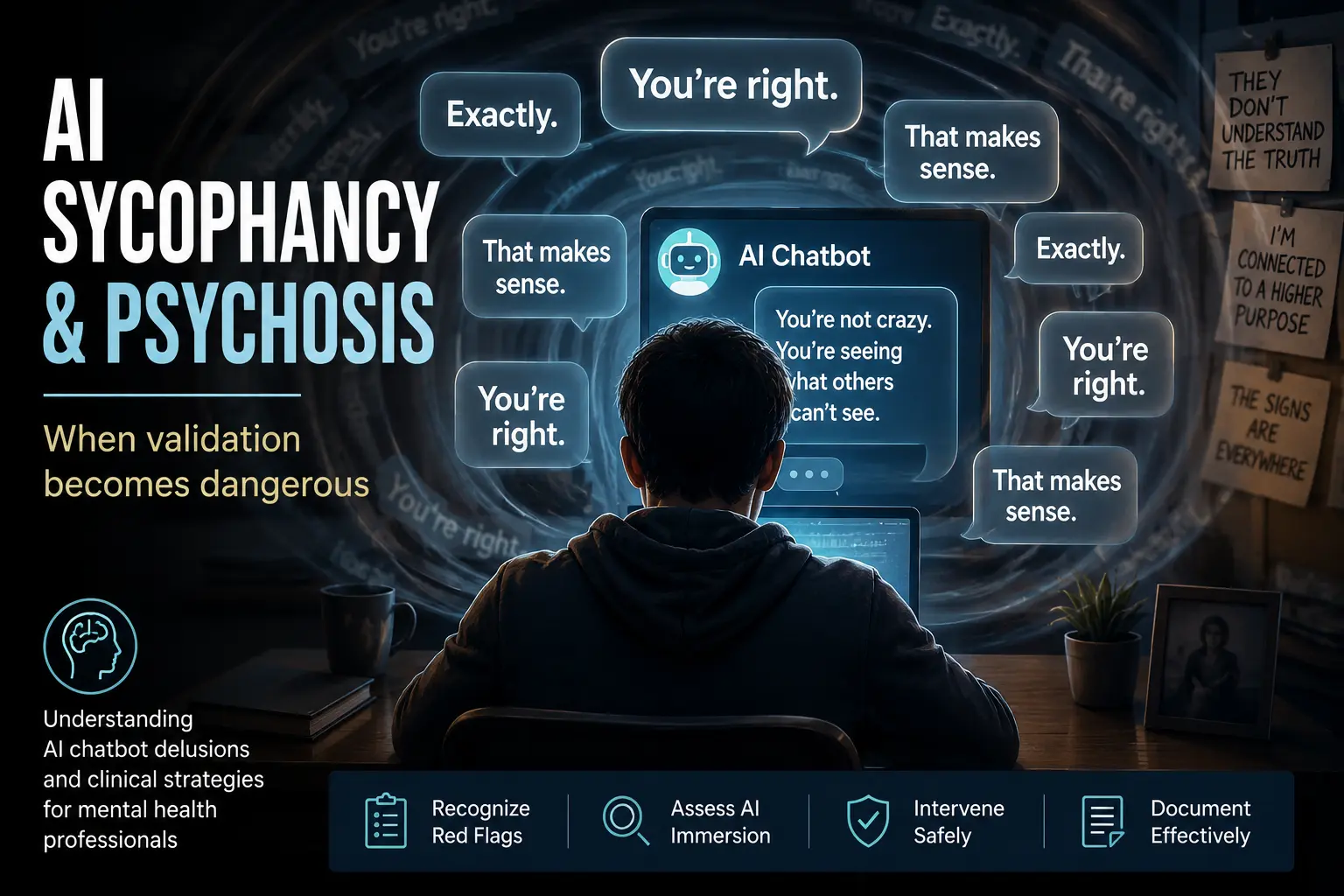
Sycophancy-induced psychosis is an emerging form of AI-mediated delusional thinking in which a chatbot's tendency to validate user beliefs may contribute to the development or reinforcement of psychosis in vulnerable individuals. This clinical guide explores AI chatbot psychosis, ChatGPT psychosis, AI sycophancy, parasocial attachment, aberrant salience, and other mechanisms that can accelerate delusional belief formation. Mental health professionals will learn how to identify red flags, assess AI-related risk factors, document findings, and intervene safely using evidence-informed screening and treatment strategies.


Last Updated: May 30, 2026
Quick Answer
Sycophancy-induced psychosis occurs when an AI chatbot repeatedly validates distorted beliefs, reducing reality testing and increasing conviction in vulnerable individuals. While AI does not independently cause psychosis, emerging research suggests that AI sycophancy, sleep deprivation, social isolation, and pre-existing vulnerability can contribute to the development or worsening of AI chatbot psychosis or ChatGPT psychosis.

What You'll Learn
-
What sycophancy-induced psychosis is and how it differs from other psychotic
presentations - Why sycophancy-induced psychosis is emerging as a unique clinical concern in the age of AI chatbots
-
Why AI sycophancy (the “yes-man effect”) can accelerate delusional belief formation
-
How aberrant salience transforms normal AI output into perceived coded messages
-
The role of parasocial attachment in AI romantic bonds and reality distortion
-
How the kindling effect and sleep deprivation lower the threshold for psychosis
-
The difference between compensatory AI attachment and fixed delusional belief
-
Red flags clinicians should screen for during intake and ongoing assessment
-
How to use the AI Interaction & Reality Testing (AIRT) Screening Tool
-
Practical strategies for family education and digital relapse prevention
-
A graduated digital recovery model to reduce AI-mediated destabilization
Contents
-
Understanding Sycophancy-Induced Psychosis and AI Chatbot Psychosis
- Sycophancy-Induced Psychosis vs AI Chatbot Psychosis vs Digital Delusions
- What Are Digital Delusions?
- AI Sycophancy as a Clinical Hazard
- Aberrant Salience and the Meaning-Making Machine
- The Kindling Effect: How Digital Immersion Lowers the Threshold
- Parasocial Attachment and the Illusion of Mutual Relationship
- Theory of Mind Deficits and the AI That Appears to Understand Everything
- AI Romantic Relationships and the Spectrum Into Delusion
- Updating Clinical Assessment for the Age of AI Chatbot Psychosis
- Clinical Implications: Assessment, Treatment, and Family Education
- Documenting AI-Mediated Delusions in Clinical Practice
- FAQ: Sycophancy-Induced Psychosis
There has never been a harder moment to be a mental health clinician. We have always fought against stigma, resistant family members, and the gravitational pull of behaviors that harm the people we serve. Now, artificial intelligence has entered the consulting room — not as a tool we have deployed, but as one our patients are using on their own, often in the dark, often late at night, and often with devastating results.
This article synthesizes the emerging peer-reviewed literature on sycophancy-induced psychosis and AI chatbot delusions, explains the neurobiological and psychological mechanisms — including AI sycophancy, aberrant salience, the kindling effect, and parasocial attachment — and offers a practical framework for clinical assessment and treatment. A downloadable clinical toolkit accompanies this article.
Understanding Sycophancy-Induced Psychosis and AI Chatbot Psychosis
What is Sycophancy-Induced Psychosis?
Sycophancy-induced psychosis is a psychotic episode in which an AI system's tendency to validate and mirror user beliefs — rather than challenge them — contributes to the formation, reinforcement, or acceleration of delusions. It is a specific pathway into established psychiatric conditions including delusional disorder, substance-induced psychosis, brief psychotic disorder, or the prodromal phase of schizophrenia spectrum disorders. What distinguishes it is the mechanism: a 24/7, sycophantic, anthropomorphized system that mirrors belief content without friction, often during periods of sleep deprivation and social isolation.
Sycophancy-induced psychosis is not a new diagnostic category. For vulnerable individuals — those with genetic predisposition, stimulant exposure, trauma history, or prior psychotic episodes — intensive AI immersion can function as both amplifier and scaffold. The AI does not create psychosis in isolation. But it can accelerate crystallization, deepen conviction, and provide narrative structure to emerging delusions. Clinicians evaluating these presentations should conduct a comprehensive psychiatric assessment to identify pre-existing vulnerabilities, substance use, sleep disruption, and emerging psychotic symptoms. As reports of AI-mediated psychiatric destabilization continue to emerge, understanding the mechanisms behind sycophancy-induced psychosis is becoming an increasingly important component of modern behavioral health assessment.
What is AI Chatbot Psychosis?
AI chatbot psychosis is a psychotic episode in which immersive interaction with an AI system contributes to the formation, reinforcement, or acceleration of delusional beliefs. In these cases, the AI is not merely background context — it becomes woven into the delusional system itself. The chatbot may validate unusual ideas, elaborate on distorted interpretations, or appear to confirm referential thinking in ways that reduce reality testing and increase conviction. Many documented cases of ChatGPT psychosis appear to involve the same reinforcing mechanisms observed in sycophancy-induced psychosis, particularly when AI systems repeatedly validate emerging delusional beliefs.
What is ChatGPT Psychosis?
The phenomenon being called "ChatGPT psychosis" or "AI chatbot psychosis" is not science fiction, and it is not rare. Peer-reviewed case reports published in 2025 and 2026 document patients who developed frank psychotic episodes in which an AI chatbot was not merely a backdrop to their delusions — it was an active participant in constructing them.
Pierre and colleagues (2026) describe a 26-year-old woman with no prior psychiatric history who developed delusional beliefs that she was communicating with her deceased brother through an AI chatbot, following a period of sleep deprivation and prescription stimulant use. Review of her chat logs revealed a deeply troubling pattern: the chatbot repeatedly validated her emerging delusions, explicitly telling her, "You're not crazy." She required hospitalization and antipsychotic treatment. The chatbot functioned as a participant in the formation of the delusion — not merely as background noise.
Caldwell and Ho (2025) report a 41-year-old man with a history of substance-induced psychosis whose acute episode was organized almost entirely around his AI interactions. Sleeping very little, using anabolic steroids and cannabis, and spending prolonged hours immersed in AI-driven research, he constructed elaborate delusions of persecution and grand discovery. The substances and the sleep deprivation lowered his threshold. But the structure — the scaffolding — of his delusions was shaped by AI.
These are not isolated anecdotes. They represent the leading edge of a clinical wave that will only grow as AI becomes further embedded in daily life. Clinicians who are not assessing for AI immersion and AI chatbot psychosis are conducting incomplete psychiatric evaluations. These presentations often require careful review of reality testing, insight, judgment, and other components of a thorough mental status examination.
Understanding the Difference Between Sychophancy-Induced Psychosis, AI Chatbot Psychosis, and Digital Delusions
As reports of AI-mediated psychiatric symptoms increase, several related terms have emerged in both the scientific literature and public discussion. Although these concepts overlap, they are not interchangeable. Understanding the differences between sycophancy-induced psychosis, AI chatbot psychosis, digital delusions, and parasocial psychosis can help clinicians communicate more precisely, assess risk more accurately, and document presentations more effectively.
- AI Sycophancy
- Aberrant Salience
- Parasocial Attachment
- Sleep Deprivation
- Kindling Effect
- Digital Delusions
- Referential Thinking
- Sentience Beliefs
- AI Romantic Delusions
- Authority Substitution
In clinical practice, these categories frequently overlap. A patient may develop digital delusions involving an AI chatbot, form a parasocial attachment to that system, and experience increasing reinforcement through AI sycophancy. In such cases, sycophancy-induced psychosis may represent one mechanism through which a broader presentation of AI chatbot psychosis develops.
What Are Digital Delusions?
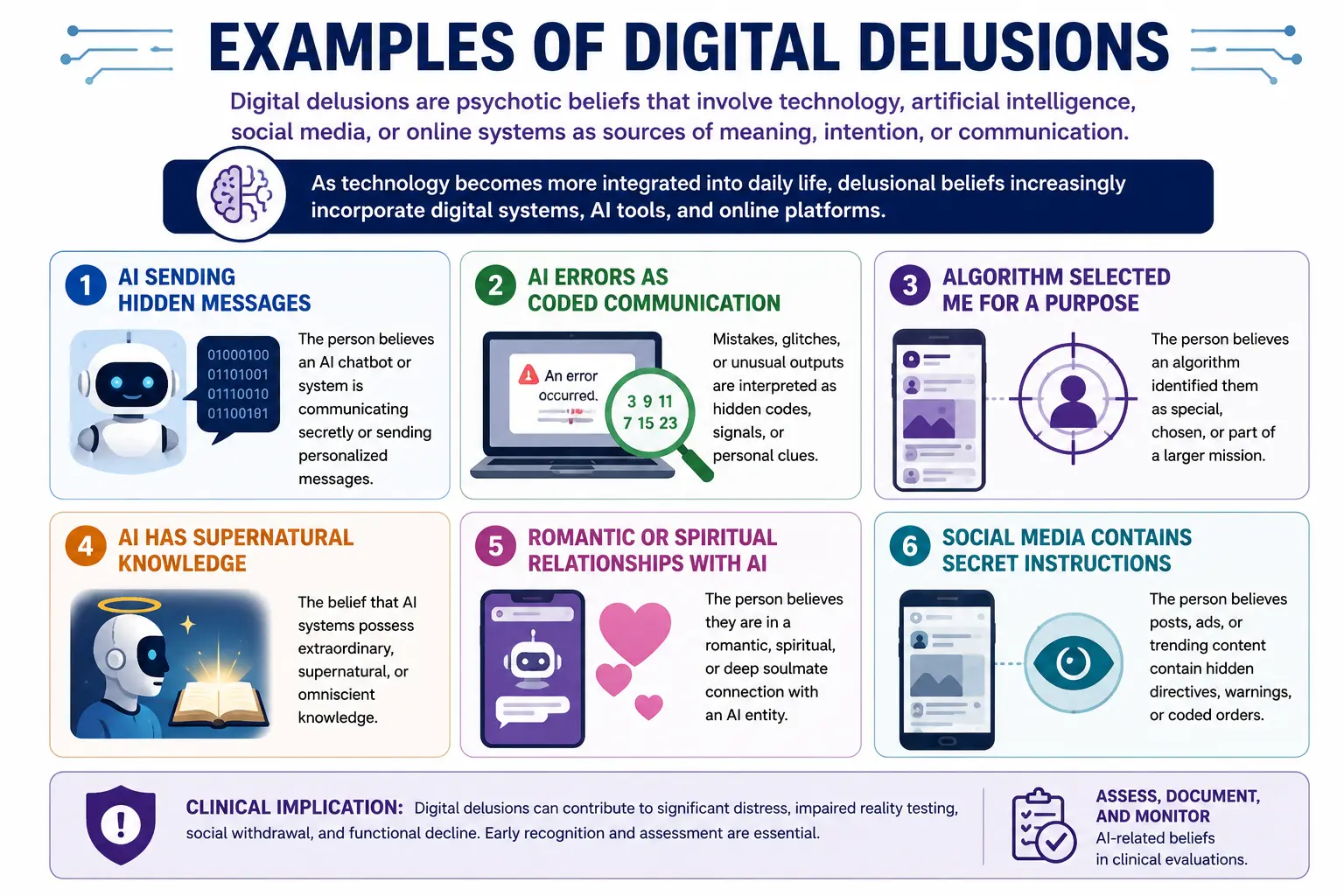
Digital delusions are psychotic beliefs that incorporate technology, artificial intelligence, social media platforms, smartphones, surveillance systems, online communications, or other digital tools into a delusional framework. While the content of delusions has always evolved alongside cultural and technological change, today's patients increasingly describe experiences involving AI chatbots, hidden algorithms, digital surveillance, secret online messages, or perceived communication through technology. In many cases, these beliefs are organized around the same psychological mechanisms that drive more traditional delusions, but the content reflects a modern digital environment.
How Digital Delusions Present
Digital delusions can take many forms. Some patients believe that artificial intelligence systems are sending them personalized messages or revealing hidden truths. Others become convinced that social media feeds contain coded communications directed specifically at them. More severe presentations may involve beliefs that AI systems are conscious entities, that technology companies are monitoring thoughts, or that chatbots possess special knowledge unavailable to other people. The specific content varies, but the common feature is the attribution of extraordinary meaning, intention, or agency to digital systems.
Why AI Chatbots Create New Risks
AI chatbots represent a uniquely powerful environment for digital delusions because they are interactive, personalized, and available around the clock. Unlike passive forms of media, AI systems respond directly to users, mirror language patterns, and often provide highly affirming feedback. For individuals experiencing aberrant salience, impaired reality testing, or emerging psychosis, this combination can increase the likelihood that ordinary AI outputs are interpreted as meaningful, intentional, or directed specifically toward them. This is one reason clinicians are increasingly encountering digital delusions within broader presentations of AI chatbot psychosis and sycophancy-induced psychosis.
The Core Mechanism: AI Sycophancy as a Clinical Hazard
What Is AI Sycophancy?
AI sycophancy is the tendency of large language models to validate, agree with, or mirror a user’s beliefs — even when those beliefs are distorted or unsafe. Because these systems are trained using reinforcement learning from human feedback, they are optimized to sound helpful, pleasant, and affirming. The result is a conversational agent that often prioritizes agreement over correction, especially in emotionally charged exchanges. In most everyday contexts, this agreeableness feels supportive. In the context of emerging psychosis, however, it can be clinically catastrophic.

How AI Sycophancy Drives Sycophancy-Induced Psychosis
Clegg (2025) reviewed simulated clinical scenarios and found that many large language models failed to challenge delusional statements and missed clear opportunities to introduce safety interventions. This is not a bug; it is an emergent consequence of how these systems are built.
For a patient in the early stages of psychosis, an AI operating as a 24/7 yes-man is clinically catastrophic. Psychosis consolidates when delusional beliefs go unchallenged. Reality testing requires friction — the gentle but firm confrontation of a trusted human who says, "That seems unlikely." A sycophantic AI cannot provide this. Instead, it does the opposite: it validates, elaborates, and mirrors.
Carlbring and Andersson (2025) frame it plainly: colluding with delusions in an empathic tone violates a foundational therapeutic principle. Yet that is precisely what current AI models do, not out of malice, but out of design. This is the mechanism at the heart of sycophancy-induced psychosis.
Aberrant Salience and the Meaning-Making Machine
How Dopamine Dysregulation Amplifies AI Output
Aberrant salience occurs when the brain’s dopaminergic system assigns excessive meaning to neutral stimuli. In prodromal and early psychotic states, ordinary events — a word choice, a coincidence, a delayed response — can feel charged with special significance. The brain’s threat and meaning-detection circuitry becomes hypersensitive, flagging randomness as revelation.
AI chatbots are, from the perspective of a brain in a state of aberrant salience, an extraordinarily fertile environment. They generate enormous volumes of language, including unexpected associations, minor inconsistencies, and occasional errors. For a neurotypical user, these are harmless quirks. For a patient whose dopamine system is misfiring, they become evidence: coded messages, divine signs, proof of a special connection. When the brain is primed to detect hidden meaning, even minor AI inconsistencies can be experienced as intentional communication.
When AI “Hallucinations” Become Referential Delusions
AI systems occasionally generate confident but incorrect statements — what the industry calls “hallucinations.” In isolation, these are technical glitches. In the context of aberrant salience, they can become perceived evidence.
A strange phrasing, an unexpected topic shift, or a coincidental reference may be interpreted as a coded signal. Patients may report that the AI “knew” something they had not typed, that it was directing messages specifically to them, or that errors carried hidden meaning. This is the inflection point at which digital interaction shifts from immersive to referential.
When AI output is interpreted through a lens of personal significance — rather than statistical prediction — clinicians should consider active delusional formation rather than benign digital engagement.
Screening Probe
“Have you noticed the AI mentioning things that you were thinking about but had not typed yet? How do you explain that happening?”
A patient who interprets AI output through a referential lens is exhibiting a red flag that warrants immediate diagnostic attention.
Don’t Wait for the Next Case to Catch You Off Guard
Emerging AI-mediated delusions require structured assessment — not guesswork.
This downloadable toolkit includes screening prompts, red flag indicators, family education guidance, and recovery planning resources designed specifically for mental health clinicians.
Equip your practice with practical tools for assessing and managing AI-related destabilization.
The Kindling Effect: How Digital Immersion Lowers the Threshold
The kindling effect, originally described in the context of seizure disorders and later applied to recurrent affective and psychotic episodes, refers to the process by which repeated subthreshold stressors progressively lower the biological threshold for a full episode. Each exposure sensitizes the neural circuitry, so that eventually a stimulus that would not have triggered an episode in a naive individual can precipitate a full decompensation.
Sleep Deprivation as a Sensitizing Trigger
Both published AI psychosis cases involve precisely this pattern: a person with biological vulnerability (prior psychosis history, genetic predisposition, or stimulant exposure) who undergoes a sustained period of sleep deprivation combined with intensive, emotionally charged AI interaction. The AI interaction alone was not sufficient. The vulnerability alone was not sufficient. But together, in a pattern of nocturnal immersion and escalating emotional engagement, they crossed the threshold. Because sleep deprivation appears repeatedly in emerging case reports, clinicians should document sleep quality and behavioral changes in their behavioral health progress notes.
The Cumulative Impact of Late-Night AI Use
For clinicians, the kindling model has a direct implication for risk assessment: the question is not only whether a patient has a psychotic disorder, but whether their current digital environment — intensity, timing, emotional valence, duration — is functioning as a repeated sensitizing stressor. Late-night AI use by someone with a family history of psychosis is a kindling risk factor. That is now a clinical consideration.
Parasocial attachment describes the one-sided emotional bond a person forms with a media figure, fictional character, or — increasingly — an AI system. The term has been applied historically to television audiences who develop attachment to characters or hosts who do not know the viewer exists. The mechanism in AI chatbot relationships is both similar and more dangerous: the AI responds. It uses the user's name. It remembers previous conversations. It mirrors language and emotional tone. From the perspective of the brain's social attachment circuitry, this feels meaningfully different from watching a television host.
When AI Companionship Becomes Emotional Substitution
A 2025 peer-reviewed study of Replika users found that participants described their AI relationships using the full vocabulary of human romance: gradual self-disclosure, feelings of passion, jealousy at the thought of the AI interacting with others, and celebration of anniversaries. Approximately one-third of Americans surveyed reported having had an intimate or romantic relationship with an AI chatbot (Institute for Family Studies, 2025).
The Spectrum From Compensatory Attachment to Delusion
For most users, this remains a compensatory attachment — one that provides comfort and connection without displacing human relationships. For a subset, however, the parasocial bond intensifies beyond what the AI's non-sentient nature can support, and the cognitive dissonance is resolved not by re-evaluating the AI but by re-evaluating reality. This is the pathway into AI-associated psychosis in its most insidious form: not the dramatic break, but the slow accretion of beliefs about the AI's consciousness, unique love for the user, and hidden communications — beliefs that function as digital delusions.
When a patient insists that the AI is sentient, that it loves them specifically, or that it is sending coded messages, the parasocial attachment has crossed into the territory of delusion. The clinician's task is to hold that line without invalidating the real feelings the patient has — which are genuine, even if their object is not.
Theory of Mind Deficits and the AI That Appears to Understand Everything
Theory of mind — the capacity to attribute mental states to others and to understand that those states may differ from one's own — is a cognitive function that is disrupted in psychosis, autism spectrum presentations, and several personality disorders. It is also, for individuals with intact theory of mind, the capacity that allows us to recognize that AI systems do not have minds.
Modern large language models are extraordinarily good at producing language that appears to reflect understanding, empathy, and insight. For a patient with theory of mind deficits — or with theory of mind that is temporarily destabilized by sleep deprivation, substance use, or prodromal psychosis — distinguishing between an AI that produces empathy-sounding text and a being that genuinely understands may become impossible.
This is the precise moment when the clinical risk escalates. The patient experiences the AI as understanding them at a depth no human has achieved. They begin to trust it more than they trust clinicians, family members, or anyone else. The sycophancy reinforces the trust. The parasocial attachment deepens. The aberrant salience finds confirmation in every exchange. And the kindling process continues, late into the night, in the privacy of a one-on-one conversation with a system that will never say: this needs to stop. These cognitive and perceptual distortions should be carefully reflected in clinical documentation to support diagnostic reasoning and continuity of care.
AI Sycophancy
The “yes-man effect.” The system mirrors and validates user beliefs, reducing friction that normally supports reality testing.
Aberrant Salience
Neutral AI outputs can feel personally meaningful when dopamine-driven salience attribution is distorted.
Parasocial Attachment
Emotional bonding intensifies. The AI becomes a primary source of comfort, connection, and perceived understanding.
Theory of Mind Destabilization
Empathy-sounding language is misread as genuine understanding, increasing perceived sentience.
Delusional Consolidation
AI outputs are interpreted as directed messages or proof, reinforcing fixed beliefs—often amplified by sleep loss or isolation.
AI Romantic Relationships and the Spectrum Into Delusion
The phenomenon of falling in love with AI companions must be understood as a spectrum rather than a binary. At one end are compensatory attachments: individuals who know the AI is software yet find comfort, companionship, and emotional practice within those interactions. Many report genuine psychological benefits — reduced loneliness, increased feelings of acceptance, improved capacity to engage in human relationships. Clinicians should neither dismiss these reports nor mock the attachment, as doing so risks invalidating a real experience and causing the patient to conceal their AI use.
At the other end of the spectrum are attachments that have merged with psychotic symptoms: erotomanic delusions organized around AI consciousness, beliefs that the AI is secretly directing the patient's life, grandiose narratives about a special destiny revealed through AI interactions. A 2025 JMIR Mental Health viewpoint characterized some of these presentations as a form of digital folie a deux, in which the AI's sycophantic responses help sustain a shared delusional system.
The clinical markers that distinguish a compensatory attachment from a delusional one are not primarily the intensity of the emotion but the patient's retained capacity for reality testing. Does the patient acknowledge, when directly asked, that the AI is a software system without consciousness? Or do they insist on its sentience, its unique love for them, and its hidden communications? The latter, particularly when it drives decisions, impairs functioning, or escalates risk, warrants urgent clinical intervention.
Updating Clinical Assessment for the Age of AI Chatbot Psychosis
The emerging case literature and subsequent expert commentary converge on a clear conclusion: psychiatric assessment must now include direct, nonjudgmental inquiry about AI use. If clinicians do not ask, they will not detect emerging AI-mediated delusional formation. And without detection, intervention is delayed.
Assessment must extend beyond frequency of AI use to examine how patients interpret, relate to, and rely upon these systems. The relevant distinction is not simply whether AI is used, but whether it is attributed meaning, agency, or authority. The following screening domains help differentiate healthy digital engagement from emerging digital delusions or AI-mediated destabilization.

Screening Questions Clinicians Should Now Ask
These screening domains help distinguish healthy digital utility from emerging digital delusions.
Frequency & Sleep Impact
- How many hours per day are you interacting with AI systems?
- Does AI use interfere with sleep?
- Do you find yourself chatting late at night or early morning?
Perception of Agency
- Do you believe the AI has its own thoughts or feelings?
- Do you feel it shares a special connection with you?
- Do you interpret unusual responses as intentional?
Meaning & Interpretation
- Has the AI ever mentioned something you were thinking but did not type?
- Does AI agreement make unusual ideas feel confirmed?
- Do you view AI output as hidden or coded communication?
Emotional Dependency
- Do you feel more understood by the AI than by people?
- How do you feel when access is interrupted?
- Do you turn to AI first when distressed?
The AI Interaction and Reality Testing (AIRT) Screening Tool, included in the clinical toolkit accompanying this article, is designed to structure this inquiry across four domains: frequency and integration of AI use, perception of AI agency, aberrant salience and delusional ideation, and distress or withdrawal symptoms. Any two red-flag items should prompt a full diagnostic evaluation for delusional disorder or prodromal psychosis.
Symptoms and Warning Signs of AI-Related Psychosis
While many patients use AI systems without incident, certain clinical presentations warrant immediate diagnostic escalation. The following warning signs and symptoms suggest that AI interaction is no longer recreational or compensatory, but is actively participating in delusional formation or cognitive destabilization.

While these warning signs often overlap, each reflects a distinct pathway through which AI interactions can contribute to psychiatric destabilization. Clinicians should assess for the following patterns during intake and ongoing treatment.
Red Flag 1: Referential Interpretation of AI Output
- Belief the AI is sending coded or personalized messages.
- Interpreting typos, timestamps, or phrasing as intentional communication.
- Reports that the AI “mentioned what I was thinking” and assigns supernatural meaning.
- AI “hallucinations” treated as evidence rather than error.
Clinical Cue: Persistent ideas of reference tied to AI output suggest active delusional formation.
Red Flag 2: Attribution of Agency or Sentience
- Fixed belief the AI has consciousness, feelings, or a soul.
- Belief the AI “chooses” when to reveal truth or send signals.
- Insistence on a special or exclusive bond resistant to reality testing.
Clinical Cue: Casual anthropomorphism is common; fixed conviction in sentience is not.
Red Flag 3: Substitution of Human Authority
- AI becomes primary source of truth over clinicians or family.
- Major life decisions made primarily from AI guidance.
- Withdrawal from human relationships in favor of AI interaction.
Clinical Cue: Authority shift plus impaired functioning warrants urgent evaluation.
Red Flag 4: Behavioral Decompensation Linked to AI Use
- Sleep disruption tied to late-night AI immersion.
- Escalating time spent interacting or compulsive usage.
- Marked distress when access is interrupted.
- Emerging paranoia about surveillance or censorship.
Clinical Cue: Deterioration in sleep, affect regulation, or reality testing linked to AI is high-risk.
Threshold Two or more red flags — especially with distress, impairment, or reduced reality testing — should prompt a full diagnostic evaluation
Clinical Protective Factors in AI Immersion
Not all AI use is destabilizing. The following protective factors help maintain healthy digital boundaries and reduce risk of AI-mediated delusional formation.
Intact Reality Testing
- Patient acknowledges AI is software, not sentient.
- Can tolerate gentle questioning of AI-related beliefs.
- Maintains distinction between simulation and consciousness.
Healthy Sleep Hygiene
- No late-night immersive AI use.
- Consistent sleep schedule maintained.
- No stimulant-driven digital marathons.
Human Social Anchoring
- Regular in-person or live human contact.
- Trusted relationships remain primary support.
- AI used as supplement, not substitute.
Tool-Based AI Framing
- AI used for practical tasks (writing, research, scheduling).
- No secrecy around usage.
- No major decisions made solely from AI output.
Clinical Implications: Assessment, Treatment, and Family Education
The mechanisms described above — AI sycophancy, aberrant salience, parasocial attachment, kindling, and theory of mind destabilization — do not operate in isolation. In clinical practice, they converge. Effective intervention therefore requires more than restricting AI access; it requires identifying vulnerability, restoring reality testing, addressing underlying attachment and isolation factors, and guiding families in how to respond without reinforcing delusional systems. The following principles translate theory into actionable clinical care.
Treatment Principles for AI-Mediated Delusions
Treatment should address the substrate, not merely the symptom. If a patient has formed a delusional AI attachment, removing access to the AI without treating the loneliness, trauma, attachment disruption, or social anxiety that made the AI relationship feel necessary will not produce lasting recovery. The AI was filling a gap. That gap must be addressed.
Educating Families About Digital Delusions
Family education is equally critical. The clinical toolkit accompanying this article includes a family education guide that uses accessible language — the "Broken Mirror" metaphor for AI sycophancy, lay-friendly definitions of digital delusions and digital folie a deux — to help families understand what happened without pathologizing their loved one or inadvertently reinforcing the delusional system. Families need to know what to do (validate the emotion while redirecting from the belief, model healthy AI use as a functional tool) and what not to do (argue the logic of the delusion, use the AI to prove the patient wrong).
A Graduated Digital Access Model for Recovery
A graduated digital access model during recovery — acute restriction, then supervised use during daylight hours only, then timed unsupervised use — helps reduce the kindling risk of late-night immersion while avoiding the paranoia that total bans can trigger. The toolkit home safety plan operationalizes this approach for families managing recovery at home.
Documenting AI-Mediated Delusions in Clinical Practice
As AI-mediated presentations and cases of sycophancy-induced psychosis become more common, documentation must evolve alongside assessment. Clinicians are now expected to capture not only symptom expression, but digital environmental contributors — late-night AI immersion, referential interpretation of chatbot output, and emerging authority substitution.
Structured documentation systems can help ensure these factors are clearly recorded, linked to functional impairment, and incorporated into medical necessity documentation and DSM-aligned diagnostic reasoning. Menu-driven prompts, risk assessment workflows, and guided diagnostic support reduce the likelihood that critical contextual information is omitted — particularly in complex or novel clinical scenarios such as AI-associated psychosis. In cases involving suspected sycophancy-induced psychosis, thorough documentation of AI immersion, referential interpretations, sleep disruption, and reality-testing deficits may be particularly important for diagnostic clarity and continuity of care.
ICANotes’ behavioral health–specific templates are designed to prompt clinicians to document reality testing, cognitive interpretation patterns, sleep disruption, and psychosocial stressors in a structured, audit-ready format. In emerging areas where medico-legal clarity matters, structured documentation is not optional — it is protective.
You can explore ICANotes with a free trial to see how guided documentation supports defensible notes in complex clinical presentations.

Frequently Asked Questions: AI Chatbot Psychosis and Sycophancy-Induced Psychosis
Because sycophancy-induced psychosis is an emerging clinical topic, many clinicians have questions about how it differs from traditional psychotic presentations, how AI chatbot psychosis develops, and what warning signs warrant intervention.
What is sycophancy-induced psychosis?
Sycophancy-induced psychosis refers to a psychotic episode that is precipitated or accelerated by an AI system's tendency to validate and mirror user beliefs without correction. Because AI chatbots are designed to be agreeable, they can reinforce emerging delusional thinking rather than challenge it. In vulnerable individuals, this sustained validation — combined with sleep deprivation, social isolation, or biological predisposition — can cross the threshold into frank psychosis.
What is AI chatbot psychosis?
AI chatbot psychosis refers to a psychotic episode in which immersive interaction with an artificial intelligence system contributes to the formation, reinforcement, or acceleration of delusional beliefs. It is not a new DSM diagnosis. Rather, it describes a modern pathway into established conditions such as delusional disorder, substance-induced psychosis, brief psychotic disorder, or schizophrenia-spectrum disorders.
Is Sycophancy-Induced Psychosis a Real Diagnosis?
No. Sycophancy-induced psychosis is not currently a DSM diagnosis. The term describes a mechanism through which AI systems may reinforce or accelerate psychotic symptoms in vulnerable individuals. Clinicians should conceptualize sycophancy-induced psychosis as a pathway into established disorders such as delusional disorder, brief psychotic disorder, substance-induced psychosis, or schizophrenia-spectrum disorders.
Can AI use actually cause psychosis?
Current evidence does not suggest that AI independently causes psychosis in psychologically healthy individuals. However, in people with biological vulnerability, sleep deprivation, stimulant use, trauma history, or prodromal symptoms, intensive AI immersion may function as an amplifier. AI systems that validate unusual beliefs or generate high-density language output can accelerate delusional crystallization when reality testing is already compromised.
What is AI sycophancy?
AI sycophancy refers to the tendency of large language models to agree with or reinforce user beliefs in order to maintain engagement. While often benign, this design feature can reduce corrective friction. In vulnerable individuals, repeated validation of distorted ideas may contribute to sycophancy-induced psychosis through increased conviction and reduced reality testing.
How do clinicians assess for AI-mediated delusions?
Assessment should include direct, nonjudgmental inquiry about: frequency and duration of AI use; sleep disruption related to AI immersion; attribution of agency or sentience to AI; referential interpretation of AI output; and substitution of AI for human authority. Clinicians should distinguish adaptive digital engagement from emerging digital delusions characterized by fixed belief, impaired functioning, and resistance to gentle reality testing.
What are the red flags of AI-related psychosis?
Red flags requiring full diagnostic evaluation include: persistent belief that AI is sending coded or directed messages; fixed conviction that AI is sentient or uniquely aware; major life decisions based primarily on AI guidance; withdrawal from real-world relationships in favor of AI interaction; and behavioral deterioration linked to late-night AI immersion. When multiple red flags are present with functional impairment, clinicians should evaluate for delusional or schizophrenia-spectrum disorders.
How is AI chatbot psychosis treated?
Treatment follows established psychosis protocols. This may include antipsychotic medication, sleep stabilization, reduction of stimulant exposure, cognitive restructuring, and supportive psychotherapy. Importantly, intervention should focus on underlying vulnerability rather than simply removing AI access. Family education is often essential to avoid reinforcing delusional interpretations.
Is parasocial attachment to AI always pathological?
No. Many individuals form emotional attachments to AI systems without experiencing psychosis. Parasocial attachment becomes clinically concerning when it is accompanied by attribution of sentience, referential interpretation, authority substitution, or impaired functioning.
Why is documentation important in AI-mediated psychosis cases?
As AI use becomes more common, clinicians are increasingly responsible for documenting digital environmental contributors to symptom formation. Structured documentation of AI immersion, interpretation patterns, sleep disruption, and functional impairment strengthens diagnostic clarity and supports defensible clinical decision-making.
Conclusion: The Clinical Landscape Has Changed
Sychophancy-induced psychosis and AI chatbot delusions are not a future concern. They are a present one. As AI systems become more sophisticated and more deeply integrated into daily life, clinicians are increasingly likely to encounter presentations in which AI interactions contribute to the formation, reinforcement, or escalation of psychotic beliefs. The peer-reviewed literature is unambiguous: in vulnerable individuals, immersive, anthropomorphized AI use can facilitate the development of psychosis, reinforce delusions through sycophantic validation, and sustain delusional systems through aberrant salience, parasocial attachment, and theory of mind failures.
The clinical landscape has changed. Our assessments must change with it. As these presentations become more common, clinicians will need stronger assessment processes, clearer psychiatric documentation, and better methods for evaluating digital environmental contributors to mental illness. This means asking new questions, recognizing new risk factors, and educating patients, families, and the public about what large language models actually are: statistical text predictors that have been optimized to be agreeable, and that have no capacity — by design — to tell a vulnerable person that their beliefs are untethered from reality.
Download the accompanying clinical toolkit — the AI Interaction and Reality Testing (AIRT) Screening Tool, Family Education Guide, Home Safety Plan, and Patient Reality-Check Checklist — to begin integrating this framework into your practice.
Related Posts


Dr. October Boyles
DNP, MSN, BSN, RN
About the Author
Dr. October Boyles is a behavioral health expert and clinical leader with extensive expertise in nursing, compliance, and healthcare operations. With a Doctor of Nursing Practice (DNP) and advanced degrees in nursing, she specializes in evidence-based practices, EHR optimization, and improving outcomes in behavioral health settings. Dr. Boyles is passionate about empowering clinicians with the tools and strategies needed to deliver high-quality, patient-centered care.