Blog > Treatment Strategies > Family Therapy Interventions + Examples
Family Therapy Interventions: Techniques and Examples for Clinicians
Family therapy interventions are structured techniques that help clinicians improve communication, reduce conflict, and shift unhealthy interaction patterns within family systems. This guide explores evidence-based family therapy techniques, practical family intervention examples, and strategies for selecting the right approach based on presenting patterns and treatment goals. You’ll learn how to apply interventions such as circular questioning, structural mapping, reframing, and boundary setting — and how to document family therapy interventions effectively in behavioral health practice.


Last Updated: February 20, 2026


What You'll Learn
- What family therapy interventions are and how they shift interaction patterns within the family system
- The most effective family therapy techniques for improving communication, reducing conflict, and clarifying roles
- Practical family intervention examples you can apply in parent–adolescent, blended family, and high-conflict cases
- How to choose the right intervention based on systemic patterns, developmental stage, and treatment goals
- Strategies for managing resistance, escalation, and confidentiality challenges in family sessions
- How to document family therapy interventions clearly and defensibly in your behavioral health EHR
Contents
- What Is Family Therapy?
- What Can Family Therapy Interventions Address?
- Core Principles Behind Family Therapy Interventions
- Key Family Therapy Interventions Used in Practice
- Family Intervention Examples in Clinical Practice
- Choosing the Right Family Therapy Intervention
- Managing Challenges in Family Therapy
- Supporting Family Therapy Workflows with ICANotes
- FAQ: Family Therapy Interventions
Family therapy interventions are structured techniques used to improve communication, reduce conflict, and strengthen relationships within a family system. Clinicians use these approaches to address interaction patterns rather than focusing only on individual symptoms.
This guide explains the most common family therapy interventions, when to use them, and how they work in practice. You will find clear family intervention examples and practical tips to help you apply these techniques confidently and document progress more effectively across family sessions.
What Is Family Therapy?
Family therapy is a form of psychotherapy that treats the family system as the primary focus of care. Rather than working only with individual symptoms, family therapy examines how relationships, roles, communication styles, and emotional responses influence distress and behavior.
In family therapy, problems are understood as emerging within patterns of interaction. Sessions focus on helping family members recognize these patterns, understand their role within them, and practice new ways of responding that support healthier functioning.
What Can Family Therapy Interventions Address?
Family therapy interventions address a wide range of relational, behavioral, and emotional concerns by improving communication, reducing conflict, and strengthening relationships within the family system. These interventions focus on interaction patterns that contribute to ongoing distress.
Common areas addressed by family therapy interventions include:
Communication and Conflict
Improving communication, reducing repeated conflict, managing emotional escalation, and supporting clearer, more respectful interactions.
Behavioral and Mental Health Concerns
Supporting families managing behavioral challenges in children and adolescents, as well as mental health conditions such as anxiety, depression, substance misuse, and serious mental illness, where family systems often play a central role in the development and maintenance of symptoms.
Family Transitions and Structure
Helping families adapt to major changes such as separation or divorce, blended family adjustments, bereavement, relocation, and shifts in roles and boundaries.
Systemic and Relational Issues
Addressing issues such as chronic illness, trauma, unclear boundaries, and entrenched relational patterns to strengthen the family’s ability to cope with stress.
Across these areas, family therapy interventions are designed to shift interaction patterns and support healthier family functioning over time.
Core Principles Behind Family Therapy Interventions
Most family therapy interventions are grounded in a small set of shared principles, regardless of the specific model used. These principles shape how clinicians assess family dynamics, identify intervention targets, and support sustainable change.
Systems Thinking
Family therapy views families as interconnected systems in which each person’s behaviour, emotions, and responses influence others. A change in one part of the system can shift the entire family dynamic, which is why interventions often focus on relationships rather than individuals alone, a principle rooted in systems thinking in family therapy. Visualizing family system dynamics helps clinicians identify feedback loops and recurring interaction patterns that maintain distress.
Patterns Over Blame
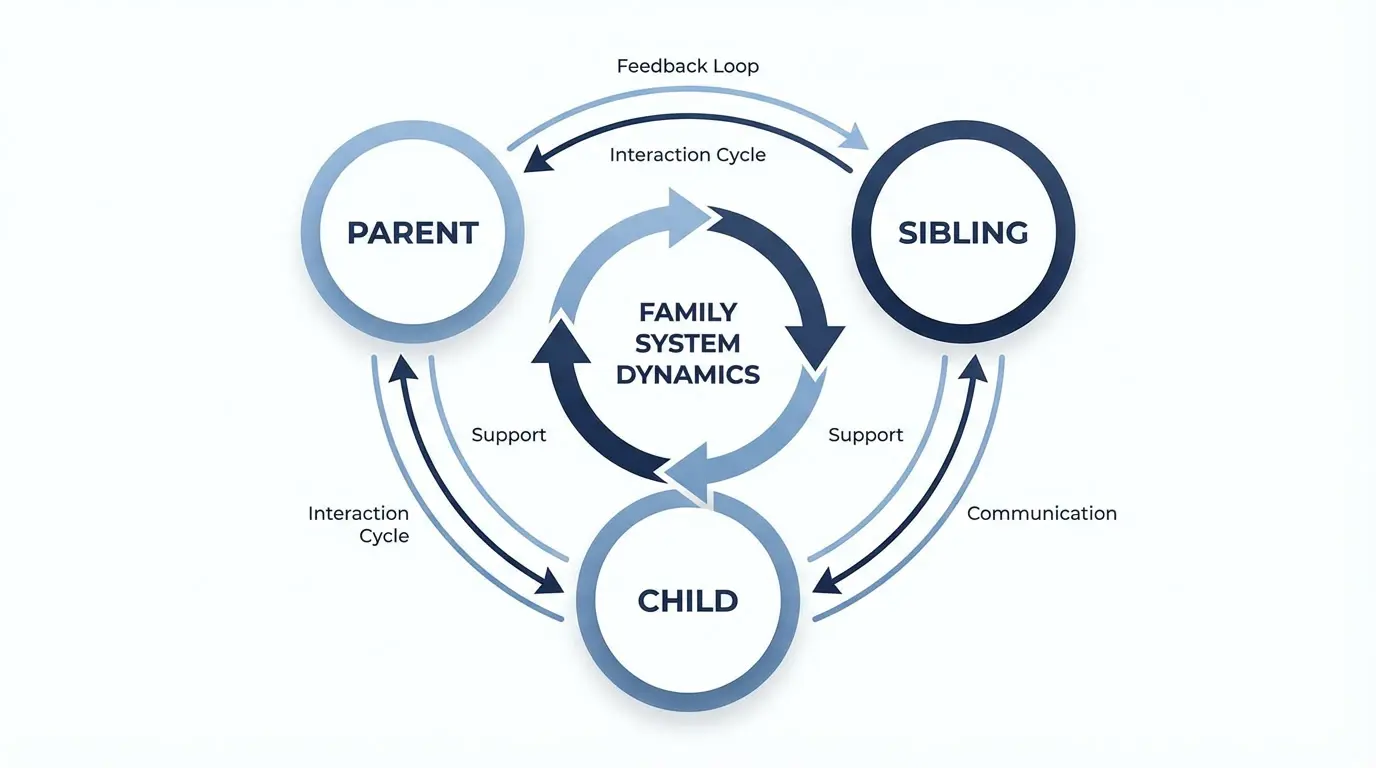
Rather than assigning responsibility to one family member, family therapy interventions focus on repeated interaction cycles that keep problems in place. By identifying these patterns, clinicians help families move away from blame and toward shared responsibility for change.
Roles, Boundaries, and Hierarchies
Family functioning is shaped by how roles are defined, boundaries are maintained, and authority is exercised within the system. When roles are unclear or boundaries are weak or rigid, families often experience conflict, anxiety, or power struggles. Interventions aim to clarify expectations and support healthier role organization.
Emotional Regulation Within Relationships
Strong emotions often drive conflict and escalation in family systems. Family therapy interventions support families in recognizing emotional triggers, slowing reactive responses, and responding to one another more intentionally. Improving emotional regulation within relationships is essential for reducing conflict and supporting long-term change.
Together, these principles guide clinicians in understanding family difficulties and selecting interventions that target the underlying interaction patterns that maintain distress.
Make Family Therapy Documentation Easier
Family sessions are complex — and documentation errors are common.
We created a practical toolkit with worksheets, genogram templates, and sample progress note language to help you document family therapy interventions with clarity and confidence.
Key Family Therapy Interventions Used in Practice
Family therapy interventions are typically introduced in stages, beginning with assessment and pattern identification, followed by interventions that restructure interaction patterns and support change over time. Clinicians often combine approaches based on family needs, readiness, and risk.
In practice, these approaches are typically recorded using structured therapy documentation that captures interaction patterns, clinician observations, and family responses over time.
Assessment and Pattern-Mapping Interventions
Assessment-focused interventions help families and clinicians identify the interaction patterns that contribute to distress. These techniques create a shared understanding of how problems develop and persist within the family system.
Genograms and Pattern Mapping
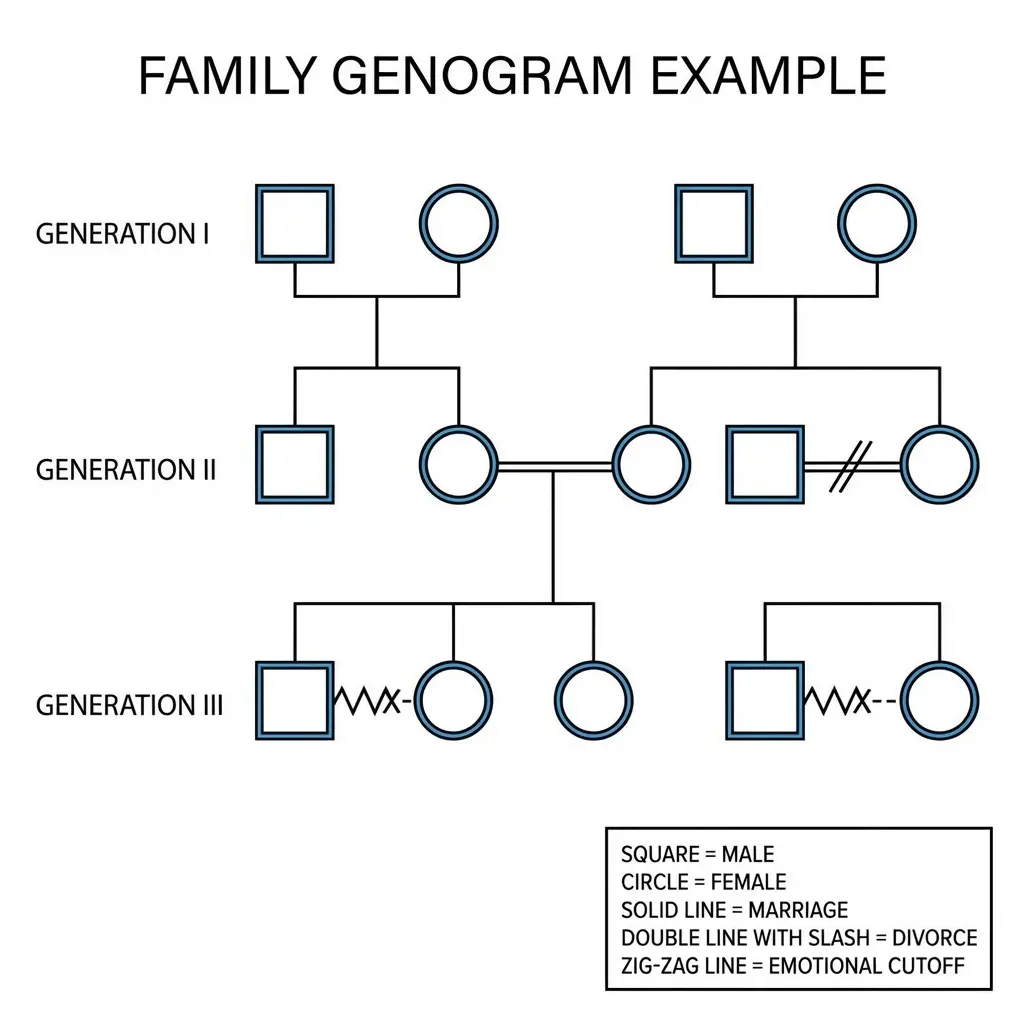
Genograms are visual tools used to map intergenerational relationships, roles, and recurring patterns such as conflict styles and emotional cutoffs, and they form part of a broader systemic family assessment framework that helps clinicians understand family functioning and plan strengths-oriented interventions. Genograms visually map intergenerational patterns that often influence present-day family dynamics.
Circular Questions
Circular questioning helps family members understand how each person’s behavior and emotional responses affect others within the system. These questions shift attention away from individual fault and toward interaction cycles, supporting perspective-taking and shared responsibility.
Examples include:
- “When one person withdraws, what usually happens next?”
- “Who tends to intervene when conflict escalates, and how does that affect the outcome?”
Interventions That Restructure Interaction Patterns
These interventions focus on changing how families interact in real time. They are especially useful when insight is present, but behavior has not yet shifted.
Structural Mapping and Enactments
Structural mapping and enactments allow therapists to observe family roles, hierarchies, and boundaries as they occur during sessions. Family members are guided to act out typical interactions while the therapist coaches more functional responses and patterns.
Boundary Setting and Role Clarification
Boundary interventions help reduce enmeshment, triangulation, and role confusion within families. They are particularly effective when children are drawn into adult conflict, one member feels responsible for others’ emotions, or parental authority is unclear. Clarifying adult versus child responsibilities often improves emotional safety and stability.
These dynamics are commonly seen when children assume emotional or practical responsibilities beyond their developmental role, a pattern associated with parentification and long-term relational strain.
Unbalancing
Unbalancing is a structural technique in which the therapist temporarily disrupts rigid family roles or power dynamics. By shifting emphasis within the system, this intervention creates space for underused strengths and new interaction patterns to emerge.
Communication and Emotional Regulation Interventions
Communication and emotional regulation interventions help families reduce escalation, improve understanding, and practice healthier ways of expressing needs and responding to conflict.
Communication Skills Training
Communication skills training focuses on observable, practiced behaviors such as active listening, reflecting back, using “I” statements, making clear requests, and repairing after conflict. Teaching one skill at a time and practicing it in session improves carryover into daily interactions, particularly in family and couple therapy sessions where pacing, structure, and repair attempts shape outcomes.
Conflict Resolution and Active Listening
These interventions support families in managing disagreements more constructively. Family members learn how to express concerns clearly, listen with empathy, and respond without defensiveness, which helps reduce tension and repeated conflict.
Role-Playing and Empty Chair Techniques
Role-playing and empty chair techniques provide a structured way to practice new communication strategies and express emotions safely. These exercises support perspective-taking and allow families to rehearse healthier responses before applying them outside of sessions.
Meaning-Making and Perspective-Shifting Interventions
These interventions help families change how they understand behaviors, conflict, and emotional responses. Shifting meaning often reduces blame and supports collaboration.
Reframing
Reframing helps families view behaviors or conflicts through a more constructive and compassionate lens. By changing how situations are interpreted, reframing reduces shame and defensiveness while encouraging problem-solving.
Externalizing the Problem
Externalizing techniques separate the problem from the person. For example, conflict may be framed as a response to anxiety or stress rather than intentional defiance, which supports emotional regulation and shared responsibility for change.
Family Sculpting
Family sculpting is an experiential exercise in which one member physically arranges others to represent their perception of family relationships. This intervention can increase insight into emotional distance, alliances, and power dynamics within the family.
Supporting Change Between Sessions
Between-session interventions help families practice new skills and reinforce progress outside therapy.
Psychoeducation
Psychoeducation helps family members understand mental health conditions, relational patterns, and treatment goals. By creating shared understanding, it reduces confusion and blame while improving engagement and follow-through.
Behavioral Contracts and Between-Session Practice
Structured homework and behavioral contracts support change between sessions by setting clear expectations and responsibilities. Examples include co-parenting communication rules, daily routines, repair plans after conflict, and shared problem-solving tasks. These tools are most effective when they are realistic, specific, and reviewed regularly.
When assigning between-session practice, choose one micro-skill (e.g., a 20-second pause + one reflective statement) and have the family track only whether they tried it—not whether it went perfectly.
Family Intervention Examples in Clinical Practice
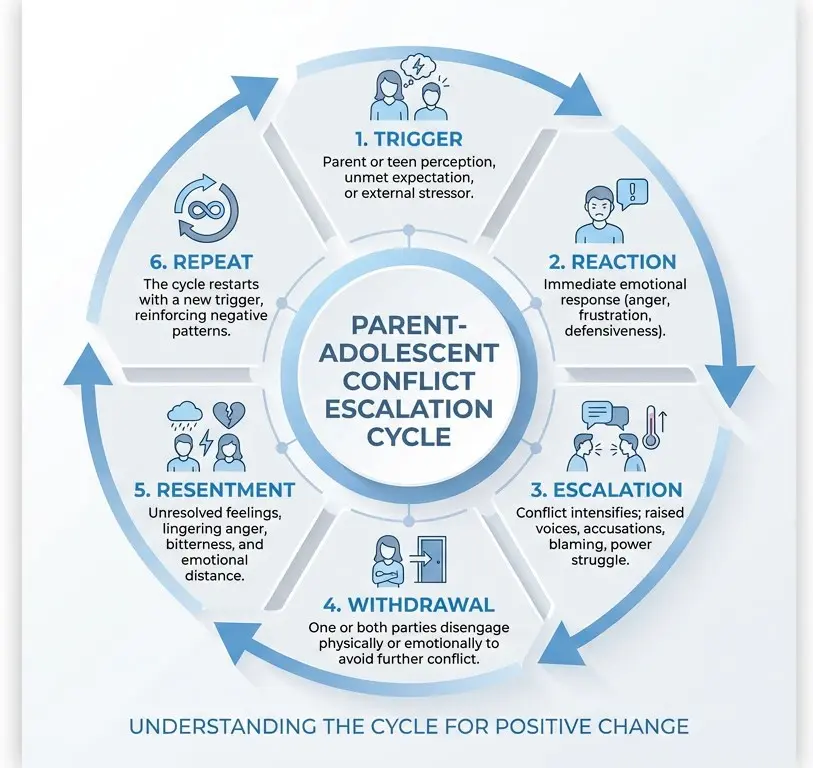
The family reports frequent arguments between a parent and adolescent that escalate quickly. Disagreements often move from a specific issue to raised voices, emotional withdrawal, or threats of consequences, followed by lingering resentment and minimal repair.
Circular questioning is used to help family members identify the escalation cycle and recognize how each person’s reactions contribute to the conflict. Communication skills training focuses on slowing interactions, using clear requests, and reflecting back before responding. Repair routines are introduced to support reconnection after disagreements.
In session, the therapist maps the escalation pattern step by step and coaches brief communication practice. Between sessions, the family practices pausing arguments and using a short repair script to reconnect after conflict.
Arguments become shorter and less intense, expectations are clearer, and family members recover emotionally more quickly after disagreements.
The escalation pattern below illustrates how quickly parent–adolescent conflict can move from a minor trigger to entrenched resentment when the cycle goes unaddressed.
A blended family experiences ongoing tension between a child, stepparent, and biological parent. Discipline and decision-making are inconsistent, leading to power struggles, divided loyalties, and triangulation during conflict.
Boundary clarification is used to define adult and child roles more clearly. Enactments allow the family to practice new interaction patterns in session. Reframing helps the family understand the child’s behavior as a response to loyalty conflicts rather than defiance.
The therapist guides parents through enactments that strengthen adult alignment and clarify expectations. Language is reframed to reduce blame and support empathy for the child’s adjustment process.
Adults respond more consistently, triangulation decreases, and the child shows reduced reactivity and increased trust in family structure.
Choosing the Right Family Therapy Intervention
Choosing the right family therapy intervention starts with understanding the family’s primary needs and the interaction patterns contributing to distress. Effective interventions focus on improving relationship dynamics within the family system rather than addressing one individual in isolation.
Key factors to consider include:
Assess the Family’s Needs
Identify whether the main challenge involves communication breakdowns, recurring conflict, parenting difficulties, behavioral concerns, trauma, or adjustment to major life changes. Clear treatment goals help guide intervention selection.
Use a Systemic Perspective
Family therapy interventions work best when the family is treated as a unit. Behaviors seen as individual problems are often maintained by relational patterns that require systemic intervention.
Match the Approach to the Pattern
Different models support different needs. Systemic approaches focus on relationships and communication, strategic approaches target recurring behavioral patterns, and structural approaches address roles, hierarchies, and boundaries. Functional Family Therapy or Multisystemic Therapy are commonly used for significant behavioral issues in adolescents.
In couple and attachment-based presentations, interventions grounded in emotional responsiveness and de-escalation are often indicated when disconnection rather than behavior is the primary driver of distress.
Consider Developmental Context and Expertise
Intervention should reflect the age of family members, clinical complexity, and the therapist's area of expertise. Engagement and commitment by all participants are essential for effective change.

Key Takeaway
Behaviors seen as individual problems are often maintained by relational patterns that require systemic intervention.
Managing Challenges in Family Therapy
Family therapy often involves complex dynamics, strong emotions, and differing levels of motivation. Managing these challenges effectively helps keep sessions productive and supports progress over time.
Resistance and Ambivalence
Some family members may feel unsure about therapy or reluctant to participate. Acknowledge concerns early, clarify the purpose of sessions, and focus on small, achievable goals that demonstrate value without increasing pressure.
High-Conflict Sessions
When conflict escalates quickly, structure becomes essential. Setting clear ground rules, slowing the pace of interaction, and redirecting conversations toward patterns rather than positions can reduce emotional intensity and restore focus.
Balancing Individual and Family Needs
Family therapy requires attending to individual experiences while maintaining a systemic focus. Clearly define confidentiality boundaries and treatment goals so that individual concerns are respected within the context of shared family objectives. This complexity is often compounded by the need to manage family therapy scheduling across parents, children, and caregivers.
Maintaining Therapeutic Boundaries
Strong emotions and alliance shifts can challenge neutrality. Maintaining clear boundaries, consistent structure, and a pattern-focused approach helps preserve safety and therapeutic effectiveness.
Addressing these challenges proactively allows family therapy interventions to remain focused on meaningful change rather than repeated conflict.
In family therapy notes, avoid “he said/she said” transcripts. Capture the interaction pattern you observed, the intervention you used, and what changed (even slightly) during or after the intervention.
Supporting Family Therapy Workflows with ICANotes
Documenting family therapy sessions requires capturing multiple perspectives, interaction patterns, and shared goals. Without the right tools, this can become time-consuming and inconsistent.
ICANotes is a behavioral health EHR designed to support clear, efficient, and compliant family therapy documentation. Key features include:
- Structured templates for family and group therapy sessions
- Menu-driven charting that reduces typing and improves consistency
- Clear documentation of interventions, responses, and shared goals
- Support for multiple participants in a single session
- Built-in tools that help support medical necessity
- Integrated scheduling, billing, and telehealth.
With ICANotes, clinicians spend less time documenting and more time focused on care.
Ready to streamline family therapy notes?
Start a free trial or book a demo to see how ICANotes simplifies documentation.

Start Your 30-Day Free Trial
Experience the most intuitive, clinically robust EHR designed for behavioral health professionals, built to streamline documentation, improve compliance, and enhance patient care.
- Complete Notes in Minutes - Purpose-built for behavioral health charting
- Always Audit-Ready – Structured documentation that meets payer requirements
- Keep Your Schedule Full – Automated reminders reduce costly no-shows
- Engage Clients Seamlessly – Secure portal for forms, messages, and payments
- HIPAA-Compliant Telehealth built into your workflow


Frequently Asked Questions: Family Therapy Interventions
Related Posts





Donald Morrison
MSW, LCSW
About the Author
Donald Morrison graduated from UNC Charlotte in 2004. He has since worked as a school-based therapist, inpatient social work supervisor and outpatient clinician. Donald currently works in private practice, and he is also an adjunct faculty member at the UNC Charlotte School of Social Work. In addition, Donald serves as a clinical supervisor to LCSW associates, and he regularly presents at area mental health conferences and seminars.