
Blog > Treatment Strategies > Spousification, Parentification & Surrogate Spouse Syndrome: Childhood Role Reversal Explained
Spousification vs Parentification: Key Differences, Symptoms, and Clinical Impact
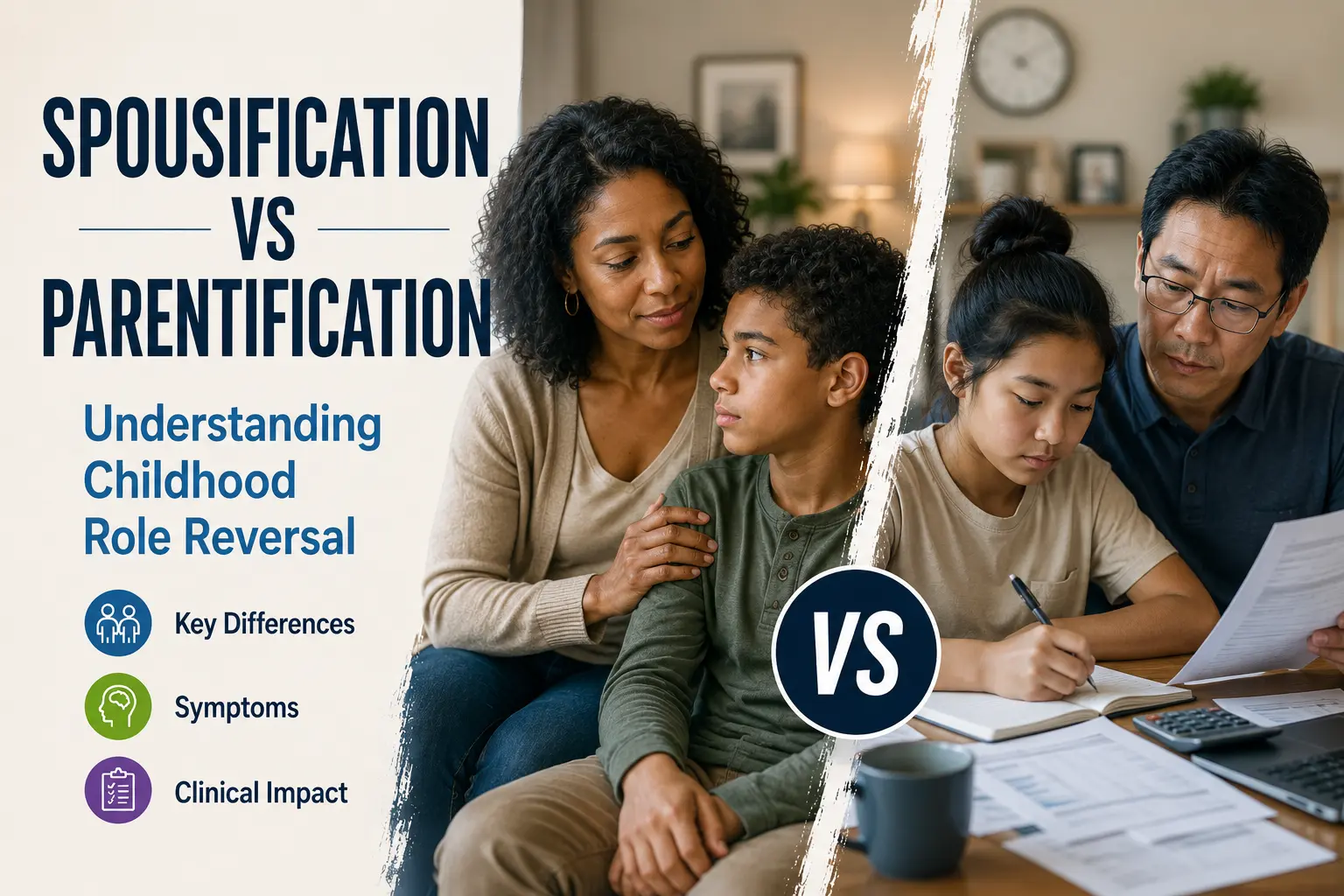
Spousification and parentification are forms of childhood role reversal that can have lasting effects on attachment, self-worth, boundaries, and adult relationships. While parentification involves a child taking on caregiving or emotional responsibilities typically handled by adults, spousification occurs when a parent relies on a child to meet emotional needs that would normally be fulfilled by an adult partner — a dynamic sometimes referred to as surrogate spouse syndrome. This article explores the differences between spousification and parentification, including emotional parentification, their psychological consequences, and evidence-based clinical strategies that support healing and recovery.


Last Updated: June 8, 2026

What You'll Learn
- The key differences between parentification, spousification, and surrogate spouse syndrome
- How childhood role reversal develops and affects emotional, relational, and identity formation
- The difference between emotional parentification and instrumental parentification, with real-world examples
- Common parentification symptoms and signs of spousification in children and adults
- How parentification trauma, emotional parentification, and covert incest can influence adult attachment patterns
- How family systems theory and evidence-based therapies guide assessment, boundary repair, and recovery
Contents
- What is Parentification?
- What is Emotional Parentification? Definition and Examples
- Parentification vs Spousification: Key Differences
- Spousification and Covert Incest: Understanding the Overlap
- Why Parentification and Spousification Develop
- Parentification and Spousification Symptoms
- Clinical Considerations for Treatment
- Treatment Goals: Boundary Restoration
- FAQs: Parentification vs Spousification in Childhood and Adulthood
- How ICANotes Supports Documentation for Spousification and Parentification Treatment
- Conclusion: Understanding Spousification and Parentification in Childhood Role Reversal
What is Spousification?
Spousification occurs when a parent treats a child as a surrogate spouse or romantic partner. This dynamic dissolves healthy boundaries as the child fulfills emotional needs typically met by an adult partner. Sometimes referred to as “spouse-focused parentification” or “surrogate spouse syndrome,” spousification involves parents who rely on their children for emotional validation, companionship, or comfort during stress or loneliness.
Mother-son spousification occurs more frequently than father-daughter spousification [5]. It often emerges after divorce, separation, or emotional withdrawal in a marriage, when a parent unconsciously turns to their child for support and intimacy [2].
Surrogate Spouse Syndrome: When Spousification Becomes a Pattern
Surrogate spouse syndrome describes a persistent relational pattern in which a parent consistently relies on a child to fulfill the emotional, social, and companionship functions typically provided by an adult partner. Unlike isolated instances of role confusion, surrogate spouse syndrome reflects an entrenched dynamic — one in which the child has been systematically positioned as the parent’s primary emotional support over months or years.
The syndrome most commonly emerges in the aftermath of divorce, separation, or within emotionally distanced marriages. A parent experiencing loneliness or unmet intimacy needs may unconsciously turn to their child as a confidant, companion, or source of validation. In some presentations, the child accompanies the parent to adult social events, is confided in about romantic problems, or is expected to manage the parent’s emotional states on an ongoing basis.
Clinically, surrogate spouse syndrome sits within the broader category of spousification but is distinguished by its chronicity and the degree to which the child’s identity becomes organized around the parental relationship. Clients who experienced this pattern often present with significant difficulty forming peer relationships and tend to describe their childhood primarily in terms of their parent’s emotional needs rather than their own.
What is Parentification?
Parentification represents a broader form of role reversal between parent and child. It occurs when children take on developmentally inappropriate responsibilities that exceed their emotional or cognitive capacity [2]. There are two types:
- Instrumental parentification: children manage practical tasks such as cooking, cleaning, managing finances, or caring for siblings [9].
- Emotional parentification: children tend to the psychological and emotional needs of family members, which may include becoming a parent’s confidant, elevating silblings’ self-esteem, or promoting family harmony [2].
Healthy responsibility can build confidence, but parentification becomes harmful when it replaces normal caregiving and emotional nurturing from the parent.
Instrumental Parentification
Instrumental parentification occurs when a child assumes practical responsibilities that would typically be handled by a parent or other adult caregiver. These responsibilities may include cooking meals, cleaning the home, managing household finances, caring for younger siblings, arranging transportation, or assisting with medical needs. While age-appropriate chores can foster responsibility and independence, instrumental parentification becomes problematic when a child's caregiving duties are excessive, chronic, or essential to the family's daily functioning.
Children who experience instrumental parentification often become highly self-sufficient and competent at an early age. However, the pressure to meet adult expectations can interfere with normal developmental tasks, including socialization, play, emotional expression, and identity formation. Many parentified children learn to prioritize the needs of others over their own, a pattern that can persist into adulthood.
Instrumental parentification differs from emotional parentification in that the child is primarily responsible for physical or logistical caregiving rather than managing a parent's emotional wellbeing. Although both forms of parentification can have lasting psychological effects, emotional parentification is generally associated with greater disruption to attachment and relational development.
What is Emotional Parentification? Definition and Examples
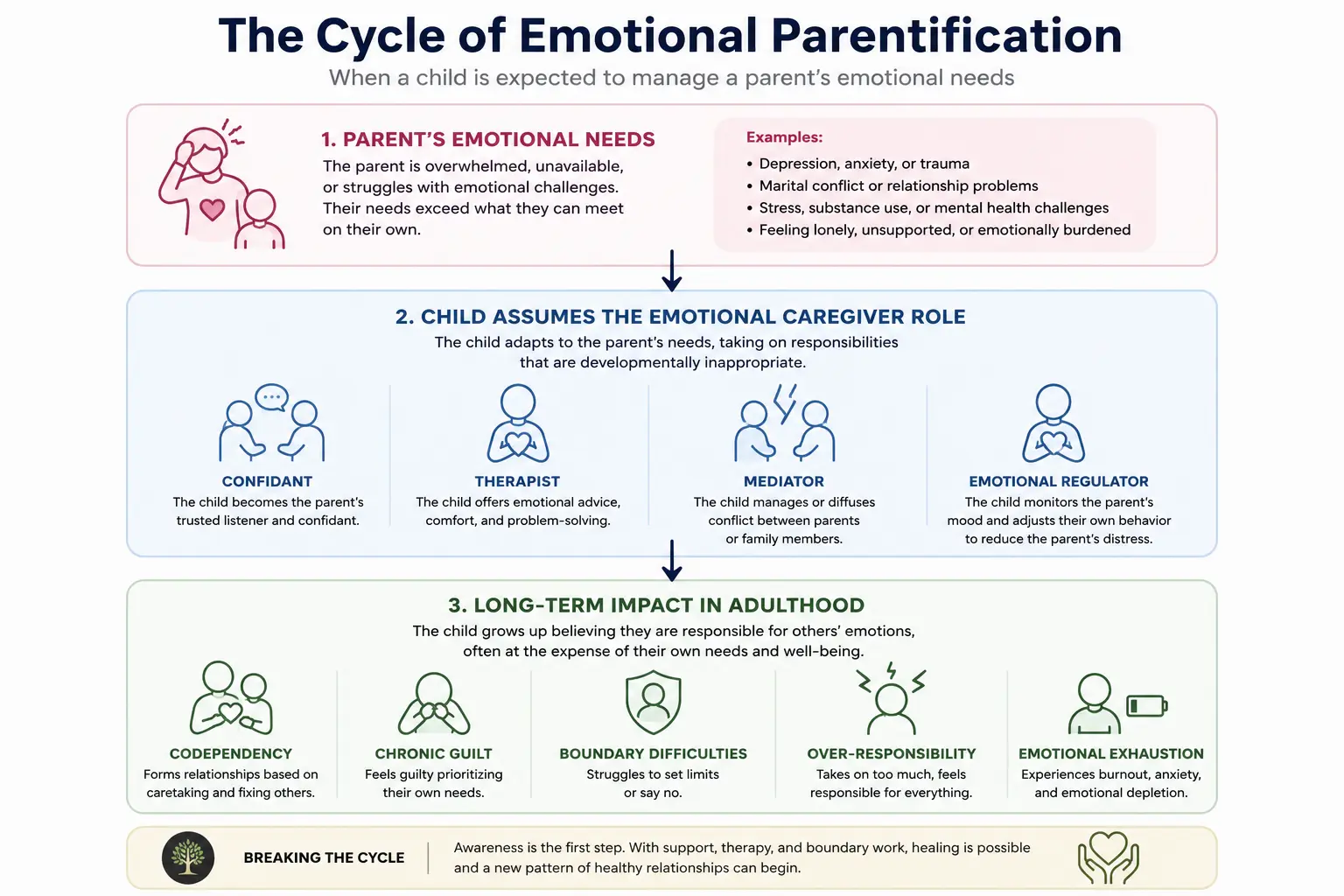
Emotional parentification occurs when a child is repeatedly called upon to manage, regulate, or support the emotional and psychological needs of a parent or other family member. Unlike instrumental parentification — which involves taking on physical tasks like cooking or coordinating childcare — emotional parentification places the child in the role of therapist, confidant, or emotional regulator for the adult. This dynamic is particularly harmful to development because it directly disrupts the parent-child attachment relationship, replacing appropriate caregiving with emotional dependency. Emotional parentification correlates strongly with attachment disruption [13], anxiety, and depression — especially when children are expected to manage a parent’s psychological distress [14].
Clinical Examples of Emotional Parentification
Emotional parentification can be difficult to identify because the behaviors often look like closeness or maturity. In clinical practice, watch for clients who describe childhood experiences like these:
- A parent routinely shares the details of their romantic conflicts, financial worries, or mental health struggles with their child — seeking comfort or advice rather than providing it
- A child learns to monitor a parent’s mood and adjusts their own behavior accordingly: staying quiet when the parent is anxious, performing cheerfulness to prevent the parent’s sadness, or stepping in to mediate parental conflict
- A parent relies on a child for daily emotional check-ins and becomes distressed or withdrawn when the child is unavailable or emotionally focused elsewhere
- A child consistently suppresses their own distress, grief, or anger because expressing it would overwhelm or destabilize the parent
- A parent describes their child as their “best friend” or “the one who really understands me” — framing the child as an emotional peer
Emotional Parentification and Codependency
Adults who experienced emotional parentification frequently present with codependent patterns in their adult relationships. Having internalized the belief that their value lies in their capacity to regulate others’ emotions, they often find it difficult to identify and express their own needs. Codependency in this context is not a character flaw — it is a learned survival strategy shaped by early relational demands. Attachment-focused therapy and cognitive restructuring can help clients recognize this pattern and begin building relationships based on mutual need rather than one-directional caretaking.
Parentification vs Spousification: Key Differences
Although parentification and spousification are both forms of childhood role reversal, they differ in the roles children are expected to fulfill and the needs they are expected to meet. In both dynamics, the child takes on responsibilities that exceed their developmental capacity. However, the nature of those responsibilities can vary significantly.
The primary distinction lies in who the child is serving and how the role manifests. Parentification is a broader concept that occurs when a child assumes caregiving responsibilities for parents, siblings, or the household. These responsibilities may be practical, such as cooking meals or caring for younger children, or emotional, such as providing reassurance and emotional support to family members.
Spousification is a more specific form of role reversal in which a child is placed in a role that resembles that of an adult partner. Rather than functioning as a caregiver to the family generally, the child becomes a parent's primary confidant, companion, or source of emotional support. The parent may rely on the child to listen to marital problems, attend social events as a substitute partner, or provide emotional validation that would normally be sought from another adult.
| Parentification | Spousification |
|---|---|
| Child assumes caregiving responsibilities for parents, siblings, or the household | Child serves as a parent's emotional confidant or surrogate spouse |
| May involve parents, siblings, or household needs | Focuses on meeting a parent's emotional and relational needs |
| Can be instrumental or emotional | Primarily emotional and relational |
| Often presents as excessive responsibility | Often presents as emotional enmeshment |
| May create guilt around caregiving | May create confusion around boundaries and intimacy |
While both experiences can contribute to attachment difficulties, boundary problems, and challenges in adult relationships, spousification is generally characterized by a greater degree of emotional enmeshment and role confusion within the parent-child relationship.
Spousification and Covert Incest: Understanding the Overlap
Spousification is often discussed alongside — and sometimes confused with — the concept of covert incest, also referred to as emotional incest. Covert incest describes a pattern in which a parent treats a child as an emotional and relational substitute for an adult partner. It involves inappropriate sharing of intimate details, progressive boundary dissolution, and the development of an enmeshed emotional bond that mimics aspects of adult intimacy. The dynamic is not physical, but it places significant relational demands on the child that exceed their developmental capacity to process.
The distinction between spousification and covert incest is largely one of framing and clinical tradition: spousification emphasizes the role assigned to the child within the family system, while covert incest foregrounds the nature of the boundary violation and its psychological impact on the child. In practice, clinicians may encounter both terms used interchangeably, particularly in trauma-informed and family systems contexts.
When clients present with confusion about whether their childhood experience “counts” as harmful — especially when no physical abuse occurred — psychoeducation around covert incest and spousification can be validating. Naming the dynamic helps clients contextualize their relational patterns without requiring them to adopt a label they find uncomfortable or overstated.
Why Parentification and Spousification Develop
Parentification and spousification develop through complex interactions of family circumstances, psychological factors, and broader societal influences. Understanding these origins helps clinicians identify at-risk families and develop targeted interventions.

Family Stress, Caregiver Burden, and Economic Hardship
Children in single-parent or economically strained households often step into adult roles to maintain stability. When a parent lacks emotional, practical, or financial support, the child may provide companionship, reassurance, or practical assistance. Over time, this can create role confusion that evolves into parentification or spousification.
Children in single-parent households frequently compensate for responsibilities once shared by an absent partner. This dynamic becomes particularly evident when economic pressures force parents to work multiple jobs, leaving limited time and energy for caregiving. Data from high-risk samples indicate that 51% of affected families were single-parent households, and 61% had incomes below 200% of the federal poverty level [6].
The economic burden can create a vacuum in which children step in to maintain family functioning. Rather than receiving adequate nurturing, these children become sources of emotional support and practical assistance for overwhelmed caregivers.
Trauma, Mental Illness, and Family Instability
Parental depression, trauma, chronic illness, or substance use disorders significantly increase the risk of parentification and spousification. In these families, children often assume caregiving or emotional caretaking roles in an effort to preserve stability and reduce family distress.
Children whose parents struggle with mental health challenges or chronic medical conditions frequently take on responsibilities beyond their developmental capacity. Following traumatic events, families may adapt in ways that require children to assume inappropriate levels of responsibility. Parents coping with unresolved trauma may also unconsciously recreate similar family dynamics across generations. Clinicians should also recognize the complex relationship between family trauma, substance use, and loss, as these factors frequently coexist in families affected by parentification and spousification. Learn more about the connections between trauma, addiction, and loss.
Family members affected by a loved one's mental illness often experience substantial caregiver burden, taking on additional tasks while managing heightened stress, frustration, and emotional exhaustion [9]. For children, this burden can interfere with healthy emotional development and contribute to long-term difficulties with boundaries and self-identity.
Intergenerational Transmission: How Parentification Patterns Repeat Across Generations
One of the most significant — and often overlooked — risk factors for parentification and spousification is a parent's own developmental history. Research suggests that adults who experienced role reversal, parentification, or significant boundary confusion in childhood may be more likely to recreate similar dynamics with their own children, often without conscious awareness. This is not a matter of poor parenting intent. Rather, it reflects how early attachment experiences and family relationship patterns can shape expectations about caregiving, emotional support, and family roles.
Attachment theory helps explain why these patterns persist across generations. Parents who experienced unresolved trauma, loss, or emotional neglect may struggle to provide a consistent sense of security for their children. In some cases, children respond by taking on caregiving or emotional support roles within the family, creating the conditions for parentification or spousification to emerge.
Family systems theorists have also noted that parentification can be transmitted through what are sometimes called "invisible loyalties" — unconscious expectations and obligations passed from one generation to the next. A parent who was expected to meet the emotional needs of caregivers during childhood may come to view those dynamics as normal, later seeking similar support from their own child. These patterns often reflect broader cycles of family trauma that persist across generations, making it important to understand how clinicians can support clients in healing intergenerational trauma.
Several factors can increase the likelihood of intergenerational parentification:
- A parent's unresolved grief, trauma, or loss
- Social isolation or a lack of adult emotional support
- Early experiences of parentification that were normalized as maturity or closeness
- Insecure or disorganized attachment patterns
- Limited awareness of healthy parent-child boundaries
For clinicians, exploring a client's family-of-origin history can provide important context for understanding current relationship patterns. Identifying intergenerational role reversal often helps clients recognize that these dynamics are systemic rather than personal failures, reducing shame and supporting more effective treatment planning.
Cultural and Systemic Influences
Cultural values can influence whether caregiving responsibilities are experienced as adaptive or harmful. In some collectivist cultures, moderate forms of family caregiving may foster resilience, empathy, and social competence. However, when responsibilities become excessive, chronic, or emotionally burdensome, the risk of parentification-related distress increases regardless of cultural context.
Clinicians should evaluate caregiving expectations within the family's cultural framework while also assessing whether the child's developmental, emotional, and relational needs are being adequately supported.
Treating Spousification or Parentification in Therapy?
Download our free Spousification & Parentification Clinical Toolkit — including assessment checklists, treatment planning language, documentation examples, and a trauma-informed client handout on Childhood Role Reversal.
Designed for behavioral health clinicians.
Parentification and Spousification Symptoms Across the Lifespan
Children exposed to role confusion follow distinct developmental trajectories that persist into adulthood. Understanding these outcomes helps clinicians identify parentification symptoms early and design targeted therapeutic interventions.
Parentification Symptoms: Signs in Children and Adults
Parentification symptoms frequently go unrecognized because they can resemble maturity or responsibility rather than distress. A parentified child may be praised for their helpfulness, self-sufficiency, or “old soul” quality — making it harder for caregivers, educators, and clinicians to identify that something is wrong. Accurate identification requires looking beyond surface-level functioning to assess whether caregiving behavior reflects healthy development or a chronic pattern of inappropriate role assignment.
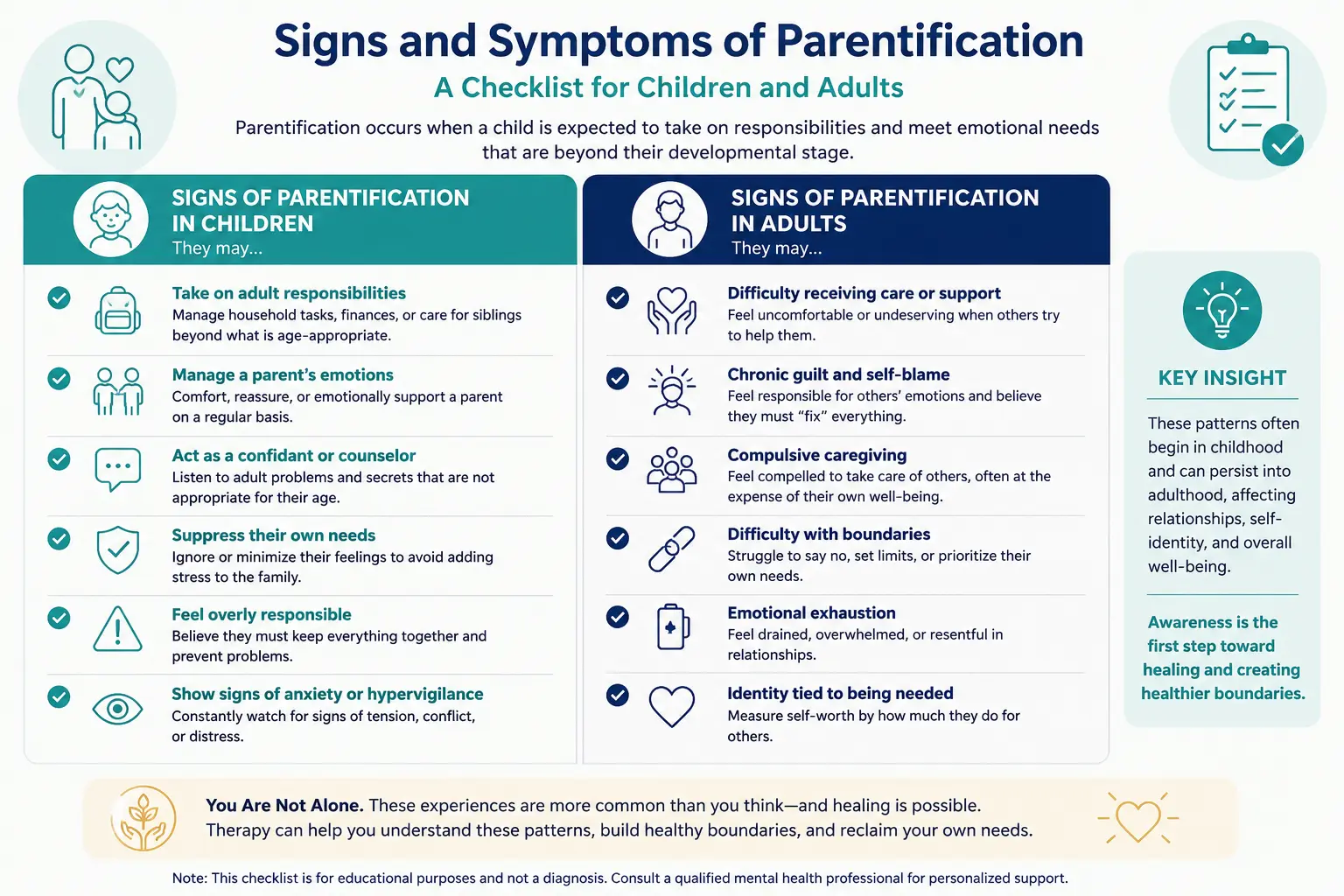
Signs of Parentification in Children
When assessing younger clients or gathering developmental histories, look for these indicators:
- Takes on primary responsibility for household tasks — cooking, cleaning, managing finances, or caring for siblings — to a degree inconsistent with their age
- Acts as mediator during parental conflict or is regularly drawn into adult disagreements and decisions
- Monitors and responds to a parent’s emotional state, adjusting their own behavior to prevent or manage the parent’s distress
- Expresses excessive, age-atypical worry about a parent’s wellbeing, finances, health, or relationships
- Struggles to engage in age-appropriate play or peer activities and reports feeling “too old” for childhood activities
- Appears hypervigilant, anxious, or unusually self-reliant — rarely asks adults for help and becomes uncomfortable when adults offer it
- Describes their childhood primarily through the lens of a parent’s experiences rather than their own
Signs of Parentification in Adults
Adult clients presenting for therapy may not identify their childhood experience as parentification — or may actively resist the framing. These clinical patterns warrant further developmental exploration:
- Chronic over-responsibility in relationships — reflexively absorbing others’ problems, emotions, or burdens as their own
- Difficulty receiving care, help, or support without significant discomfort, guilt, or the impulse to reciprocate immediately
- Persistent guilt when setting limits, declining requests, or prioritizing their own needs over others’
- Habitual minimization or dismissal of their own emotional experiences, often framed as “I’m fine” or “It wasn’t that bad”
- A pattern of relationships in which they consistently assume a caretaking role, often with emotionally dependent partners
- High external achievement or a “competent facade” that conceals significant anxiety, exhaustion, or low self-worth
- Difficulty identifying what they want, feel, or need when asked — having spent years focused on others’ internal states rather than their own
Spousification Creates Emotional Burden and Identity Confusion
Spousified children carry inappropriate emotional burdens that distort identity formation. This role reversal dissolves critical psychological boundaries needed for healthy development [10]. The ongoing stress actually changes brain structure — shrinking the hippocampus, which regulates memory, emotion, and stress management [11].
These children become overly attuned to others' emotional states while disconnecting from their own needs. Many report feeling "robbed of their childhood" and experience profound confusion about their identity and role [12]. Children with spousification typically struggle with the separation-individuation phase described by Mahler, which is essential for developing a distinct sense of self [10]. This pattern interferes with self-differentiation and can cause boundary difficulties, anxiety, or relationship dependency later in life.
Adult Relationship Patterns After Childhood Spousification and Parentification
Parentified adults who experienced childhood spousification often become compulsive caregivers or “fixers” in relationships [15]. They may attract emotionally unavailable partners, struggle to ask for help, or equate love with self-sacrifice [1]. These patterns can lead to burnout, co-dependency, and difficulty maintaining equal partnerships [3]. Clinically, you’ll observe heightened anxiety (specifically regarding caring for others, compulsive overworking, and difficulty functioning independently [11].
Internalized Roles Reshape Self-Worth
The internal message, “I am only valuable when I care for others,” drives chronic guilt and low self-esteem [1]. Over time, this becomes part of identity. In therapy, clients may show people-pleasing, perfectionism, and emotional suppression, often linked to deep-seated shame from early parentification trauma [17]. Over time, the constant pressure to remain responsible, capable, and emotionally available can contribute to what some clinicians describe as resilience fatigue, a state of exhaustion that develops when coping becomes a lifelong expectation rather than a temporary response to adversity.
Clinical Considerations for Treatment
Effective treatment for spousification and parentification begins with accurate clinical identification. These dynamics rarely present as isolated symptoms. Instead, they emerge through recurring relational patterns, attachment difficulties, boundary problems, and deeply ingrained beliefs about responsibility, self-worth, and caregiving.

Family Systems Assessment Framework
Family systems theory provides a valuable framework for understanding childhood role reversal. From this perspective, symptoms are viewed not solely as individual pathology, but as adaptations to dysfunctional family roles and boundary patterns.
When assessing clients with histories of parentification or spousification, explore:
- Triangulation: the child is drawn into parental conflict or alliance-building
- Role reversal: the child assumes caregiving responsibilities for parents or siblings
- Emotional enmeshment: family members lack appropriate interpersonal boundaries
- Detouring: marital or family conflict is redirected toward the child
- Intergenerational patterns of caregiving, role confusion, or attachment disruption
Understanding a client's position within the family system often provides critical insight into current relationship patterns and treatment needs. When family involvement is clinically appropriate, structured family therapy interventions can help address unhealthy roles, strengthen boundaries, and improve communication patterns.
Adaptive vs Maladaptive Caregiving Roles
Not all caregiving behaviors are harmful. The key distinction lies in developmental appropriateness, duration, and the availability of support. Children can benefit from age-appropriate responsibilities when those expectations are balanced and recognized. Problems emerge when caregiving becomes chronic, emotionally burdensome, or essential to family functioning.
Consider the following factors when evaluating whether caregiving has become maladaptive:
- Duration: temporary support versus long-term responsibility
- Recognition: appreciated contributions versus expected obligations
- Developmental fit: age-appropriate tasks versus adult-level responsibilities
- Emotional burden: support roles versus emotional caretaking of adults
- Impact on development: whether caregiving interfered with play, peer relationships, identity formation, or emotional growth
Treatment Goals: Boundary Restoration
Treatment often focuses on helping clients recognize that the caregiving strategies that protected them in childhood may no longer serve them in adulthood. Many survivors struggle with the belief that their value depends on meeting the needs of others, making boundary work a central therapeutic task.
Core treatment goals include:
- Identifying personal needs, preferences, and emotional experiences
- Building tolerance for guilt associated with setting limits
- Developing healthy communication and assertiveness skills
- Recognizing over-responsibility and compulsive caregiving patterns
- Establishing reciprocal rather than one-sided relationships
Helping Clients Reclaim a Sense of Self
Recovery from parentification and spousification involves more than reducing symptoms — it often requires helping clients develop an identity separate from the caregiving roles they adopted in childhood. Many clients enter treatment with a deeply ingrained belief that their value depends on meeting the needs of others. As a result, they may struggle to identify personal preferences, establish boundaries, or tolerate feelings of guilt when prioritizing themselves.
Therapeutic work often focuses on increasing self-awareness, strengthening self-differentiation, and helping clients recognize that healthy relationships involve mutual care rather than one-sided responsibility. Interventions may include values clarification, boundary-setting exercises, attachment-focused exploration, and cognitive restructuring of beliefs related to obligation, guilt, and self-worth. Over time, clients can begin developing relationships based on reciprocity rather than caretaking, creating space for a more authentic sense of self.
Working with Adult Survivors
Adult survivors frequently benefit from interventions that address both attachment injuries and unresolved grief. Validation is often an important starting point, particularly for clients who were praised for their maturity and responsibility while their own developmental needs went unmet.
Treatment may include:
- Attachment-focused therapy to address relational insecurity
- Cognitive restructuring of beliefs related to responsibility and self-worth
- Grief work focused on missed childhood experiences and unmet needs
- Identity exploration beyond caregiving roles
- Development of self-care practices that do not trigger excessive guilt
Many adult survivors grieve losses that were never fully recognized, including missed childhood experiences, disrupted attachment needs, and the burden of growing up too quickly. These experiences often resemble forms of disenfranchised grief, where the loss is real but rarely acknowledged by others.
As treatment progresses, clients can learn to replace patterns of over-functioning and emotional caretaking with healthier boundaries, greater self-compassion, and more balanced relationships.
Conclusion: Understanding Spousification and Parentification in Childhood Role Reversal
Parentification and spousification are forms of childhood role reversal that emerge when family systems place adult responsibilities on children who are not developmentally prepared to carry them. Although these adaptations often help families survive periods of stress, loss, trauma, or instability, they can leave lasting effects on attachment, identity, boundaries, and adult relationships.
For clinicians, understanding the distinctions between parentification, emotional parentification, spousification, and related concepts such as surrogate spouse syndrome can improve assessment, case conceptualization, and treatment planning. By helping clients recognize how these patterns developed — and how they continue to influence current relationships — therapy can support the development of healthier boundaries, stronger self-worth, and more secure attachment.
With appropriate support, individuals who experienced childhood role reversal can move beyond patterns of over-responsibility and emotional caretaking, building relationships that are defined not by obligation, but by mutual respect, connection, and choice.
Frequently Asked Questions: Parentification vs Spousification in Childhood and Adulthood
+
What is surrogate spouse syndrome?
+
What is emotional parentification?
+
Can parentification cause PTSD?
+
What is the main difference between spousification and parentification?
+
How do spousification and parentification affect child development?
+
What are signs of childhood spousification or parentification?
+
How does family structure contribute to spousification or parentification?
+
What therapeutic approaches help adults who experienced spousification or parentification?
How ICANotes Supports Documentation for Spousification and Parentification Treatment
Treating the complex relational dynamics of spousification and parentification requires clinical documentation that can capture what matters most: family role patterns, boundary violations, attachment histories, and evolving treatment goals. Documentation isn’t just a compliance requirement — it’s how you track a client’s progress from a place of role confusion toward a clearer, healthier sense of self. ICANotes simplifies this process with:
- Family Systems Templates: Structured fields help clinicians document relational roles, boundary violations, and attachment disruptions using language consistent with family systems theory.
- Customizable Progress Notes: Easily record parentification symptoms such as excessive caregiving, anxiety, or hypervigilance, and link them to treatment goals focused on boundary restoration and self-identity.
- Treatment Planning Tools: ICANotes allows clinicians to align interventions, like attachment-based therapy or cognitive restructuring, with measurable objectives and medical necessity standards.
- Secure and Compliant Records: HIPAA-compliant documentation ensures sensitive family details and trauma narratives are protected while maintaining audit-ready completeness.
- AI-Assisted Note Drafting: The AI Ambient Listening Scribe transcribes and summarizes therapy sessions accurately, capturing nuances in discussions around family roles, emotional boundaries, and self-concept.
By using ICANotes, clinicians can efficiently translate complex relational patterns into clear, clinically precise documentation that supports both therapeutic outcomes and reimbursement. Start a free trial of ICANotes to explore family systems templates and trauma-informed documentation tools designed specifically for behavioral health clinicians.
Document Complex Family Dynamics with Confidence
Accurately documenting parentification, spousification, emotional parentification, attachment injuries, and family role reversal requires an EHR built specifically for behavioral health. ICANotes helps clinicians create compliant, clinically rich documentation while spending less time on paperwork.
See why thousands of behavioral health clinicians trust ICANotes to streamline documentation and reclaim valuable clinical time.
Start Your Free 30-Day Trial
Explore the complete ICANotes behavioral health EHR with full access to documentation, treatment planning, scheduling, billing, and more.
Recent Posts






Dr. October Boyles
DNP, MSN, BSN, RN
About the Author
Dr. October Boyles is a behavioral health expert and clinical leader with extensive expertise in nursing, compliance, and healthcare operations. With a Doctor of Nursing Practice (DNP) and advanced degrees in nursing, she specializes in evidence-based practices, EHR optimization, and improving outcomes in behavioral health settings. Dr. Boyles is passionate about empowering clinicians with the tools and strategies needed to deliver high-quality, patient-centered care.