Blog > Documentation > What to Look for in an Ambient AI Scribe for Mental Health (2026 Guide)
What You Actually Want in an Ambient AI Scribe (Especially in Mental Health)
Choosing an ambient AI scribe for mental health care requires more than flashy demos and buzzwords. This guide explains what clinicians should actually prioritize — reducing documentation burden without expanding legal or ethical risk. Drawing on medico-legal research and real-world liability concerns, it explores why AI scribes that retain session audio or transcripts can increase subpoena exposure and documentation discrepancies. You’ll learn why privacy-first, no-retention AI scribes are often the most defensible choice for therapists and psychiatrists, and how the ICANotes+ Ambient AI Scribe delivers time-saving, HIPAA-compliant documentation without creating a parallel medical record.

Last Updated: January 27, 2026
There's a lot of noise right now about AI scribes. Demos. Buzzwords. "Always-on." "Full fidelity." "Complete capture."
But when you step back and ask a simpler question... what actually protects you as a clinician? ...the answer gets much clearer. Especially in mental health.
An ambient AI scribe should reduce your cognitive load, not expand your legal footprint. It should help you write better notes, not quietly create a second medical record you didn't ask for. The best AI scribe tool should protect you, and it should be clinically humble.
That clarity starts with one core principle:
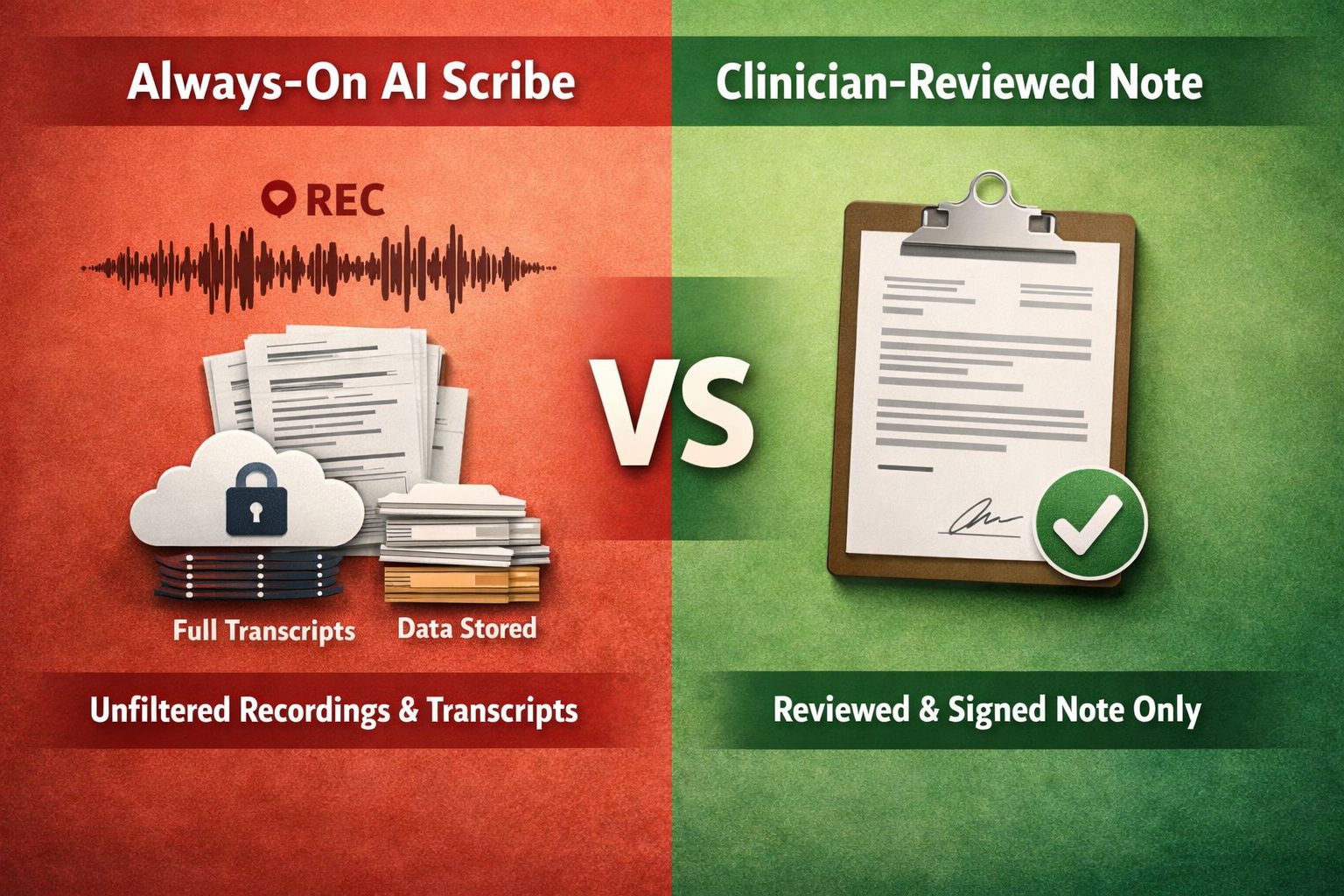
The AI scribe software should not retain session recordings or full transcripts. Only the note you review and sign should exist.
The research increasingly supports this position.
The Medical Record Is Already Central in Malpractice and Board Cases
Documentation is not a side issue in malpractice or licensing matters. It is often the primary evidence used to reconstruct what happened in a visit.
A 2022 review of malpractice case law found that charting practices play a decisive role in diagnosis-related claims. Accurate,
contemporaneous documentation can protect clinicians, while incomplete or inconsistent records are frequently used to support allegations of negligence or concealment. When a note appears unclear or contradictory, plaintiffs and boards do not stop there. They look deeper into the record.
That reality already places significant pressure on clinicians to document carefully. AI scribes that expand what "the record" includes change that pressure in meaningful ways.
Related: Mental Health Malpractice: Common Lawsuit Triggers and How to Protect Your Practice
Stored Audio and Transcripts Expand the Discoverable Record
Ambient or "always-on" AI ambient scribe tools do more than assist with documentation. They generate additional layers of data beyond the finalized note.
Academic commentary on AI scribes has identified new risk categories tied directly to this expansion, including legal liability, documentation discrepancies, and data repurposing. Each additional layer a vendor retains — raw audio, full transcripts, draft notes, backend AI artifacts — creates more material that can be requested in discovery and analyzed against the signed chart.
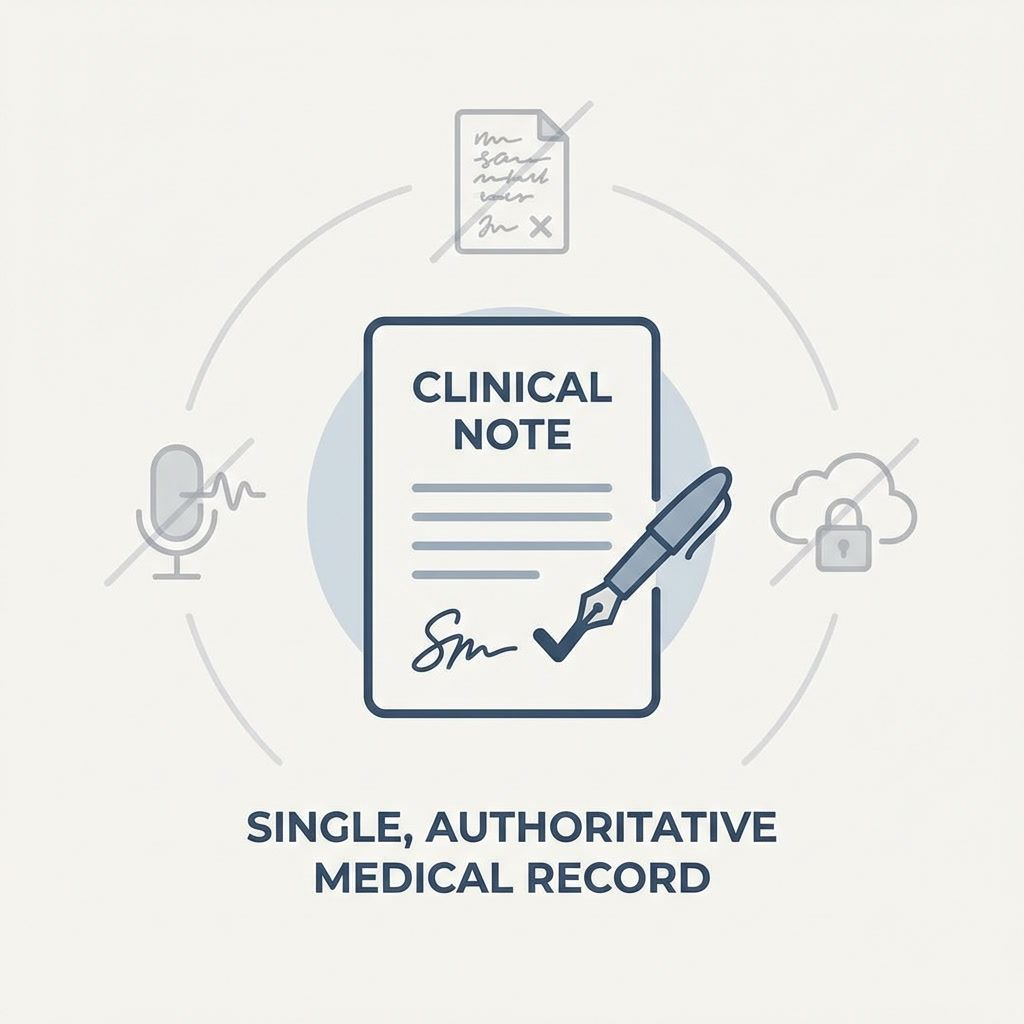
In practical terms, this means clinicians may no longer be defending a single, reviewed medical record. They may be defending that record plus a parallel archive they did not author, edit, or control.
AI Scribe Audio Can Be Subpoenaed and Used Against Clinicians
Legal education sources are now explicitly warning clinicians that AI scribe audio may be subpoenaed in malpractice cases.
Historically, the written note was often the most authoritative account of a visit. AI scribe tools alter that dynamic by introducing stored audio that can be weighed against the chart. If a recording confirms a patient's claim that a symptom or concern was raised but not documented, that recording can undermine the defense, even when the care itself was appropriate.
This is not about bad practice. It is about how evidence is interpreted when multiple versions of the same encounter exist.
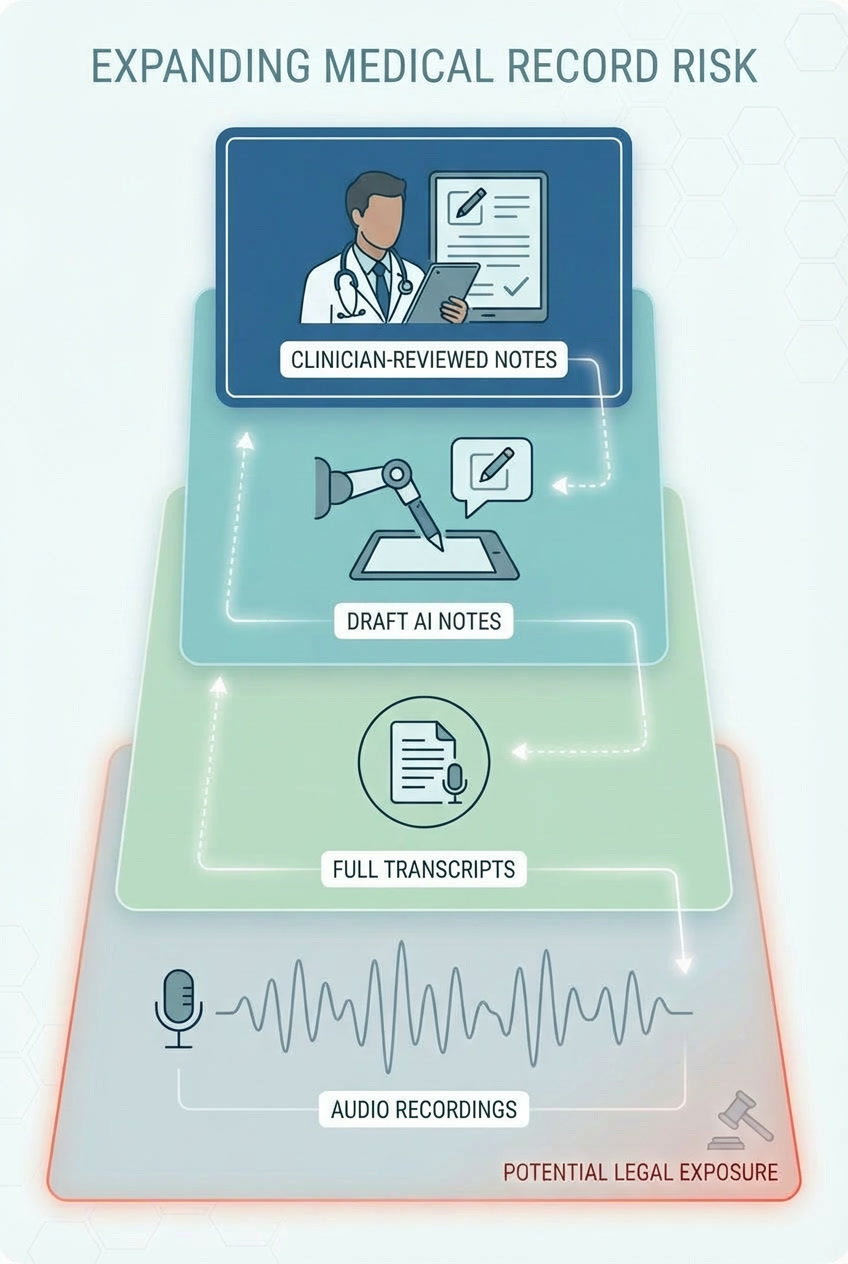
With AI scribes that retain audio, clinicians are no longer defending just their documentation. They are defending their documentation plus a raw, unfiltered record of everything said.
Recordings Shift the Evidentiary Landscape
Medico-legal risk management analyses acknowledge that recordings can improve recall and transparency, but they also recognize that recordings fundamentally change how visits are evaluated after the fact.
Risk experts describe recordings as "proof of all that was or was not said," and note that liability complications arise when the recording and the chart do not perfectly align. Research does not argue that clinicians should never record, but it consistently emphasizes the need for clear policies governing when recording occurs, how long data is retained, who owns it, and how it is destroyed.
Mental health encounters are complex, exploratory, and relational. No clinical note captures every nuance, tone shift, or therapeutic hypothesis discussed in real time. Permanent recordings do not account for that reality, and when discrepancies arise, the recording is often treated as the more objective account.
AI Scribes Create New Liability and Attribution Problems
Another risk identified in the academic literature is unclear responsibility for AI-generated errors.
Reviews of AI scribe software list legal liability as a distinct risk category, citing concerns about documentation discrepancies and unclear attribution when AI output does not match clinical intent. While vendors may generate the documentation, clinicians remain responsible for reviewing, correcting, and signing the final note.
When vendors retain large archives of recordings and drafts, clinicians inherit liability for discrepancies they do not fully control. From a risk perspective, the clinician's name is still on the chart, regardless of how much automation was involved.
Documentation Inconsistencies Are a Reliable Malpractice Lever
Across malpractice case reviews, documentation inconsistencies repeatedly appear as a central issue in adverse outcomes. Incomplete, contradictory, or mismatched records are often interpreted as carelessness or attempts to obscure facts.
Risk management guidance has noted that before digital recordings, the medical record was typically viewed as the most accurate and contemporaneous documentation of care. With recordings in play, that assumption shifts. When audio, transcripts, and notes do not align perfectly, the discrepancy itself becomes the focus.
In these situations, even well-intentioned documentation can be reframed as inadequate.
Why No-Retention or Minimal-Retention AI Scribes Are More Defensible
Taken together, the research supports a clear conclusion.
The chart is already a central piece of evidence in malpractice and board cases. Expanding that record to include permanent audio and transcripts grows the discoverable footprint without necessarily improving the clinician's legal position.
Medico-legal and academic sources consistently acknowledge that recordings and AI scribe tools introduce new liability channels, including subpoena risk for stored audio, discrepancies between notes and recordings, and unclear attribution for AI-generated errors. Risk experts emphasize the importance of explicit policies on whether to record, how long to retain data, and how to destroy it, implicitly recognizing that indefinite storage is not benign.
For mental health clinicians, a safer and more defensible stance is to choose an AI scribe that processes audio in real time and either never stores recordings or deletes them promptly after the chart is finalized. In that model, the authoritative record remains the note the clinician reviewed, edited, and signed.
How ICANotes+ Ambient AI Scribe Addresses These Concerns
ICANotes+ Ambient AI Scribe was built specifically to address the documentation and liability concerns raised by traditional "always-on" AI ambient scribe tools.
Privacy-First Architecture: No Permanent Audio Storage
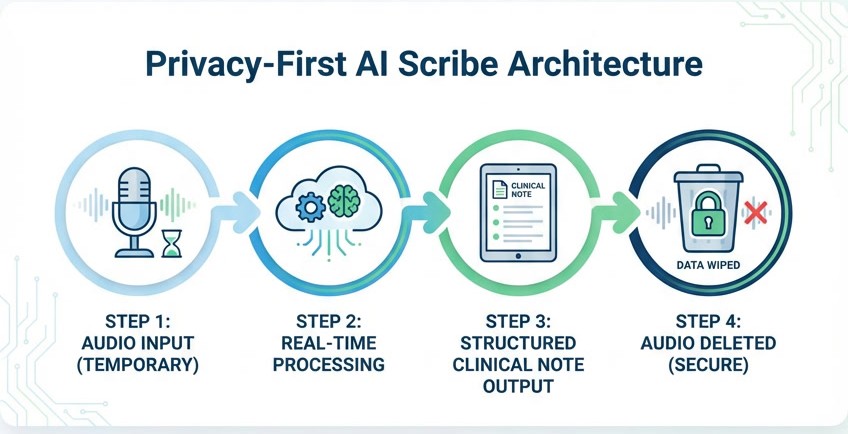
Unlike many AI scribe tools that retain session recordings indefinitely, ICANotes+ AI Scribe processes audio in real time to generate structured clinical notes — and then immediately discards the recording. No audio files. No full transcripts stored in perpetuity. No parallel archives that could be subpoenaed or create documentation discrepancies.
The only artifact that remains is the clinical note you review, edit, and sign. This approach dramatically reduces your discoverable footprint while still delivering the time-saving benefits of AI-powered documentation.
Built Directly Into Your EHR Workflow
ICANotes+ AI Scribe isn't a bolt-on tool requiring separate logins, exports, or reformatting. It's integrated directly into the ICANotes+ EHR, producing structured, bill-ready notes that fit seamlessly into your existing documentation workflow.
This integration means:
• No copying and pasting between systems
• No reformatting to match your note structure
• No compliance gaps between external tools and your medical record
• Notes are generated in formats designed for therapy and psychiatry, not generic transcription
HIPAA-Compliant and Clinically Sound
Every component of ICANotes+ AI Scribe is HIPAA-compliant by design. All data processing occurs through Business Associate Agreements (BAAs) with U.S.-based AI providers, and all session data is encrypted in transit and at rest.
Clinicians must obtain patient consent before using the AI Scribe feature — and ICANotes provides standard consent language and documentation tools to support this requirement.
Designed by Clinicians, For Clinicians
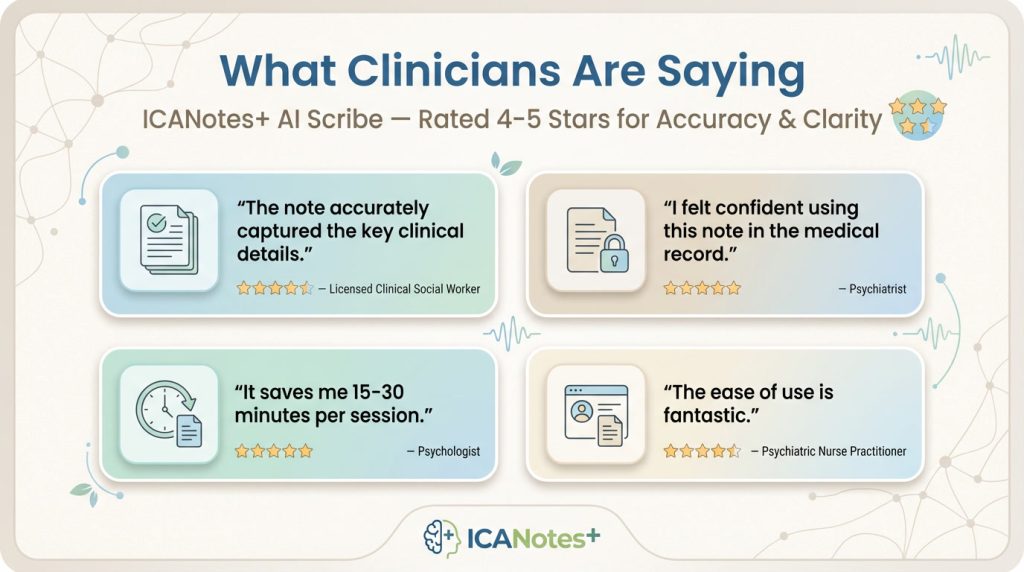
Early users consistently rate ICANotes+ AI Scribe 4–5 out of 5 for accuracy and clarity. Clinicians describe it as:
• Accurate: "The note accurately captured the key clinical details."
• Reliable: "I felt confident using this note in the medical record."
• Time-saving: "It saves me 15–30 minutes per session."
• Easy to use: "The ease of use is fantastic."
The best AI scribe for therapists and the best AI scribe for psychiatry doesn't just transcribe — it understands the structure and compliance requirements of mental health documentation.
Reduces Burnout Without Expanding Risk
The documentation burden is one of the leading drivers of clinician burnout. ICANotes+ AI Scribe reclaims 15–30 minutes per session — time that can be reinvested in patient care, professional development, or simply achieving better work-life balance.
But unlike "always-on" ambient AI scribe tools that expand your legal exposure, ICANotes+ AI Scribe reduces your documentation workload without creating a parallel archive of audio and transcripts that could later be used against you.

Frequently Asked Questions: Ambient AI Scribes
The Bottom Line
The best ambient AI scribe does not capture everything. It captures what matters.
It supports clinical thinking without expanding legal exposure. It improves documentation without turning therapy into surveillance. In mental health practice, less retained data often means more safety, more autonomy, and more trust.
And the research increasingly suggests that this is not just a preference. It is a defensible, clinically sound approach to using AI in care.
ICANotes+ Ambient AI Scribe delivers on that promise: accurate, structured notes generated in real time, with no permanent audio storage, fully integrated into your EHR workflow, and built specifically for the needs of mental health clinicians.
Try ICANotes+ AI Scribe Risk-Free
Experience the difference of an AI scribe tool designed to protect you while saving you time.
Get a 7-day free trial of ICANotes+ AI Scribe and see how real-time audio processing, zero permanent storage, and seamless EHR integration can transform your documentation workflow — without expanding your legal footprint.
Related Posts


Dr. October Boyles
DNP, MSN, BSN, RN
About the Author
Dr. October Boyles is a behavioral health expert and clinical leader with extensive expertise in nursing, compliance, and healthcare operations. With a Doctor of Nursing Practice (DNP) and advanced degrees in nursing, she specializes in evidence-based practices, EHR optimization, and improving outcomes in behavioral health settings. Dr. Boyles is passionate about empowering clinicians with the tools and strategies needed to deliver high-quality, patient-centered care.