
Behavioral Health Billing Metrics & KPIs: The Benchmarks Every Practice Should Know in 2026
Behavioral health billing metrics are among the most important operational metrics for measuring the financial health of a mental health practice. Tracking key behavioral health billing KPIs such as Days in Accounts Receivable (AR), Net Collection Rate, Clean Claim Rate, Claim Denial Rate, and First-Pass Resolution Rate helps organizations improve revenue cycle performance, reduce billing inefficiencies, and strengthen cash flow. This guide covers the 8 essential behavioral health billing metrics every practice should monitor in 2026, including industry benchmarks and strategies for improvement.


Last Updated: May 29, 2026

What You'll Learn
- Why behavioral health billing metrics and KPIs are essential for financial stability in 2026.
- The 8 most important KPIs every behavioral health practice should track — with 2026 industry benchmarks for each.
- How to benchmark your own performance and conduct root cause analysis when metrics fall short.
- Common billing challenges unique to behavioral health and how metrics help you address them.
- How to tailor KPIs to your specialty — from session-based billing to authorization tracking.
- How your EHR affects these KPIs — and what to look for in a billing-integrated platform.
- A free Benchmark Scorecard to assess your revenue cycle health in minutes.
Contents
- Why Revenue Cycle KPIs Matter in Behavioral Health
- Common Challenges in Behavioral Health Billing
- 8 Essential KPIs to Track in 2026: Benchmarks for Behavioral Health Revenue Cycle Success
- How to Analyze and Improve each KPI
- Tailoring KPIs to Behavioral Health Specialties
- How Your EHR Affects These KPIs and What to Look For
- Using KPIs to Drive Strategic Growth
- FAQs: Behavioral Health Billing Metrics
- Conclusion
- How ICANotes Helps Practices Optimize Behavioral Health Billing Metrics
Running a financially sustainable behavioral health practice requires more than strong clinical outcomes — it requires a clear view of operational performance. For most practices, the most consequential operational metrics live in the revenue cycle: how quickly claims are paid, what percentage are denied, and how much collectible revenue goes uncollected. This guide focuses on the 8 billing and RCM metrics that drive financial health in behavioral health practices, with 2026 industry benchmarks to help you know exactly where you stand.
Tracking the right behavioral health billing metrics is essential for protecting revenue and strengthening financial performance. In today’s increasingly complex healthcare environment, organizations that fail to monitor key indicators risk higher denial rates, slower collections, and missed opportunities for growth. By focusing on behavioral health billing KPIs — including days in accounts receivable, net collection rate, and clean claim rate, among others — practice leaders can uncover hidden inefficiencies, benchmark performance against industry standards, and make data-driven decisions that improve profitability. This guide explores the most important billing metrics and KPIs behavioral health practices should track in 2026, with specific benchmarks for each.
Why Revenue Cycle KPIs Matter in Behavioral Health
Did you know that behavioral health providers lose up to 20% of potential revenue due to preventable billing errors and inefficient revenue cycle management?
In today’s complex healthcare landscape, mastering behavioral health billing metrics and KPIs is not just about boosting your bottom line — it is essential for financial sustainability. Yet many behavioral health organizations struggle to identify which metrics truly matter. Tracking the wrong metrics leads to missed opportunities and persistent cash flow problems.
The unique challenges of behavioral health billing — from authorization requirements to specialized coding — demand a tailored approach to performance measurement. Understanding and optimizing behavioral health billing KPIs has become a defining competency for practice leaders who want to remain financially viable.
The Role of KPIs in Financial Sustainability
Financial sustainability is an absolute necessity for behavioral health practices to operate effectively. As the healthcare industry shifts from fee-for-service toward value-based care models, organizations must fine-tune their workflows and operations to maintain financial health.
Understanding financial KPIs helps behavioral health providers:
- Uncover hidden revenue opportunities while exposing the gaps that quietly erode collection processes.
- Measure profitability across different service lines
- Allocate staff and resources effectively based on data-driven insights
Tracking metrics like revenue per patient helps spot opportunities to improve billing processes and overall profitability. Without this visibility, practices essentially operate in the dark regarding their financial performance.
Strong financial health directly influences a practice’s ability to serve patients effectively. When revenue cycle processes run smoothly, staff can dedicate more time to patient care rather than administrative troubleshooting.
How KPIs Support Compliance and Care Quality
Beyond financial benefits, tracking the right behavioral health financial metrics plays a vital role in maintaining compliance and improving care quality. Accurate and timely documentation — a key component of effective KPI management — supports personalized care, protects organizations during disputes, and enables seamless care coordination.
In behavioral health, documentation tends to be fluid, qualitative, and narrative-based, making it challenging to extract consistent, structured data. Under fee-for-service models, payment hinges on complete, precise documentation that aligns with services delivered. In value-based care, the stakes are even higher — documentation directly impacts reimbursement, care quality, and outcomes.
Monitoring metrics like documentation completeness rate helps organizations identify areas for improvement and avoid the compliance risks that drive claim denials.
Common Challenges in Behavioral Health Billing
Behavioral health practices face unique billing complexities that go beyond typical medical specialties. Unlike standard medical services, behavioral health billing involves a wide range of procedure codes and diagnoses, unique insurance policies, and additional privacy rules.
Primary challenges include:
- Complex documentation requirements: Insurers increasingly expect evidence-based descriptions to prove therapy was medically necessary, going beyond general clinical notes.
- Specialized coding systems: Billing requires expertise in ICD-10, DSM-5 terminology, CPT therapy codes, and HCPCS modifiers.
- Restrictive coverage policies: Mental health services face coverage limitations that do not apply to physical health despite federal parity laws.
- Authorization hurdles: Most mental health services require prior authorization, often renewed at each treatment stage.
These challenges result in high claim denial rates, primarily due to missing or expired authorizations, services exceeding frequency limitations, non-covered diagnoses, and provider credentialing issues. The resolution process for behavioral health denials is often prolonged, significantly impacting cash flow.
By tracking revenue cycle KPIs, behavioral health organizations gain the foresight to identify vulnerabilities early and act before they escalate into significant revenue loss.
The 8 Essential KPIs to Track in 2026: Benchmarks for Behavioral Health Revenue Cycle Success
Tracking the right metrics transforms your revenue cycle from a mystery into a manageable process. The eight KPIs below represent the most critical measures of billing performance in behavioral health, each paired with the specific benchmark targets that define on-track performance.
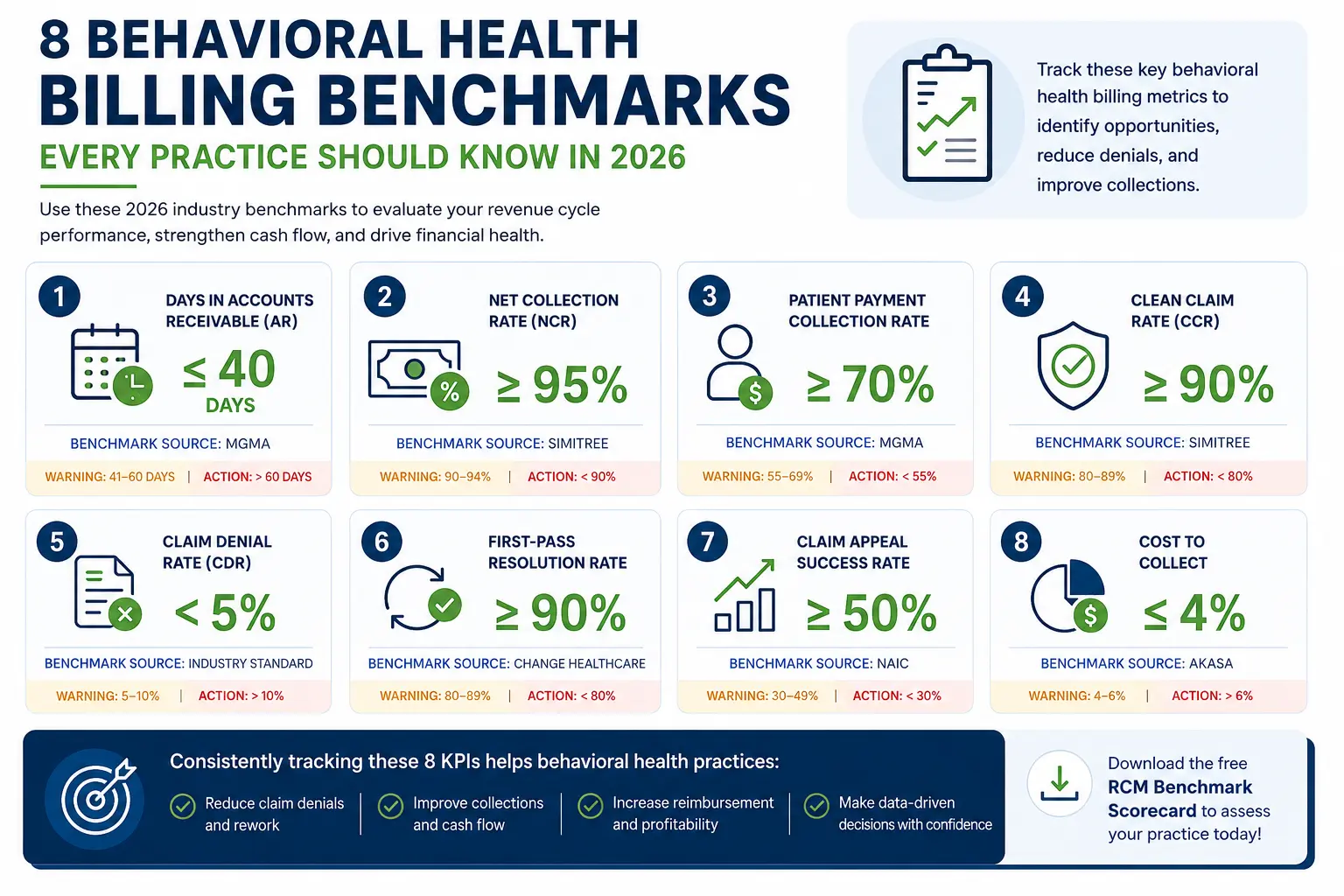
Behavioral Health Billing KPI Benchmarks for 2026
Use this quick-reference table to compare your behavioral health billing metrics against industry benchmarks and quickly identify which areas of your revenue cycle may need attention.
| KPI | Target Benchmark | Source | Warning Zone | Action Zone |
|---|---|---|---|---|
| Days in Accounts Receivable | ≤ 40 days | MGMA | 41–60 days | > 60 days |
| Net Collection Rate | ≥ 95% | Simitree | 90–94% | < 90% |
| Patient Payment Collection Rate | ≥ 70% | MGMA | 55–69% | < 55% |
| Clean Claim Rate | ≥ 90% | Simitree | 80–89% | < 80% |
| Claim Denial Rate | < 5% | Industry Standard | 5–10% | > 10% |
| First-Pass Resolution Rate | ≥ 90% | Change Healthcare | 80–89% | < 80% |
| Claim Appeal Success Rate | ≥ 50% | NAIC | 30–49% | < 30% |
| Cost to Collect | ≤ 4% | AKASA | 4–6% | > 6% |
Note: Benchmarks represent commonly cited industry targets for behavioral health revenue cycle performance. Individual practice goals may vary based on payer mix, specialty, and organizational size.
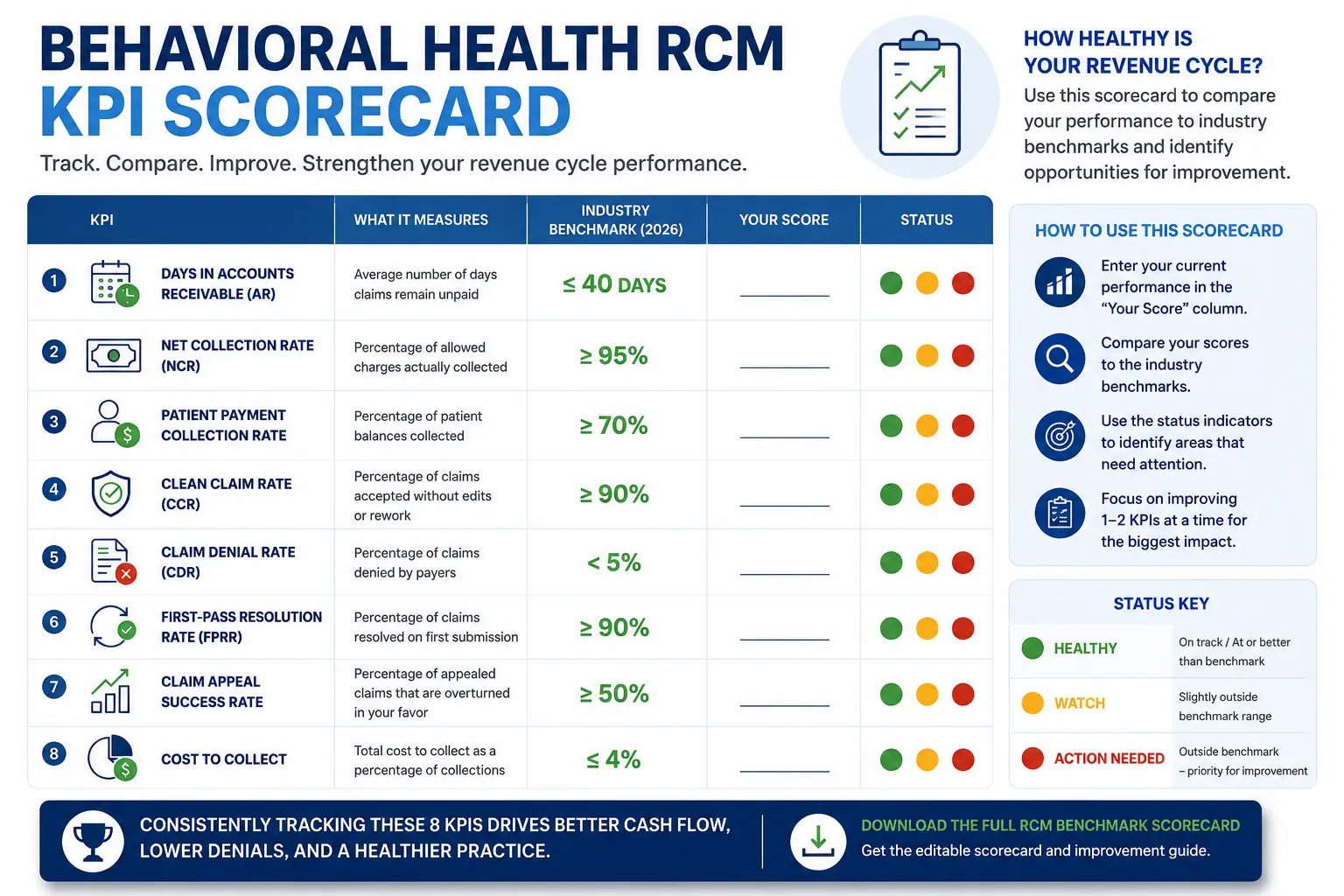
Free Download
See How Your Revenue Cycle Compares
Download the free Behavioral Health RCM KPI Scorecard to compare your practice’s billing metrics against 2026 industry benchmarks and identify which areas may need attention.
- Benchmark all 8 essential behavioral health billing KPIs
- Identify red, yellow, and green performance zones
- Prioritize opportunities to reduce denials and improve collections
-
Days in Accounts Receivable (AR)
Days in AR measures how long your practice takes to collect payments after submitting claims. The Medical Group Management Association (MGMA) recommends keeping AR days below 40, with optimal performance between 30–35 days. High AR days strangle cash flow, delay reinvestment, and compromise operational efficiency. Breaking down AR by payer helps identify problem areas — whether a specific insurance company or patient payment issues. Accounts aging beyond 90 days represent revenue at significant risk, as the likelihood of collection diminishes substantially over time.
-
Net Collection Rate
Net Collection Rate (NCR) measures the percentage of collectible revenue — after contractual adjustments — your practice actually receives. Unlike gross collection rates, NCR provides a more accurate picture of revenue cycle efficiency. Successful behavioral health practices maintain an NCR of at least 95%, though many struggle to reach this benchmark. When NCR falls below 90%, urgent examination of your revenue cycle processes becomes necessary. Common causes include avoidable write-offs, fee schedule mismatches, and uncollected patient balances.
-
Claim Denial Rate
Claim denial rate tracks how often your claims are rejected by payers. Industry standards call for denial rates below 5%, with top-performing practices achieving rates below 3%. In behavioral health, claim denials occur at rates 85% higher than medical claims despite federal parity laws requiring equal coverage. Tracking denial patterns helps identify systemic issues such as authorization problems, coding errors, or documentation gaps. Common denial triggers in behavioral health include expired authorizations, non-covered diagnoses, and provider credentialing issues.
-
Cost to Collect
Cost to collect represents your total expenses for collecting payments from both payers and patients, expressed as a percentage of total collections. The industry standard ranges from 3–4%, with lower percentages indicating more efficient processes. Healthcare organizations utilizing automation report an average cost-to-collect of 3.51% versus 3.74% for those without automation. For a practice with $5 million in annual revenue, this difference can translate to more than $100,000 in savings.
-
Clean Claim Rate
Clean claim rate represents the percentage of claims that pass through your billing system without errors or manual intervention. This metric directly determines how quickly you get paid. Healthcare providers should aim for a clean claims rate of 90% or higher, with top performers exceeding 95%. High clean claim rates indicate effective front-end processes and proper staff training. The most common reasons for claim rejections are missing information (45%) and eligibility issues (24%).
-
Patient Payment Collection Rate
This metric measures the percentage of patient-responsible payments successfully collected. With high-deductible plans increasingly common, patient collections have become a significant share of practice revenue. Industry data shows that patient balance collection averages only around 57% after services are rendered, highlighting the importance of upfront collection strategies, online payment options, and automated balance-due reminders.
-
First-Pass Resolution Rate (FPRR)
First-Pass Resolution Rate (FPRR) measures the percentage of claims paid on first submission without requiring resubmission or corrections. The industry benchmark is 90% or higher. High FPRR indicates efficient billing processes, resulting in faster payment cycles and reduced administrative costs. According to Change Healthcare, the average cost to rework a denied claim ranges from $25 to $117 — a significant operational expense when multiplied across hundreds of claims
-
Claim Appeal Success Rate
This metric tracks how often your appeals of denied claims succeed. Mental health claims achieve external review overturn rates of approximately 54%, significantly higher than the 38% average for all claim types. Despite high success rates, fewer than 1% of denied claims are appealed, representing substantial missed revenue. Building a systematic appeals workflow is one of the highest-ROI investments in behavioral health billing.
How to Analyze and Improve each KPI
Merely collecting KPI data is not enough. Successful behavioral health organizations analyze these metrics and act on them. Turning billing metrics into actionable insights involves three critical components: benchmarking, root cause analysis, and real-time tracking tools.
Benchmarking Against Industry Standards
Setting clear benchmarks empowers behavioral health organizations to measure performance with objectivity, replacing guesswork with evidence. Key benchmark targets include:
- Days Receivable Outstanding: 35 days or less
- Aging accounts receivable: No more than 14.6% should be 120+ days old
- Net collection rate: Equal to or greater than 97% for top performers
- First submission denials: Maximum of 4%
Behavioral health organizations should also break down metrics by payer to identify specific problem areas. For example, calculating AR days separately for Medicaid versus commercial payers often reveals very different performance levels that require different interventions.
Using Root Cause Analysis for Underperformance
When a metric falls short of its benchmark, root cause analysis becomes essential. As one expert notes, “Unless it can be measured, it can’t be improved.”
To conduct effective root cause analysis:
- Gather consistent, accurate, and timely data about the underperforming KPI.
- Break down the metric by relevant factors such as payer, service type, or billing staff member.
- Look for patterns in the data that suggest systemic issues.
- Identify process improvements and assign ownership for implementing them.
For example, if AR days exceed 35, analyze whether certain payers consistently take longer to pay or if there are submission issues like incorrect diagnoses or missing authorization codes.
Root Cause Analysis for Underperforming Billing KPIs
When a behavioral health billing metric falls outside its benchmark range, use a structured root cause analysis process to identify whether the issue is tied to authorization, coding, documentation, payer behavior, or collection workflows.
Examples: high denial rate, rising AR days, low clean claim rate, or weak collections
1. Is the issue related to authorization?
Check for expired authorizations, missing approvals, incorrect visit limits, or payer-specific authorization rules.
2. Is the issue related to coding?
Review CPT codes, modifiers, add-on codes, diagnosis-code alignment, and payer-specific billing requirements.
3. Is the issue related to documentation?
Look for incomplete notes, missing medical necessity language, unsigned documentation, or mismatches between services provided and services billed.
4. Is the issue payer-specific?
Break down the metric by payer to identify delayed reimbursements, recurring denials, underpayments, or inconsistent adjudication patterns.
5. Is the issue tied to patient collections?
Review upfront payment collection, statement timing, payment plan use, online payment options, and patient balance aging.
Prioritize the Fix and Track the KPI Again
Assign ownership, update workflows, train staff where needed, and monitor the same KPI over time to confirm whether the intervention improved performance.
Tools and Dashboards for Real-Time Tracking
Real-time KPI monitoring enables proactive management of the revenue cycle. Modern behavioral health software solutions offer robust, fully customizable reporting capabilities that generate tailored reports from any data entered into the system.
Effective dashboards should be:
- Accessible to all stakeholders, not just leadership
- Designed to display critical results transparently
- Capable of showing trends over time
- Configurable for different levels of analysis
By visualizing KPIs, administrators can monitor performance trends and interact with data to identify issues before they become crises.
Tailoring KPIs to Behavioral Health Specialties
Behavioral health practices face distinctive revenue cycle challenges that general medical facilities do not encounter. Standard healthcare KPIs often fall short in addressing the specific needs of mental health and substance use disorder providers. Tracking billing KPIs tailored to your specialty is essential.
Primary Care vs. Behavioral Health KPI Focus
In contrast to primary care, behavioral health organizations navigate specialized service codes, complex documentation requirements, and varying payer policies that create multiple billing efficiency challenges. Primary care facilities typically focus on procedure-based metrics, whereas behavioral health requires session-based measurements.
Historically, quality measurement development for behavioral health lags significantly behind general medical care. Of the 611 measures endorsed by the National Quality Forum, only 31 are behavioral health measures. This gap underscores the importance of developing practice-specific tracking frameworks rather than relying solely on general healthcare benchmarks.
Tracking Session-to-Submission Delays
Bill charge lag times — measuring the interval between service delivery and claim submission — are especially critical for behavioral health providers. The optimal practice involves submitting claims within 24–48 hours of service delivery. For recurring services like ABA therapy, establishing consistent weekly or monthly submission schedules ensures timely billing.
Tracking average session length also becomes essential in behavioral health settings where billing depends on time-based service codes. Different therapies require different session lengths, which directly impacts billing and revenue cycle management.
Authorization and Documentation Metrics
Documentation in behavioral health tends to be fluid, qualitative, and narrative-based, making it challenging to extract consistent data. Monitoring these specialized metrics becomes vital:
- Documentation Completeness Rate: Identifies how many incomplete documents are submitted with billing, preventing financial loss due to noncompliance.
- Time Spent per Note: Measures provider time investment in documentation, a significant contributor to clinician burnout.
- Authorization Adherence Rate: Crucial since most mental health services require prior authorization, often at each treatment stage.
How Your EHR Affects These KPIs — and What to Look For
Your EHR is not just a documentation tool — it is one of the most significant determinants of your billing KPIs. The features your platform includes (or lacks) directly affect your clean claim rate, AR days, denial rate, and cost to collect. When evaluating or upgrading an EHR, it is worth asking: does this platform actively support the KPIs that matter most to behavioral health billing?
Here is what to look for, and how ICANotes addresses each area:
| KPI | What to Look For in Your EHR | How a Behavioral-Health-Specific EHR Helps |
|---|---|---|
| Days in AR | Real-time AR aging dashboards, automated claim follow-up workflows, and payer-specific reporting. | Built-in AR aging reports show AR by payer in real time. |
| Clean Claim Rate & First-Pass Resolution Rate | Pre-submission claim scrubbing, eligibility verification during scheduling, and automated coding assistance. | Automated E&M coding and integrated claim scrubbing help reduce submission errors before claims are sent. |
| Claim Denial Rate | Denial tracking by payer and reason code, authorization monitoring, and tools to identify recurring denial trends. | Denial tracking tools and authorization management help identify patterns and prevent repeat denials. |
| Net Collection Rate | Electronic patient statements, online payment options, and automated balance reminders. | Digital patient statements and online payment tools help reduce patient balance write-offs and improve collections. |
| Authorization Adherence | Authorization expiration alerts, renewal reminders, and pre-visit eligibility checks. | Integrated eligibility verification and authorization tracking help reduce the risk of unauthorized sessions. |
| Cost to Collect | Automated eligibility checks, claim status updates, clearinghouse integration, and workflow automation. | Integrated clearinghouse connectivity and billing automation reduce manual work and administrative costs. |
The right EHR eliminates the manual steps that drive up cost-to-collect and AR days. Practices that use a platform with integrated billing, automated coding, real-time eligibility verification, and denial tracking consistently outperform those relying on disconnected or general-purpose systems. When evaluating options, prioritize platforms built specifically for behavioral health — the coding complexity, authorization workflows, and documentation requirements of this specialty demand a system that understands them.
Using KPIs to Drive Strategic Growth
Beyond tracking and analyzing behavioral health KPIs, successful organizations transform these insights into strategic advantages. Setting clear revenue cycle goals and aligning your team toward these objectives enables consistent, measurable improvement.
Aligning Behavioral Health KPIs with Organizational Goals
Behavioral health KPIs work most effectively when tailored to your practice’s unique operations and objectives. With customized metrics, you capture meaningful data aligned with specific goals, whether focused on income growth or expanding service impact. Tracking these personalized measurements helps your practice evaluate business performance, identify emerging trends, and maintain focus on organizational priorities.
Effective alignment requires regular analysis of tracked KPIs to identify innovation opportunities, connecting financial metrics with care quality indicators, and establishing realistic improvement targets based on historical performance.
Training Staff Based on KPI Insights
Even the best KPI system will fail without proper training and support. Engaging team members in KPI tracking fosters accountability and distributes data collection responsibility across the organization. Different staff roles require different levels of training:
- Front desk staff need education on insurance verification metrics and eligibility capture.
- Clinical staff must understand documentation requirements that affect billing accuracy and denial rates.
- Billing specialists require in-depth training on claim submission, denial management, and appeals.
- Managers need training on reporting tools, dashboard interpretation, and KPI-based performance conversations.
Leveraging KPIs for Payer Negotiations
Data-driven payer performance analysis enables strategic decisions about contract renewals and payer relationships. Organizations that implement systematic performance tracking gain significant negotiation leverage with payers. Strong performance metrics allow you to provide concrete evidence of your practice’s value, identify underpayments through payment accuracy monitoring, and support requests for rate increases with objective data.
Related Behavioral Health Billing Resources
Looking to improve your behavioral health billing knowledge? Explore these additional resources covering mental health billing fundamentals, CPT coding, assessment billing, and ICD-10 diagnosis coding.
Guide to Mental Health Billing
Learn the fundamentals of behavioral health billing, including common challenges, payer requirements, reimbursement considerations, and best practices for improving collections.
Read Article →CPT Code Basics: What You Should Know
Understand the purpose of CPT codes, how they affect reimbursement, and why coding accuracy is critical for reducing denials and improving clean claim rates.
Read Article →Understanding CPT Code 96127
Explore the billing requirements, reimbursement considerations, and documentation expectations for CPT code 96127 and behavioral health screening services.
Read Article →Commonly Used ICD-10 Codes for Behavioral Health
Review frequently used behavioral health diagnosis codes and learn how accurate ICD-10 coding supports cleaner claims and fewer reimbursement issues.
Read Article →
Frequently Asked Questions: Behavioral Health Billing Metrics
Conclusion
In 2026 and beyond, mastering behavioral health billing metrics and KPIs is not optional — it is a defining competency for practices determined to achieve lasting financial stability. The eight KPIs outlined in this guide provide a comprehensive framework for monitoring your revenue cycle health: Days in AR for payment timelines, Net Collection Rate for revenue recovery, Clean Claim Rate and First-Pass Resolution Rate to streamline submission, and Claim Appeal Success Rate to recover denied revenue.
But tracking is only the beginning. Successful organizations benchmark their metrics against industry standards, conduct root cause analysis when performance falls short, and use KPI insights to inform staff training, EHR selection, and payer negotiations. The practices that embrace this data-driven approach will outperform those relying on intuition alone.
Use the free Benchmark Scorecard to assess your own revenue cycle health in minutes — and identify the specific KPIs where focused improvement will have the greatest impact on your bottom line.
How ICANotes Helps Practices Optimize Behavioral Health Billing Metrics
Tracking the right behavioral health billing metrics and KPIs is only half the battle — having the right tools to act on them is what drives financial success. ICANotes provides behavioral health organizations with built-in billing and revenue cycle management features that make monitoring and improving these KPIs seamless.
With ICANotes, practices can:
- Generate clean, audit-ready claims on first submission through automated E&M coding and pre-submission scrubbing.
- Monitor billing KPIs in real time with reports.
- Automate eligibility verification and authorization tracking to reduce denials before they happen.
- Improve patient collections through digital statements and online payment tools.
- Track AR aging, denial rates, and collection performance by payer in one integrated platform.
Ready to strengthen your revenue cycle? Book a demo with ICANotes today and see how our platform helps behavioral health practices stay financially healthy while focusing on what matters most — delivering exceptional care.
Improve Revenue Cycle Performance
Ready to Improve Your Billing KPIs?
If your practice is struggling with high denial rates, aging accounts receivable, low clean claim rates, or inconsistent collections, the right technology can make a measurable difference. ICANotes helps behavioral health organizations streamline documentation, automate coding, reduce billing errors, improve claim acceptance rates, and gain real-time visibility into the metrics that matter most.
Schedule Your Personalized ICANotes Demo
See how behavioral health practices use ICANotes to improve revenue cycle performance, strengthen financial health, and spend less time chasing claims.
Recent Posts






Fatima Davis
RCM Manager
Fatima C. Davis is the RCM Manager at ICANotes and a seasoned expert in behavioral health revenue cycle management. With over 20 years of experience, she specializes in optimizing collections, reducing denials, and ensuring compliance across diverse payer landscapes. Fatima has led RCM operations for large multi-agency systems and is passionate about helping behavioral health practices achieve financial sustainability.