
Blog > Practice Management > Digital Marketing for Therapists: Proven Strategies to Grow
Digital Marketing Strategies for Therapy Practices
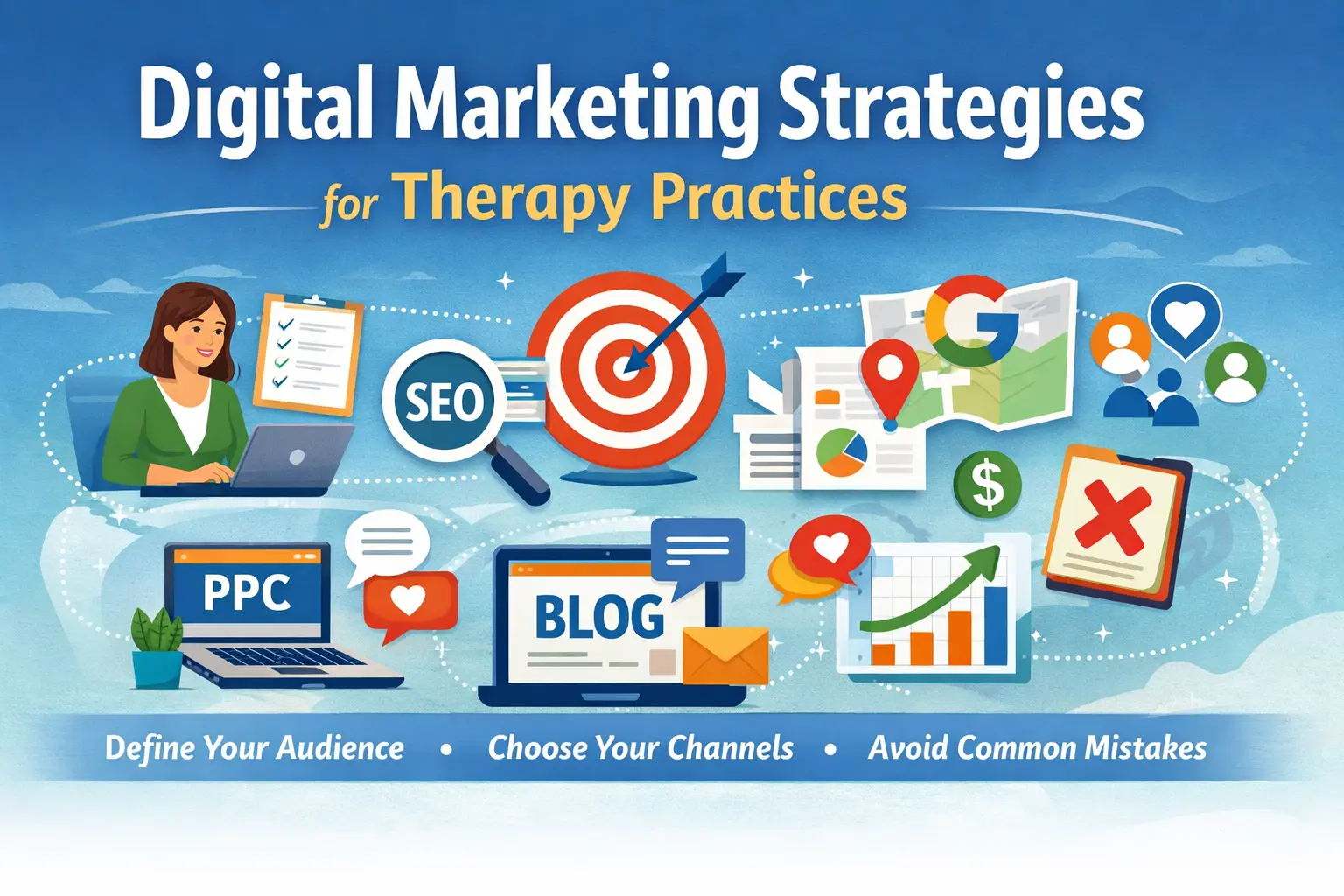
Digital marketing is essential for growing a modern therapy practice—but it doesn’t have to be overwhelming. This guide walks therapists through how to define their ideal client, choose the right marketing strategies, and build a sustainable approach to attracting and retaining clients. You’ll learn how to prioritize your efforts, improve your visibility online, and avoid common mistakes that prevent many practices from growing.


Last Updated: March 27, 2026
What You'll Learn
- How to define your ideal client and position your practice effectively
- Which digital marketing strategies actually work for therapists
- How to use SEO to increase visibility and attract clients
- How to turn website visitors into scheduled sessions
- What mistakes to avoid when marketing your practice
Contents
Why Digital Marketing Matters for Therapy Practices
Define Your Ideal Client Before You Market
Key Questions to Guide Your Marketing Strategy
The Most Effective Digital Marketing Strategies for Therapists
Common Digital Marketing Mistakes Therapy Practices Make
How to Build a Sustainable Marketing Plan
Most therapists don’t go into private practice because they love marketing — but in today’s digital world, having a strong online presence is essential to building a sustainable caseload.
The challenge? There’s no shortage of advice, tools, and platforms competing for your attention. From SEO and directories to social media and paid ads, it can quickly become overwhelming to know where to focus your time and energy.
The good news is that effective digital marketing for therapists doesn’t require doing everything — it requires doing the right things consistently. When you understand your ideal client, clarify your positioning, and choose the channels that align with your goals, marketing becomes far more manageable — and far more effective.
Why Digital Marketing Matters for Therapy Practices
For many therapists, marketing still feels secondary to clinical work. But the reality is that most clients begin their search for care online. Whether they’re looking for help with anxiety, relationship issues, or medication management, they are typing those needs into Google long before they reach out to a provider.
That means your online presence is often your first interaction with a potential client.
If your website, directory listings, or content don’t clearly communicate who you help and how, those clients will move on to someone else — often within seconds. Digital marketing, at its core, is about making sure the right people can find you and feel confident enough to take the next step.
Define Your Ideal Client Before You Market
One of the biggest reasons therapy marketing efforts fall flat is a lack of focus. When your messaging tries to speak to everyone, it rarely resonates with anyone.
A more effective approach is to start by narrowing your focus. Think about the clients you most enjoy working with and the types of problems you’re best equipped to treat. This might include a specific diagnosis, life stage, or presenting concern.
To get there, ask yourself these questions:
- Who are the last five clients I felt most energized working with? What did they have in common?
- What presenting concerns do I have the most training or experience treating?
- Is there a specific age group, life stage, or population I naturally connect with?
- What types of sessions leave me feeling like I did my best work?
- If I could fill my entire caseload with one type of client, who would that be?
Once you've answered those, try turning your answers into a positioning statement. Compare the difference between these two approaches:
Vague: "I work with adults experiencing a range of mental health concerns."
Specific: "I help high-achieving professionals in their 30s and 40s who are struggling with anxiety and burnout but haven't been able to slow down long enough to address it."
The second version immediately tells a potential client whether or not you're the right fit — and that clarity is what makes people reach out.
For example, a therapist who specializes in anxiety disorders will naturally attract more of those clients by using language that reflects their experiences. Writing content around topics like interventions for anxiety not only improves SEO but signals to potential clients that you understand their needs.
This kind of clarity makes every other marketing decision easier — from what you write on your homepage to which keywords you target.
Key Questions to Guide Your Marketing Strategy
Before investing time or money into specific tactics, it’s worth stepping back and thinking strategically.
Where are your ideal clients already looking for help? What language are they using to describe their problems? And what might be preventing them from reaching out?
Answering these questions helps you avoid a common trap: spreading your efforts too thin across too many platforms. Instead, you can focus on the channels most likely to connect you with the right clients.
A practical way to start is to simply ask your current clients how they found you. If most come through Google searches, that tells you to prioritize SEO. If referrals are your primary source, your energy might be better spent building referral relationships and making sure those referred clients find a compelling website when they look you up. Let the data guide the strategy rather than guessing.
The Most Effective Digital Marketing Strategies for Therapists
Once you’ve clarified your audience and goals, the next step is choosing how to reach them. Most successful therapy practices rely on a combination of a few core strategies rather than trying to do everything at once.

1. Search Engine Optimization (SEO) for Therapists
SEO is one of the most valuable long-term investments you can make in your practice. It allows your website to appear when potential clients are actively searching for services like yours.
But effective SEO is not just about adding keywords to your site. It involves understanding how your ideal clients search, creating content that answers their questions, and structuring your website so it’s easy for both users and search engines to navigate.
How to start with keyword research — even without any tools:
The simplest way to begin is to open Google and type your specialty plus your city. For example, type "anxiety therapist in Denver" and look at what Google suggests in the autocomplete dropdown. Those suggestions reflect what real people are actually searching for. Do the same with variations: "therapist for," "counseling for," "help with." Write down the phrases that match the services you offer.
Next, scroll to the bottom of any Google search results page and look at the "People Also Ask" section and the related searches. These are free, real-time insights into the exact questions your potential clients are asking.
On-page SEO basics every therapist should address:
Your website doesn't need to be technically complex, but a few structural elements make a significant difference in how search engines understand and rank your pages.
- Title tags: Each page on your site should have a unique, descriptive title tag that includes your primary keyword. For example, your homepage title might be "Anxiety Therapy in Denver | [Your Practice Name]" rather than just your practice name alone.
- Meta descriptions: These are the short summaries that appear below your page title in search results. Write them like a brief pitch to a potential client — what you offer, who it's for, and what to do next.
- Header structure: Use H1 tags for your main page heading and H2s for subsections. This helps Google understand the hierarchy of your content and makes your pages easier to scan.
- Location pages: If you serve multiple areas or offer telehealth across a state, consider creating individual pages for each location you want to rank in, with content tailored to that community.
For therapists, effective SEO also means creating blog content that addresses common concerns, explains treatment approaches, and reflects real client experiences.
If you’re newer to SEO, this is a good place to go deeper:
SEO for Therapists: A 2026 Guide for Counselors, Psychiatrists, and Mental Health Professionals
2. Online Directories and Local Visibility
While your website is your digital home base, directories often serve as the first point of contact for potential clients — especially those searching locally.
Profiles on platforms like Psychology Today or Google Business are most effective when they go beyond basic information. The goal is to clearly communicate who you help, how you work, and what a client can expect.
What separates a strong directory profile from a forgettable one:
Compare these two Psychology Today bio openings:
Before: "I am a licensed therapist with 10 years of experience. I use a variety of evidence-based approaches to help clients achieve their goals. I work with individuals, couples, and families."
After: "If you're a new parent feeling overwhelmed, disconnected from your partner, or wondering whether what you're experiencing is more than just 'normal stress' — I can help. I specialize in working with adults navigating the transition to parenthood, using evidence-based approaches like CBT and emotionally focused therapy."
The first version describes the therapist. The second speaks directly to the client's experience. That distinction is what drives someone to click "Contact" instead of scrolling past.
A quick directory profile checklist:
- Does your opening line speak to a specific client experience rather than listing your credentials?
- Have you named the specific issues you treat using the language clients would use (not just clinical terms)?
- Is your photo professional, warm, and recent?
- Have you included practical details like insurance accepted, availability, and session formats (in-person, telehealth)?
- Does your profile match the messaging on your website?
Consistency also matters. When your messaging aligns across your website and directory listings, it reinforces trust and improves your overall visibility.
3. Content Marketing as a Trust-Building Tool
Content marketing is where many therapists begin to see compounding results. By publishing helpful, relevant content, you create multiple entry points for potential clients to discover your practice.
This doesn’t mean writing for the sake of writing. The most effective content answers specific questions your clients already have. The challenge is figuring out what those questions are.
Four practical ways to surface content ideas:
- Review your intake forms. Look for patterns in what clients write about why they're seeking therapy. The phrases they use are often the exact phrases other people are typing into Google.
- Pay attention to what clients mention Googling. If a client says "I was reading about attachment styles" or "I looked up whether what I'm feeling is normal," that's a content topic worth covering.
- Use the "People Also Ask" box in Google. Search for a topic you treat and look at the expandable questions Google displays. Each of those is a potential blog post.
- Check online forums and communities. Subreddits, Facebook groups, and Q&A sites related to mental health are full of real questions from real people looking for the kind of answers you can provide.
For example, a blog post on how to write progress notes may may attract clinicians, while a post on treatment approaches or symptom management can attract clients. Knowing which audience you're writing for with each piece helps you stay focused.
Over time, this content builds authority and increases the likelihood that a potential client will choose your practice when they’re ready to reach out.
4. Paid Advertising and When to Use It
Paid advertising can be a useful supplement to your marketing strategy, particularly if you’re trying to grow quickly or operate in a highly competitive market.
However, it works best when it’s built on a strong foundation. Without clear messaging and a well-designed website, even well-targeted ads can underperform.
If you do have that foundation, here's what to know:
Google Ads tends to be the most effective paid channel for therapy practices because it targets people who are actively searching for help — they've already identified a need and are looking for a provider. This is fundamentally different from social media ads, which interrupt someone who wasn't looking for therapy in that moment.
For a starting point, many solo practitioners allocate between $500 and $1,500 per month for Google Ads. A simple starter campaign might target two to three high-intent keywords (like "anxiety therapist in [your city]" or "couples counseling near me") and direct clicks to a dedicated landing page — not your homepage — with a clear call to action to schedule a consultation.
Track your results from the start. At a minimum, know how much you're spending per click, how many clicks lead to a contact form submission or phone call, and what your cost per new client is. If you're paying $200 or more to acquire a single client and your average client only stays for a few sessions, the math may not work.
Think of paid ads as a way to accelerate what's already working—not as a replacement for organic strategies like SEO and content.
5. Social Media and Audience Engagement
Social media often gets more attention than it deserves in therapy marketing. While it can be helpful for building familiarity and sharing educational content, it's rarely the primary driver of new clients.
What tends to work:
Short educational posts that normalize common experiences tend to perform well for therapists. Think along the lines of: "Three signs your anxiety might be more than just stress" or "What couples therapy actually looks like (it's not what you see on TV)." On Instagram, carousel posts that walk through a concept in a few slides tend to get saved and shared more than single-image posts. On LinkedIn, brief reflections on clinical themes or practice-building lessons can build credibility with referral sources.
What's usually a time sink:
Trying to maintain a consistent presence on more than one or two platforms, creating highly produced video content without a clear strategy, or spending hours engaging in comments hoping it will translate to bookings. For most therapy practices, social media supports your other channels — it's not the engine.
Used well, social media can reinforce your expertise and keep you visible. But it should support — not replace — your core marketing channels.
Want to see how experienced clinicians approach attracting clients in real-world practice?
This on-demand webinar walks through practical strategies you can start using right away.

Turn More Website Visitors Into Billable Sessions
Effective marketing brings clients to your practice — but what happens next determines whether that growth is sustainable.
ICANotes helps behavioral health clinicians streamline clinical documentation, support medical necessity, and improve reimbursement — so the clients you attract actually translate into a more efficient and profitable practice.
Start Your Free 30-Day TrialNo credit card required.
Common Digital Marketing Mistakes Therapy Practices Make
Many therapists approach marketing with good intentions but inconsistent results. Often, the issue isn’t effort — it’s lack of focus.
Trying to maintain a blog, run ads, post on multiple social platforms, and optimize SEO all at once can quickly become overwhelming. Without a clear strategy, it’s easy to abandon efforts before they have time to work.
Another common issue is unclear messaging.
Here's what this looks like in practice:
A homepage headline that's too vague: "Welcome to my practice. I provide therapy for individuals seeking personal growth and wellness in a safe, supportive environment."
This sounds warm, but it doesn't tell anyone what you actually specialize in or who you help. A visitor can't tell whether you're the right therapist for their specific situation.
A clearer alternative: "Therapy for adults navigating anxiety, perfectionism, and burnout — helping you move from surviving your days to actually living them."
Now a potential client with anxiety or burnout immediately sees themselves in your messaging. That's the difference between someone bouncing off your site and someone clicking "Book a Session."
Other common mistakes to watch for:
- Writing blog content without any keyword strategy, so it never gets found in search.
- Having different specialties listed on your website versus your directory profiles, which confuses both clients and search engines.
- Launching a marketing effort (like a blog or ad campaign) and abandoning it after a few weeks before it's had time to gain traction.
- Spending time on the platforms you personally enjoy rather than the ones your clients are actually using.
How to Build a Sustainable Marketing Plan
The most effective marketing strategies are not the most complex — they're the most consistent.
A sustainable plan typically starts with a strong foundation: a clear niche, a well-structured website, and one or two primary channels for attracting clients. For many therapists, this means focusing on SEO and directory visibility first, then layering in content and other strategies over time.
01
Clarify your ideal client, tighten your website messaging, and update your directory profiles so your practice clearly communicates who you help and why you’re the right fit.
02
Publish content based on real client questions and search behavior. Focus on topics that reflect your specialties and help potential clients find and trust your practice.
03
Look at which pages, profiles, and channels are generating traffic and inquiries. Double down on what’s working, adjust what isn’t, and build from there.
A sample 90-day starter plan:
Month 1 — Lay the foundation. Refine your ideal client profile using the questions above. Update your website homepage and about page so they speak directly to that client. Claim and optimize your Google Business Profile. Rewrite your Psychology Today listing using the directory checklist in this guide.
Month 2 — Start creating content. Publish two blog posts targeting keywords you identified through your research. Each post should address a specific question your ideal client is asking. Share those posts on one social media platform you're comfortable with. Set up Google Search Console (it's free) so you can start tracking which searches are bringing people to your site.
Month 3 — Review and refine. Look at what's working: which pages are getting traffic, which directory profiles are generating contacts, and where your new clients are coming from. Double down on what's showing results. Drop or pause what isn't. Decide whether adding paid advertising or a second content channel makes sense for the next quarter.
Instead of asking, "What else should I be doing?" a better question is, "What can I do consistently for the next six months?"
That shift — from trying everything to committing to a few high-impact strategies — is what ultimately drives growth.
How ICANotes Supports Your Growth Behind the Scenes
Attracting new clients is only one part of growing a successful therapy practice. What happens after that first session — your documentation, billing, and workflow — determines whether that growth is sustainable.
Many clinicians find that as their caseload increases, administrative demands grow just as quickly. Notes take longer, claims get delayed, and it becomes harder to keep up without sacrificing time or energy.
This is where having the right system in place becomes critical.
ICANotes is designed specifically for behavioral health clinicians, with tools that help streamline documentation while supporting medical necessity and compliance. Instead of starting from scratch with every note, clinicians can use structured templates that guide them through clinically relevant language and required elements.
That efficiency doesn’t just save time — it directly impacts revenue. When documentation is complete, accurate, and aligned with payer expectations, claims are less likely to be delayed or denied.
In other words, marketing helps you grow your practice — but your systems determine whether that growth is manageable.
If you're ready to grow your practice without getting buried in documentation and billing, start a free 30-day trial of ICANotes and experience the difference firsthand.

Start Your 30-Day Free Trial
Experience the most intuitive, clinically robust EHR designed for behavioral health professionals, built to streamline documentation, improve compliance, and enhance patient care.
- Complete Notes in Minutes - Purpose-built for behavioral health charting
- Always Audit-Ready – Structured documentation that meets payer requirements
- Keep Your Schedule Full – Automated reminders reduce costly no-shows
- Engage Clients Seamlessly – Secure portal for forms, messages, and payments
- HIPAA-Compliant Telehealth built into your workflow

Final Thoughts: Start Simple and Stay Consistent
Digital marketing doesn't require perfection. It requires clarity, consistency, and a willingness to refine your approach over time.
When your marketing reflects your clinical strengths and speaks directly to the clients you want to serve, it becomes less of a burden—and more of a natural extension of your work.

Frequently Asked Questions About Digital Marketing for Therapists
Related Posts





Sandy Crowley
Chief Marketing Officer
About the Author
Sandy Crowley is the Chief Marketing Officer at ICANotes, a leading EHR platform purpose-built for behavioral health. Sandy has over two decades of experience bridging healthcare, marketing, and software innovation. Formerly the company’s CEO, she guided ICANotes through a period of rapid growth and product expansion. With a background in communications from Stanford University and a passion for helping clinicians streamline documentation and improve outcomes, Sandy continues to drive ICANotes’ mission to make behavioral health software smarter, more efficient, and clinician-focused.