Blog > Practice Management > How to Get More Therapy Clients: A Complete Guide
How to Get More Therapy Clients in 2026: A Sustainable Growth Strategy for Insurance + Private Pay Practices
If you're wondering how to get more therapy clients — whether through insurance panels or private pay — you’re not alone. Most clinicians receive little to no training in marketing or business development, yet growing a sustainable private practice requires both. In this comprehensive guide, you’ll learn how to attract private pay therapy clients, optimize directory listings, strengthen therapy networking, use advertising strategically, and build systems that support long-term retention — all while staying aligned with your values as a clinician.


Last Updated: February 17, 2026


What You'll Learn
- How to get more therapy clients without feeling salesy or overwhelmed
- How to attract private pay therapy clients while maintaining insurance balance
- Which directories and platforms actually generate inquiries
- How SEO and content marketing create long-term visibility
- How therapy networking builds referral stability
- Why retention and streamlined systems are essential for sustainable growth
Contents
- Directory Strategy (Beyond "Just Be Listed")
- Insurance-Enabling Platforms vs Direct Credentialing vs Large Therapy Networks
- How to Attract Private Pay Therapy Clients
- Using Ethical Advertising to Extend Your Reach
- Therapy Networking: The Most Underestimated Growth Strategy
- SEO as a Long-Term Growth Engine
- Using Social Media to Attract Therapy Clients
- Using Digital Tools to Streamline Scheduling, Intake & Communication
- Retaining Clients: The Overlooked Growth Strategy
- FAQ: How to Get More Therapy Clients
If you’re wondering how to get more therapy clients — and also feeling slightly uncomfortable about even asking that question — you are not alone.
Most therapists were trained in ethics, theory, and treatment planning. Very few were trained in business development, positioning, or marketing psychology. Yet without a steady caseload, even the most skilled clinician struggles to stay in practice long-term.
And today’s environment is more complex than ever:
- Increased therapist competition
- The expansion of insurance networks
- Directories and booking platforms
- Insurance-enabling companies
- AI chat tools entering the mental health conversation
The solution is not to “market harder.” It’s to market smarter — with clarity, alignment, and strategy.
A financially stable practice isn’t about ego. It’s about sustainability.
Demand for mental health services continues to grow, with more adults seeking counseling and an increasing role for telehealth in expanding access. These broader trends underline why strategic positioning and effective outreach can help therapists connect with clients in a system where needs often outpace provider availability.
This guide will walk you through:
- Positioning your practice for clarity
- Leveraging directories effectively
- Attracting both insurance and private pay clients
- Evaluating credentialing networks and marketplace platforms
- Using advertising ethically
- Building referral relationships
- Responding thoughtfully to AI
- Creating a long-term growth system
Positioning Is the Foundation (Not Promotion)
Before investing in directories, ads, or networking, pause and ask:
Who do I work best with — and how do I describe that clearly?
Many therapists struggle to get more counseling clients not because they are invisible — but because they are indistinct.
If your messaging reads:
“I treat anxiety, depression, trauma, stress, and life transitions.”
It doesn’t differentiate you. It blends you into hundreds of similar listings.
Clients don’t search for diagnoses. They search for relief, clarity, and outcomes.
Instead, ask:
- Who do I work best with?
- What specific struggle do they recognize?
- What change do they want?
- What is it like to work with me?
A Strengths-Based Positioning Shift
In our webinar on building a thriving private practice, Dr. Carmichael emphasized something subtle but powerful: many private-pay clients are high-functioning individuals who don’t identify with being “broken.” Messaging that recognizes competence alongside struggle tends to resonate more deeply.
Instead of: “Are you overwhelmed and falling apart?”
Try: “You’re doing a lot — and it’s taking more out of you than you expected.”
The second example doesn’t minimize distress. It simply respects the client’s strengths.
That nuance matters — especially for private pay clients — and increasingly, for insurance clients who have options and are comparing providers.
Not Sure Why Your Caseload Isn’t Growing?
Download the Therapy Practice Growth Audit — a 10-minute self-assessment designed for insurance and private pay therapists — and identify the one bottleneck holding your practice back.
The Therapy Practice Growth Audit shows you:
-
What’s working
-
What’s leaking
-
What to fix first
Growth happens through focused improvement — not random tactics.
Find your growth priority in minutes.
Directory Strategy (Beyond “Just Be Listed”)
Being visible where prospective clients are looking is one of the best ways to increase inbound inquiries. Trusted directory profiles signal credibility and help you capture client interest before competitors do. The difference between “I tried that and it didn’t work” and “I get steady inquiries” usually comes down to positioning.
Psychology Today
Psychology Today is still one of the most widely used therapist search tools. Many clients begin their search here before they ever Google you.
What works:
- Make the first 2–3 lines niche-specific
- Use plain language instead of clinical terminology
- Include a short, warm introductory video (if available)
- Clearly state insurance and private pay options
- Use a warm, professional photo
Clients scroll quickly. If they cannot immediately tell who you’re for, they move on.
GoodTherapy, TherapyDen, and Theravive
These directories often attract clients who are actively comparing therapists. They may not drive as much volume as Psychology Today, but they can contribute steady visibility.
What makes them effective is consistency:
- Matching language across platforms
- Clarifying specialties
- Making it easy to take the next step
If your messaging shifts wildly from one directory to another, clients feel uncertainty. Consistency builds trust.
Therapist Directory Comparison: Psychology Today vs GoodTherapy vs TherapyDen vs Theravive
Compare major therapist directory sites to see differences in cost, SEO visibility, referral potential, and overall marketing value for private practice clinicians.
| Feature | Psychology Today | GoodTherapy | TherapyDen | Theravive |
|---|---|---|---|---|
| Monthly Cost | ~$29.95/month | ~$29.95/month | ~$30–35/month (tiered) | ~$29–39/month (varies) |
| SEO Authority / Traffic | Very high (dominates therapist search results) | Moderate | Growing / moderate | Lower national visibility |
| Client Traffic Volume | Very high | Moderate | Moderate | Lower–moderate |
| Profile Customization | Moderate (structured template) | Moderate | High (more identity filters & tags) | Moderate |
| LGBTQ+ / Identity Filters | Basic | Moderate | Strong emphasis | Basic |
| Blog / Article Publishing | Limited (by invitation) | Yes (member contributions) | No | No |
| Competition Level | Very high (many providers per zip code) | Moderate | Moderate | Lower |
| Best For | Maximum visibility & brand legitimacy | SEO + professional association feel | Clinicians wanting inclusive filtering | Less saturated markets |
Zocdoc
Zocdoc functions differently. It’s booking-forward. Many users are ready to schedule.
This platform works especially well for insurance-based practices because clients can filter by insurance plan. The key here is operational clarity:
- Keep your availability accurate
- Make intake steps clear
- Reduce back-and-forth communication
Zocdoc isn’t about persuasion — it’s about removing friction.
Insurance-Enabling Platforms vs Direct Credentialing vs Large Therapy Networks
In recent years, new players have reshaped insurance-based private practice.
Insurance Credentialing Networks
Networks like Headway and Alma help therapists credential with insurance and handle billing infrastructure. They also function as directories of sorts.
These platforms can:
- Increase insurance visibility
- Reduce administrative burden
- Connect you with clients searching within their networks
However, they also create more competition within their own ecosystem. If you use one of these platforms, differentiation still matters. Your profile must clearly communicate fit.
Insurance doesn’t eliminate marketing. It shifts it.
| Feature | Headway | Alma | Grow Therapy | Rula | SonderMind |
|---|---|---|---|---|---|
| Primary focus | Insurance access + billing support + client referrals | Insurance support + clinician community + practice tools | Client marketplace + insurance support (varies by state) | Large therapy network; often virtual-first referrals + admin support | Insurance + matching + measurement / clinical support (varies) |
| Credentialing support | Yes (typically handled by platform) | Yes (typically handled by platform) | Yes (typically handled by platform) | Yes (typically handled by platform) | Yes (typically handled by platform) |
| Billing / claims help | Yes | Yes | Yes | Yes | Yes |
| How clinicians typically pay | Often no membership fee; platform-supported reimbursement model | Often membership-fee model + platform-supported reimbursement model | Usually no membership fee; platform-supported reimbursement model | Usually no membership fee; platform-supported reimbursement model | Usually no membership fee; platform-supported reimbursement model |
| Referrals / directory | Yes (client search + matching) | Yes (directory + referrals) | Yes (marketplace-style discovery) | Yes (network referrals) | Yes (matching + referrals) |
| Telehealth option | Varies | Varies | Varies | Varies | Varies |
| In-person sessions | Varies (by provider + region) | Varies (by provider + region) | Varies (by provider + region) | Varies (many are virtual-first) | Varies (by provider + region) |
| Practice tools / EHR | Limited vs full EHR | Some tools (often more robust) | Some tools (often integrates with others) | Some tools (network dependent) | Some tools (often includes clinical support features) |
| Best fit (quick take) | Clinicians who want to accept insurance without running billing themselves | Clinicians who want insurance + community + practice-growth supports | Clinicians who want marketplace exposure + insurance workflows | Clinicians who want network referrals (often virtual-first) | Clinicians who want matching + insurance + structured clinical support |
Key Differences Explained
Headway
- Great entry point because there’s no membership cost — you share reimbursement instead.
- Focuses on getting clinicians credentialed quickly and connecting them to clients.
- Built-in scheduling and basic documentation tools help simplify workflows.
Alma
- Uses a membership fee model but bundles credentialing, billing, EHR, telehealth, and a directory into one platform.
- Can be appealing if you want an all-in-one system with more practice management tools.
- Known for wide insurance acceptance including Medicaid and Medicare in many areas, with deep specialty filters.
- Emphasizes flexible matching and detailed provider choice.
- Strong virtual-focused platform with a robust set of in-network insurers.
- Slightly simpler compared to others but still handles credentialing and billing.
- Pairs insurance support with guided client matching, measurement-based care workflows, and comprehensive EHR.
- Offers structured tools such as progress tracking and integrated clinical resources.
How to Use This Table When Choosing
Here’s a simple way to think about it:
-
Cost priority: Headway or Rula often have lower entry costs (no membership) but share revenue.
-
All-in-one practice tools: Alma bundles EHR and billing, great if you want less third-party software.
-
Broadest insurance reach: Grow Therapy tends to have very wide payer acceptance.
-
Structured clinical workflows: SonderMind emphasizes clinical tracking and measurement tools.
Many clinicians choose a hybrid approach:
- Start with platforms (like Headway, Alma, Rula, or SonderMind) to get credentialed quickly and build a client base.
- Simultaneously credential with insurers independently or use stand-alone credentialing services so they can own their payer contracts long-term.
Large Subscription Networks: When and Why to Consider Them
Platforms like BetterHelp operate at scale and provide built-in demand. For newer clinicians or those wanting supplemental income, they can offer immediate client flow.
But consider:
- Lower reimbursement per session
- Less control over positioning
- Platform-driven matching
For some therapists, these platforms are a stepping stone. For others, they are not aligned with long-term private practice goals.
There’s no universal answer. The question is:
Does this platform support the kind of practice you want to build?
Online Therapy Subscription Platforms Compared: BetterHelp vs Talkspace and More
Use this quick comparison table to see which online therapy services offer a subscription model, therapist sessions, messaging options, and whether insurance may be accepted.
| Platform | Subscription Model | Therapist Sessions | Messaging | Insurance |
|---|---|---|---|---|
| BetterHelp | ✔️ | ✔️ | ✔️ | ❌ |
| Talkspace | ✔️ | ✔️ (therapy + psychiatry) | ✔️ | ✔️ (often) |
| Online-Therapy.com | ✔️ | ✔️ | ✔️ | ❌ |
| Calmerry | ✔️ | ✔️ | ✔️ | ❓ |
| 7 Cups | ✔️ (counseling) | Optional | ✔️ / community | ❌ |
How to Attract Private Pay Therapy Clients (Without Becoming “Salesy”)
Attracting clients who pay out-of-pocket often requires different positioning than insurance-based work. Private pay growth isn’t about aggressive marketing. It’s about clarity and perceived value.
Private pay clients often ask:
- What makes you different?
- What will change if I work with you?
- Why not just use insurance?
If you accept both insurance and private pay, transparency helps:
I accept select insurance plans and also offer private pay. If you prefer out-of-network benefits, I provide superbills for reimbursement.
Ways to Appeal to Private Pay Clients
- Clarify your niche — people seeking private pay often want specialized support, e.g., trauma therapy, couples work, or executive coaching.
- Show value clearly — explain the benefits of private pay (e.g., fewer insurance restrictions, personalized care) on your website
- Highlight experience and outcomes — use testimonials (with consent) and case studies to build trust
- Offer transparent pricing — clients appreciate knowing costs upfront

Using Ethical Advertising to Extend Your Reach
Therapists often hesitate to advertise — but strategic ads can put your practice in front of people actively seeking support.
Advertising Options
- Google Ads targeting location + keywords like “therapist near me” or “private pay therapist”
- Social media ads on platforms like Facebook and Instagram (targeted by interests and location)
- Retargeting ads to people who visited your website but didn’t book
Start small, track what works, and scale your budget to target what brings the best leads.
Therapy Networking: The Most Underestimated Growth Strategy
When therapists ask how to get more therapy clients, the conversation often turns immediately to directories, SEO, or advertising.
But one of the most stable, long-term growth engines is simpler:
Relationships.
Therapy networking isn’t about attending endless mixers or handing out business cards at random events. It’s about becoming a trusted referral partner within your local professional ecosystem.
And unlike paid advertising, strong referral relationships compound over time.
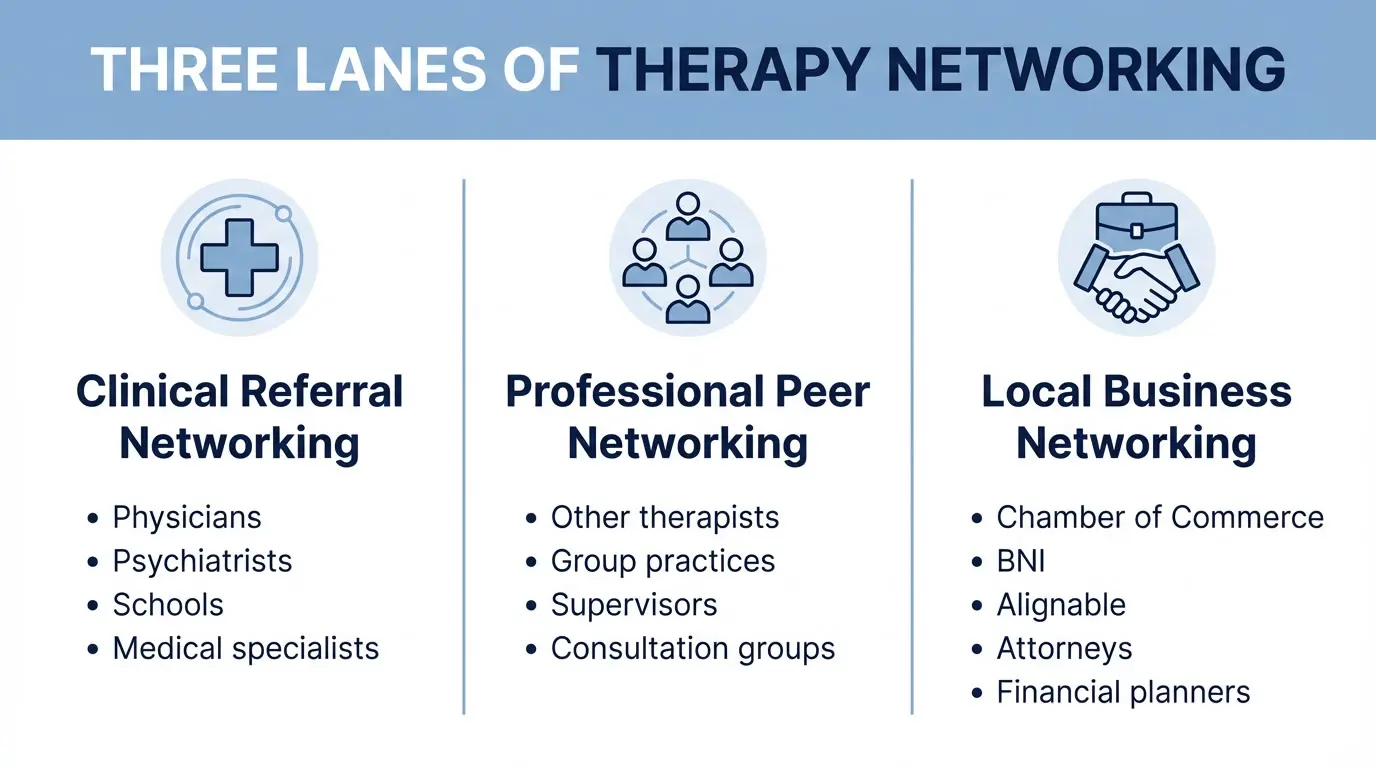
The Three Lanes of Therapy Networking
To make networking feel manageable (and not overwhelming), it helps to think of it in three lanes:
- Clinical referral networking
- Peer collaboration networking
- Local business networking
Each serves a different purpose.
Clinical Referral Networking (High-Impact, High-Relevance)
This is the most direct and often most effective lane.
Examples include:
- Primary care physicians
- Psychiatrists
- Nurse practitioners
- OB/GYN providers
- Pediatricians
- School counselors
These professionals regularly encounter patients who need therapy support. What they want is:
- A reliable clinician
- Clear intake steps
- Professional follow-through
- Good communication
You don’t need dozens of referral partners. Three to five strong relationships can consistently support an insurance-based or hybrid practice.
How to Approach It
Instead of “asking for referrals,” offer value.
- Provide a brief educational lunch-and-learn
- Share a short guide relevant to their patient population
- Send a quarterly update email outlining who you’re currently accepting
For example:
“I’m currently accepting referrals for high-functioning adults experiencing anxiety and burnout. I accept Aetna and Blue Cross, and I provide secure online intake.”
Clarity makes it easy for professionals to refer.
Peer Networking (Collaborative Growth)
Other therapists are not competitors — they are collaborators.
Peer networking helps when:
- You’re full and need to refer out
- You specialize and need complementary clinicians
- You’re building a reputation in a niche
Joining consultation groups or specialty associations builds credibility and long-term referral reciprocity.
If you’re focused on how to attract private pay therapy clients, niche peer visibility matters even more. Therapists who know your specialty will confidently refer cases that don’t fit their scope.
Local Business Networking (Often Overlooked)
Beyond clinical circles, therapists can build strong referral streams through local business networks.
Examples include:
- Chamber of Commerce
- BNI chapters
- Local professional meetups
- Alignable business networking platform
Platforms like Alignable allow therapists to connect with local attorneys, financial planners, HR professionals, and medical providers. These aren’t direct client marketplaces — they are relationship-building environments.
This can be particularly helpful for:
- Therapists working with professionals or executives
- Divorce or custody-related therapy specialties
- Trauma or legal-related cases
- High-functioning private pay clients
The key is not volume.
It’s visibility and trust.
One consistent referral partner can outperform multiple passive directory listings.
Making Networking Sustainable
Networking becomes overwhelming when it feels vague.
Instead, consider:
- Identifying 10 potential referral partners
- Reaching out to 2 per month
- Tracking outreach and follow-up
- Offering a short educational resource
- Clarifying your current availability
Consistency matters more than intensity.
Why Networking Works (Especially in an AI Era)
As AI tools become more visible in mental health conversations, human relationships matter even more.
Professionals refer to clinicians they:
- Trust
- Have met
- Understand clearly
- Believe will take care of their patients
No algorithm replaces professional confidence. Therapy networking builds that confidence.
If you’re wondering how to get more therapy clients, start by asking: Who already interacts with the type of clients I want to serve? Then build from there.
You don’t need to network everywhere. You need to network intentionally. Relationships grow practices.
SEO as a Long-Term Growth Engine
Directories generate visibility. SEO builds authority.
Most clients today start their search online when looking for therapy — and not finding you there means lost opportunities. Prioritize these foundational SEO strategies:
Create an SEO-Friendly Website
Your website should be more than a digital business card — it should be a conversion tool:
- Use key phrases like “mental health counselor accepting insurance” and “private pay therapist in [your city]” in your pages
- Write blog content that answers client questions (e.g., “How therapy works,” “Signs you might benefit from counseling”)
- Include clear calls-to-action (free consult, contact form, phone number)
Local SEO Matters
Optimize local search signals so people near you can find your practice:
- Claim your Business Profile on Google
- Use consistent practice name, address, and phone (NAP) across sites
- Add location-specific content to your site
Use Targeted Keywords
Keyword research helps your practice rank for what people actually search:
- Terms like “therapy services in [city],” “private pay counselor,” and “licensed therapist near me”
- Long-tail phrases (e.g., “how to find anxiety therapy for teens near me”)
Your website should:
- Target niche keywords
- Include location pages
- Feature blog content answering client questions
- Clarify insurance + private pay
For comprehensive SEO guidance, read our related post ➡ SEO Content Strategy for Clinicians in 2026
Create Valuable Content That Builds Authority
Content marketing isn’t just for big brands — it’s an essential way to be discoverable and help people before they reach out.
Content Ideas That Attract Clients:
- Blog posts on topics like “What to Expect in Therapy”
- Educational videos explaining common concerns
- Downloadable guides (e.g., stress management tips)
- Client testimonials and success stories (ethically shared)
Blog content also improves SEO and gets you found for more target and longtail queries.
When therapists ask how to get more therapy clients, social media often feels either overwhelming or inauthentic. Many clinicians worry it will feel performative, self-promotional, or “not therapist-like.”
The truth is: social media is not about becoming an influencer. It’s about becoming visible and understandable.
Today’s clients — especially private pay clients — rarely book with a therapist they haven’t researched first. They will look at your website. They may scan your LinkedIn. They may scroll your Instagram. Not to judge you — but to get a sense of who you are.
Used intentionally, social media allows potential clients to experience your tone, clarity, and philosophy before they ever reach out.

What Actually Works on Social Media for Therapists
The most effective content tends to:
- Translate clinical concepts into plain language
- Normalize common struggles (stress, burnout, relationship confusion)
- Offer small, actionable insights
- Clarify what therapy feels like — not just what it treats
For example, instead of posting generic inspirational quotes, consider:
- A short video explaining how high-functioning anxiety presents
- A post clarifying how therapy differs from talking to AI tools
- A LinkedIn article on managing stress for professionals
- A 60-second explanation of what happens during a first session
This builds authority and trust — particularly for clinicians wondering how to attract private pay therapy clients. Private pay clients often seek clarity, professionalism, and confidence in a therapist’s approach.
Choosing the Right Platform
You do not need to be everywhere.
- LinkedIn supports therapy networking and professional referrals.
- Instagram builds familiarity and human connection.
- YouTube supports long-term SEO growth and educational authority.
Consistency matters more than frequency. One thoughtful post per week, batched and scheduled, can be more effective than sporadic bursts of activity.
If you’d like more in-depth discussion of this area, our guide on SEO for therapists explains how blog content and social media can work together to build long-term visibility.
Using Digital Tools to Streamline Scheduling, Intake & Communication
Getting more therapy clients is only half the equation. Sustainable growth depends on what happens after the inquiry.
Many clinicians lose momentum not because demand is low, but because administrative friction becomes overwhelming.
Delayed callbacks. Intake paperwork emailed manually. Insurance confusion. Missed reminders. Documentation backlog.
These small inefficiencies quietly limit growth.
Why Systems Matter for Practice Growth
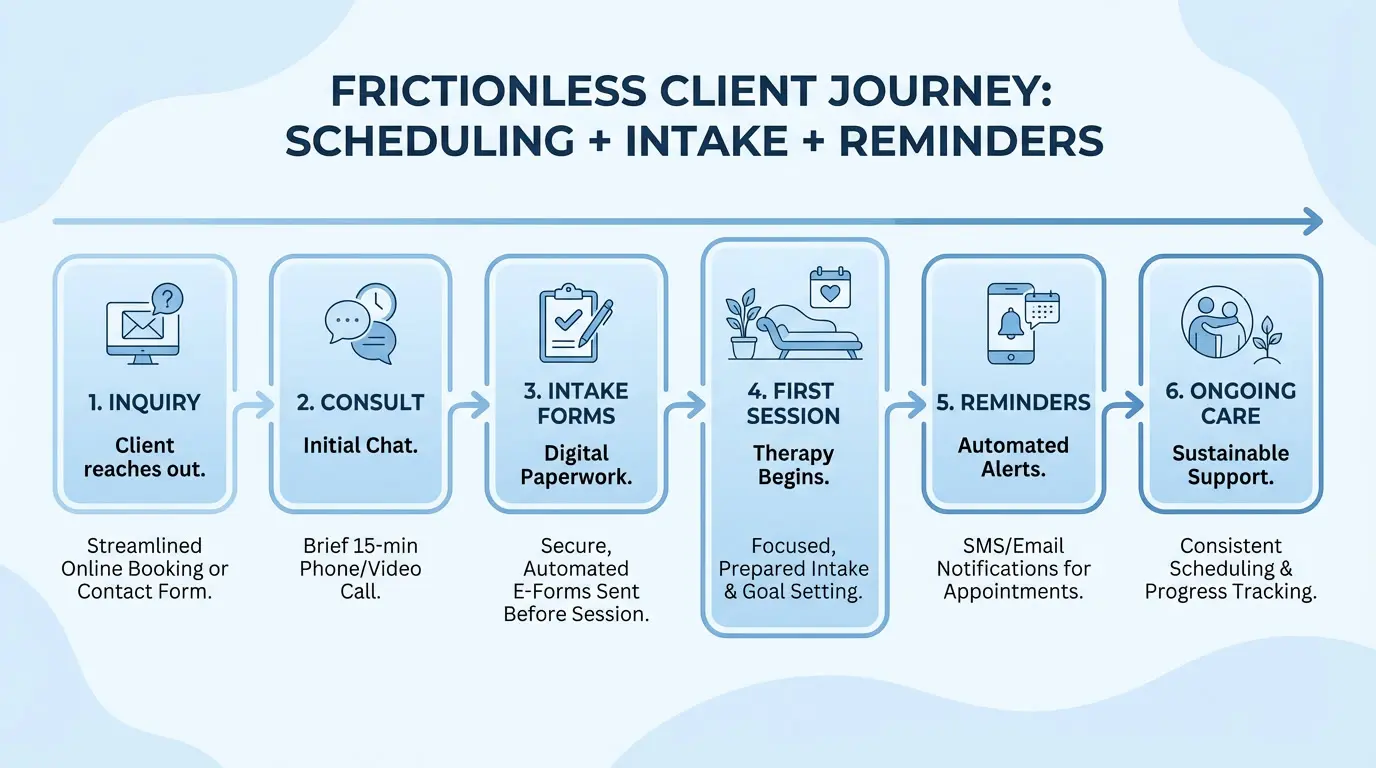
When a prospective client reaches out, speed and clarity matter. A smooth intake process communicates professionalism and safety. A clunky one creates hesitation.
Digital tools can reduce this friction in several ways:
Online Scheduling
Allowing clients to request or book consultations online removes unnecessary barriers. It also supports clients who prefer asynchronous communication.
Digital Intake & Secure Forms
Electronic intake forms reduce paperwork confusion and ensure essential information is collected before the first session.
Automated Reminders
Text and email reminders significantly reduce no-shows — which directly impacts revenue and consistency.
Secure Messaging & Documentation
Clear documentation workflows protect compliance while allowing you to focus on clinical care rather than chasing forms.
As your caseload grows, these systems stop being conveniences — they become growth infrastructure.
Behavioral-health-specific EHR systems like ICANotes are designed with these workflows in mind: structured documentation templates, integrated scheduling, billing support, and secure communication tools that support both insurance and private pay practices.
The goal isn’t to “automate therapy.” It’s to remove friction so you can deliver therapy more effectively.
Retaining Clients: The Overlooked Growth Strategy
When discussing how to get more therapy clients, most conversations focus on acquisition.
But sustainable private practice growth depends just as much on retention.
Retention improves:
- Clinical outcomes
- Revenue stability
- Referral likelihood
- Professional satisfaction
A client who attends consistently, engages in treatment planning, and feels supported is more likely to refer others — especially in private pay settings.
What Drives Client Retention?
Retention rarely depends on charisma. It depends on clarity and structure.
Clients are more likely to continue when:
- Expectations are clear from the first session
- Treatment goals are collaborative and visible
- Scheduling is consistent
- Communication feels professional and responsive
- Reminders reduce accidental cancellations
Many turnover issues are not about therapeutic fit — they’re about logistics, confusion, or missed follow-ups.
If retention has been a challenge, we explore this more deeply in:
Strengthening retention doesn’t just stabilize your practice — it increases the return on every marketing effort you make.
Growth isn’t only about bringing new clients in the door. It’s about building a system where they stay engaged and make progress.
How ICANotes Supports SEO and Sustainable Practice Growth
Attracting more therapy clients doesn’t end with marketing.
Once someone finds you through Google, a directory listing, or a referral, what happens next determines whether your practice grows — or leaks opportunities.
Your EHR and practice management system quietly play a major role in:
-
How easy it is for clients to schedule
-
How quickly intake paperwork is completed
-
Whether reminders reduce no-shows
-
How professional your process feels
-
Whether your documentation supports medical necessity for insurance reimbursement
In other words, your infrastructure becomes a trust signal.
A clean, efficient intake process communicates professionalism.
Automated reminders reduce friction.
Secure portals reinforce credibility.
Well-structured documentation protects revenue and reduces audit risk.
When systems are clunky or manual, growth creates stress instead of sustainability.
Where ICANotes Fits In
ICANotes was built specifically for behavioral health — not retrofitted from general medical software.
For clinicians focused on growing their practice, ICANotes supports:
✔ Structured clinical documentation
Menu-driven templates designed for mental health improve note quality and consistency — which is critical for insurance-based practices.
✔ Streamlined scheduling and intake
Online intake forms, secure portals, and automated workflows reduce administrative friction for new clients.
✔ Built-in compliance support
Role-based security, behavioral health–specific content, and medical necessity documentation tools help protect your revenue as your caseload grows.
✔ Scalable growth
Whether you’re solo, hybrid insurance/private pay, or building a group practice, the system grows with you.
When your backend systems are aligned, your marketing efforts become more powerful because you can confidently handle increased inquiries.
If your goal in 2026 is to improve visibility, attract both insurance and private pay clients, reduce documentation stress, and build a sustainable, profitable practice then your technology should support that growth — not slow it down. Get a free 30-day trial of ICANotes today.

Start Your 30-Day Free Trial
Experience the most intuitive, clinically robust EHR designed for behavioral health professionals, built to streamline documentation, improve compliance, and enhance patient care.
- Complete Notes in Minutes - Purpose-built for behavioral health charting
- Always Audit-Ready – Structured documentation that meets payer requirements
- Keep Your Schedule Full – Automated reminders reduce costly no-shows
- Engage Clients Seamlessly – Secure portal for forms, messages, and payments
- HIPAA-Compliant Telehealth built into your workflow


Frequently Asked Questions: How to Get More Therapy Clients
The Core Drives of Sustainable Practice Growth
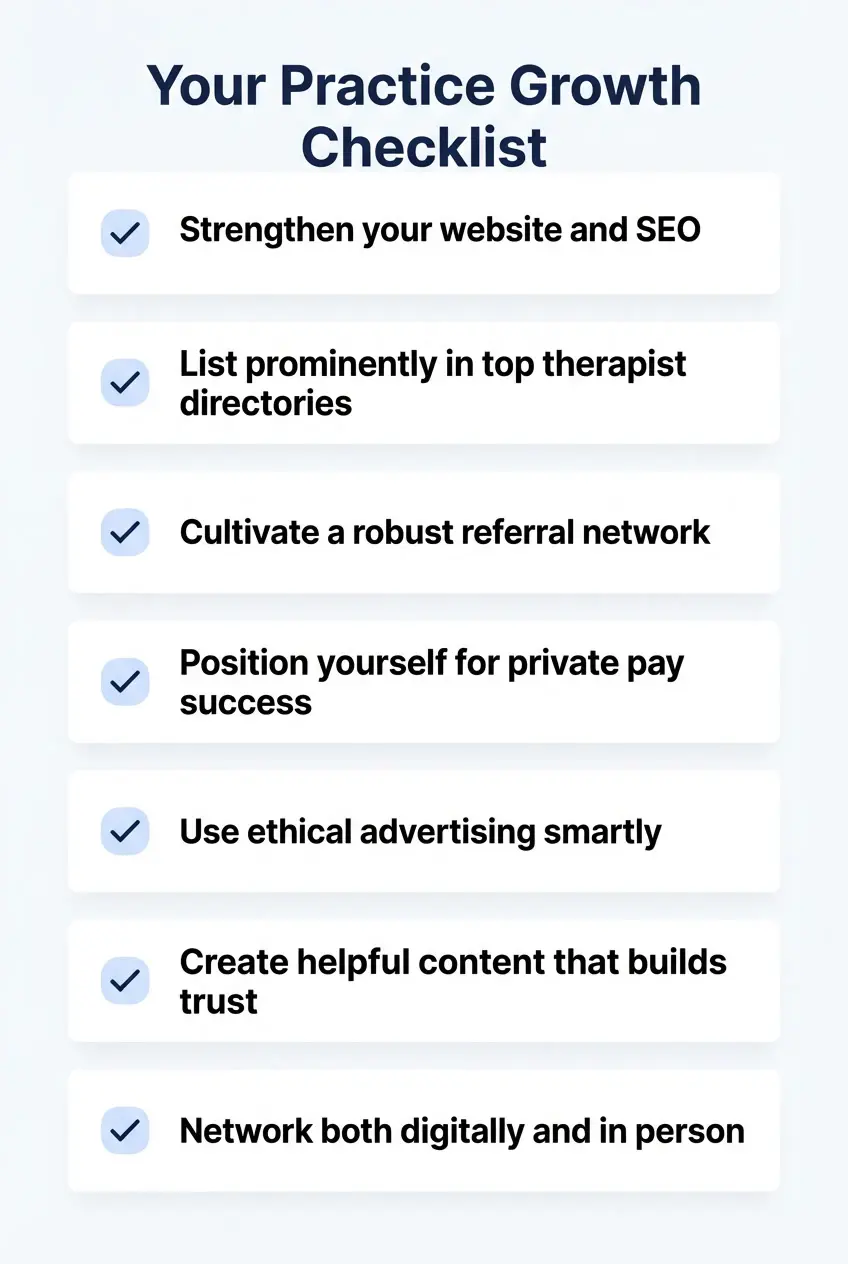
If this feels like a lot, here’s the reassuring truth: You do not need to implement everything.
Sustainable growth usually comes from:
- Clear niche messaging
- One or two optimized directories
- Consistent referral relationships
- Removing friction from inquiry → booking
That’s it. Not daily posting. Not constant reinvention.
Just clarity and consistency.
Building a Practice That Lasts
If you’re trying to figure out how to get more therapy clients, you’re not asking the wrong question. You’re asking a responsible one.
A stable, thriving practice allows you to:
- Serve more people
- Offer better care
- Reduce burnout
- Stay in the profession longer
Marketing doesn’t have to change who you are. It simply helps the right clients find you.
Related Posts





Sandy Crowley
Chief Marketing Officer
About the Author
Sandy Crowley is the Chief Marketing Officer at ICANotes, a leading EHR platform purpose-built for behavioral health. Sandy has over two decades of experience bridging healthcare, marketing, and software innovation. Formerly the company’s CEO, she guided ICANotes through a period of rapid growth and product expansion. With a background in communications from Stanford University and a passion for helping clinicians streamline documentation and improve outcomes, Sandy continues to drive ICANotes’ mission to make behavioral health software smarter, more efficient, and clinician-focused.
Using Social Media to Attract Therapy Clients (Without Feeling Salesy)