Blog > Billing and Insurance > Best Mental Health Billing Software & EHRs for Therapists (2026)
Best Mental Health Billing Software & EHRs for Therapists (2026)
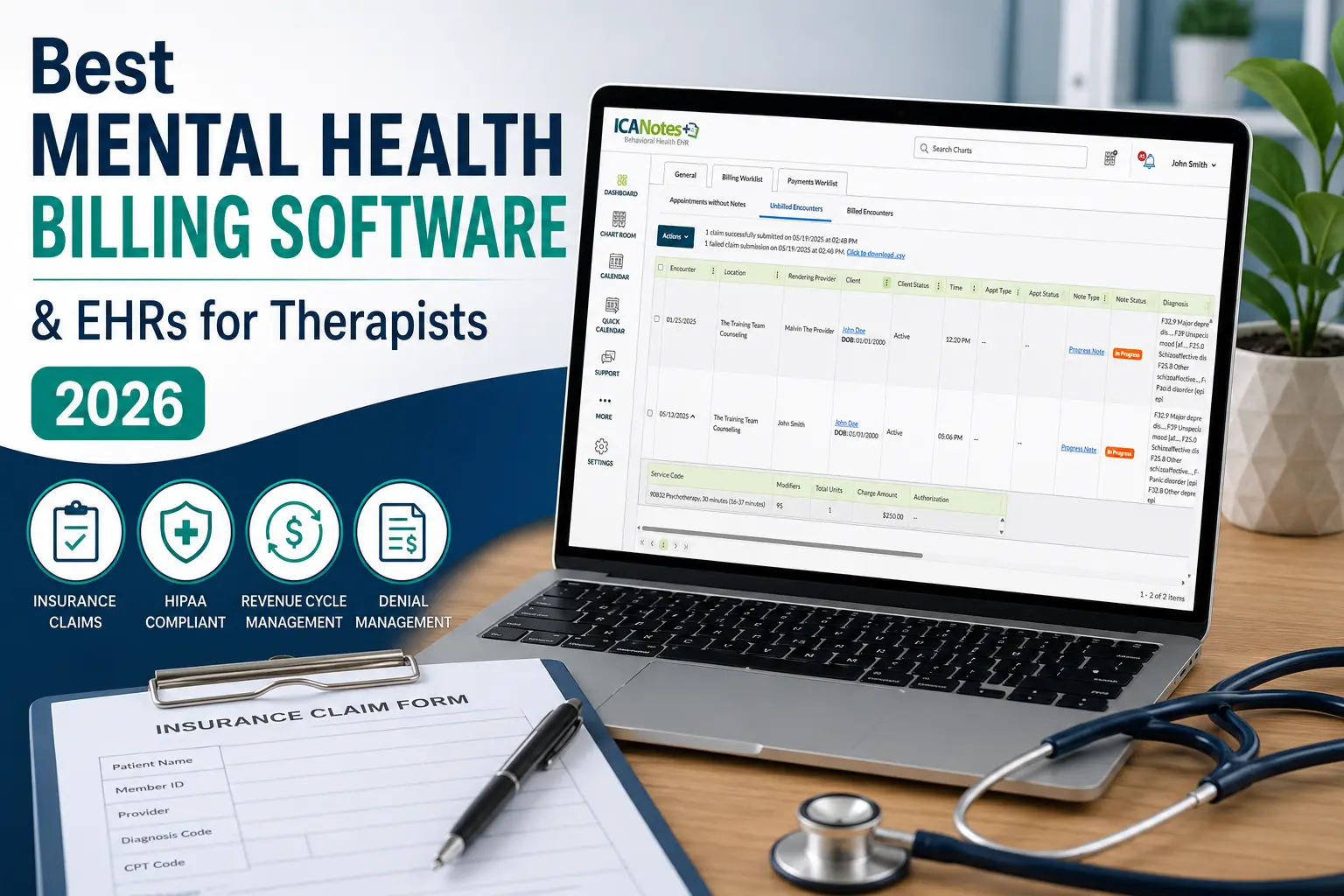
Choosing the right mental health billing software can have a major impact on your practice's revenue, efficiency, and claim approval rates. In this guide, we compare the best therapist billing software and behavioral health EHRs for 2026, including ICANotes, TherapyNotes, SimplePractice, TheraNest, and Valant. Learn which features matter most for insurance billing, claims management, denial prevention, and revenue cycle management so you can find the best solution for your therapy, psychology, or psychiatry practice.


Last Updated: June 18, 2026
What You'll Learn
- Why mental health billing software requirements differ from those of general medical practices
- Which billing, claims management, and revenue cycle features matter most in a behavioral health EHR
- How the leading mental health billing software platforms compare for therapists, psychologists, psychiatrists, and group practices
- What to look for in therapist billing software to reduce claim denials and improve reimbursement rates
- How integrated documentation and billing workflows can save time and improve claim accuracy
- Which EHR solutions are best suited for solo practitioners, small practices, and larger behavioral health organizations
- Common mental health billing mistakes and the software features that help prevent them
- How to choose the best mental health billing software for your practice's size, payer mix, and growth goals
Contents
- Best Mental Health Billing Software Platforms for Therapists
- Why ICANotes is a Leading Mental Health Billing Software Solution
- Common Mental Health Billing Mistakes and How Billing Software Prevents Them
- How to Choose the Best Mental Health Billing Software for Your Practice
- Best Billing Software for Psychologists
- Best Psychiatry Billing Software for Medication Management Practices
- Best Therapist Billing Software for Solo Practices
- FAQ: Mental Health Billing Software
Mental health clinicians spend a substantial share of their time on administrative work — with psychiatrists in one study spending about 20% — and billing sits at the top of that list. Between deciphering payer requirements, managing prior authorizations, tracking claim denials, and reconciling remittances, insurance billing can feel like a second job layered on top of clinical work.
The EHR platform you choose shapes how much of that burden you carry. Some platforms treat billing as a feature checkbox. Others — particularly those built specifically for behavioral health — weave billing directly into clinical workflows so that documentation, coding, and claim submission work together rather than against each other.
This guide is written for behavioral health clinicians and practice administrators who are evaluating or reconsidering their EHR. It covers what to look for in mental health billing software, how the leading behavioral-health EHR platforms compare, and what makes some platforms genuinely better at handling the billing complexity that comes with mental health practice.
Why Mental Health Billing Software Matters for Therapists and Psychologists
Mental health billing is not a simplified version of medical billing. It carries its own documentation requirements, coding conventions, and payer dynamics — and the margin for error is narrow.
- Higher documentation requirements tied to reimbursement: Unlike many medical specialties, behavioral health insurers frequently require detailed session notes, treatment plans, and progress documentation before approving ongoing care. A claim submitted without adequate supporting documentation isn't just delayed — it's denied, and resubmission requires clinician time.
- Behavioral health CPT codes and modifiers add complexity: The behavioral health CPT code set includes nuances that don't exist in primary care. The difference between 90832 and 90837 isn't just session length — it affects reimbursement rates and, for some payers, triggers different documentation requirements. Add modifiers for telehealth (95, GT), group therapy, or evaluation and management (E&M) services and the coding picture becomes more intricate.
- Claim denial rates are higher in mental health: Available data suggest behavioral health claims are denied more often than other claims, with one report finding denial rates of 30% versus 19%. Common reasons include missing or incorrect diagnosis codes, mismatched CPT codes, lack of prior authorization, and coordination-of-benefits issues. Each denial costs time and delays revenue — and without a systematic denial management workflow, some practices never recover those reimbursements.
- The documentation-to-billing gap is costly: In practices where clinical notes and billing exist in separate systems, information has to be re-entered or manually transferred at the point of claim submission. Every handoff is an opportunity for error. An EHR that connects documentation directly to billing — where a completed note automatically populates a claim — removes that gap and the errors it creates.
- General medical EHRs often fall short: Platforms built for primary care or multi-specialty practices may handle billing broadly, but they rarely account for the specific CPT codes, payer rules, and documentation workflows that define behavioral health billing. Workarounds are common — and workarounds mean staff time and billing errors.
Essential Features in Mental Health Billing Software
Not every billing-related feature carries equal weight in a behavioral health practice. Here are the capabilities that matter most — and why each one is specifically relevant to mental health clinicians.
Insurance Claim Submission and Electronic Remittance
The ability to submit claims electronically to payers — and receive Electronic Remittance Advice (ERA) and Explanation of Benefits (EOB) back — is foundational. Without it, practices are processing paper remittances manually, which adds significant administrative time and delays posting. Look for a platform that handles the full claims lifecycle: submission, tracking, remittance receipt, and payment posting.
HIPAA-Compliant Billing and Documentation
Behavioral health records carry heightened sensitivity requirements under HIPAA — particularly around mental health and substance use records, which may fall under additional protections such as 42 CFR Part 2. Any EHR handling billing in a behavioral health practice must be built with HIPAA compliance as a baseline, not an add-on. This includes secure data transmission for claims, appropriate access controls on patient financial data, and audit trails.
Clearinghouse Integration
A clearinghouse sits between your practice and payers, scrubbing claims for errors before submission and routing them to the correct payer. Integrated clearinghouse access means claims are validated before they reach the payer — catching common errors that would otherwise result in denials. Some EHRs partner with a clearinghouse and include access as part of the platform; others require a separate subscription. Integrated is almost always preferable: fewer handoffs, faster identification of issues, and consolidated claim tracking.
Automated Eligibility Verification
Verifying a patient's insurance eligibility before every session is a best practice most practices aspire to and many don't achieve — because manual eligibility checks are time-consuming. An EHR with automated eligibility verification can run checks in real time or in batch prior to scheduled appointments, flagging coverage issues before the patient arrives rather than after the claim is submitted.
Behavioral Health CPT and ICD-10 Code Support
The platform should support the full set of behavioral health CPT codes (individual therapy, group therapy, family therapy, psychological testing, medication management, telehealth) along with relevant modifiers and ICD-10 diagnosis codes . Ideally, the EHR also offers coding suggestions or auto-population based on documentation — reducing the risk of mismatches between what was documented and what was billed.
Denial Management and Resubmission Workflows
This is one of the most underserved areas in EHR billing tools — and one of the most consequential. A strong denial management workflow means the platform tracks denied claims, surfaces the denial reason, and facilitates resubmission or appeals. Without this, denied claims can slip through the cracks entirely, representing permanent revenue loss. Look for visibility into denial rates, denial reasons, and the status of resubmissions.
Superbill Generation
Practices that see self-pay patients or work with patients seeking out-of-network reimbursement need to generate superbills — itemized receipts that patients can submit to their insurance for partial reimbursement. Superbill generation should be fast and accurate, pulling diagnosis codes, CPT codes, and session details directly from the clinical record.
Patient Statements and Payment Processing
After insurance adjudication, practices typically bill patients for copays, coinsurance, and deductibles. The EHR should generate clear patient statements and support payment collection — ideally including online payment options to reduce the time between statement delivery and payment receipt.
Revenue Cycle Management Reporting
Billing visibility matters. The right EHR provides reporting that lets practice owners and administrators see key revenue cycle metrics : claim submission volume, denial rates, days in accounts receivable, collections by payer, and outstanding balances. This data is essential for identifying billing problems before they become revenue problems.

Mental Health Practice
Billing Audit Checklist
Discover hidden revenue leaks, identify billing workflow gaps, and evaluate how effectively your practice manages claims, denials, eligibility verification, payment posting, and compliance.
- 38 questions to evaluate your billing workflow
- Identify denial risks and reimbursement bottlenecks
- Benchmark your revenue cycle processes
- Uncover opportunities to improve cash flow
No cost. Instant access. Built specifically for behavioral health practices.
Best Mental Health Billing Software Platforms for Therapists
The following platforms are all purpose-built or specifically adapted for behavioral health. We've excluded general medical EHRs and platforms without a meaningful behavioral health billing focus, because the workarounds they require aren't worth the time.
This comparison chart highlights the leading mental health billing software platforms for therapists, psychologists, psychiatrists, and behavioral health organizations, helping practices evaluate billing, claims management, and revenue cycle capabilities at a glance.

ICANotes
ICANotes is an EHR built exclusively for behavioral health — from the ground up, for this specialty, with no general medical framework underneath it. Its billing capabilities are fully integrated with clinical documentation, which means the path from a completed session note to a submitted claim is as direct as it can be. ICANotes supports a comprehensive billing workflow including clearinghouse integration, electronic claims, ERA/EOB processing, automated E&M coding , and optional revenue cycle management services .
Key Billing Features
- Integrated clearinghouse with claim scrubbing prior to submission
- Automatic E&M coding based on clinical documentation
- Electronic claims submission with status tracking
- ERA and EOB processing with automated payment posting
- Patient statements
- CMS-1500 claim form support
- Medicaid and Medicare compliance
- Optional RCM services
- Behavioral health CPT and modifier support, including telehealth
Best For
Behavioral health practices of all sizes — solo practitioners, group practices, and agencies — particularly those with high insurance claim volume or complex payer mixes.
Notable Considerations
Optional revenue cycle management services are available for organizations that prefer to outsource billing operations.
TherapyNotes
TherapyNotes is a widely used behavioral health EHR with a strong reputation for usability. Its billing tools cover the essentials well: electronic claims submission, ERA management, and patient billing. It's a solid option for practices that prioritize ease of use and want a platform they can learn quickly.
Key Billing Features
- Electronic claims submission
- ERA and EOB management
- Insurance payment posting
- Patient billing and online payments
- Eligibility verification
Best For
Practices prioritizing ease of use alongside solid billing functionality.
Notable Limitation
Less depth in denial management and RCM reporting compared to more billing-focused platforms. Customization options are more limited.
SimplePractice
SimplePractice is one of the most recognized names in mental health practice management software, with a large solo practitioner and small practice user base. Its billing features cover standard outpatient needs: electronic claims, payment processing, and client billing. The platform is designed to be accessible for clinicians who are managing billing themselves without dedicated billing staff.
Key Billing Features
- Electronic claims submission
- Insurance payment tracking
- Client billing and online card-on-file payments
- Eligibility verification
- Superbill generation
Best For
Solo practitioners and small practices with relatively straightforward payer mixes.
Notable Limitation
Billing features are less robust for practices with complex insurance billing or high claim volume. RCM capabilities are limited.
TheraNest
TheraNest offers a flexible, affordable billing toolkit suitable for smaller or newer practices. It covers core billing functions and supports both self-pay and insurance billing workflows.
Key Billing Features
- Electronic claims submission
- ERA management
- Patient billing and payment processing
- Eligibility verification
- Billing reports
Best For
Cost-conscious solo practitioners and small practices that need functional billing without enterprise-level features.
Notable Limitation
Reporting depth and denial management capabilities are more basic than larger platforms.
Valant
Valant is a behavioral health EHR positioned for mid-to-large group practices and organizations. It offers integrated billing alongside clinical documentation, with a focus on larger practices managing multiple clinicians and complex payer relationships.
Key Billing Features
- Electronic claims and ERA management
- Denial tracking and management
- Revenue cycle reporting
- Eligibility verification
- Patient billing
Best For
Mid-to-large behavioral health organizations that need multi-clinician billing management and stronger reporting.
Notable Limitation
More complex implementation and a steeper learning curve; may be more platform than smaller practices need.
Why ICANotes is a Leading Mental Health Billing Software Solution
Because ICANotes was built exclusively for behavioral health, its billing capabilities don't require adaptation or workarounds — they're designed around the actual billing realities clinicians face every day. Here's how the key billing features work in practice.

Integrated Clearinghouse
ICANotes includes integrated clearinghouse access, which means claims are scrubbed for errors before they reach the payer. The clearinghouse checks for common problems — incorrect codes, missing information, formatting issues — and flags them for correction before submission. This front-end validation materially reduces denial rates by catching errors that would otherwise only surface after a payer rejection.
Automatic E&M Coding
One of ICANotes' most distinctive billing features is automatic Evaluation and Management (E&M) coding. As a clinician completes documentation, the system evaluates the complexity of the visit based on what was documented and suggests the appropriate E&M code. This reduces undercoding (and the revenue loss that comes with it) and helps ensure that billing accurately reflects the work performed.
Medicaid and Medicare Compliance
Many behavioral health practices — particularly community mental health centers and agencies — serve high proportions of Medicaid and Medicare patients. ICANotes is built with Medicaid and Medicare compliance requirements in mind, including support for the documentation standards and billing rules these payers require.
CMS-1500 Claim Form Support
ICANotes supports the CMS-1500 claim form, the standard paper and electronic claim form used for professional services billing. For practices that still work with payers requiring CMS-1500 submissions, the platform handles form population directly from patient and clinical data.
ERA and EOB Processing
Electronic Remittance Advice (ERA) files from payers are processed automatically in ICANotes, with payment information posted against the corresponding claims. This eliminates manual remittance reconciliation — one of the most time-consuming billing tasks in practices managing high claim volume.
Patient Statements
After insurance adjudication, ICANotes generates and delivers patient statements. Statements can be sent via mail or electronically, supporting practices that want to offer patients flexible billing communication.
Revenue Cycle Management Services
For practices that prefer to outsource billing entirely — or that need additional support managing complex payer relationships — ICANotes offers optional revenue cycle management (RCM) services. RCM clients have access to professional billing specialists who manage claim submission, follow-up, denial management, and reporting on their behalf.
The Documentation-to-Billing Connection
Perhaps the most important structural advantage of ICANotes is the direct connection between clinical documentation and billing. Because the EHR is built as an integrated system, a completed session note doesn't need to be manually translated into billing data — diagnosis codes, CPT codes, session details, and clinician information flow directly into the claim. This eliminates the transcription errors and information gaps that occur when documentation and billing exist in separate systems.
Spend Less Time Billing.
Spend More Time Caring for Patients.
If you're evaluating mental health billing software, don't settle for a system that treats billing as an afterthought. ICANotes combines behavioral health documentation, scheduling, insurance billing, claims management, eligibility verification, and reporting in a single integrated platform.
Discover how behavioral-health-specific workflows can help reduce claim denials, accelerate reimbursement, simplify compliance, and eliminate duplicate data entry between clinical documentation and billing.
Book Your Personalized Demo
See how ICANotes can streamline documentation, billing, and revenue cycle management for your practice.
Common Mental Health Billing Mistakes and How Billing Software Prevents Them

Using Incorrect CPT Codes for Behavioral Health Sessions
Billing a 60-minute individual therapy session with the wrong CPT code — or using a code without the appropriate modifier — results in either a denial or an underpayment. An EHR with behavioral-health-specific CPT code support and coding guidance reduces this risk significantly. When the documentation and billing systems are integrated, the platform can cross-reference what was documented against what's being billed, flagging mismatches before submission.
Missing or Incomplete Documentation for Insurance Reimbursement
Many payers require specific documentation elements — clinical necessity justification, treatment plan references, progress notes meeting certain standards — before reimbursing behavioral health claims. Submitting a claim before documentation is complete, or with documentation that doesn't meet payer requirements, is a common and avoidable source of denials. An EHR with documentation templates built around insurance requirements — and that ties claim submission to note completion — addresses this directly.
Claim Submission Errors That Could Be Caught at the Clearinghouse
Demographic errors (misspelled patient names, incorrect dates of birth, wrong insurance ID numbers), missing provider information, and formatting issues are responsible for a significant share of claim rejections. These aren't clinical errors — they're data errors, and they're largely preventable. Integrated clearinghouse access catches most of them before the claim reaches the payer, where a rejection adds days to the revenue cycle.
Failing to Verify Eligibility Before Appointments
Coverage status changes. Patients change jobs, age out of a parent's plan, or have a gap in coverage without realizing it. If eligibility isn't verified before an appointment, a practice may render and bill services only to find the claim denied because the patient wasn't covered on the date of service. Automated eligibility verification — run against the appointment schedule before each session day — is the most reliable way to prevent this.
Not Tracking Denials or Following Up on Resubmissions
A denial that isn't followed up on is lost revenue. Yet many practices, particularly those managing billing manually or in a system without robust denial tracking, lose track of denied claims in the volume of daily billing activity. An EHR with denial management workflows — where denials are automatically surfaced, categorized by reason, and tracked through resubmission — makes it possible to systematically recover revenue that would otherwise slip away.
How to Choose the Best Mental Health Billing Software for Your Practice
The right platform depends on your practice size, payer mix, and how billing is managed in your organization.

Solo Practitioners
Solo practitioners typically need a platform that's easy to use without dedicated billing staff, supports electronic claims submission and patient billing, and doesn't require a large upfront investment. SimplePractice and TheraNest are commonly chosen in this segment. ICANotes is also well-suited for solo practitioners who have complex billing needs — particularly those accepting Medicaid, Medicare, or working with multiple payers — and who want more billing depth than general-purpose platforms provide.
Small Group Practices
Small group practices add complexity: multiple clinicians, potentially varied payer contracts, and the need for practice-level billing reporting. ICANotes and TherapyNotes both serve this segment well. The deciding factors are usually the depth of billing reporting needed and the complexity of the payer mix. Practices with high insurance claim volume or frequent denials benefit from the more robust billing infrastructure ICANotes provides.
Larger Behavioral Health Organizations
Larger practices, group practices with 10+ clinicians, community mental health centers, and behavioral health agencies need EHRs with enterprise-level billing capabilities: multi-clinician billing oversight, sophisticated revenue cycle reporting, and often, integration with organizational billing or finance systems. ICANotes and Valant are the most common choices in this tier. ICANotes' optional RCM services make it particularly well-suited for organizations that want professional billing support without building a large internal billing department.
Practices with High Insurance Volume
Volume amplifies the importance of automation. Practices submitting hundreds of claims per week cannot afford manual processes at any step of the billing cycle. For high-volume practices, clearinghouse integration, automated eligibility verification, ERA processing, and denial management workflows aren't nice-to-haves — they're operational requirements.
Practices Accepting Medicaid or Medicare
Medicaid and Medicare billing carries specific documentation requirements, billing rules, and compliance obligations that not all EHRs address adequately. Practices with significant Medicaid or Medicare volume should explicitly evaluate a platform's compliance with these payer requirements before committing — including how the EHR handles Medicare's documentation standards and Medicaid's state-by-state variation.
Best Billing Software for Psychologists
Psychologists often have billing needs that differ from those of other behavioral health professionals. In addition to psychotherapy services, many psychologists provide psychological testing, assessments, and specialized evaluations that require accurate CPT coding and detailed documentation. Because reimbursement is closely tied to documentation quality, choosing billing software that integrates seamlessly with clinical records is especially important.
The best billing software for psychologists should support a wide range of behavioral health CPT codes, automate insurance claim submission, verify patient eligibility, and simplify denial management. Integrated EHR platforms offer an additional advantage by connecting documentation directly to claims, reducing the risk of coding errors and missing information.
For psychologists who regularly bill insurance, features such as electronic claims submission, ERA processing, clearinghouse integration, and robust reporting can significantly reduce administrative workload while improving reimbursement rates. Platforms designed specifically for behavioral health, such as ICANotes, are often better equipped to support the documentation and billing requirements associated with psychological services than general-purpose medical software.
Best Psychiatry Billing Software for Medication Management Practices
Psychiatric practices face unique billing challenges because many encounters involve Evaluation and Management (E&M) services in addition to psychotherapy. Selecting the right psychiatry billing software can help clinicians accurately capture service complexity, apply appropriate CPT codes, and maintain compliance with Medicare, Medicaid, and commercial payer requirements.
Psychiatry billing software should support psychiatric diagnostic evaluations, medication management visits, psychotherapy add-on codes, telehealth services, and E&M coding workflows. Automated coding assistance can be particularly valuable because undercoding can reduce revenue while overcoding may increase audit risk.
For practices that manage a high volume of insurance claims, integrated billing features such as claim scrubbing, eligibility verification, denial tracking, and electronic remittance processing can improve cash flow and reduce administrative burden. Behavioral-health-focused EHRs such as ICANotes are designed to support these specialized psychiatric billing workflows while maintaining a direct connection between clinical documentation and claims submission.
Best Therapist Billing Software for Solo Practices
Solo practitioners often need therapist billing software that is both easy to use and affordable. Without dedicated billing staff, therapists typically handle many administrative responsibilities themselves, making efficiency and automation critical factors when evaluating software options.
The best therapist billing software should simplify insurance claims management, patient invoicing, eligibility verification, payment collection, and superbill generation. An integrated platform can eliminate duplicate data entry by automatically pulling diagnosis codes, session information, and clinician details from the clinical record into billing workflows.
Therapists who accept insurance should also look for software that includes clearinghouse integration, claim tracking, denial management tools, and electronic remittance processing. While some solo practitioners choose lightweight practice management systems, those with complex payer mixes or significant insurance billing volume often benefit from a behavioral-health-specific EHR that combines clinical documentation and billing in a single system. This integrated approach helps reduce claim errors, improve reimbursement timelines, and minimize administrative workload.
Frequently Asked Questions About Mental Health Billing Software
Recent Posts






Fatima Davis
RCM Manager
About the Author
Fatima C. Davis is the RCM Manager at ICANotes and a seasoned expert in behavioral health revenue cycle management. With over 20 years of experience, she specializes in optimizing collections, reducing denials, and ensuring compliance across diverse payer landscapes. Fatima has led RCM operations for large multi-agency systems and is passionate about helping behavioral health practices achieve financial sustainability.