Insurance Credentialing Pitfalls That Cost Mental Health Clinicians Thousands (And How to Avoid Them)
Insurance credentialing mistakes can quietly cost mental health clinicians thousands of dollars through denied claims, delayed reimbursement, and lost network status. This in-depth guide breaks down the most common insurance credentialing pitfalls for therapists and group practices, explains how these errors impact revenue, and outlines practical steps clinicians can take to prevent denials, protect cash flow, and maintain compliant payer relationships.


Last Updated: February 10, 2026

What You'll Learn
- How small credentialing oversights can snowball into major revenue losses
- Where therapists and group practices most often get credentialing wrong
- How to spot credentialing-related issues behind recurring claim denials
- What systems help protect your practice from credentialing lapses
- When it makes sense to seek credentialing or billing support
Contents
- The Most Common Insurance Credentialing Pitfalls for Therapists
- How Credentialing Issues Lead to Claim Denials
- Can You Recover Lost Revenue from Credentialing Mistakes?
- How To Avoid Insurance Credentialing Pitfalls Going Forward
- When It Makes Sense to Get Help with Insurance Credentialing
- FAQ: Insurance Credentialing for Mental Health Clinicians
Insurance credentialing is often treated as a one-time administrative hurdle — something you “get through” so you can start seeing clients and billing insurance.
But for many mental health clinicians, credentialing mistakes quietly cost thousands of dollars every year through denied claims, delayed reimbursements, missed effective dates, and loss of network status — often without anyone realizing credentialing was the root cause.
If you’ve ever thought:
- “I thought I was credentialed…”
- “Why are these claims suddenly denying?”
- “We’ve always billed this payer without issues before…”
This article is for you.
Below, we’ll walk through the most common insurance credentialing pitfalls for therapists and behavioral health practices, how they impact reimbursement, and what you can do to protect your revenue moving forward.
Why Insurance Credentialing Mistakes Are So Expensive
Credentialing errors don’t usually show up as obvious line items on a balance sheet. Instead, they show up as:
- Claims denied weeks or months after sessions occur
- Payments reduced or clawed back
- Inability to retroactively bill for services already provided
- Gaps in cash flow that look like “billing problems” but aren’t
Unlike documentation errors, credentialing issues often invalidate otherwise clean, compliant claims. That means even perfect notes can still result in $0 reimbursement.
Over time, these issues compound, especially in insurance-based or hybrid practices.
Credentialing isn’t just administrative busywork — it’s a compliance gatekeeper governed by CMS and payer rules, which is why credentialing is not clerical.
Audit Your Insurance Credentialing Before It Costs You Revenue
Credentialing gaps often go unnoticed until claims are denied or payments stop. Use this free Insurance Credentialing Audit Worksheet to review CAQH accuracy, payer status, effective dates, and recredentialing risk — before small issues turn into lost revenue.
The Most Common Insurance Credentialing Pitfalls for Therapists
Insurance credentialing problems rarely come from one dramatic mistake. More often, they stem from small oversights — missed updates, incorrect assumptions, or systems that quietly fall out of sync over time. Below are the most common insurance credentialing pitfalls therapists encounter, along with why they matter and how they can impact reimbursement.
Incomplete or Inaccurate CAQH Profiles
CAQH ProView is a central hub for credentialing data, but it’s also one of the most common failure points.
Common CAQH mistakes include:
- Expired licenses or malpractice insurance
- Mismatched practice addresses or tax IDs
- Missing signatures or attestations
- Forgetting to re-attest every 90 days
Even small discrepancies can delay credentialing approvals or trigger rejections, sometimes without direct notification.
Assuming “In Network” Means “Ready to Bill”
Many clinicians are told they’re “in network” and assume billing can begin immediately.
In reality, credentialing, enrollment, and contracting are separate steps, and billing before the official effective date can invalidate claims.
If services are rendered before credentialing is finalized:
- Claims may be denied outright
- Retroactive billing may not be allowed
- Revenue may be permanently lost
This is especially common when starting a new practice or adding insurance panels quickly.
Missing Recredentialing Deadlines
Credentialing is not a one-and-done process.
Most payers require recredentialing every 2–3 years, and missing a deadline can result in:
- Automatic termination from the network
- Silent removal from payer panels
- Denials that begin months later with no obvious cause
Because recredentialing often happens quietly in the background, clinicians may continue seeing clients unaware their network status has changed.
Credentialing New Clinicians Incorrectly in Group Practices
Group practices face additional credentialing risks, especially when onboarding new clinicians.
Common issues include:
- Incorrect rendering provider assignments
- Supervisory relationships not documented correctly
- Clinicians seeing clients before credentialing is complete
- Mismatched NPIs between clinicians and the practice
These errors can affect every claim a new clinician submits — not just one or two.
Telehealth and Multi-State Credentialing Errors
Licensure and credentialing are not the same thing.
Clinicians practicing via telehealth may:
- Be licensed in a state but not credentialed with that state’s payer
- Assume PSYPACT or compact licensure guarantees payer approval
- Overlook Medicaid’s state-specific credentialing rules
This can lead to large volumes of denied claims after weeks or months of services.
How Credentialing Errors Lead to Claim Denials
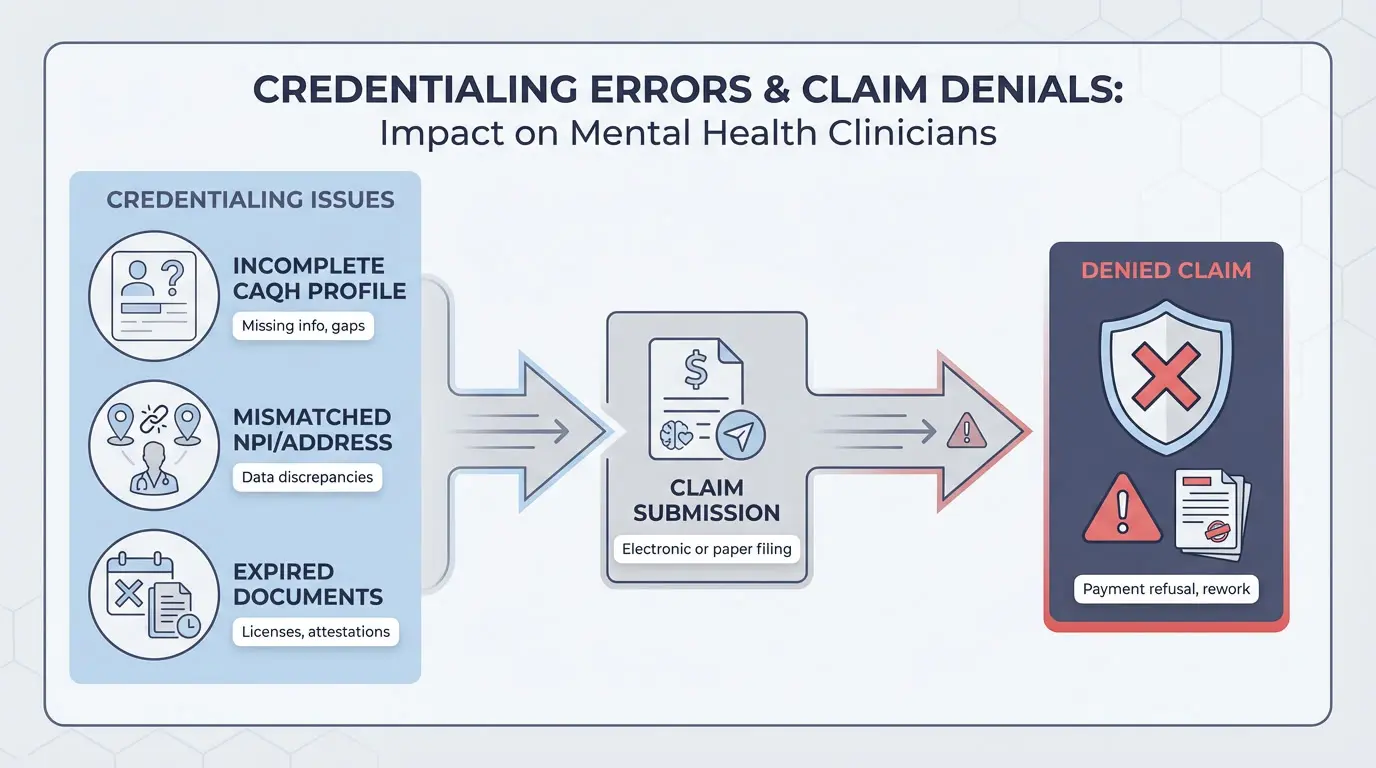
Credentialing-related denials often appear as:
- “Provider not eligible on date of service”
- “Rendering provider not recognized”
- “Invalid billing provider”
- “Out of network”
Because these denials don’t reference documentation, many practices waste time revising notes or resubmitting claims — when the real issue is credentialing. For a deeper look at why credentialing is not just clerical work and why compliance failures stop payment, see “why credentialing is not just clerical.”
Without a clear system for tracking credentialing status and effective dates, these denials can persist indefinitely.
Can You Recover Lost Revenue from Credentialing Mistakes?
Sometimes — but not always.
Retroactive billing may be allowed if:
- The payer permits retroactive effective dates
- Proper documentation is in place
- Credentialing was ultimately approved
However, many payers do not allow retroactive billing, meaning services provided before approval are unrecoverable, even if the clinician is eventually credentialed.
This is why prevention is far more effective than correction.
How to Avoid Insurance Credentialing Pitfalls Going Forward
To protect your practice, consider implementing:
- A credentialing checklist for every payer and clinician
- Centralized tracking for application status and effective dates
- Calendar alerts for recredentialing deadlines
- Regular audits of CAQH profiles and payer records
- Clear rules about when clinicians can begin seeing insurance clients
Credentialing should be treated as a revenue-protection system, not just an administrative task.
When It Makes Sense to Get Help with Insurance Credentialing
Many clinicians choose to outsource credentialing when:
- They’re opening a new practice
- They’re expanding a group practice
- They’re adding multiple payers or states
- Credentialing errors have already impacted cash flow
Whether handled internally or externally, the key is having clear accountability and reliable tracking.
For practices that want expert support without managing multiple vendors, ICANotes offers insurance credentialing services designed specifically for behavioral health clinicians. Our team understands payer enrollment requirements, CAQH maintenance, recredentialing timelines, and the downstream impact credentialing has on billing and reimbursement — so issues are addressed before they disrupt payment.

Need a Second Look at Your Credentialing Setup?
Credentialing failures rarely announce themselves until payment stops. ICANotes works with behavioral health practices every day to identify enrollment gaps, compliance risks, and credentialing issues that can quietly disrupt reimbursement. Our team understands the CMS, NCQA, and payer requirements that govern credentialing — and how those rules play out in real clinical and billing workflows.
Book a Free Credentialing Consult
No obligation. Designed for mental health clinicians and practice leaders.


Frequently Asked Questions: Insurance Credentialing for Mental Health Clinicians
Final Takeaway for Mental Health Clinicians
Insurance credentialing mistakes don’t just slow down reimbursement, they can permanently erase it.
By understanding common pitfalls and putting systems in place early, clinicians can:
- Reduce denials
- Stabilize cash flow
- Spend less time untangling administrative problems
- Focus more energy on client care
Credentialing isn’t just paperwork. It’s a critical foundation for a financially healthy practice.
Related Posts



Racheal Morris
RHIT, RCM Account Manager
About the Author
Racheal Morris is a certified medical coder and biller with over 15 years of experience in behavioral health settings. As an RCM Account Manager at ICANotes, she ensures that our customers' billing, claims, and reimbursement processes run smoothly, efficiently, and compliantly — and that revenue is maximized with minimal delays or denials.