Blog > Treatment Strategies > Group Therapy Activities for Teens: 15 Evidence-Based Ideas
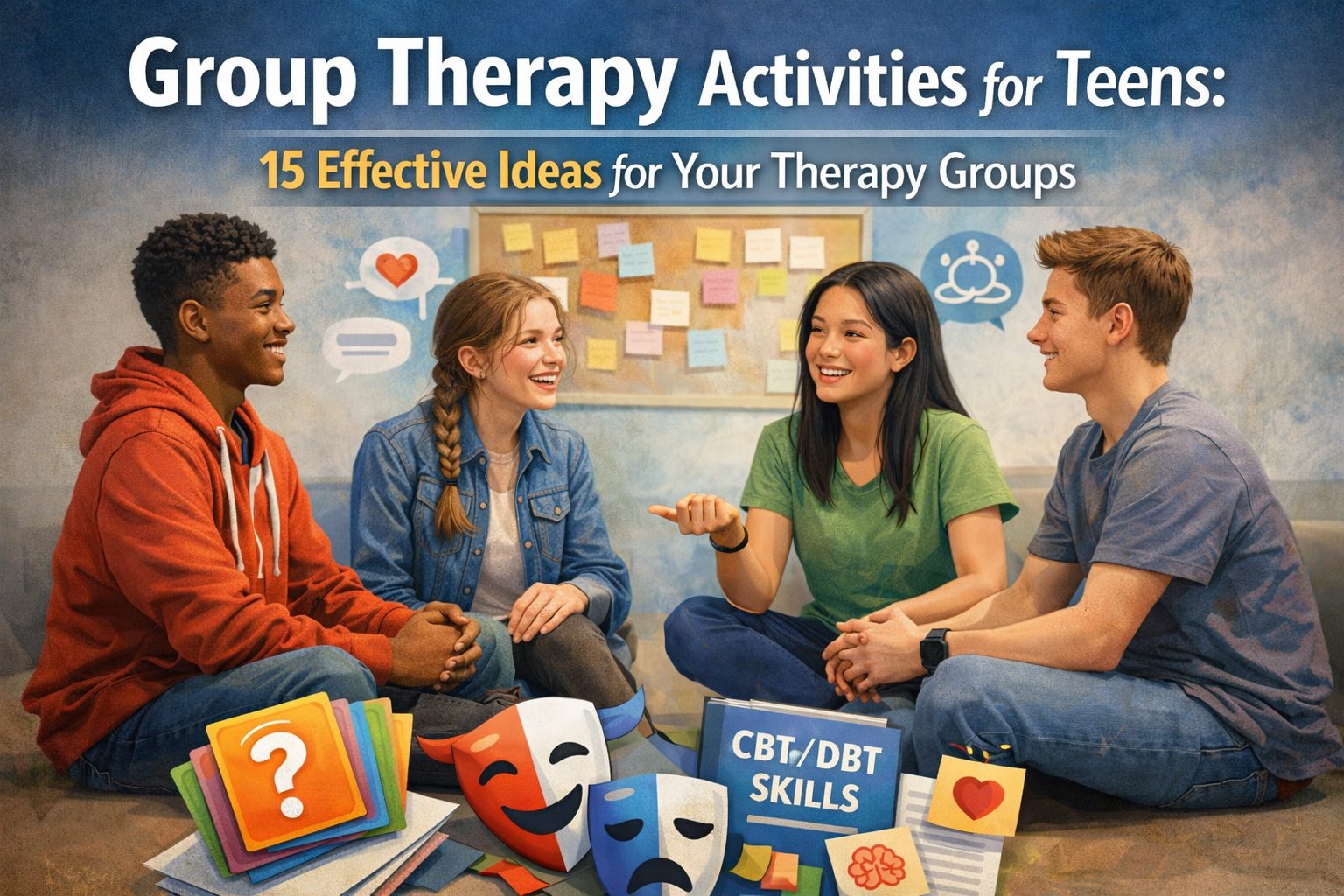
Group Therapy Activities for Teens: 15 Effective Ideas for Your Therapy Groups
This comprehensive guide to group therapy activities for teens offers clinicians 15 evidence-informed, developmentally appropriate ideas designed to boost engagement, emotional regulation, communication skills, and self-esteem in adolescent therapy groups. Drawing from CBT, DBT, trauma-informed care, and strengths-based approaches, these practical group therapy ideas for teens include clear goals, step-by-step instructions, processing questions, and clinical tips to support both in-person and virtual settings. Whether you’re facilitating outpatient, school-based, or intensive treatment groups, this resource equips therapists with flexible, ready-to-use activities that foster safety, connection, and meaningful therapeutic progress.


Last Updated: August 18, 2026

What You'll Learn
-
Proven group therapy activities for teens that build emotional regulation, coping skills, and peer connection
-
Practical group therapy ideas for teens grounded in CBT, DBT, trauma-informed, and strengths-based approaches
-
How to structure and facilitate teen group sessions that increase engagement while maintaining emotional safety
-
Ways to adapt group activities for different settings, ages, and virtual therapy environments
-
Best practices for processing and documenting teen group therapy sessions effectively
Contents
- Icebreaker Activities for Teen Groups
- Emotional Regulation & Coping Skills Activities
- Communication & Social Skills Activities
- Identity, Self-Esteem & Strengths-Based Activities
- Trauma-Informed & Emotional Safety Group Activities
- Creative & Expressive Therapy Activities
- Virtual Group Therapy Ideas for Teens
- How to Document Teen Group Therapy Sessions
- FAQ: Teen Group Therapy Activities
- Conclusion
Running effective group therapy sessions for adolescents requires more than good intentions — it demands structured, developmentally appropriate activities that engage teens while addressing therapeutic goals. Whether you're facilitating outpatient groups, intensive programs, or school-based sessions, having a toolkit of evidence-informed activities can transform your practice.
Research consistently demonstrates the value of group therapy for adolescents. Studies show that teens participating in group therapy experience increased self-esteem, improved social functioning, and enhanced emotional well-being. Importantly, peer feedback that occurs in group settings is a key part of the process of change for adolescents.
This comprehensive guide provides 15 ready-to-use group therapy activities specifically designed for teens. Each activity includes clear goals, step-by-step instructions, processing questions, and important clinical considerations to help you run engaging, therapeutic sessions with confidence.
How to Structure Group Therapy for Teens
Before diving into specific activities, it's essential to establish a therapeutic framework that supports safety, engagement, and clinical effectiveness. Structured group therapy creates predictability for teens while allowing flexibility to meet their changing needs.
Related: Teen Group Therapy: How to Run Effective Therapy Groups for Teens
Ideal Group Size and Composition
Groups of 6–10 teens typically work best. This size allows for diverse perspectives while ensuring each member has opportunities to participate. Screen participants carefully for appropriateness, considering developmental level, presenting concerns, and ability to engage respectfully with peers.
Establishing Group Norms
Collaboratively develop group agreements during the first session. Essential norms include:
- Confidentiality (with clear limits regarding safety concerns)
- Respectful communication and active listening
- Choice-based participation (no forced sharing)
- Right to pass or step out if overwhelmed
- Cell phones off or away during sessions
Post these norms visibly and revisit them regularly, especially after breaks or when new members join.
Session Structure
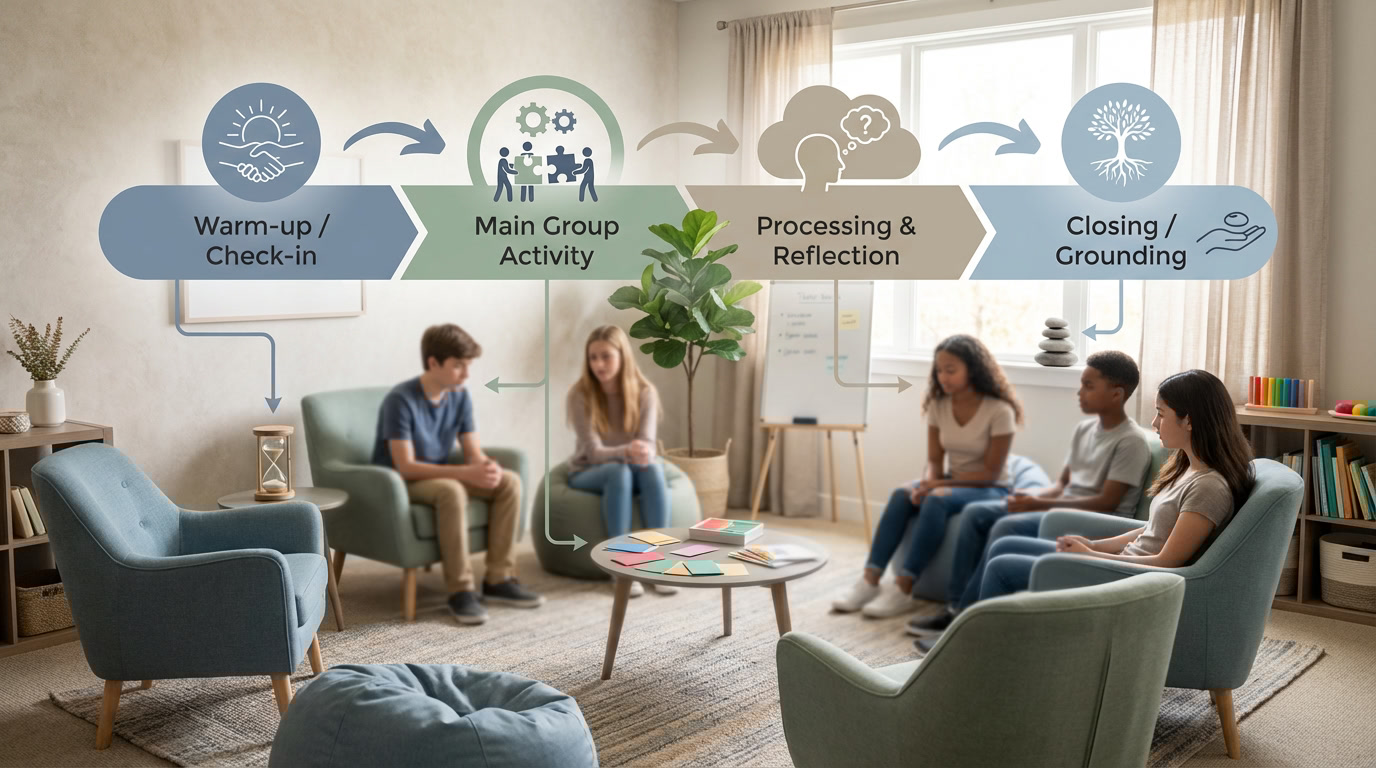
Consistent session structure helps teens feel secure and engaged. A typical 60-minute session might include:
- Warm-up/Check-in (5-10 minutes): Brief icebreaker or mood check
- Main Activity (30-40 minutes): Structured therapeutic exercise
- Processing Discussion (10-15 minutes): Reflection and connection to personal goals
- Closing Ritual (5 minutes): Summary, takeaway, or grounding exercise
Consistency in timing and transitions helps teens with executive functioning challenges and creates therapeutic predictability.
Trauma-Informed Considerations
Many teens in therapy have trauma histories. Never force sharing, avoid surprise activities that might trigger fight-or-flight responses, and always provide options for how teens participate. Allow teens to step out if overwhelmed and have a designated calming space available. Watch for signs of dysregulation and be prepared to shift activities if the group energy becomes too activated or shut down.
Icebreaker Activities for Teen Groups
Icebreakers reduce initial anxiety, build rapport, and set a positive tone. For teen groups, the best icebreakers balance playfulness with psychological safety — avoiding activities that feel childish or overly exposing.
Two Truths and a Strength
Goal: Build connection while focusing on strengths (not vulnerabilities).
How it works: Each teen shares two true statements and one personal strength. The group guesses which statement is the strength (or allow all three to be true to reduce pressure).
Processing: What makes recognizing strengths harder than naming problems?
Values Card Sort (Quick Round)
Goal: Introduce personal values and create immediate common ground.
How it works: Spread 15–20 value cards (print or digital). Each teen picks their top 3. Go around: share one value and why it matters.
Processing: Any surprises? How do your values show up in daily choices?
Inside / Outside Mask Exercise
Goal: Explore public self vs. internal experience in a choice-based way.
How it works: Teens fill a mask template with words, images, and colors: outside = how they show up; inside = how they feel. Share as much or as little as they want.
Processing: What makes it hard to show the “inside”? When does it feel safest to be real?
15 Teen Group Therapy Activities You Can Use Immediately
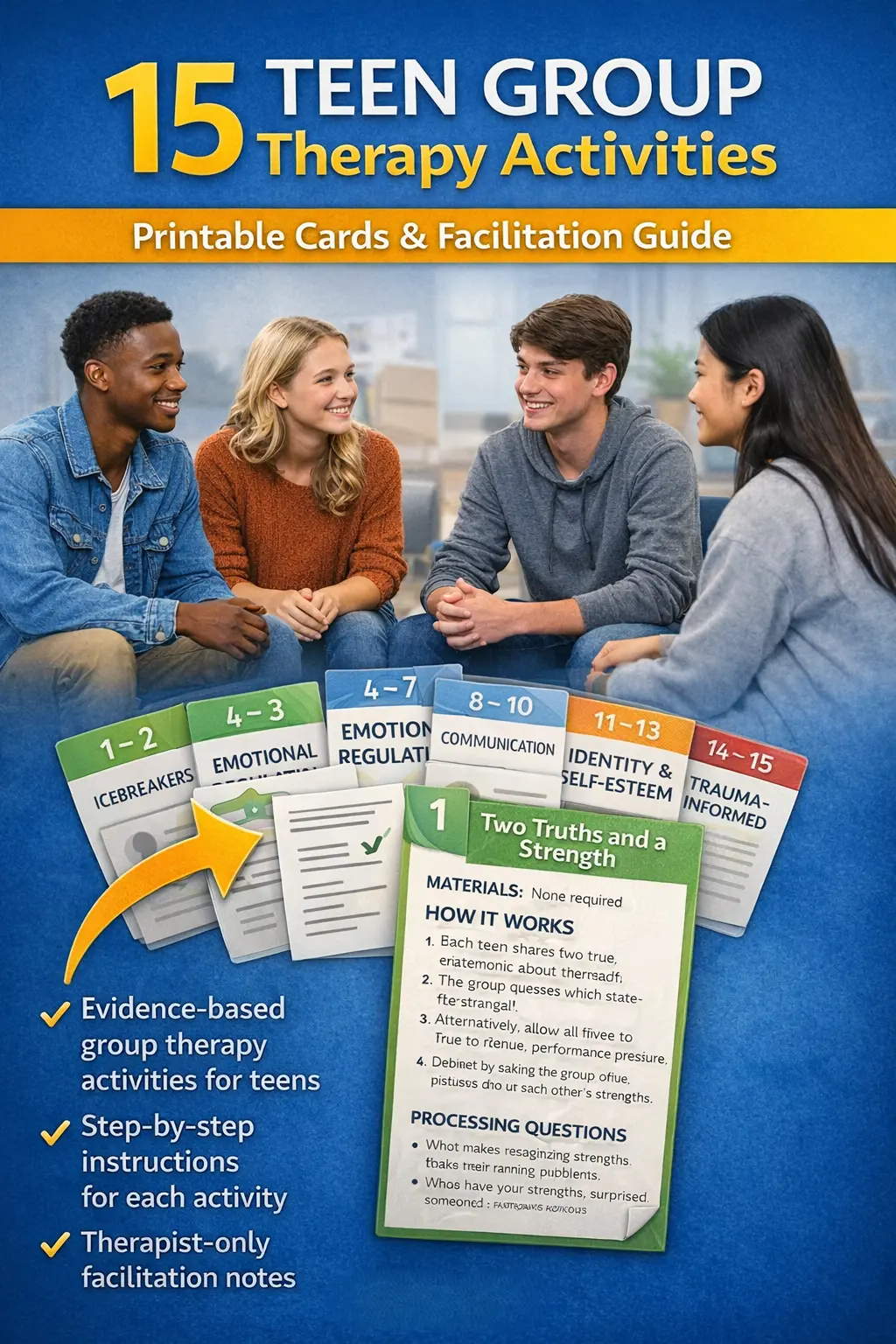
Stop scrambling to plan your next session. This printable set gives you ready-to-use activity cards and facilitation guidance so you can run engaging, structured teen groups with confidence.
Download the Printable Cards & Facilitation Guide and bring it directly into your next group session.
- 15 evidence-based teen group therapy activities
- Step-by-step instructions for each activity
- Processing questions to deepen engagement
- Therapist-only facilitation notes
- Organized by clinical goals (CBT, DBT, trauma-informed care)
No prep required. Just print, bring, and run your session.
Emotional Regulation & Coping Skills Activities (CBT/DBT-Informed)
Teaching teens to identify, understand, and regulate emotions is central to group therapy. These activities draw from cognitive-behavioral (CBT) and dialectical behavior therapy (DBT) frameworks, emphasizing skills like emotional awareness, distress tolerance, and wise mind thinking.
Research supports the effectiveness of DBT-based interventions for adolescents. Meta-analyses have found that DBT demonstrates a large effect in reducing non-suicidal self-injury and a small but meaningful effect on depression symptoms in teens. Additionally, school-based DBT skills groups have shown high rates of acceptability among youth, with 86% of participants reporting they enjoyed the content and would recommend it to peers, along with improved emotion regulation and reduced impulsivity.
Emotional Regulation & Coping Skills Activities (CBT/DBT-Informed)
Ready-to-use group activities that help teens identify emotions, build distress tolerance, and practice coping skills.
Feelings Thermometer
Goal: Help teens identify emotional intensity and catch escalation early.
Materials
Large poster or whiteboard thermometer (0–10 scale), markers
Steps
- Draw a thermometer (0 = calm, 10 = most intense).
- Choose a feeling (e.g., anxiety, anger, sadness).
- Teens mark when they first notice it and name early warning signs.
- Map body sensations, thoughts, and behaviors at levels (3, 5, 7, 9).
- Brainstorm coping strategies that fit each intensity level.
Processing: When does it get harder to use coping skills? What helps you catch emotions earlier?
DBT Wise Mind Circles
Goal: Teach teens to balance emotion mind and reasonable mind to find wise mind.
Materials
Whiteboard or large paper, markers
Steps
- Draw two overlapping circles: Emotion Mind and Reasonable Mind.
- Label the overlap as Wise Mind.
- Present a teen-relevant scenario (friend conflict, bad grade, parent argument).
- Brainstorm what Emotion Mind says and what Reasonable Mind says.
- Identify a Wise Mind response that includes feelings + facts.
- Repeat with additional scenarios to build fluency.
Processing: What changed when you considered both feelings and facts? Where do you get “stuck” most often?
Coping Skills Scavenger Hunt
Goal: Expand coping strategies and match skills to different needs/situations.
Materials
Index cards with coping skills, poster/whiteboard with categories
Steps
- Prep cards (breathing, music, movement, journaling, calling a friend, etc.).
- Create categories: Calm Me Down • Distract Me • Help Me Think • Connect Me • Release Energy.
- Teens place skills into categories (some can fit more than one).
- Each teen chooses 2–3 skills to try before the next session.
Processing: Which category do you rely on most? Least? What gets in the way of trying new skills?
Thought–Feeling–Action Chain (CBT)
Goal: Show how thoughts influence emotions and behaviors—and how to create alternatives.
Materials
Whiteboard or large paper, markers, scenario cards (optional)
Steps
- Present a triggering situation (bad grade, not invited, conflict).
- Draw: Situation → Thought → Feeling → Action → Consequence.
- Group fills in chain with an unhelpful thought and its downstream impacts.
- Replace with a more balanced thought and rebuild the chain.
- Compare outcomes and identify real-life “next time” options.
Processing: How did the thought change the feeling/action? What thoughts show up most often for you?
The DBT Wise Mind Circles activity makes an abstract DBT concept concrete. Research shows that teens participating in DBT skills groups particularly value learning emotion regulation and mindfulness skills, reporting these help them rethink past situations and manage present difficulties more effectively. Repeat with multiple scenarios to build skill.
Cognitive-behavioral approaches like the Thought-Feeling-Action Chain are particularly effective for adolescent depression and anxiety. This activity builds cognitive flexibility and reduces emotional reactivity by teaching teens to identify and challenge cognitive distortions like catastrophizing or overgeneralization.
Communication & Social Skills Activities
Peer relationships are central to adolescent development, yet many teens struggle with effective communication, conflict resolution, and perspective-taking. These activities provide structured practice in social skills within a safe therapeutic context. Research demonstrates that enhanced social functioning within peer groups is a key benefit of group therapy, as teens develop the ability to form healthier relationships with peers outside the therapy setting.
Communication & Social Skills Activities
Structured group therapy activities that help teens practice listening, perspective-taking, and healthy communication.
Back-to-Back Drawing
Goal: Improve clarity, listening, and awareness of assumptions in communication.
Materials
Paper, markers, simple line drawings or abstract shapes
Steps
- Pair teens and seat them back-to-back.
- Person A describes a drawing without naming objects.
- Person B draws based only on the description.
- Compare drawings, then repeat allowing questions.
Processing: What made communication harder or easier? How does this show up in real conversations?
Pass the Problem
Goal: Practice empathy, perspective-taking, and collaborative problem-solving.
Materials
Index cards, pens
Steps
- Each teen writes an anonymous problem or challenge (real or hypothetical).
- Collect, shuffle, and redistribute cards.
- Teens read the problem aloud as if it’s theirs.
- The group offers supportive ideas and solutions.
Processing: How did it feel to give advice? To hear support from peers?
Shared Story Circle
Goal: Build cooperation, turn-taking, and social awareness.
Materials
None (optional story prompts)
Steps
- Group sits in a circle.
- Facilitator starts a story with one sentence.
- Each teen adds one sentence, building on the story.
- Continue until time runs out or the story naturally concludes.
Processing: What was challenging about building on others’ ideas? How does the story reflect the group's values or goals?
Identity, Self-Esteem & Strengths-Based Activities
Adolescence is a critical period for identity formation. These activities help teens explore who they are, recognize their strengths, and envision their future selves — all protective factors against mental health challenges. Studies published in the Journal of Clinical Child & Adolescent Psychology have found that participants demonstrated increased self-esteem levels after attending group therapy sessions consistently over time, making strengths-based work particularly valuable.
Identity, Self-Esteem & Strengths-Based Activities
Group therapy activities that help teens explore identity, recognize strengths, and build confidence through values and future-oriented thinking.
Strength Shields
Goal: Help teens identify and “claim” strengths in a creative, tangible format.
Materials
Shield templates (paper or digital) and markers/colored pencils
Steps
- Provide a shield divided into 4 quadrants.
- Quadrant 1: A strength others see in me.
- Quadrant 2: A strength I see in myself.
- Quadrant 3: A challenge I’ve overcome.
- Quadrant 4: A value or motto I live by.
- Teens fill in each section with words, images, or symbols
- Teens share shields in pairs or with the group (choice-based).
Processing: Which quadrant was easiest to fill? Hardest? How do your strengths help you through tough moments?
Future Headlines
Goal: Strengthen hope, clarify personal goals, and build future-oriented motivation.
Materials
Paper formatted like a newspaper front page (or blank paper), markers
Steps
- Ask teens to imagine it’s 5–10 years in the future.
- Create a newspaper headline about a meaningful success or accomplishment.
- Write a short “article” explaining what they achieved and how they got there.
- Add “quotes” from friends/family highlighting strengths they used.
- Share in pairs or with the group (choice-based).
Processing: What steps could you take now toward this future? What obstacles might show up, and how could you handle them?
Personal Values Mapping
Goal: Help teens identify core values and connect values to day-to-day actions.
Materials
Large paper, markers, values word list
Steps
- Provide a values list (e.g., honesty, adventure, family, independence, creativity, kindness).
- Each teen selects their top 5 values.
- Create a “map” with values written in different sizes based on importance.
- Write specific actions/behaviors around each value that show it in real life.
- Identify one value to honor more intentionally in daily life.
Processing: Which value feels most important right now? Where do your actions match (or not match) your values?
The Personal Values Mapping activity supports ACT (Acceptance and Commitment Therapy) principles by clarifying values and committed action.
Trauma-Informed & Emotional Safety Group Activities
Many teens in group therapy have experienced trauma. These activities prioritize safety, choice, and emotional regulation, helping teens develop awareness of their nervous system responses and practice self-regulation strategies.
Trauma-Informed & Emotional Safety Group Activities
Activities designed to prioritize safety, choice, and nervous system regulation for teens in group therapy.
Window of Tolerance Mapping
Goal: Help teens recognize dysregulation patterns and identify strategies that support returning to their “window.”
Materials
Large poster/whiteboard with three zones (Hyperarousal | Window of Tolerance | Hypoarousal), sticky notes, markers
Steps
- Introduce the “window of tolerance” as the best zone for learning, connecting, and problem-solving.
- Describe hyperarousal (fight/flight) and hypoarousal (shutdown/freeze) in teen-friendly language.
- Teens write triggers that push them out of the window on sticky notes.
- Teens write early signs of dysregulation (body sensations, thoughts, behaviors).
- Teens write strategies that help them return to the window (grounding, movement, connection, etc.).
- Place notes in the appropriate zones and reflect on patterns as a group.
Processing: What helps you notice you’re leaving your window sooner? Which strategies feel most realistic to use in daily life?
Clinical note: Emphasize choice-based sharing. Normalize dysregulation, and remind teens they can “pass,” take a break, or step out if overwhelmed.
Grounding Stations (5 Senses)
Goal: Practice sensory grounding skills that support regulation during anxiety, overwhelm, flashbacks, or dissociation.
Materials
5 stations (Sight, Sound, Touch, Smell, Taste) with simple sensory items (e.g., glitter jar, calming audio, stress balls, tea bags, mints)
Steps
- Set up five stations for the senses (Sight, Sound, Touch, Smell, Taste).
- Explain: grounding helps bring attention back to the present moment.
- Teens rotate through stations, spending 2–3 minutes at each.
- At each station, teens notice: “What do I feel in my body? What changes?”
- Have each teen choose 1–2 strategies they could use outside group.
Processing: Which sense was most grounding for you? When might you use this skill during the week?
Clinical note: Offer opt-outs (especially for smell/taste). Avoid unexpected stimuli, and invite teens to suggest items that feel safe and culturally appropriate.
The Window of Tolerance concept, developed by psychiatrist Dan Siegel, describes the optimal emotional zone within which an individual can effectively manage emotions without becoming overwhelmed or numb. This psychoeducation activity normalizes dysregulation and emphasizes that healing involves widening the window of tolerance. For trauma survivors, the window is often narrowed, making them more prone to dysregulation from relatively minor stressors. The concept is complemented by Stephen Porges' Polyvagal Theory, which describes how shifts in autonomic nervous system states influence our sense of safety and social engagement.
Sensory grounding techniques help bring individuals back into their window of tolerance by anchoring them in the present moment. These techniques are particularly valuable for teens who experience hyperarousal (anxiety, panic) or hypoarousal (dissociation, numbness) as they provide concrete, accessible tools for self-regulation.
Still Building Out Your Session Plan?
You've just worked through the trauma-informed and regulation-focused activities — usually the ones that take the most prep to run well. Skip the re-typing: download the printable Activity Cards & Facilitation Guide with step-by-step instructions and processing questions for all 15 activities, ready to bring straight into your next group.
Download the Activity Cards & Facilitation GuideCreative & Expressive Therapy Activities
Creative expression bypasses verbal defenses and allows teens to process emotions, explore identity, and build problem-solving skills through art, music, and storytelling. These activities are especially valuable for teens who struggle with talk therapy alone.
Creative & Expressive Therapy Activities
Expressive activities that help teens process emotions, explore identity, and build insight beyond talk-based therapy.
Scribble-to-Art Transformation
Teens begin with chaotic scribbles and transform them into meaningful images.
Therapeutic focus: Emotional processing, reframing chaos, creativity as regulation.
Music Mood Boards
Create individual or shared playlists where songs represent emotions or experiences.
Therapeutic focus: Emotional awareness, regulation, nonverbal expression.
Identity Collage
Use images and words to explore who I am, who I’m becoming, and how others see me.
Therapeutic focus: Identity development, self-concept, strengths exploration.
Comic Strip Problem-Solving
Draw a four-panel comic showing a problem, reaction, consequence, and alternative response.
Therapeutic focus: Insight, cognitive flexibility, behavioral rehearsal.
Clinical Note: Always process creative activities. Ask:
- What did you notice while creating?
- What surprised you?
- How does this connect to your life?
Research indicates that non-verbal expression through art and music can be particularly therapeutic for teens who struggle to articulate feelings through words alone.
Virtual Group Therapy Ideas for Teens
Virtual groups present unique challenges — screen fatigue, limited nonverbal cues, and home distractions. These activities are designed specifically for online engagement, keeping teens active and connected despite physical distance.
Virtual Group Therapy Activities for Teens
Engagement-focused activities designed specifically for online and telehealth group therapy sessions.
Virtual Emotion Charades
Teens silently act out emotions on camera while the group guesses.
Therapeutic focus: Emotional literacy, nonverbal communication, engagement.
Digital Gratitude Wall
Teens add gratitude notes to a shared digital whiteboard throughout the week.
Therapeutic focus: Positive affect, perspective-shifting, group cohesion.
Online Scavenger Hunt
Prompt teens to find objects that represent strengths, calm, or emotions in their space.
Therapeutic focus: Movement, self-reflection, grounding, engagement.
Shared Playlist Project
Create a collaborative playlist where each song reflects mood or experiences.
Therapeutic focus: Emotional expression, connection, reflection.
Best Practices for Virtual Groups: Keep cameras on when possible, use breakout rooms for pair activities, incorporate movement breaks, and send materials list in advance so teens can prepare. Research on virtual group therapy implementation has shown that with proper structure and engagement strategies, online groups can be as effective as in-person sessions.

Frequently Asked Questions: Teen Group Therapy Activities
How to Document Teen Group Therapy Sessions
Thorough documentation is essential for continuity of care, treatment planning, and meeting regulatory requirements. Group therapy notes should capture individual participation, therapeutic interventions, and clinical observations while respecting confidentiality.
Key Elements to Document
- Attendance and participation level for each member
- Group topic/activity and therapeutic goals addressed
- Individual progress toward treatment goals
- Notable interactions, insights, or skill development
- Behavioral observations (engagement, affect, peer interactions)
- Safety concerns or crisis interventions
- Plan for next session and any follow-up needed
Document individual participation without breaching other members' confidentiality. For example: 'Client actively participated in communication skills activity, demonstrating improved assertiveness when sharing perspective on group scenario.'
How ICANotes Supports Group Therapy Documentation
Every activity in this guide still ends the same way: with a note that has to hold up. ICANotes gives you group therapy documentation templates built specifically for behavioral health settings, so you can document individual participation within a group context — accurately, quickly, and without breaching another member's confidentiality.
Benefits include:
- Group-specific note templates that capture individual participation within group context
- Quick documentation of attendance, engagement, and goal progress
- Integration with treatment plans to track goal-related interventions
- Customizable templates for different group types (CBT, DBT, process, psychoeducation)
- HIPAA-compliant secure documentation accessible across devices
Curious what that looks like in practice? See how ICANotes documents group sessions or start a 30-day free trial and try it on your next group note.

Start Your 30-Day Free Trial
Experience the most intuitive, clinically robust EHR designed for behavioral health professionals, built to streamline documentation, improve compliance, and enhance patient care.
- Complete Notes in Minutes - Purpose-built for behavioral health charting
- Always Audit-Ready – Structured documentation that meets payer requirements
- Keep Your Schedule Full – Automated reminders reduce costly no-shows
- Engage Clients Seamlessly – Secure portal for forms, messages, and payments
- HIPAA-Compliant Telehealth built into your workflow

Conclusion: Using Group Therapy Activities for Teens to Build Skills, Safety, and Connection
Effective group therapy for teens requires intentionality, flexibility, and a deep understanding of adolescent development. The activities in this guide provide a structured starting point grounded in research evidence, but the real magic happens when you adapt them to your unique group's needs, energy, and goals.
Remember: the activity is just a container for connection, skill-building, and healing. What matters most is your therapeutic presence, your ability to read the room, and your commitment to creating a space where teens feel seen, heard, and capable of growth.
Whether you're running your first teen group or your hundredth, trust that showing up with intention, curiosity, and genuine care for these young people is the most powerful intervention of all.
Related Posts





Dr. October Boyles
DNP, MSN, BSN, RN
About the Author
Dr. October Boyles is a behavioral health expert and clinical leader with extensive expertise in nursing, compliance, and healthcare operations. With a Doctor of Nursing Practice (DNP) and advanced degrees in nursing, she specializes in evidence-based practices, EHR optimization, and improving outcomes in behavioral health settings. Dr. Boyles is passionate about empowering clinicians with the tools and strategies needed to deliver high-quality, patient-centered care.