Blog > Treatment Strategies > Family Therapy Activities: 12 Exercises to Improve Communication

Family Therapy Activities: 12 Practice Exercises to Improve Communication and Connection

Family therapy activities are most effective when they move beyond open conversation and into structured, skill-building exercises that improve how family members communicate, express emotions, and resolve conflict. This guide provides 12 evidence-based family therapy exercises designed to strengthen connection, reduce reactivity, and create more productive interactions between parents, children, and partners. Each activity includes clear goals, step-by-step instructions, and clinical insights, making it easy for therapists to implement these interventions in session and help families build lasting communication skills.

Gemini_Generated_Image_67wtof67wtof67wt

Last Updated: April 30, 2026

fav (10)

What You'll Learn

  • 12 structured family therapy activities to improve communication and reduce conflict
  • How to use exercises like the Speaker–Listener technique and “I Feel” statements effectively in session
  • Ways to help families build emotional awareness and express needs without blame
  • Practical strategies for engaging resistant family members and increasing participation
  • How to adapt family therapy exercises for children, teens, and telehealth settings
  • Techniques for improving problem-solving, attachment, and overall family connection

Family therapy is most effective when it moves beyond open-ended conversation and into structured, goal-oriented interventions. While families often enter treatment hoping to “communicate better,” achieving that goal requires clinicians to guide interactions using specific family therapy activities that reshape how members listen, express emotions, and solve problems together.

Structured family therapy exercises help slow down reactive communication patterns, reduce blame cycles, and create emotional safety for every family member — including children and adolescents who may otherwise disengage. When facilitated intentionally, these activities build skills that families can practice between sessions and carry forward long after treatment ends.

This guide provides 12 clinician-ready family therapy activities, each with a defined goal, step-by-step instructions, processing questions, and clinical considerations. Whether you work in outpatient, school-based, or telehealth settings, these exercises are designed to be practical, adaptable, and grounded in evidence-based frameworks including structural family therapy, attachment theory, and cognitive-behavioral approaches.

Related: Family Therapy Interventions: Techniques and Examples for Clinicians

Why Communication Is Central to Family Therapy

Many of the presenting concerns in family therapy — escalating conflict, emotional withdrawal, behavioral issues in children, co-parenting disagreements — trace back to disrupted communication patterns. Family members may interrupt, criticize, stonewall, or avoid difficult conversations entirely. Over time, these patterns calcify into rigid dynamics that feel impossible to change without outside support.

Communication exercises for family therapy address these dynamics directly. They create a structured framework where each person has a defined role, reducing the likelihood of reactive exchanges. They also help children and teens participate meaningfully in sessions by providing concrete, age-appropriate ways to express emotions and needs.

Research consistently supports the relationship between improved family communication and better treatment outcomes across a range of presenting issues, from adolescent behavior problems to caregiver burnout. When families learn to listen actively, express feelings without blame, and collaborate on solutions, the therapeutic gains extend well beyond the session room.

How These Family Therapy Exercises Are Structured

Each of the 12 activities in this guide follows a consistent format so clinicians can quickly assess fit and implement them in session:

  • Goal: What the activity is designed to accomplish therapeutically
  • Steps: A clear sequence for facilitating the exercise
  • Processing Questions: Prompts to debrief and deepen insight after the activity
  • Clinical Considerations: Adaptations, contraindications, and tips for specific populations

These family therapy activities can be adapted across a range of family structures and treatment contexts, including families with young children, adolescent-focused sessions, blended or stepfamily dynamics, and high-conflict or court-referred cases.

12 Family Therapy Activities for Clinicians
Activity 1

Family Speaker–Listener Exercise

Goal: Improve turn-taking and reduce interruptions during family conversations.

Many families develop a pattern where one or two members dominate conversations while others withdraw. This exercise uses a structured turn-taking format to ensure every voice is heard.

Steps
  1. Choose a low-stakes topic for the family to discuss (e.g., “What is one thing you wish we did more of as a family?”).
  2. Designate a “speaker” who holds a physical object (a pen, ball, or card) as a talking token. Only the person holding the token speaks.
  3. The “listener” must paraphrase what the speaker said before responding. The speaker confirms accuracy or clarifies.
  4. Rotate roles until all members have spoken and been paraphrased.
Processing Questions
  • What was it like to wait your turn before responding?
  • Did you feel heard when your words were repeated back?
  • What did you notice about your family’s typical communication patterns during this exercise?
Clinical Considerations

This activity works well as a session opener or early-phase intervention. For younger children, simplify by asking them to repeat one key word the speaker said. In high-conflict families, the clinician may need to serve as the intermediary paraphraser initially.

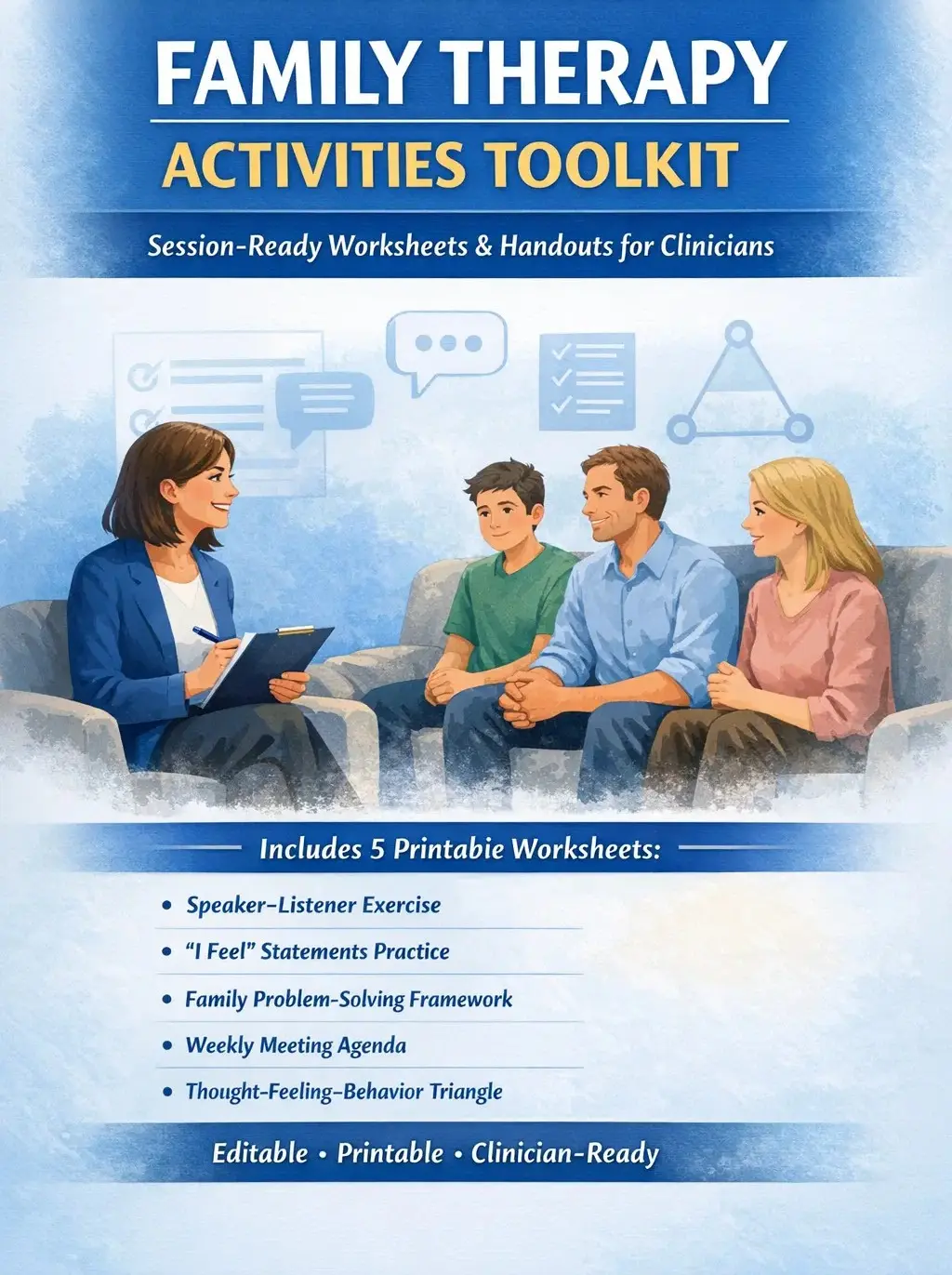
Family Therapy Activities Toolkit with printable worksheets for clinicians
Free Download

Family Therapy Activities Toolkit

Get 5 printable, session-ready worksheets designed to improve communication, reduce conflict, and build stronger family dynamics.

  • Speaker–Listener Exercise
  • “I Feel” Statements Practice
  • Family Problem-Solving Framework
  • Weekly Family Meeting Agenda
  • Thought–Feeling–Behavior Triangle

Use in session or assign as structured homework.

This field is for validation purposes and should be left unchanged.
Name(Required)
This field is hidden when viewing the form
Activity 2

"I Feel" Statements for Families

Goal Reduce blame and increase emotional awareness across family members.
Best For: Families stuck in blame cycles, emotionally reactive interactions, and sessions focused on building healthier communication habits

Blame-laden language ("You always..." "You never...") is one of the most common barriers to productive family communication. This exercise teaches a structured alternative.

Steps
  1. Introduce the formula: "I feel [emotion] when [specific behavior] because [reason]."
  2. Model an example: "I feel frustrated when dinner conversations are interrupted because I want everyone to feel included."
  3. Ask each family member to practice the formula using a recent situation that created tension.
  4. After each statement, ask the person being addressed to reflect back what they heard without defending or correcting.
Processing Questions
  • How did it feel to name your emotion directly?
  • Was it difficult to describe a behavior without using "always" or "never"?
  • What changed when the listener reflected without defending?
Clinical Considerations

Pre-teach emotional vocabulary to younger children using a feelings chart or visual emotion wheel. For families with a history of emotional invalidation, normalize that this skill takes repeated practice and may feel awkward initially.

Activity 3

Family Roles Mapping

Goal Identify rigid or unspoken family roles that may be maintaining dysfunction.
Best For: Enmeshed families, parentified dynamics, and cases where one member is consistently cast into a limiting role

In many families, members unconsciously take on fixed roles — the peacemaker, the identified patient, the parentified child, the disengaged member. This activity makes those patterns visible and discussable.

Steps
  1. Give each family member a sheet of paper. Ask them to write their name in the center and list 2-3 roles they feel they play in the family (e.g., "the one who keeps the peace," "the one who gets blamed").
  2. Have each member share their roles. Ask other family members if they see the same roles or different ones.
  3. Identify which roles feel chosen versus assigned, and which roles feel burdensome.
  4. Discuss what would need to change for roles to feel more flexible.
Processing Questions
  • Were you surprised by how other family members see your role?
  • Which role feels most exhausting or limiting?
  • What would it look like if that role were shared or released?
Clinical Considerations

This activity is especially useful for enmeshed or parentified family systems. Use caution with very young children who may not have the abstract thinking to identify roles — consider having them draw or act out their roles instead. Avoid framing any role as "bad"; instead, explore how each role developed and what function it serves.

Activity 4

Genogram Exploration

Goal Increase insight into intergenerational patterns that influence current family dynamics.
Best For: Families exploring patterns across generations, communication legacies, and long-standing relational themes

Genograms help families see that their current challenges often have roots in patterns passed down across generations — communication styles, conflict approaches, emotional expression norms, and relational cutoffs.

Steps
  1. On a whiteboard or large paper, draw a basic three-generation genogram with the family. Include key relationships, significant events, and emotional patterns.
  2. Ask each member to identify one pattern they notice repeating (e.g., "Men in our family don't talk about feelings," "Conflict always leads to someone leaving").
  3. Discuss which patterns the family wants to continue and which they want to change.
  4. Identify one concrete step the family can take to begin shifting an unwanted pattern.
Processing Questions
  • What surprised you about seeing your family's history mapped out?
  • Which pattern feels most influential in your current family life?
  • What would it mean to be the generation that changes this pattern?
Clinical Considerations

Genograms can surface sensitive material including trauma, addiction, and estrangement. Prepare the family by explaining that the goal is understanding, not blame. This exercise works best in mid-treatment when trust is established. For telehealth, use a shared digital whiteboard.

Activity 5

Weekly Family Meeting Structure

Goal Improve problem-solving and shared decision-making through a predictable, structured format.
Best For: Families needing a repeatable at-home routine for discussing issues before they escalate

Family meetings give families a recurring forum to address issues before they escalate. This activity teaches a structured meeting format that families can use independently between sessions.

Steps
  1. Explain the four-part meeting structure: appreciations, old business, new business, and planning.
  2. Set ground rules: one person speaks at a time, no interrupting, all ideas are written down before being evaluated.
  3. Facilitate a practice meeting in session using a real issue the family is facing.
  4. Assign the family to hold one meeting at home before the next session, using a simple agenda template.
Processing Questions
  • How did it feel to have a structured format for discussing problems?
  • Did starting with appreciations change the tone of the conversation?
  • What obstacles do you anticipate in holding meetings at home?
Clinical Considerations

This is an excellent homework assignment that builds autonomy and generalizes skills outside of therapy. Provide a printed or digital agenda template. For families with young children, keep meetings to 15-20 minutes and include a child-friendly role, such as timekeeper.

Activity 6

Emotion Identification Round

Goal Increase emotional literacy in children, teens, and caregivers.
Best For: Families with limited emotional vocabulary, children or teens who struggle to name feelings, and sessions focused on emotional awareness

Many families lack a shared emotional vocabulary. Parents may default to "fine" or "angry," while children may act out emotions they cannot yet name. This activity expands the family's emotional language.

Steps
  1. Display a visual emotion wheel or feelings chart with at least 20-30 emotion words (expand beyond "mad, sad, glad, scared").
  2. Ask each family member to identify one emotion they felt in the past week and describe the situation briefly.
  3. After each share, ask the family to suggest one additional emotion the person might have also felt.
  4. Normalize the idea that people often feel multiple emotions simultaneously.
Processing Questions
  • Was it easy or hard to choose a word for your emotion?
  • Were you surprised by the emotion someone else suggested for you?
  • How does naming an emotion change how you experience it?
Clinical Considerations

Use visual aids with younger children and consider sorting emotions by body sensation (e.g., "Where did you feel that in your body?"). This activity pairs well with the "I Feel" Statements exercise. For teens who resist emotional disclosure, allow them to choose a fictional character's emotion as a starting point.

Activity 7

Problem-Solving Steps Worksheet

Goal Teach collaborative resolution skills the family can use independently.
Best For: Families who jump from conflict to argument without a clear process for solving everyday problems

Families in conflict often jump from problem identification straight to arguing about solutions. This exercise introduces a structured, step-by-step problem-solving process.

Steps
  1. Present the five-step model: (1) Define the problem in one sentence, (2) Brainstorm solutions without evaluating them, (3) Evaluate pros and cons of each option, (4) Choose one solution to try, (5) Set a review date.
  2. Choose a current, moderate-intensity family issue to work through together.
  3. Write down every idea during brainstorming — emphasize that no idea is rejected at this stage.
  4. Have the family vote or reach consensus on one solution, then plan when they will evaluate how it worked.
Processing Questions
  • What was it like to brainstorm without immediately judging ideas?
  • How did you decide which solution to try first?
  • What will you do if this solution doesn't work?
Clinical Considerations

Provide a printed worksheet families can take home and reuse. Start with low-stakes problems (e.g., screen time rules, chore distribution) before applying the process to emotionally charged issues. For younger children, use drawings or stickers to represent ideas during brainstorming.

Activity 8

Appreciation Circle

Goal Increase positive reinforcement and counterbalance negative interaction patterns.
Best For: Families in chronic conflict, low-connection periods, and sessions where positive interaction needs rebuilding

Research on family dynamics consistently shows that healthy families maintain a higher ratio of positive to negative interactions. The Appreciation Circle intentionally builds that positive balance.

Steps
  1. Seat the family in a circle. Each person takes a turn making one specific, genuine appreciation statement to another family member.
  2. Statements must be specific and behavioral: "I appreciate that you helped me with homework on Tuesday" rather than "You're nice."
  3. The recipient responds only with "Thank you" — no deflecting, minimizing, or reciprocating immediately.
  4. Continue until each person has given and received at least one appreciation.
Processing Questions
  • How did it feel to receive a specific appreciation?
  • Was it difficult to accept the appreciation without deflecting?
  • How often does your family share appreciations at home?
Clinical Considerations

This exercise is deceptively powerful. Families in chronic conflict may struggle to generate appreciations; start by modeling one and allowing time for reflection. For families where one member is consistently left out, the clinician may need to gently redirect to ensure balance.

Activity 9

Conflict Rewind Exercise

Goal Review and rework a recent conflict in a structured, safe format.
Best For: Mid-to-late treatment, unresolved family arguments, and practicing new skills on real conflict scenarios

Instead of rehashing conflicts in the reactive patterns that created them, this exercise gives families a framework to revisit a disagreement with new awareness and skills.

Steps
  1. Ask the family to identify a recent conflict that remains unresolved or still creates tension.
  2. Each family member describes what happened from their perspective, uninterrupted, for 1-2 minutes.
  3. After each person shares, the clinician helps identify the underlying emotions and unmet needs behind each perspective.
  4. The family then role-plays a "redo" of the same conflict, applying skills practiced in therapy (I-statements, paraphrasing, problem-solving steps).
Processing Questions
  • What was different about the "redo" version compared to what actually happened?
  • What unmet need did you discover underneath the conflict?
  • What would help you pause and "rewind" during a real conflict at home?
Clinical Considerations

Use this activity in mid-to-late treatment after the family has developed foundational communication skills. Avoid using conflicts involving active safety concerns. The clinician should maintain structure and redirect if the redo devolves into the original dynamic.

Activity 10

Values and Family Mission Statement

Goal Strengthen shared identity and cohesion by articulating what matters most to the family.
Best For: Families seeking stronger shared identity, blended families, and values-based treatment work

Families in distress often lose sight of their shared values. This activity helps them reconnect with what they want their family to stand for and how they want to treat one another.

Steps
  1. Give each family member a list of 30-40 values (e.g., honesty, fun, respect, independence, togetherness, faith, learning). Ask each person to choose their top 5.
  2. Compare lists as a family. Identify shared values and discuss values that differ.
  3. Collaboratively write a 2-3 sentence Family Mission Statement that reflects the shared values.
  4. Post the mission statement in the home and revisit it periodically as a reference point during disagreements.
Processing Questions
  • Were you surprised by which values your family members chose?
  • How do your shared values show up in daily family life?
  • How could you use this mission statement during a disagreement?
Clinical Considerations

This activity works especially well with blended families navigating how to merge different family cultures. Avoid rushing the selection process — allow space for genuine reflection. For younger children, simplify the values list and consider using pictures or icons to represent each value.

Activity 11

Attachment Check-In

Goal Identify unmet emotional needs between family members, particularly between caregivers and children.
Best For: Caregiver-child dyads, emotionally disconnected relationships, and attachment-focused family work

Drawing from attachment theory and emotionally focused therapy principles, this activity helps families surface the emotional needs that often drive conflict and disconnection.

Steps
  1. Explain the concept briefly: "When we feel securely connected to the people who matter most, we can handle stress better. When that connection feels threatened, we react."
  2. Ask each family member to complete two sentence stems: "I feel closest to you when..." and "I feel most disconnected from you when..."
  3. Have each pair share their responses directly to each other, with the clinician facilitating.
  4. Identify one specific action each person can take to strengthen the attachment bond.
Processing Questions
  • What was it like to hear what makes your family member feel close to you?
  • Was the "disconnected" statement surprising or confirming?
  • What is one thing you're willing to do differently this week based on what you learned?
Clinical Considerations

This activity works best in dyads (caregiver-child or partner-partner) rather than the full family simultaneously. Be prepared for emotional responses; have grounding strategies available. This exercise is contraindicated in families with active abuse dynamics, where the check-in could be weaponized.

Activity 12

CBT Thought-Feeling-Behavior: Family Version

Goal Challenge assumptions and reactive interpretations that fuel family conflict.
Best For: Adolescents and adults, families prone to misinterpretation, and CBT-informed family work

Cognitive-behavioral techniques are well-established in individual therapy but can be equally powerful in a family context. This activity helps family members see how their thoughts about one another drive their emotional and behavioral reactions.

Steps
  1. Introduce the CBT triangle: Thoughts, Feelings, Behaviors. Explain that the same situation can produce different reactions depending on the thought that accompanies it.
  2. Present a recent family scenario. Ask each member to identify their automatic thought, the feeling it produced, and the behavior that followed.
  3. Explore together: Was the automatic thought accurate? What other explanations exist? How might a different thought change the feeling and behavior?
  4. Practice generating one alternative thought for each family member's identified scenario.
Processing Questions
  • Were you aware of your automatic thought before this exercise?
  • How did hearing your family member's thought about the same situation change your perspective?
  • What would help you catch your automatic thoughts in real time?
Clinical Considerations

This activity requires sufficient cognitive development; it works best with adolescents and adults. For younger children, simplify by focusing on "What did you think happened?" and "What actually happened?" Use a visual triangle handout to anchor the concept.

Additional Communication Exercises for Family Therapy

Beyond the 12 structured activities above, clinicians may want to incorporate shorter communication exercises for family therapy that can be used as session warm-ups, brief homework assignments, or skill refreshers.

Mirroring Between Parent and Child

The caregiver repeats exactly what the child says—word for word—without interpretation or correction. This exercise validates the child’s experience and slows down reactive parenting responses. It is particularly useful in families where children report feeling unheard.

Structured Apology Framework

Teach families a four-part apology format: (1) State what you did, (2) Acknowledge the impact, (3) Take responsibility without excuses, and (4) State what you will do differently. This replaces hollow “I’m sorry” statements with meaningful repair.

Active Listening Rounds

Each family member speaks for 2 minutes on a given topic while others listen silently. After the speaker finishes, each listener shares one thing they heard. This builds the habit of listening to understand rather than listening to respond.

Non-Verbal Communication Awareness

Ask the family to spend 5 minutes discussing a topic while paying attention to body language, facial expressions, and tone of voice. Debrief by asking what non-verbal signals each person noticed and how those signals affected the conversation.

How to Adapt Family Therapy Activities for Telehealth

Telehealth has expanded access to family therapy, but it also introduces unique challenges for facilitating interactive activities. Many of the exercises in this guide can be adapted for virtual delivery with a few modifications.

Use shared digital whiteboards (such as Google Jamboard, Miro, or a shared Google Doc) for activities that involve writing, drawing, or mapping—such as the Genogram Exploration, Family Roles Mapping, or Values and Family Mission Statement exercises. Visual tools help maintain engagement when family members are not physically in the same room.

Assign structured turn-taking explicitly, since natural conversational cues are harder to read on video. Use the Speaker–Listener Exercise format as a default for any telehealth discussion, or designate the clinician as a consistent moderator.

Incorporate visual emotion charts that can be displayed on screen during Emotion Identification Rounds. Digital tools like interactive emotion wheels allow children and teens to click or point to their emotion rather than needing to articulate it verbally.

For families with younger children, use shorter activity intervals (10–15 minutes rather than 20–30) and build in brief movement breaks to manage attention and engagement.

How to Document Family Therapy Sessions

Accurate documentation of family therapy sessions is essential for treatment continuity, insurance reimbursement, and clinical accountability. Family sessions present unique documentation challenges because clinicians must capture the dynamics between multiple participants, not just individual progress.

When documenting family therapy exercises, include the presenting family dynamic (who attended, the current relational climate, any notable shifts from previous sessions), the specific intervention or activity used, each member’s level of participation and engagement, emotional responses observed during and after the activity, progress toward identified family treatment goals, and any homework or between-session assignments.

Structured EHR templates designed for behavioral health can significantly streamline this process. Templates that include fields for multiple participants, family treatment goals, and intervention-specific documentation reduce the time clinicians spend on notes while improving the consistency and completeness of the clinical record. An EHR built for behavioral health can also help track family treatment goals across sessions, making it easier to demonstrate progress during utilization reviews or treatment plan updates.

30-Day Free Trial

Simplify Family Therapy Documentation with ICANotes

Documenting multi-member family sessions doesn’t have to slow you down. ICANotes offers structured behavioral health EHR templates designed to capture family dynamics, track treatment goals across members, and produce compliant clinical notes in minutes.

Start your free trial today and see how purpose-built documentation tools can give you more time for the clinical work that matters.

  • Pre-built templates for family therapy sessions
  • Capture multi-client dynamics in one structured note
  • Track treatment goals across family members
  • Improve compliance and reduce documentation time
  • Built specifically for behavioral health clinicians

No credit card required. Get started in minutes.

icons (26)

Frequently Asked Questions About Family Therapy Activities

What are the best family therapy activities for improving communication?

The Speaker–Listener Exercise, “I Feel” Statements, and Active Listening Rounds are among the most effective family therapy activities for directly improving communication. These exercises teach specific, repeatable skills—turn-taking, emotional expression without blame, and reflective listening—that families can practice between sessions.

How do therapists engage resistant family members?

Resistance often signals that a family member feels unheard, blamed, or uncomfortable with vulnerability. Start with low-risk activities like the Appreciation Circle or Emotion Identification Round to build safety before introducing exercises that require more self-disclosure. Validate resistance as a protective response and explore what would need to change for that person to feel more comfortable participating.

How can family therapy exercises be adapted for young children?

Use visual aids like feelings charts and emotion wheels. Simplify language and sentence stems. Allow drawing, acting out, or pointing instead of verbal responses. Shorten activities to 10–15 minutes and build in movement or play transitions. Assign children concrete, age-appropriate roles (e.g., timekeeper, note-taker with stickers) to keep them engaged.

What should a therapist do if a family session escalates?

Pause the activity and return to a grounding structure. Use a brief breathing exercise or redirect to a safer topic. Normalize that escalation can happen when families practice difficult conversations, and use it as a clinical moment to process what triggered the escalation. If safety is a concern, transition to individual check-ins within the session.

How do clinicians measure progress in family therapy?

Progress can be measured through standardized instruments (e.g., the Family Assessment Device, FACES-IV), session-by-session goal tracking, clinician observation of communication patterns, and family self-report. Tracking specific indicators—such as reduced interruptions during the Speaker–Listener Exercise or increased specificity in Appreciation Circle statements—provides concrete evidence of skill development.

Dr. October Boyles

DNP, MSN, BSN, RN

About the Author

Dr. October Boyles is a behavioral health expert and clinical leader with extensive expertise in nursing, compliance, and healthcare operations. With a Doctor of Nursing Practice (DNP) and advanced degrees in nursing, she specializes in evidence-based practices, EHR optimization, and improving outcomes in behavioral health settings. Dr. Boyles is passionate about empowering clinicians with the tools and strategies needed to deliver high-quality, patient-centered care.