
Blog > Documentation > ESA Letter Template for Therapists: FHA-Compliant Housing Guide (2026)
Emotional Support Animal (ESA) Letter Template for Therapists (2026 Guide)
This comprehensive guide helps licensed mental health clinicians write ethical, FHA-compliant emotional support animal (ESA) letters that withstand housing provider scrutiny. It covers legal requirements, state-specific rules, clinical assessment standards, documentation best practices, and includes a copy-paste ESA letter template designed to reduce liability and support defensible accommodation recommendations.


Last Updated: April 1, 2026


What You'll Learn
-
How to write a Fair Housing Act–compliant ESA letter that withstands landlord scrutiny and regulatory review
-
The clinical assessment criteria required before ethically recommending an emotional support animal
-
Exactly what must be included in an ESA letter and which missing elements create the highest audit risk
-
How to document clinical justification linking specific symptoms to animal-related therapeutic benefit
-
When and how to decline ESA requests appropriately while maintaining professional boundaries and client trust
Contents
- Legal Protections for Emotional Support Animals
- ESA Letters for Housing: FHA Accommodation Requirements
- State-by-State ESA Letter Requirements
- Clinical Assessment Protocol for ESA Requests
- What to Include in an ESA Letter: Requirements Checklist
- What Does an ESA Letter Look Like? Full Sample
- How to Write an ESA Letter as a Therapist
- Best Practices for ESA Letter Documentation
- FAQ: ESA Letters for Therapists
- How ICANotes Supports the ESA Letter Process
Licensed mental health clinicians face increasing requests for emotional support animal documentation, often complicated by questionable online certification services that undermine legitimate therapeutic recommendations. This guide provides the clinical, legal, and documentation standards required to write compliant ESA letters that withstand housing provider scrutiny and regulatory review.
You'll find detailed instructions on Fair Housing Act requirements, state-specific regulations, clinical assessment protocols, and a complete copy-paste template with merge fields. This resource addresses when ESA recommendations are clinically appropriate, how to document your rationale to reduce liability, and how to decline requests that lack clinical foundation.
What is an Emotional Support Animal?
An emotional support animal is a companion animal whose presence alleviates one or more symptoms of a documented mental health disability. Federal housing law distinguishes ESAs from household pets by recognizing their therapeutic function in supporting psychiatric or psychological conditions that substantially limit major life activities.
Unlike service animals trained to perform specific disability-related tasks, ESAs provide therapeutic benefit through their presence and the bond with their handler. No specialized training is required. The clinical determination centers on whether the animal's presence demonstrably reduces symptom severity or functional impairment documented through ongoing treatment.
ESAs are classified as assistance animals under federal housing law, not pets. This distinction carries significant implications for housing access, as detailed below.
Legal Protections for Emotional Support Animals
ESAs Are Not Protected Under the ADA
The Americans with Disabilities Act excludes emotional support animals from its protections, which cover only service animals trained to perform specific tasks for individuals with disabilities. ESAs have no legal right to accompany handlers in restaurants, retail stores, workplaces, or other public accommodations.
Many clients mistakenly believe ESA letters provide universal access rights. Clinicians must clearly communicate that ESA protections apply exclusively to housing accommodations under separate federal law.
Fair Housing Act (FHA) Protections
The Fair Housing Act prohibits housing discrimination against individuals with disabilities and mandates reasonable accommodations for assistance animals when supported by appropriate clinical documentation. FHA protections supersede no-pet policies, breed restrictions, weight limits, and pet-related fees or deposits.
Housing providers evaluate accommodation requests based on three criteria:
- Disability verification: Does the applicant have a disability that substantially limits one or more major life activities?
- Disability-related need: Does the animal provide assistance, perform tasks, or provide therapeutic benefit directly related to the disability?
- Reasonable accommodation: Does granting the request impose undue financial or administrative burden on the housing provider?
Landlords may request verification from qualified healthcare providers but cannot demand excessive documentation, ask for detailed medical records, or probe specific diagnostic information beyond establishing the disability-animal connection.
Air Carrier Access Act (ACAA)
As of December 2020, airlines are no longer required to accommodate emotional support animals in passenger cabins. The U.S. Department of Transportation revised regulations to limit cabin access to trained service dogs only. ESAs may be transported in cargo holds or prohibited entirely, depending on carrier policy.
This regulatory change followed widespread concerns about fraudulent ESA claims and safety incidents involving untrained animals in confined aircraft environments. Clinicians should inform clients that ESA letters provide no aviation-related accommodations under current federal regulations.
ESA Letters for Housing: FHA Accommodation Requirements
An ESA letter for housing is a clinical document that enables a client to request a reasonable accommodation under the Fair Housing Act. When a housing provider receives this letter, they are evaluating whether the documentation meets three specific standards: that the tenant has a qualifying disability, that the animal provides disability-related benefit, and that the accommodation request is reasonable.
Understanding what housing providers look for — and what they are legally permitted to ask — helps clinicians write letters that satisfy accommodation requirements on first submission without unnecessary back-and-forth.
What Housing Providers Can and Cannot Request
Housing providers may request reliable documentation from a licensed healthcare professional confirming the disability-related need for the animal. Under HUD guidance, this includes verification that the person has a disability and that the animal provides disability-related assistance or therapeutic benefit.
Housing providers cannot:
- Require disclosure of specific diagnosis or detailed medical records
- Demand documentation of the animal's training or certification
- Charge pet deposits, pet fees, or pet rent for approved ESAs
- Apply breed, weight, or species restrictions to approved ESAs
- Require the animal to wear identifying vests or tags
Housing providers can:
- Request documentation from a licensed, treating healthcare professional
- Verify the clinician's licensure status through state databases
- Deny requests where the animal poses a direct threat to safety or would cause substantial property damage
- Deny requests that would impose undue financial or administrative burden
- Request updated documentation if there is reason to believe circumstances have changed
Why ESA Letters Get Rejected by Housing Providers
The most common reasons housing providers reject ESA accommodation requests include letters from providers with no established therapeutic relationship, missing or unverifiable clinician credentials, generic template language that lacks individualized clinical justification, failure to reference the Fair Housing Act or specific accommodation language, and letters from online "ESA mills" that housing providers increasingly recognize and flag.
The requirements checklist and letter template below address each of these rejection triggers directly.
State-by-State ESA Letter Requirements
Individual states may impose additional requirements governing ESA letter issuance. California, for example, requires a minimum 30-day therapeutic relationship before licensed professionals may ethically write ESA recommendations (California Assembly Bill 468, 2021). This mandate addresses "ESA mill" operations offering instant certifications without genuine clinical evaluation.
Practitioners must research their state licensing board guidance and applicable statutes to ensure compliance with regional requirements that exceed federal baseline standards.
Does the ESA letter template change by state? The core letter format and required elements are consistent nationwide because ESA housing accommodations are governed by the federal Fair Housing Act. However, clinicians must ensure they meet any state-specific therapeutic relationship requirements before issuing the letter. California's 30-day minimum is the most prescriptive current requirement, but several other states have pending legislation. If you practice via telehealth across state lines, confirm you hold active licensure in the client's state of residence — not just your own.
What to Include in an ESA Letter: Requirements Checklist
Comprehensive ESA documentation must incorporate multiple discrete elements to satisfy legal scrutiny and convey clinical legitimacy. The letter should prominently display the client's full legal name as it appears on identification documents and lease agreements, ensuring housing providers can accurately match documentation to accommodation requests. Clinician identification requires complete enumeration of professional credentials, license number, and active licensure status, details verifiable through state regulatory databases.
Practice information encompasses the treating professional's business name, complete mailing address, and direct contact information enabling housing providers to authenticate letter provenance. A clear articulation of the ongoing therapeutic relationship establishes the clinician's intimate familiarity with the client's presentation, including approximate treatment commencement date and service modality. While comprehensive diagnostic disclosure remains unnecessary, the letter must reference either a specific DSM-5 diagnosis or functional impairment description substantiating disability status without violating privacy considerations.
The clinical justification represents the document's substantive core, explicating how the emotional support animal specifically ameliorates identified symptoms or functional limitations. Generic statements prove insufficient; effective rationales connect particular symptom clusters — such as social isolation, panic attacks, or mood dysregulation — to observable improvements facilitated by animal companionship. Explicit recommendation language should invoke Fair Housing Act terminology, requesting "reasonable accommodation" for housing purposes
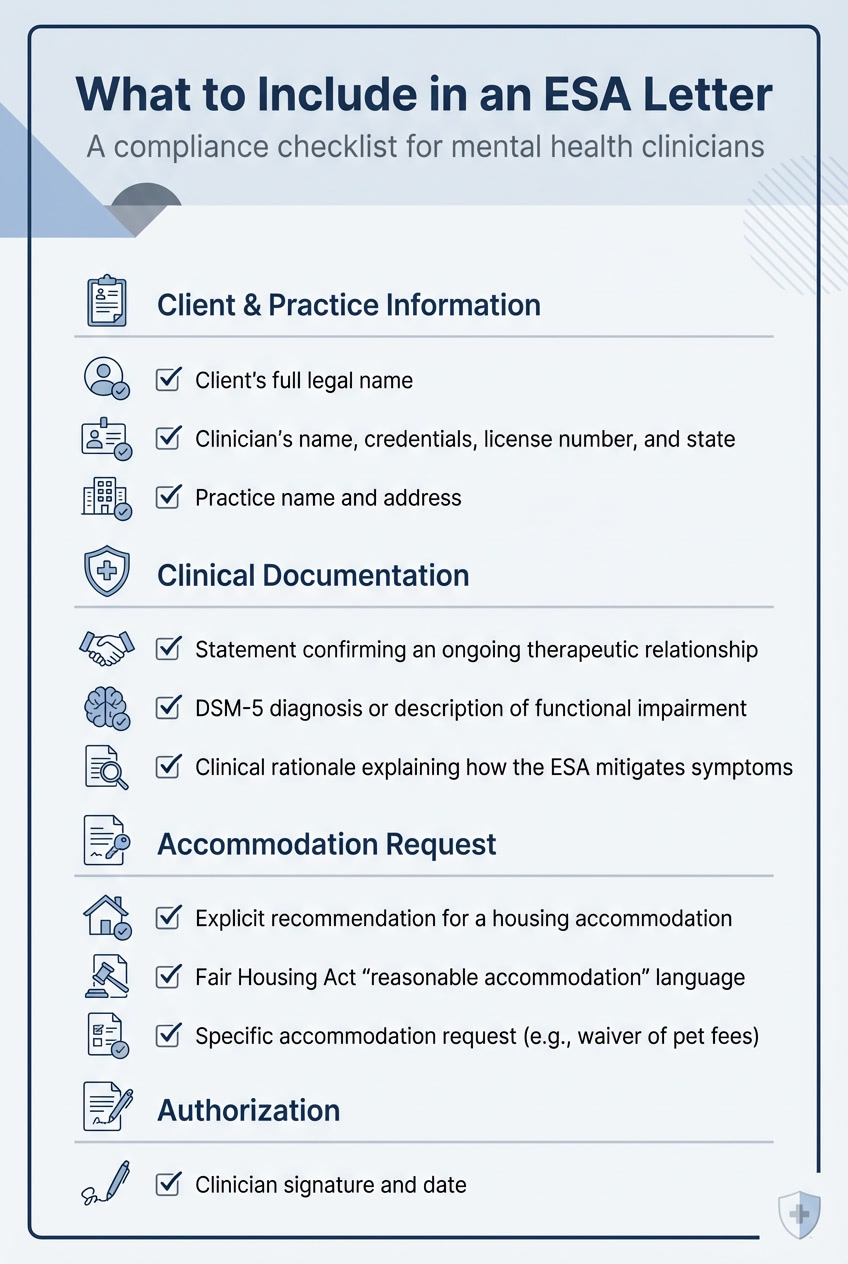
specifying desired accommodations such as pet fee waiver or exemption from species restrictions.
Professional authentication requires handwritten signature, letter date, and preferably presentation on official letterhead bearing practice branding. These authentication elements deter fraudulent manipulation while projecting professional gravitas. Housing providers increasingly scrutinize documentation aesthetics as preliminary legitimacy indicators, making polished presentation strategically advantageous beyond mere regulatory compliance.
ESA Letters for Multiple Animals
Clinicians may recommend more than one emotional support animal when clinical assessment supports the therapeutic necessity of each animal individually. A separate clinical justification is required for every animal — a single blanket statement covering multiple animals will not withstand scrutiny. For each animal, document the specific symptoms it addresses, how its therapeutic benefit differs from or complements the other animal, and why the client's treatment needs cannot be met by a single ESA. Some housing providers may request individual letters for each animal, while others accept a single letter that addresses each animal separately. Including the species and name of each animal in the letter is recommended but not federally required.
What Does an ESA Letter Look Like? Full Sample
A compliant ESA letter is typically a one-page document printed on the clinician's official letterhead. The example below shows the structure and required elements of an FHA-compliant letter. Notice how the clinical justification connects specific symptoms to the therapeutic benefit of the animal — this is the section housing providers scrutinize most closely, and it's where generic template language most commonly leads to rejection.
Abbreviated Sample ESA Letter
[Practice Name]
[Practice Address] | [Phone Number] | [Email Address]
[License Type], License #[Number] | [State of Licensure]
[Date]
Re: Emotional Support Animal Accommodation Request for [Client Full Legal Name]
To Whom It May Concern:
I am a licensed [credential, e.g., Licensed Clinical Social Worker] in the state of [State], license number [#], currently practicing at [Practice Name]. I am writing to confirm that [Client Name] is a current client under my care. I have been providing [individual psychotherapy / psychiatric treatment / counseling services] to [Client Name] since [approximate start date of treatment].
Based on my clinical assessment, [Client Name] has a mental health condition recognized in the Diagnostic and Statistical Manual of Mental Disorders, Fifth Edition (DSM-5) that substantially limits one or more major life activities, including [specific life activities affected, e.g., sleep, concentration, maintaining social relationships, daily self-care routines].
The clinical justification section — omitted from the abbreviated sample above — is the most important part of the letter and the primary reason ESA letters get rejected. Effective justifications connect the client's specific symptoms to observable, individualized improvement related to the animal's presence. Generic statements like "the animal provides emotional comfort" do not meet the documentation standard housing providers expect.
For example, a strong clinical justification might read: "The client's major depressive disorder symptoms, particularly morning anergia and social withdrawal, improve measurably on days when she engages in routine dog care activities that provide structure and motivation for leaving her residence. This behavioral activation effect complements our ongoing cognitive-behavioral treatment protocol."
Download the Complete ESA Letter Template
The full template includes the complete clinical justification section with customizable language, FHA-specific accommodation request wording, proper signature block formatting, and merge fields you can adapt for your practice or EHR system.
When adapting the template for your practice, replace the sample clinical justification with individualized language drawn from your own assessment notes — housing providers are increasingly trained to identify boilerplate language that appears across multiple letters.
Download this Complete ESA Letter Template for Therapists
How to Write an ESA Letter as a Therapist
Writing an ESA letter involves more than filling in a template — it is a clinical recommendation that carries professional and legal weight. The following step-by-step process ensures your letter is defensible, compliant, and genuinely useful to your client's housing accommodation request.
Start with your clinical records, not the letter. Before drafting, review your progress notes, diagnostic formulation, and any documented observations of the client's interaction with or response to animals. The letter should synthesize evidence already present in your records, not introduce new clinical claims.
Use your letterhead and complete credentials. Housing providers verify clinician identity as a first screening step. Include your full name, degree, license type, license number, state of licensure, practice name, address, and direct phone number. Missing or incomplete credentials are the most common reason letters are returned for revision.
State the therapeutic relationship clearly. Include the approximate date treatment began and the modality of service (in-person, telehealth, or both). Housing providers are specifically looking for evidence that the recommendation comes from an ongoing treating relationship, not a one-time evaluation.
Reference disability without over-disclosing. You do not need to share the client's full diagnostic history. A statement confirming that the client has a mental health condition that substantially limits one or more major life activities satisfies the legal standard. You may reference a DSM-5 diagnosis or use functional impairment language — either approach is acceptable.
Write an individualized clinical justification. This is the most important section of the letter and the one most frequently done poorly. Connect the client's specific symptoms to the specific therapeutic benefit the animal provides. Avoid generic language like "the animal provides emotional support." Instead, describe observable symptom-animal interactions grounded in your clinical observations: "The client's generalized anxiety disorder symptoms, including persistent insomnia and anticipatory worry, decrease measurably when her cat is present in the home, providing a calming routine that supports her sleep hygiene protocol."
Include explicit FHA accommodation language. State that you are recommending a reasonable accommodation under the Fair Housing Act. Specify the accommodation being requested — typically waiver of no-pet policies, pet deposits, pet fees, or breed/species/weight restrictions.
Sign, date, and review. Use a handwritten or secure digital signature. Review the letter against the requirements checklist above before sending. A single missing element can delay the accommodation process by weeks.
Best Practices for ESA Letter Documentation
Writing an ESA letter is more than filling in a template — it’s a clinical recommendation that should be supported by clear assessment, individualized rationale, and documentation that can withstand third-party review. The best practices below will help you create ethical, defensible ESA letters while setting appropriate expectations with clients and maintaining professional boundaries when requests aren’t clinically indicated.
Individualize Clinical Justification
Avoid generic templates that fail to address the specific client's presentation. Effective ESA letters articulate precise symptom-animal connections grounded in observed treatment response.
Template language like "the animal provides emotional support" lacks clinical substance. Strengthen justification with specific examples: "The client's major depressive disorder symptoms, particularly morning anergia and social isolation, improve measurably on days when she engages in routine dog care activities that provide structure and motivation for leaving her residence."
Maintain Documentation That Withstands Scrutiny
Housing providers increasingly challenge ESA letters, particularly those from telehealth providers or practices with high-volume ESA letter production. Comprehensive clinical records demonstrating thorough assessment processes protect against allegations of negligent or inappropriate recommendations.
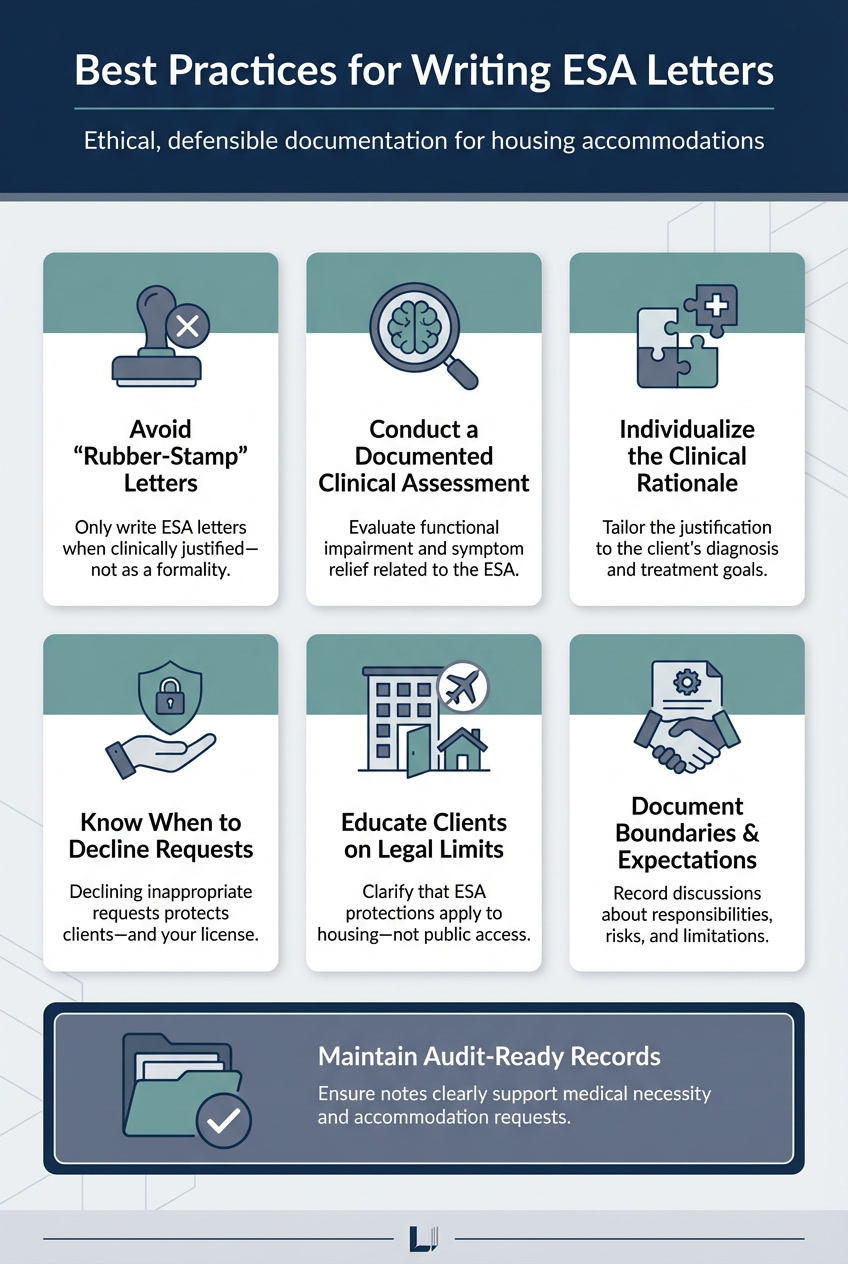
Document your clinical reasoning contemporaneously in progress notes, including specific symptom observations, treatment timeline, and rationale connecting animal presence to symptom improvement.
Educate Clients About ESA Limitations
Many clients misunderstand ESA protections, believing letters provide universal access rights or eliminate all housing provider discretion. Comprehensive client education addresses:
- ESAs have no public access rights under federal law
- Housing providers may verify documentation authenticity
- Clients remain financially responsible for animal-related damage
- Animals must not create nuisance or safety hazards
- Housing providers can deny requests that impose undue burden
This educational foundation prevents subsequent misunderstandings while promoting realistic expectations about accommodation outcomes.
Establish Clear Boundaries for Inappropriate Requests
Compassionate but firm boundary-setting preserves professional credibility. When declining ESA requests lacking clinical foundation, explain: "Clinical assessment does not support a disability-level diagnosis at this time. ESA recommendations require documented functional impairment that substantially limits major life activities. Let's continue focusing on evidence-based interventions that address your current concerns."
Offering alternative therapeutic strategies demonstrates continued investment in the client's treatment despite declining the specific request.
Related Resources
Strengthen your ESA documentation with these in-depth guides on clinical documentation, medical necessity, and defensible recordkeeping:

Frequently Asked Questions: ESA Letters for Therapists
How ICANotes Supports the ESA Letter Process
ICANotes behavioral health documentation software streamlines the ESA letter process through structured assessment templates that prompt comprehensive evaluation of relevant clinical factors. Practitioners can systematically document symptom presentation, functional impairment severity, treatment modality, and observed therapeutic benefit — creating a robust clinical record supporting accommodation recommendations. Standardized documentation frameworks reduce omission risk while ensuring consistent quality across ESA evaluations.
Clinicians can easily configure customized ESA form letter templates within the ICANotes system, incorporating merge fields that automatically populate patient information directly from the electronic health record. This intelligent automation extracts essential data points — including client name, diagnosis, treatment start date, and clinician credentials — eliminating manual transcription while minimizing typographical errors. The merge field functionality accelerates letter generation considerably, transforming what might consume thirty minutes into a streamlined three-minute workflow without sacrificing individualization or clinical precision.
The platform also enables efficient retrieval of client treatment history, diagnostic formulations, and longitudinal progress notes when synthesizing clinical justification narratives. This accessibility accelerates letter drafting while grounding recommendations in accumulated clinical evidence rather than isolated impressions. Version control features maintain documentation integrity, preserving original assessment records even when letters require revision or renewal.
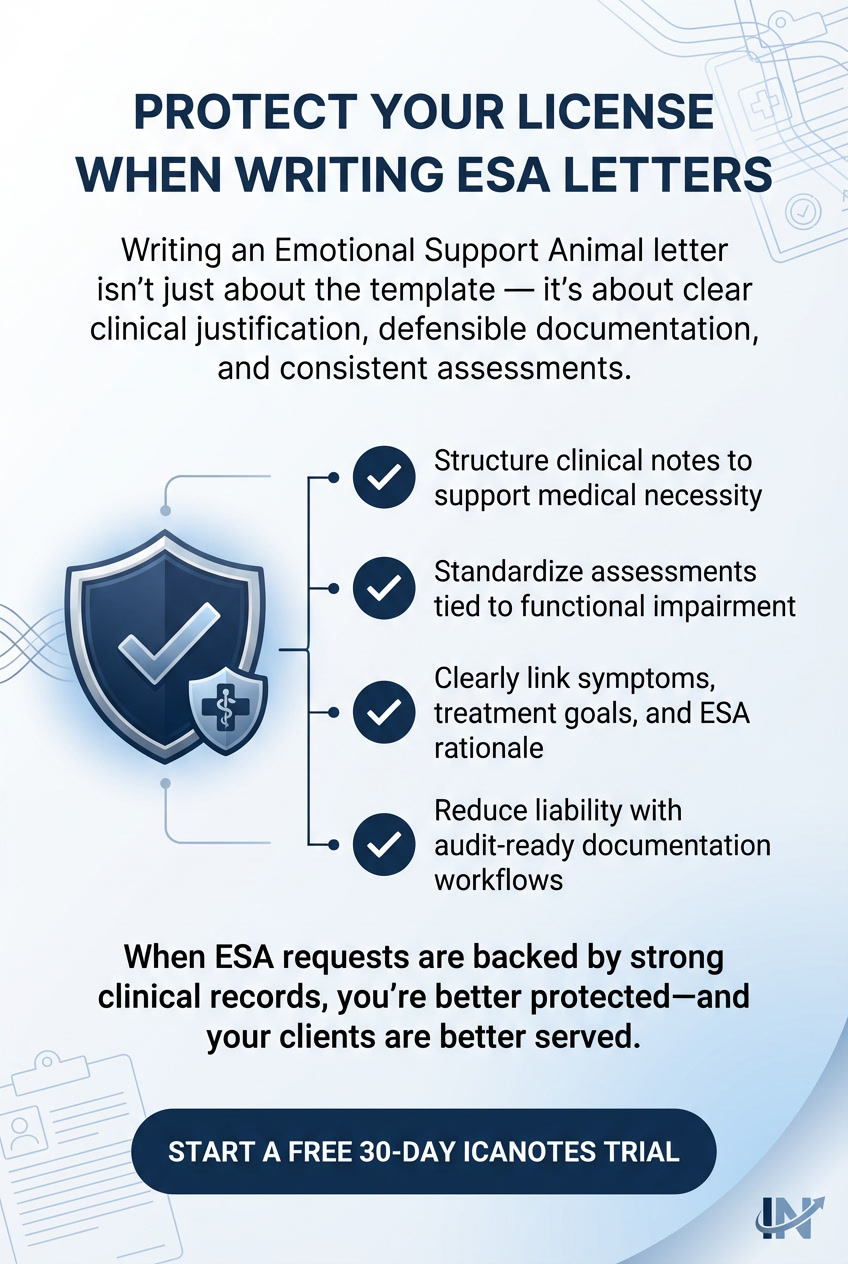
From a liability mitigation perspective, ICANotes facilitates defensible documentation practices by establishing transparent decision-making trails. Should accommodation requests face legal challenge or regulatory scrutiny, comprehensive electronic records demonstrating thorough assessment processes and individualized clinical reasoning provide powerful protection against allegations of negligent or inappropriate recommendations. The software's audit capabilities track documentation timing, modifications, and access patterns — forensic details occasionally relevant in contested proceedings.
See how ICANotes streamlines ESA documentation by signing up for a free 30-day trial or booking a demo today.

Start Your 30-Day Free Trial
Experience the most intuitive, clinically robust EHR designed for behavioral health professionals, built to streamline documentation, improve compliance, and enhance patient care.
- Complete Notes in Minutes - Purpose-built for behavioral health charting
- Always Audit-Ready – Structured documentation that meets payer requirements
- Keep Your Schedule Full – Automated reminders reduce costly no-shows
- Engage Clients Seamlessly – Secure portal for forms, messages, and payments
- HIPAA-Compliant Telehealth built into your workflow

Related Posts



Dr. October Boyles
DNP, MSN, BSN, RN
About the Author
Dr. October Boyles is a behavioral health expert and clinical leader with extensive expertise in nursing, compliance, and healthcare operations. With a Doctor of Nursing Practice (DNP) and advanced degrees in nursing, she specializes in evidence-based practices, EHR optimization, and improving outcomes in behavioral health settings. Dr. Boyles is passionate about empowering clinicians with the tools and strategies needed to deliver high-quality, patient-centered care.