
Blog > Treatment Strategies > Highly Sensitive Person (HSP): Traits & Clinical Guide
Highly Sensitive Person (HSP): Traits, Characteristics & How Clinicians Can Support HSP Clients
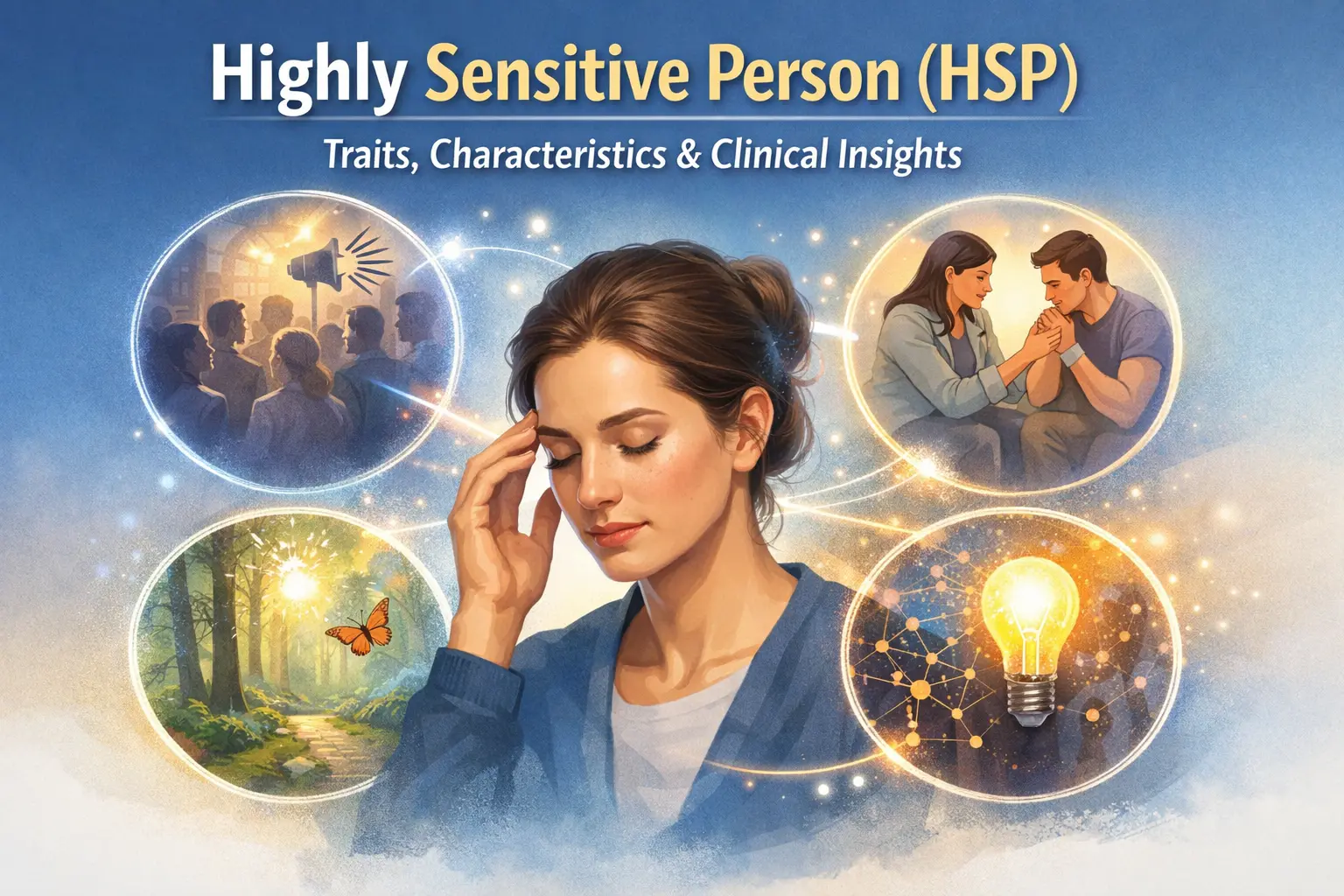
A highly sensitive person (HSP) experiences sensory processing sensitivity (SPS) — a temperament trait marked by deep processing, empathy, and overstimulation risk. This clinician-focused guide explains HSP traits, strengths, differential diagnosis, and evidence-informed support strategies.


Last Updated: March 2, 2026

What You'll Learn
-
What a highly sensitive person (HSP) is — and how sensory processing sensitivity (SPS) differs from a mental health diagnosis
-
The core HSP traits and characteristics of highly sensitive people, including the DOES framework
-
The strengths and “superpowers” associated with high sensitivity
-
How to differentiate HSP traits from anxiety disorders, autism spectrum traits, trauma responses, and ADHD
-
Practical clinical strategies for supporting highly sensitive clients in therapy
-
How emotional regulation, boundary work, and sensory management improve outcomes for HSP clients
-
Common misconceptions about HSP personality traits — and how to avoid pathologizing sensitivity
-
How structured documentation can support strengths-based treatment planning for highly sensitive clients
Highly sensitive people (HSPs) are among the most frequently misunderstood clients in behavioral health settings. They often arrive with questions — and sometimes diagnoses — that don't quite fit. They may have been told they're "too emotional," labeled with anxiety or mood disorders that only partially explain their experience, or spent years struggling to understand why the world feels so intense.
For clinicians, understanding sensory processing sensitivity (SPS) is not just a clinical nicety — it is a practical tool. Accurate psychoeducation about HSP traits can reduce misdiagnosis, strengthen the therapeutic alliance, and open more effective treatment pathways. This guide covers what HSP is, how to recognize it clinically, how to distinguish it from other presentations, and how to support HSP clients in practice.
What is a Highly Sensitive Person (HSP)?
A highly sensitive person is someone who experiences sensory processing sensitivity (SPS) — a deeply ingrained temperament trait characterized by more thorough cognitive processing of physical, emotional, and social stimuli. SPS is not a disorder, a diagnosis, or a sign of pathology. It is a normal human trait found across cultures and species.
The term was introduced in 1996 by clinical research psychologist Elaine N. Aron, PhD, whose landmark book The Highly Sensitive Person provided the first systematic framework for understanding high sensitivity as a distinct personality trait. Aron's research has since been replicated across populations and cultural contexts.
Importantly, HSP is not synonymous with introversion, shyness, or emotional fragility. Highly sensitive people can be extroverted, outgoing, and resilient — while still experiencing the world with significantly greater depth and intensity than most.
Sensory processing sensitivity (SPS) is a temperament trait, not a mental health diagnosis. Approximately 15–20% of the population are estimated to be highly sensitive, and the trait appears consistently across genders, cultures, and even non-human species.
How Common is HSP?
Research estimates that 15–20% of the general population qualifies as highly sensitive. Another 50% may present with moderate sensitivity, and approximately 30% with relatively low sensitivity. This places the trait well within the range of normal human variation — making it likely that clinicians encounter HSP clients regularly, whether or not they recognize the trait.
Cultural context matters significantly. In cultures that value emotional restraint or independence, HSP traits may be more stigmatized and suppressed. In more collectivist or emotionally expressive cultures, the same traits may be better integrated or even celebrated. Clinicians working with diverse populations should take cultural expression of sensitivity into account during assessment.
Core HSP Traits
HSP people tend to share a recognizable cluster of experiences and behaviors. While no two HSPs are identical, common traits include:
- Feeling overwhelmed by bright lights, loud noises, strong smells, or rough textures
- Being easily startled by unexpected sounds or events
- Noticing subtle changes in the environment, mood, or facial expressions of others
- Needing time alone to decompress after busy or stimulating days
- Experiencing intense emotional reactions to both positive and negative events
- Being deeply moved by art, music, or nature
- Having a rich and complex inner life
- Thinking deeply before acting or speaking
- Feeling deeply affected by criticism or conflict
- Being highly conscientious and attuned to the needs of others
- Struggling with decision fatigue when too many options are presented
- Being physiologically reactive to stress, including physical symptoms such as headaches or gastrointestinal sensitivity
While these characteristics of highly sensitive people can resemble anxiety or emotional reactivity, they often reflect deep processing rather than dysfunction.
Help Your HSP Clients Harness Their Strengths
Many highly sensitive clients struggle with shame, overstimulation, and boundary confusion. This free PDF offers five practical, strengths-based exercises clinicians can share to support empathy, imagination, emotional awareness, feedback resilience, and boundary development.
Download “5 Ways to Boost Your Powers as a Highly Sensitive Person” and use it as a client handout or session guide.
Sensory Processing Sensitivity: The DOES Framework
Dr. Aron developed the DOES acronym as a clinical tool to help clinicians conceptualize the four core dimensions of sensory processing sensitivity. Each component has practical clinical implications.
D — Depth of Processing
HSPs process information more thoroughly than most people. They tend to pause and reflect before responding, notice patterns and nuances others miss, and make more elaborate connections between new information and prior experience. Clinically, this often presents as extended deliberation, heightened awareness of relational dynamics, or a strong preference for understanding the "why" behind recommendations. HSP clients may respond especially well to insight-oriented approaches.
O — Overstimulation
Because HSPs process so deeply, they reach cognitive and emotional capacity more quickly in stimulating environments. Crowded spaces, fast-paced workplaces, noisy environments, and high-demand schedules can all lead to overstimulation and subsequent burnout. Clinically, this can manifest as exhaustion after social interactions, withdrawal, difficulty concentrating, or somatic complaints. It is not avoidance in the pathological sense — it is a neurobiological response to stimulus load.
E — Emotional Responsiveness and Empathy
HSPs tend to experience stronger emotional reactions to both internal states and the emotions of others. They are often highly empathic, absorbing the emotional tone of their environment and the people around them. This can be a profound clinical asset — HSP clients may be especially insightful, relationally attuned, and motivated in therapy. However, emotional flooding and difficulty regulating intense affect are also common challenges.
S — Sensitivity to Subtle Stimuli
HSPs notice what others overlook: the slight change in a colleague's tone, the underlying tension in a room, the texture of a fabric that most people would not register. This perceptual acuity extends to the physical environment (light, sound, smell, taste, texture) as well as relational and social cues. Clinically, HSP clients may be acutely aware of shifts in the therapeutic relationship and highly responsive to the clinician's own affect and energy.
Strengths of Highly Sensitive People
Clinicians working with HSP clients benefit from holding a genuinely strengths-based frame. Sensitivity is frequently framed as a liability, but research and clinical experience consistently show that SPS confers meaningful advantages:
- Strong empathy and interpersonal attunement, which supports deep and meaningful relationships
- Exceptional observational skills and pattern recognition
- Rich inner life and creative expression — many HSPs are drawn to the arts, writing, music, or other creative fields
- Meaning-driven decision-making rooted in values and ethical awareness
- Deep intuition that draws on subtle cues and accumulated observation
- Natural suitability for helping professions, where attunement and empathy are core competencies
- Capacity for deep focus and sustained engagement when working in low-stimulation environments
Many HSP people thrive in helping professions, creative fields, and leadership roles requiring emotional intelligence.
Framing HSP strengths explicitly in therapy can be transformative for clients who have spent years being told their sensitivity is a weakness or a problem to fix. Reframing sensitivity as a strength with regulation needs — rather than a flaw — can be transformative for clients’ self-concept.
HSPs and Mental Health
Sensory processing sensitivity is not a mental health diagnosis and should not be treated as one. However, it is a trait that interacts meaningfully with mental health, particularly when clients have not had adequate support or understanding of their trait.
HSP traits may increase vulnerability to:
- Emotional flooding and difficulty returning to baseline after intense experiences
- Overstimulation and burnout in high-demand environments
- Chronic stress and physical symptoms associated with sustained sensory load
- Sensitivity to criticism and interpersonal conflict
- Internalized shame stemming from messages that sensitivity is weakness
Conversely, highly sensitive people who grow up in supportive, nurturing environments tend to show fewer of these vulnerabilities and may thrive, particularly in roles that leverage their perceptual and empathic strengths. The interaction between SPS and environment is one of the most important factors clinicians should explore.
The clinical task is to differentiate trait-based sensitivity from disorder-driven distress.
Differential Diagnosis: HSP vs. Other Conditions
One of the most clinically significant contributions a practitioner can make is distinguishing HSP traits from presentations that may appear similar but require different treatment approaches. Misattributing HSP traits to a diagnosable condition — or missing a diagnosable condition because HSP seems sufficient as an explanation — can result in inadequate or misdirected care.
HSP vs. Anxiety Disorders
Anxiety disorders and HSP traits frequently co-occur and share overlapping features, including avoidance of stimulating environments, physiological arousal, and emotional reactivity. The key distinction is the underlying mechanism. In anxiety disorders, avoidance is typically driven by fear of catastrophic outcomes and involves anticipatory distress. In HSPs, withdrawal from stimulation is a regulatory response to overload, not a fear-based response. HSPs do not necessarily experience intrusive worry or future-focused catastrophizing; they are responding to the actual sensory or emotional load of the present moment.
HSP vs. Autism Spectrum Traits
Both HSP and autism spectrum conditions involve heightened sensory sensitivity and difficulty with overstimulation. However, autistic sensory processing differences are often accompanied by distinct patterns in social communication, rigid routines, repetitive behaviors, and sensory processing that may include hyposensitivity as well as hypersensitivity. HSPs generally have intact social reciprocity and Theory of Mind. A formal autism assessment is warranted when social communication differences, inflexibility, or developmental history suggest ASD.
HSP vs. Trauma Responses
Hypervigilance, emotional reactivity, and sensitivity to environmental cues are hallmarks of both trauma responses and high sensitivity. The crucial clinical question is: does the client's heightened sensory awareness predate trauma, or did it emerge following adverse experiences? Trauma responses typically have identifiable onset events and include trauma-specific features such as intrusion, avoidance of trauma-related stimuli, and alterations in cognition and mood. HSP traits, by contrast, are typically described as lifelong and consistent across all environments.
HSP vs. ADHD Sensory Reactivity
ADHD can also involve sensory sensitivity, particularly in presentations with emotional dysregulation. However, ADHD is characterized by executive functioning difficulties—attention regulation, impulse control, and working memory—that are distinct from SPS. HSPs are often highly attentive, perhaps even overly so. The two conditions can co-occur, and clinicians should assess for both when the presentation is complex.
No standardized diagnostic criteria for HSP exist in the DSM-5 or ICD-11. The trait is best understood as a dimension of temperament. Clinicians should use Aron’s self-report scales and clinical interview to explore the trait, while remaining alert to co-occurring conditions that require independent assessment and treatment.
Clinical Guidance: Supporting HSP Clients in Practice
Once a clinician has established that a client's presentation is meaningfully shaped by high sensitivity, several evidence-informed approaches can guide the therapeutic work:
Validation and Psychoeducation
Many HSP clients have internalized the message that their sensitivity is a character flaw. A foundational intervention is simply naming the trait accurately: sensory processing sensitivity is a normal, research-supported trait found in roughly one in five people. Providing concrete psychoeducation—including Aron’s DOES framework—can be profoundly normalizing and help clients begin to understand their own patterns without shame.
Emotion Regulation Skills
HSPs are prone to emotional flooding, particularly in high-stimulation environments. Skills-based work in emotion regulation—including distress tolerance techniques from DBT, mindfulness-based approaches, and somatic awareness practices—can help clients develop more effective responses to intense emotional states. Pacing and titration of emotional work in session is also important; pushing too hard, too fast can overwhelm the HSP client’s capacity for integration.
Sensory Environment Management
Practical, concrete guidance on sensory load management is often highly valued by HSP clients. This may include structured “decompression time” after high-stimulation activities, deliberate environmental modifications at home and work, and explicit boundary-setting around sensory demands. Clinicians can help clients identify their unique sensory profile and develop personalized coping strategies.
Boundary Setting and Interpersonal Skills
Due to their strong empathy and relational attunement, HSPs are frequently at risk of absorbing others' emotions, overextending themselves in caregiving roles, and struggling to set limits with others. Interpersonal skills work—including assertiveness training and explicit coaching on boundary communication—can help HSP clients protect their regulatory resources without sacrificing connection.
Strengths-Based Identity Work
Many HSPs have a fragmented or ambivalent relationship with their own sensitivity. Identity work that explicitly honors the adaptive dimensions of high sensitivity—empathy, creativity, depth, meaning-making—can support self-esteem and reduce the shame that often accompanies years of feeling “too much.” Narrative approaches, acceptance-based work, and positive reframing can all serve this purpose.
The following condensed account, shared with permission, illustrates how HSP traits can shape a client’s life narrative and therapeutic journey.
“I once thought being highly sensitive was a burden. I see it now as a superpower—one that requires curiosity, an open heart, clear boundaries, and the safety to wield it.”
Nōn Wels, a writer and mental health advocate, describes growing up with profound sensitivity in an environment that offered little safety or understanding.
Nōn’s story illustrates a common HSP trajectory: the experience of early dysregulation and shame, followed—when the right support and framework arrive—by a profound shift toward self-acceptance and strength-based identity. It also underscores the weight of the environment: HSPs in unsupportive contexts face significantly higher risk of anxiety, depression, and burnout. Clinicians who can recognize the trait early and offer accurate, compassionate psychoeducation may meaningfully alter this trajectory.

Frequently Asked Questions: Working with HSP Clients
How ICANotes Supports Clinicians Working with HSP Clients
Working with highly sensitive clients calls for thorough, individualized documentation that captures sensory triggers, emotional flooding patterns, strengths-based progress, and the nuanced interactions between trait-level sensitivity and mental health presentations.
ICANotes provides clinicians with structured documentation templates designed for behavioral health practice, making it straightforward to document HSP-relevant detail alongside standard clinical content. Streamlined progress notes, treatment plan tools, and assessment templates help ensure that HSP traits are captured consistently across the course of care — supporting clearer psychoeducation, more targeted goal-setting, and better continuity between sessions.
Ready to see how ICANotes can support your practice? Schedule a demo or start your free trial today.

Start Your 30-Day Free Trial
Experience the most intuitive, clinically robust EHR designed for behavioral health professionals, built to streamline documentation, improve compliance, and enhance patient care.
- Complete Notes in Minutes - Purpose-built for behavioral health charting
- Always Audit-Ready – Structured documentation that meets payer requirements
- Keep Your Schedule Full – Automated reminders reduce costly no-shows
- Engage Clients Seamlessly – Secure portal for forms, messages, and payments
- HIPAA-Compliant Telehealth built into your workflow

Related Posts





Kaylee Kron
LMSW
About the Author
Kaylee, a certified grief counselor and social worker, has dedicated the past decade to reshaping our understanding and support of grief. With experience at a nonprofit hospice, she's empowered individuals to navigate their grief journeys, recognizing that loss extends beyond death. As an author, speaker, and event organizer, Kaylee fosters spaces for acknowledging and embracing life's most challenging moments. Her work has been featured across various media, amplifying voices and broadening awareness of the diverse sources of grief in our lives.