
Blog > Practice Management > 5 Best EHRs for Group Therapy Practices in 2026
Best Group Therapy EHR Software: 5 Platforms Compared
Choosing the best EHR for group therapy practices requires more than basic scheduling and documentation tools. Group therapy EHR software must support recurring group appointments, attendance tracking, group note templates, telehealth, and billing for group therapy CPT codes. In this guide, we compare the leading EHR platforms for behavioral health practices, including ICANotes, TherapyNotes, SimplePractice, Valant, and TheraNest, and explain the key features to look for in group therapy EHR software with scheduling, documentation, and billing all in one place.


Last Updated: June 25, 2026


Key Takeaways
- Group therapy practices need specialized EHR features beyond standard individual therapy workflows, including recurring group scheduling, attendance tracking, and group note management.
- The best EHR software for group therapy practices combines scheduling, documentation, billing, and telehealth in a single platform.
- Group therapy billing requires support for CPT codes such as 90853, 90849, and H0005, along with attendance-based claim generation.
- ICANotes, TherapyNotes, SimplePractice, Valant, and TheraNest are among the leading behavioral health EHRs with group therapy capabilities.
- Choosing the right platform depends on your practice size, group volume, telehealth needs, and billing complexity.
Running group therapy sessions is one of the most operationally complex workflows in behavioral health practice. Unlike individual therapy, where each appointment maps neatly to a single patient record, a single group session generates a cascade of administrative tasks: coordinating multiple clients in a recurring schedule, tracking which members attended, writing a single clinical note that flows into several separate records, and billing correctly for each participant using the right CPT codes.
A generic EHR — or even a general-purpose mental health platform — often handles these tasks as afterthoughts, leaving group therapy practices to bridge the gaps with workarounds, spreadsheets, or manual processes that create compliance risk and eat clinician time.
This guide breaks down exactly what to look for in group therapy EHR software, compares the leading platforms on criteria that matter for group practice, and digs into the billing details that most EHR comparisons skip entirely. If you’re setting up group therapy services for the first time, or looking to switch from a system that isn’t keeping pace with your practice’s needs, this is the starting point.
Quick Comparison: Best EHRs for Group Therapy Practices
Group therapy practices need more than a standard scheduling tool — they need support for recurring group sessions, attendance tracking, group note documentation, billing workflows, and telehealth when applicable. The table below compares leading behavioral health EHRs based on core group therapy capabilities.
At a Glance: ICANotes stands out for behavioral health practices that want group scheduling, documentation, billing, and telehealth in a single behavioral-health-specific platform. TherapyNotes and SimplePractice are popular options for smaller practices, while Valant offers advanced functionality for organizations with more complex group therapy programs.
What Makes Group Therapy EHR Requirements Different?
Most EHRs are architected around the individual appointment — one clinician, one client, one note, one claim. Group therapy breaks every one of those assumptions. Understanding where the friction points are helps explain why platform selection matters so much for group practice specifically.
Group Enrollment and Rotating Membership
Groups have start and end dates, enrollment caps, and membership that changes over time. A client might join mid-cycle, miss several sessions, or be discharged from the group while remaining active in individual therapy. Your EHR needs to track past and present group members distinctly from the group’s overall session history.
Recurring Session Scheduling
Group sessions are typically recurring — every Tuesday at 2 PM, for example — but with variable attendance each week. Scheduling tools need to handle both the repeating appointment template and the week-to-week reality of who actually showed up.
Group Note Documentation
Clinicians don’t write six separate notes for a six-person group. They write one note capturing what happened in the session, and that note needs to populate — or link to — each participating client’s individual record. Without this functionality, documentation either gets duplicated manually (time-intensive and error-prone) or it lives only in a group-level record that isn’t accessible in the client’s chart.
Attendance Tracking and Billing Connection
Attendance determines billing eligibility. A client who misses a session isn’t billed. A late cancellation may or may not generate a no-show fee depending on your practice policy and payer contracts. The EHR needs to capture attendance at the individual level within each group session and feed that data directly into claim generation.
Group-Specific CPT Codes
Group therapy uses different CPT codes than individual therapy — 90853 for group psychotherapy, 90849 for multiple-family group therapy, H0005 for substance use disorder group counseling. Payer rules for these codes are distinct from individual codes, and errors at this stage translate directly to claim denials.
Telehealth for Group Sessions
Telehealth group therapy presents platform-level complexity that most EHRs don’t fully address. Running a multi-participant video session compliantly requires a HIPAA-compliant platform that can handle group video and, ideally, document attendance and session details within the same workflow.
The Admin Burden Without the Right Tools
Practices that patch together manual workflows to compensate for EHR limitations typically see higher documentation time per clinician, billing errors that affect revenue, and compliance gaps that create audit exposure. The right EHR doesn’t just make group therapy more convenient — it makes it operationally sustainable.
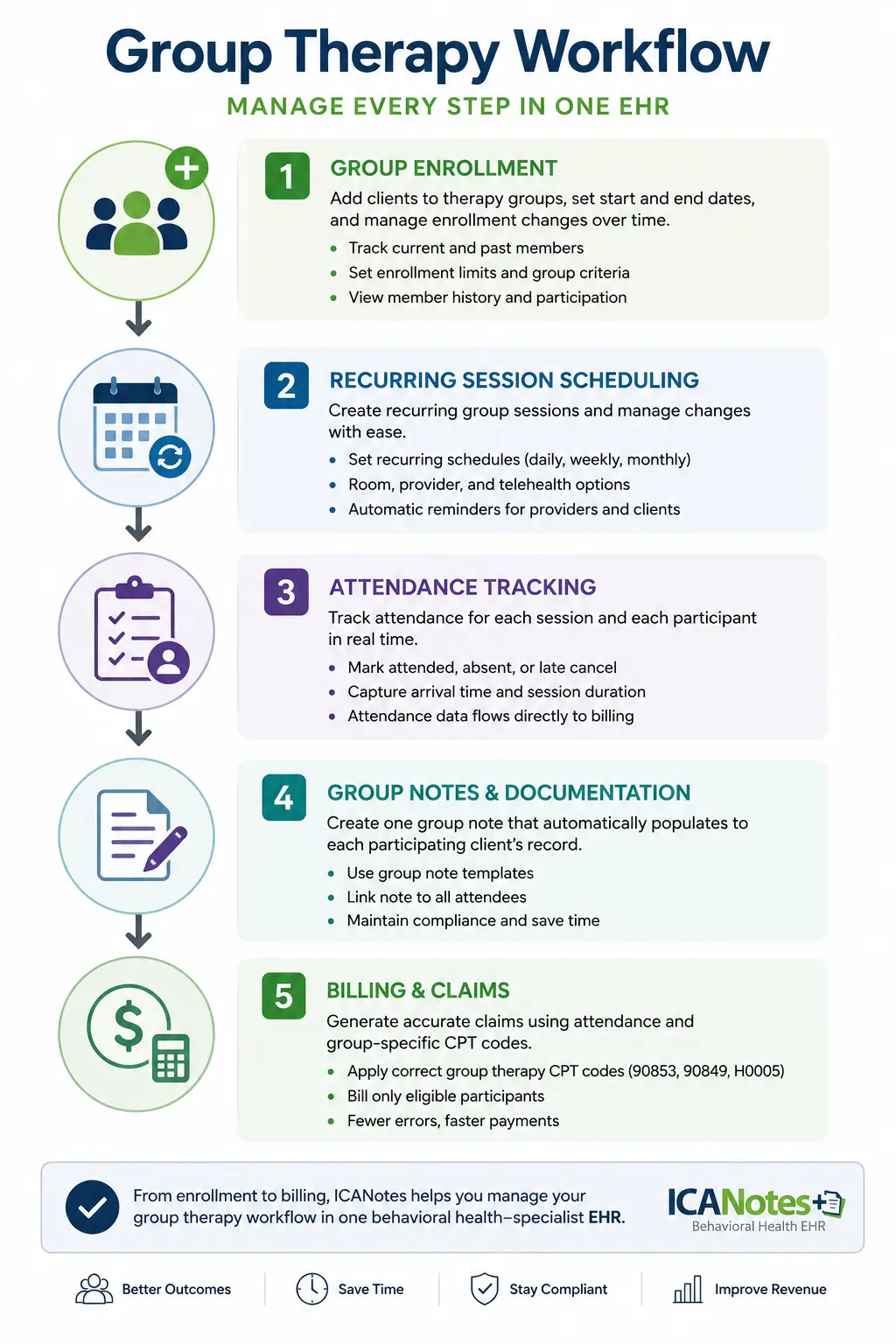
Key Features to Look for in a Group Therapy EHR
When evaluating group therapy EHR software, these are the capabilities that separate a purpose-built solution from a workaround:
- Group enrollment and attendance management — the ability to manage a roster per group, track membership over time, and record individual attendance at each session
- Recurring group session scheduling — repeating appointment templates with flexibility to handle exceptions, cancellations, and membership changes
- Group note templates that auto-populate to individual patient records — write once, have it reflect in every enrolled client’s chart
- Attendance-based billing configuration — automatic handling of present, absent, and no-show statuses that flows into claim generation
- Group-specific CPT code support — native billing support for 90853, 90849, H0005, and related codes with payer-aware logic
- Multi-participant telehealth — HIPAA-compliant group video sessions that integrate with your clinical workflow
- Client portal access for group members — the ability for group participants to complete intake forms, access scheduling information, and communicate securely
- Waitlist management — the ability to manage enrollment queues when groups are at capacity
- Reporting on group attendance and outcomes — data that supports utilization reviews, grant reporting, and quality improvement
Best EHR Software for Group Therapy Practices: Platform Comparison
The following platforms are evaluated specifically on their behavioral health group therapy capabilities. General-purpose EHRs (AdvancedMD, eClinicalWorks, Athenahealth) are excluded — they lack the behavioral health specialization that group therapy practices need.
A Note on Platform Selection
The platforms above serve meaningfully different practice profiles. A solo practitioner adding one weekly CBT group has different needs than a community mental health center running dozens of concurrent groups across multiple clinicians and payers. The right EHR is the one that matches your practice’s current complexity — with room to grow.
How ICANotes Handles Group Therapy
ICANotes is built exclusively for behavioral health — it doesn’t serve primary care, dental, or physical therapy practices. Every feature, including its group therapy tools, is designed for the workflows that behavioral health clinicians actually use. Here’s what that looks like in practice.
Group Session Scheduling and Recurring Appointments
ICANotes supports recurring group session templates, allowing practices to set up standing group appointments (day, time, frequency) and manage exceptions without rebuilding the schedule from scratch. Group sessions appear in the master schedule alongside individual appointments, giving staff a unified view of the day’s clinical activity.
Group Note Templates and Individual Record Integration
One of the most time-consuming aspects of group therapy documentation is the requirement that each client have their own progress note. ICANotes’ group note templates allow clinicians to document the session once — what was covered, clinical observations, interventions used — and have that documentation populate automatically into each attending client’s individual record. Clinicians can then personalize each client’s note with individual-specific observations before signing.
This approach dramatically reduces documentation time while preserving the clinical completeness and legal defensibility of individual progress notes. It also keeps every client’s chart audit-ready without requiring duplicate entry.
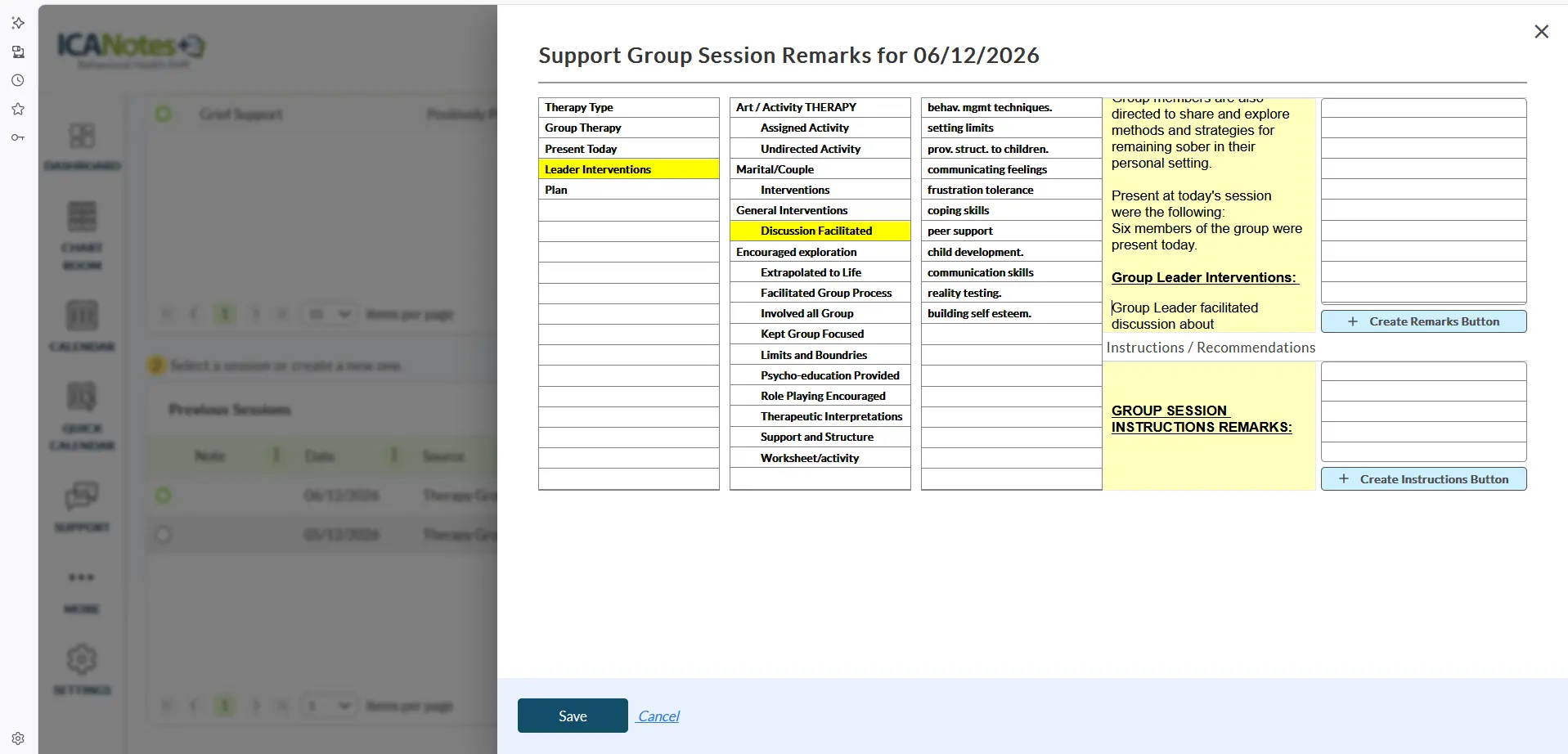
Attendance Tracking Within the EHR
Attendance is recorded at the individual level within each group session in ICANotes. The system distinguishes between clients who attended, were absent, or canceled, and this data feeds directly into the billing workflow. ICANotes supports practices in managing no-show and late-cancel workflows by allowing teams to document appointment status, track missed appointments, and apply their internal billing policies consistently.
Group-Specific Billing and CPT Code Support
ICANotes supports the CPT codes used in group therapy billing, including 90853, 90849, and H0005, with payer-aware billing logic that accounts for the differences between individual and group claims. The billing module is integrated — not bolted on — so documentation and billing are connected by design rather than requiring manual handoff between systems.
Telehealth for Group Sessions
ICANotes includes integrated telehealth that supports multi-participant video sessions, allowing group therapy to be delivered via telehealth without switching to a separate platform. Session documentation and attendance tracking work the same way whether sessions are in-person or remote.
Treatment Planning and Compliance Integration
Group therapy doesn’t operate in isolation from the rest of a client’s care. In ICANotes, group session documentation connects to treatment plans, enabling clinicians to track progress toward treatment goals through group modality and maintaining the longitudinal clinical record that payers and accreditation bodies expect to see.
The Behavioral Health Specialist Advantage
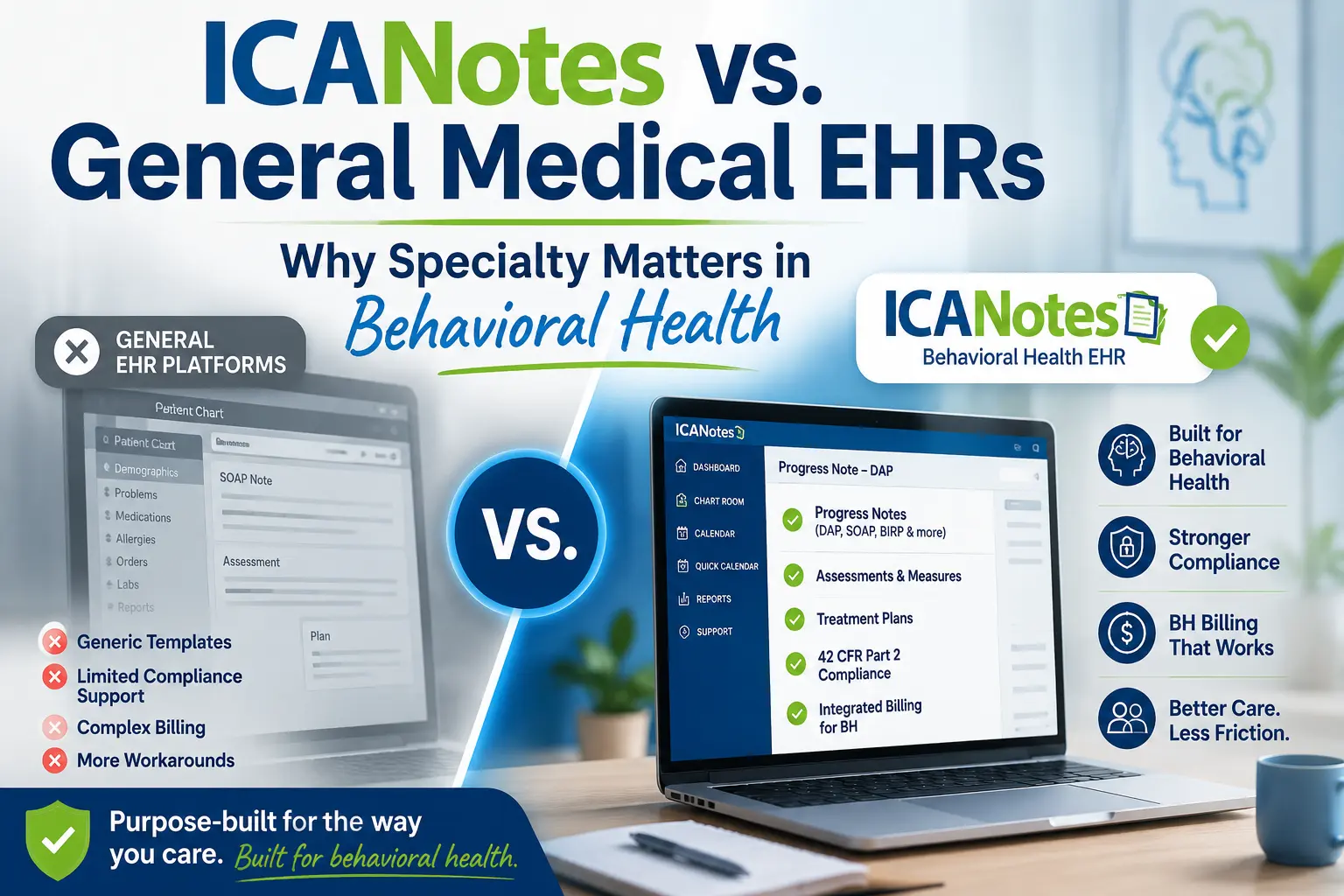
Platforms built for general outpatient care often add group therapy as a feature layer on top of individual-focused architecture. The result is functional but incomplete — workarounds for group notes, manual billing adjustments for group CPT codes, and scheduling tools that weren’t designed for enrollment management. ICANotes is built the other way around: group therapy is a core use case, not an add-on.
Group Therapy CPT Codes: What Your EHR Needs to Support
Billing for group therapy is an area where documentation errors translate directly into claim denials and compliance risk — and where most EHR comparison content provides almost no useful guidance. Here’s a practical overview of the codes that apply and what your EHR needs to handle.
How Attendance Status Affects Billing
Unlike individual therapy, where a no-show still generates a potential no-show fee billed to the client, group therapy billing is contingent on attendance. A client who does not attend a group session cannot be billed to insurance for that session. This means your EHR’s attendance tracking isn’t just a clinical record — it’s the billing source of truth.
Group therapy EHR software should automatically exclude non-attending clients from claim generation for that session and flag any attendance-billing discrepancies for review before claims are submitted.
Common Group Billing Mistakes and How the Right EHR Prevents Them
- Billing 90853 for sessions with only one client present — CPT 90853 requires at least two patients; a system that validates minimum attendance before allowing claim submission catches this automatically
- Using individual therapy codes (90834, 90837) for group sessions — different codes, different reimbursement rates, and a pattern that can trigger payer audits
- Missing modifier requirements for telehealth group sessions — telehealth claims often require GT or 95 modifiers depending on the payer; a billing-integrated EHR applies these based on how the session was delivered
- Billing for clients who canceled or no-showed — attendance-linked billing prevents this automatically
- Submitting group claims without individual session notes — payers can require individual progress notes even for group therapy; the EHR’s documentation workflow should ensure these exist before claims go out
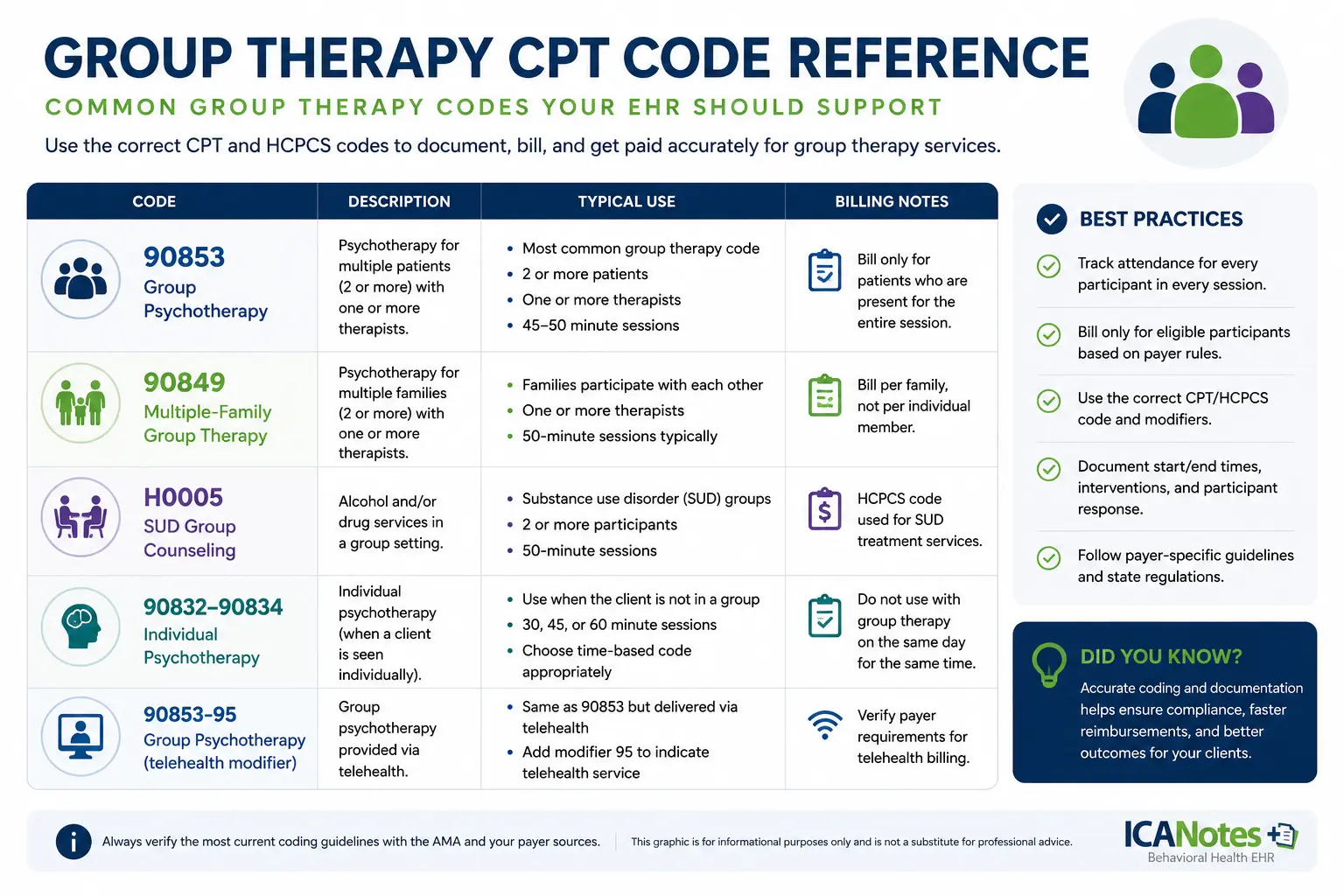
How to Choose the Right EHR for Your Group Therapy Practice
The best EHR for group therapy depends on where your practice sits today and where it’s heading. Here’s a quick decision framework.
Solo Practitioner Adding Group Sessions
You need simplicity and integration — a system where adding group appointments and generating group notes doesn’t create a completely separate administrative workflow from your individual practice. Look for EHRs where group functionality is built into the same tools you already use, not a separate module that requires separate setup.
Small Group Practice Running Regular Groups
Recurring scheduling, attendance tracking, and clean billing for group CPT codes are non-negotiable at this level. You also need a system that multiple clinicians can use without conflicts — shared schedules, group-level documentation that individual clinicians can access and add to, and billing that handles multiple providers and groups simultaneously.
Larger Behavioral Health Organization with High Group Volume
At scale, the priorities shift toward automation and reporting. You need attendance and billing data you can aggregate across groups, clinicians, and payer types. Waitlist management becomes important when groups are consistently full. And the EHR needs to support group therapy documentation that satisfies utilization review requirements for managed care contracts.
Practices Offering Both In-Person and Telehealth Group Sessions
Hybrid delivery requires an EHR where the documentation and billing workflow is the same regardless of modality. If your telehealth and in-person workflows live in different systems — or require different processes — you’re doubling your administrative overhead and introducing compliance gaps.
Practices with Complex Billing Needs (Insurance, Medicaid/Medicare)
Payer complexity is where generic EHRs show their limits most clearly. If you’re billing Medicaid for substance use disorder groups, managing prior authorizations for group therapy, or dealing with multiple payer contracts with different group billing rules, you need an EHR with behavioral-health-specific billing logic — not a general-purpose clearinghouse connection.
EHR for Group Therapy Practices: Frequently Asked Questions
Recent Posts






Dr. October Boyles
DNP, MSN, BSN, RN
About the Author
Dr. October Boyles is a behavioral health expert and clinical leader with extensive expertise in nursing, compliance, and healthcare operations. With a Doctor of Nursing Practice (DNP) and advanced degrees in nursing, she specializes in evidence-based practices, EHR optimization, and improving outcomes in behavioral health settings. Dr. Boyles is passionate about empowering clinicians with the tools and strategies needed to deliver high-quality, patient-centered care.