Blog > Treatment Strategies > Emotionally Focused Couples Therapy (EFCT): Techniques & Stages
Emotionally Focused Couples Therapy (EFCT): Techniques, Stages, and Clinical Applications
Emotionally focused couples therapy (EFCT) is an evidence-based approach designed to help partners strengthen emotional bonds, improve communication, and repair relationship distress. Rooted in attachment theory, EFCT guides couples in identifying negative interaction patterns, expressing underlying emotions, and fostering secure, lasting connections. In this guide to emotionally focused couples therapy, clinicians will learn how EFCT works, key techniques used in sessions, and how to apply EFCT strategies to support couples struggling with conflict, disconnection, or intimacy challenges.


Last Updated: March 26, 2026

What You'll Learn
- What emotionally focused couples therapy (EFCT) is and how it helps couples strengthen emotional bonds using an attachment-based framework
- How to identify common negative interaction cycles like pursue-withdraw and reframe them as the core treatment focus
- The three stages of EFCT — de-escalation, restructuring, and consolidation — and how they guide the therapy process
- Key EFCT techniques such as enactments, validation, and reframing that deepen emotional engagement in sessions
- How EFCT differs from approaches like CBT and the Gottman Method in its focus on emotion and attachment
- Which types of clients and relationship issues respond best to emotionally focused couples therapy
- How to document EFCT sessions in a clear, compliant way that supports medical necessity
- Common misconceptions about EFCT and how to apply the model effectively in clinical practice
Contents
- What is Emotionally Focused Therapy (EFT)?
- How Emotionally Focused Couples Therapy Works
- The 3 Stages of Emotionally Focused Couples Therapy
- The Role of the Couples Therapist in EFCT
- Core EFCT Techniques and Interventions
- Who Benefits from Emotionally Focused Couples Therapy?
- EFCT vs Other Couples Therapy Approaches
- Common Misconceptions About Emotionally Focused Couples Therapy
- Training and Resources for Emotionally Focused Couples Therapy
- Documenting Emotionally Focused Couples Therapy Sessions
- Final Thoughts on EFCT
- FAQ: Emotionally Focused Couples Therapy (ECFT)
What is Emotionally Focused Couples Therapy (EFCT)?
What Is Emotionally Focused Couples Therapy (EFCT)?
Emotionally focused couples therapy (EFCT) is an evidence-based, attachment-focused approach that helps couples identify and change negative interaction patterns by accessing underlying emotions and strengthening emotional bonds. EFCT focuses on creating secure attachment through improved emotional responsiveness, rather than simply teaching communication skills.
Emotionally Focused Therapy (EFT), the therapeutic brainchild of Dr. Sue Johnson, offers a transformative approach to couples therapy that resonates deeply with the human emotional experience. At its core, EFT emphasizes the importance of attachment bonds and the profound impact they have on our relationships. Originally researched with mother-child dyads, attachment theory finds new life in EFCT, where it helps us synthesize and support intimate relationships through the conduit of emotion. Following a structured and empathetic process, clinicians utilizing EFCT guide couples in identifying, understanding, and reshaping the negative interaction patterns that hinder intimacy and connection.
By promoting emotional accessibility and responsiveness, emotionally focused couples therapy supports relational healing and lasting positive change. Its effectiveness has been well-documented across diverse populations and relationship dynamics, making it an invaluable tool for navigating the complexities of intimate relationships. EFCT empowers couples to break free from cycles of conflict, panic, and distance, instead fostering a compassionate, stable bond by delving into the underlying patterns of interaction and addressing the core emotional needs driving them. Its emphasis on empathy, validation, and emotional responsiveness not only heals past attachment wounds but also provides tools for cultivating deeper intimacy and enduring connection.
For clinicians, EFCT offers a structured yet flexible framework that integrates experiential techniques with a strong theoretical foundation, making it particularly effective for treating relationship distress, trauma-related attachment injuries, and emotional disconnection. For clinicians developing structured approaches to relationship work, it can also be helpful to align EFCT interventions with clearly defined treatment goals, as outlined in our guide to couples therapy treatment goals and plans.
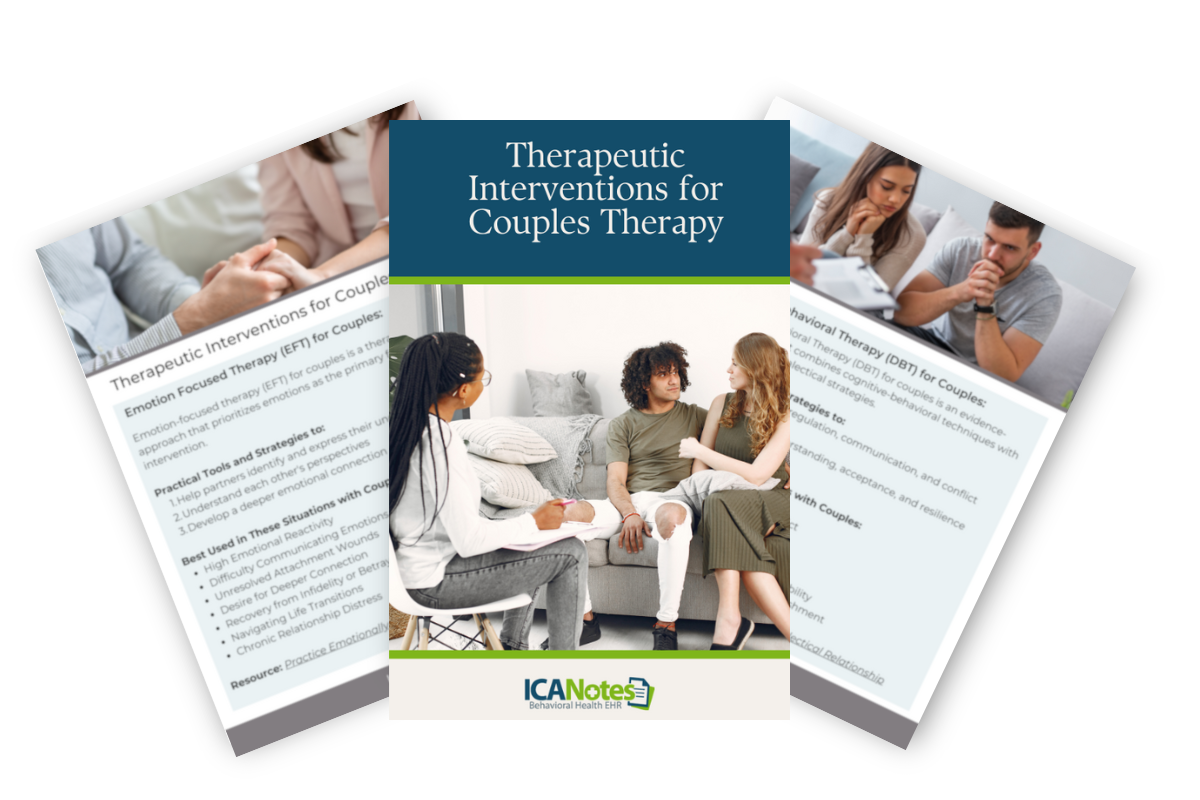
Get the Therapeutic Interventions for Couples Therapy Guide
Give your couples therapy work more structure with a practical, clinician-friendly resource you can reference anytime.
This free guide highlights interventions and best-use scenarios for Emotion-Focused Therapy (EFT), DBT for couples, and ACT for couples so you can choose strategies that fit the clinical needs of the relationship in front of you.
- Quick-reference overview of evidence-based couples therapy approaches
- Practical tools and strategies clinicians can apply in session
- Best-use cases for EFT, DBT, and ACT with couples
Perfect for therapists, counselors, and behavioral health clinicians who want a stronger toolbox for treating communication difficulties, emotional reactivity, attachment wounds, and relationship distress.
Download Your Free Couples Therapy Resource
Fill out the form below to get instant access.
How Emotionally Focused Couples Therapy Works
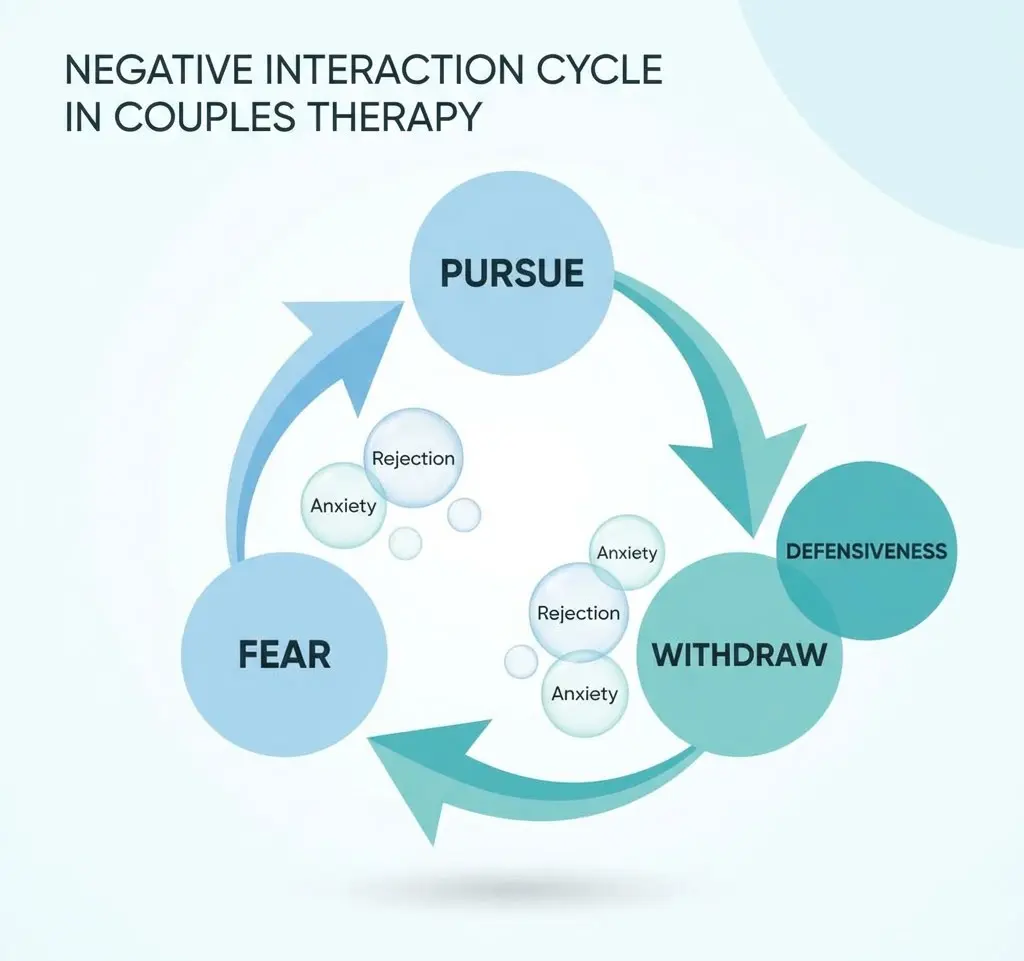
EFCT focuses on identifying and restructuring the negative interaction cycle that maintains relationship distress. These cycles often include patterns such as pursue-withdraw, criticize-defend, or attack-shut down.
Instead of assigning blame to either partner, EFCT reframes the cycle itself as the problem. Clinicians guide couples to:
- Recognize their interaction patterns
- Access underlying emotional experiences
- Express needs in a more vulnerable and direct way
- Respond to each other with empathy and emotional engagement
In doing so, partners begin to understand how their reactions are shaped by deeper fears and unmet attachment needs, rather than intentional harm. This shift reduces defensiveness and creates space for more open, emotionally attuned conversations. As each partner feels safer and more understood, they become more willing to take emotional risks and respond to one another in new ways.
Over time, these shifts help couples move from reactive, defensive patterns toward secure emotional bonding.
The 3 Stages of Emotionally Focused Couples Therapy
Emotionally focused couples therapy has a clear primary goal: to foster new attachment responses that restructure a couples’ relationship into a more secure bond (Johnson, 2004). This goal is achieved with a structured roadmap, marked by three stages: de-escalation of negative cycles of interaction, changing interactional positions, and consolidation and integration (Johnson, 2004).
Stage 1: De-Escalation of Negative Cycles
In this phase, the clinician helps the couple identify their recurring conflict patterns and understand how these cycles are fueled by unmet attachment needs. The goal is to reduce reactivity and create a shared understanding that the cycle — not either partner — is the enemy.
Stage 2: Restructuring Interactions
In stage two, de-escalation is consistently enacted by the couple and emotional safety has been restored in the relationship. Couples can now begin to acknowledge their unmet attachment needs and integrate them into the experience of their relationship. This additional focus on identifying primary emotions and naming emotional responses brings vulnerability and dimension to a once-negative interaction cycle, fostering opportunities to reprocess patterns between the partners. As reprocessing occurs, the couple begins to shift from consistent
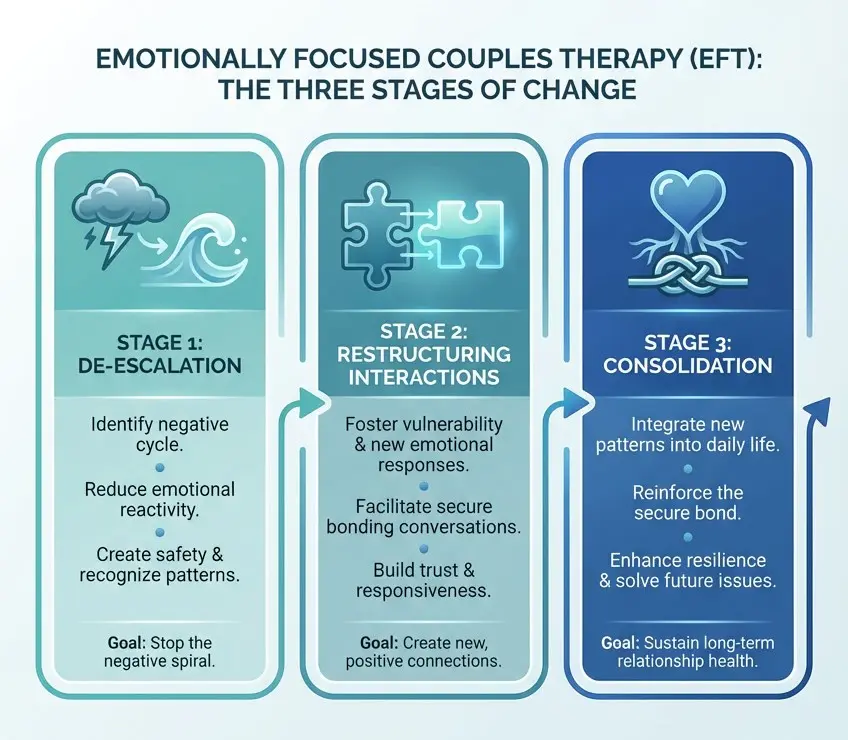
engagement in the negative cycle and feeling “stuck” to co-creating positive interactions that help reinforce their bond. This change of interactional positions reinforces positive regard and emotional intimacy for the couple, allowing each of them to lean into the security of their partner.
Stage 3: Consolidation and Integration
Stage three of emotionally focused couples therapy highlights the consolidation and integration of the new relationship pattern. In this stage, an emotion-focused therapist utilizes session relational enactments in session to reiterate and strengthen the newly attuned and vulnerable positions of each partner. This repetition of attunement allows partners to co-create new, positive, connected experiences where previously they felt lonely, angry, and sad. Ultimately, the stage of consolidation and integration helps empower couples to build and sustain a strong, resilient, and fulfilling connection rooted in trust, intimacy, and mutual support.

The Role of the Couples Therapist in EFCT
The primary role of the therapist in emotionally focused couples therapy is not to demonstrate expertise or to teach, coach, or train the couple. Rather, a therapist utilizing EFCT engages with the couple as both a process consultant and a choreographer (Johnson, 2004). This process of consultation and choreography begins with establishing a safe therapeutic environment - one where both partners understand the therapist as a neutral consultant with unconditional positive regard and a goal to further the health of the relationship. When creating a safe therapeutic environment, it is always necessary to build trust and rapport, but it is also crucial to diligently assess couples with whom you are considering using EFCT. Emotionally focused couples therapy requires that both partners are committed to the relationship - while partners may present in conflict and distress, there should be an underlying desire to remain partnered. For this reason, any incidence of violence or ongoing affairs renders EFT an inappropriate modality to use.
Once safety and rapport are established, the therapist begins their assessment, identifying a specific couple’s unique dynamic and relational “dance.” While there are common patterns, such as the “pursue-withdraw” dynamic, it’s important to identify a couple’s distinctive context, comprised of each individual’s attachment style, history of attachment wounding, and primary emotions and attachment needs. With this information, the therapist can create a multi-faceted conceptualization of negative cycles within the relationship, and can begin to utilize EFT interventions to choreograph the reprocessing of both partner’s emotions and of the relationship.
Core EFCT Techniques and Interventions
There are several common intervention techniques used in Emotionally Focused Couples Therapy, all of which are therapist-initiated and focus mainly on therapist response and direction of therapy, including intentional pacing of sessions to reflect on moments that can create change. In this way, we see that emotion-focused interventions are what contribute to the therapist’s role as choreographer. In the same way a choreographer directs movement on the dance floor, an EFT couples therapist directs the flow and cadence of relational interactions in a session by leveraging different interventions at the appropriate time.
The first intervention necessary in Emotionally Focused Couples Therapy is cycle tracking, or “assembling the process of emotion as it is triggered between two partners caught in negative cycles of separation distress (Johnson 2004; Johnson and Brubacher 2016).” The knowledge that relationship distress is often seeded not in the presence of conflict, but in the failure to repair and reconnect, highlights that understanding and naming the emotions, actions, and reactions of each partner in the cycle is the key to fostering restorative interactions.
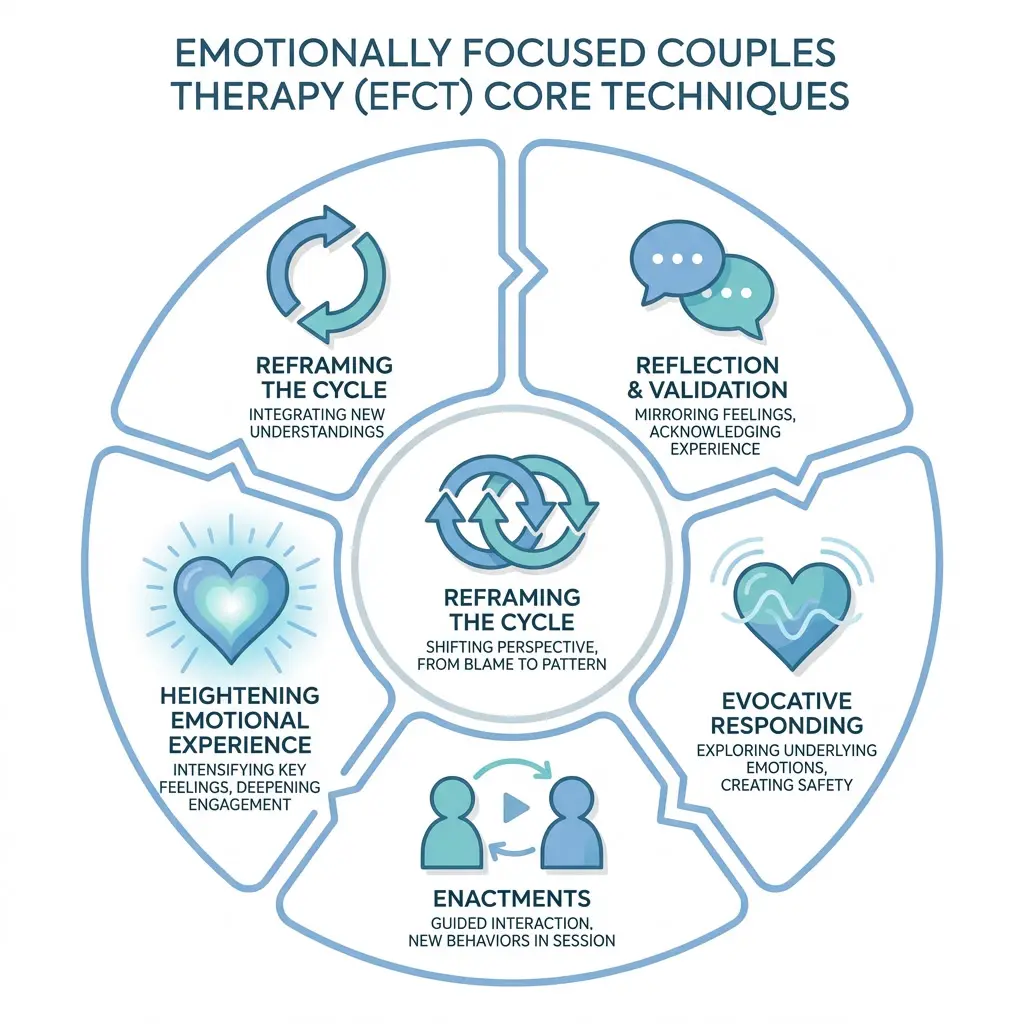
Another common intervention in Emotionally Focused Couples Therapy is known as evocative responding, a skill in which the therapist tentatively summarizes or inquires about a partner’s experience in live time during the relational interaction. If one partner’s face falls as the other describes their frustration with the house being messy, an EFT couples therapist might probe: “I noticed your expression changed as your partner described their frustration with your messy home; what’s happening for you right now?”
Similar to evocative responding, the intervention of heightening is used to deepen or intensify a partner’s emotional experience by using description and repetition to witness the emotion. For example, an EFT therapist might say: “I can see how painful that is for you when she turns away, how much it hurts, it’s agonizing! It’s like you’ve been left out in the cold alone, isn’t it?” In witnessing and naming the distress signals within the cycle enactment, the therapist is able to support partners in attuning to each other’s emotion cues and helps individuals recognize and name emotions and emotion cues within themselves. Attunement is an important part of both positive relational interactions and repair attempts, so this accentuation by the therapist helps remind partners of the familiar emotional engagement and responsiveness steps they took earlier in their relationship dance, before chronic disconnection occurred.
Later in the process of EFCT, a significant technique used by therapists is restructuring interactions. With this intervention, the couples therapist becomes an even more active choreographer of the cycle. In the early days of changing interactional positions, they might use restructuring interactions to track and replay moments in session, asking partners to elaborate or confirm the relational or emotional process of what is happening in the moment. As therapy progresses, they might offer a suggestion to turn toward the other partner, elaborate to the partner about specific emotions, or to find connective touch like holding hands. In this way, the couples therapist repeatedly directs the partners through a new relational dance, building upon the discoveries and changes they have made.
Integrating these techniques into a broader clinical framework can help ensure sessions remain focused and effective. For additional practical strategies, see these tips for effective couples therapy sessions.
Who Benefits from Emotionally Focused Couples Therapy?
EFCT is particularly effective for couples experiencing:
- Chronic conflict or communication breakdown
- Emotional disconnection or intimacy issues
- Infidelity or betrayal trauma
- Attachment injuries
- Anxiety or trauma impacting relationships
Because EFCT targets emotional bonding, it is especially helpful for clients with insecure attachment patterns or relational trauma histories.
EFCT vs Other Couples Therapy Approaches
Understanding how EFCT differs from other models can help clinicians choose the most appropriate intervention.
EFCT vs Cognitive Behavioral Couples Therapy (CBCT)
- EFCT focuses on emotional bonding and attachment
- CBCT emphasizes cognitive restructuring and behavior change
EFCT vs the Gottman Method
- EFCT prioritizes emotional experience and attachment needs
- The Gottman Method emphasizes skills, communication strategies, and relationship stability metrics
While all approaches can be effective, EFCT stands out for its focus on emotional transformation and long-term attachment security.
Common Misconceptions About Emotionally Focused Couples Therapy
Despite its strong evidence base, EFCT is sometimes misunderstood.
EFCT is not simply about encouraging emotional expression without structure. It is a highly organized, research-supported approach with clearly defined stages and interventions.
Additionally, EFCT is not limited to highly distressed couples. It can be used across a range of relationship concerns and is adaptable to different cultural and clinical contexts.
Training and Resources for Emotionally Focused Couples Therapy
For those interested in furthering their knowledge and practice of Emotionally Focused Couples Therapy, the International Centre for Excellence in Emotionally Focused Therapy (ICEEFT), offers comprehensive training modules, including theoretical foundations, practical skills development, and supervised practice with couples. Clinicians can pursue the designation of Certified EFCT Therapist, which requires a combination of didactic learning, case consultation, and clinical experience.
Dr. Sue Johnson's works, such as "Hold Me Tight" and "Attachment Theory in Practice," as well as “Creating Connection: The Practice of Emotionally Focused Couple Therapy,” offer invaluable insights into the theoretical underpinnings and clinical applications of EFCT. Additionally, ICEEFT provides a wealth of online resources, including articles, videos, and training manuals, to support ongoing learning and professional development.
Documenting Emotionally Focused Couples Therapy Sessions
Accurate documentation of EFCT sessions is essential for demonstrating medical necessity, supporting reimbursement, and ensuring continuity of care. Because emotionally focused couples therapy centers on interaction patterns, attachment needs, and emotional processing, clinicians need notes that capture both the relational dynamic and the interventions used to shift it.
Strong EFCT documentation should reflect the negative cycle observed in session, the underlying emotions or attachment fears that emerged, the specific interventions used by the clinician, and the couple’s response to those interventions. Clear, structured language helps show that the session addressed identifiable clinical concerns and moved treatment forward in a measurable way.
For example, clinicians may document patterns such as pursue-withdraw or criticize-defend, note the use of enactments or reframing, and describe how each partner accessed and expressed more vulnerable emotions. This kind of specificity supports both clinical clarity and payer scrutiny.
Example Language:
“Clients engaged in enactment exercise to express underlying attachment needs. Therapist facilitated emotional processing and reframed conflict as a negative interaction cycle. Increased emotional responsiveness observed.”
If you're looking for more structured guidance, our resource on couples therapy notes, templates, and documentation tips provides additional examples you can adapt to EFCT sessions.
This is where having the right documentation system can make a meaningful difference. ICANotes helps behavioral health clinicians create detailed, compliant couples therapy notes more efficiently, making it easier to document emotionally focused interventions, track progress over time, and maintain records that are both clinically useful and audit-ready. Instead of struggling to translate a complex couples session into a defensible note from scratch, clinicians can streamline the process while still preserving the depth of the work.
Proper documentation also supports accurate billing and reimbursement. For a deeper dive, review our couples therapy CPT code guide to ensure your services are coded correctly.
If you want a faster way to document couples therapy sessions clearly and confidently, try ICANotes free for 30 days and see how it can support your EFCT workflow.
How ICANotes Supports EFCT Documentation and Clinical Workflows
Delivering emotionally focused couples therapy requires documentation that captures both emotional processes and clinical interventions clearly and efficiently.
ICANotes helps clinicians:
- Document EFCT sessions with structured, narrative-driven templates
- Capture medical necessity and treatment progress
- Streamline note-taking without sacrificing clinical depth
- Stay audit-ready with compliant documentation
Start your free trial to see how ICANotes supports evidence-based couples therapy documentation.
Start Your Free 30-Day Trial
No credit card required. Get started in minutes.
Final Thoughts on Emotionally Focused Couples Therapy (EFCT)
Emotionally focused couples therapy offers a powerful roadmap for helping couples rebuild connection and create more secure, resilient relationships. By focusing on attachment needs and emotional responsiveness, EFCT provides clinicians with a structured, evidence-based framework for addressing relationship distress at its core.
Through targeted interventions and guided emotional experiences, couples can move beyond reactive patterns and develop deeper empathy, trust, and connection. For therapists, EFCT not only enhances clinical effectiveness but also provides a clear path for facilitating meaningful, lasting change in the relationships they support.
Related Couples Therapy Resources
Explore additional guidance on couples therapy for marriage and family therapists.

Frequently Asked Questions: Emotionally Focused Couples Therapy
Related Posts






Meredith Nisbet
MS, LMFT, CEDS-C, RYT-200
About the Author
Meredith Nisbet, MS, LMFT, CEDS-S is a Licensed Marriage and Family Therapist, a Certified Eating Disorders Specialist Supervisor, and serves as the National Clinical Response Manager for Eating Recovery Center and Pathlight Mood and Anxiety Center. In addition to her work for ERC-Pathlight and in her private practice with Three Birds Counseling, Meredith provides education, training, and consultation on weight stigma and Health At Every Size-informed care around the country. Meredith earned her bachelor’s degree from the University of North Carolina at Chapel Hill and her master’s degree in Marriage and Family Therapy from East Carolina University.