Automatic E&M Coding for Behavioral Health — Built Into Every Note

ICANotes calculates your E&M CPT code as you chart — matching your Medical Decision Making complexity to the correct level so you bill accurately, get paid faster, and stay audit-ready.

Trusted by psychiatrists, APRNs, PMHNPs, and behavioral health prescribers across the U.S.
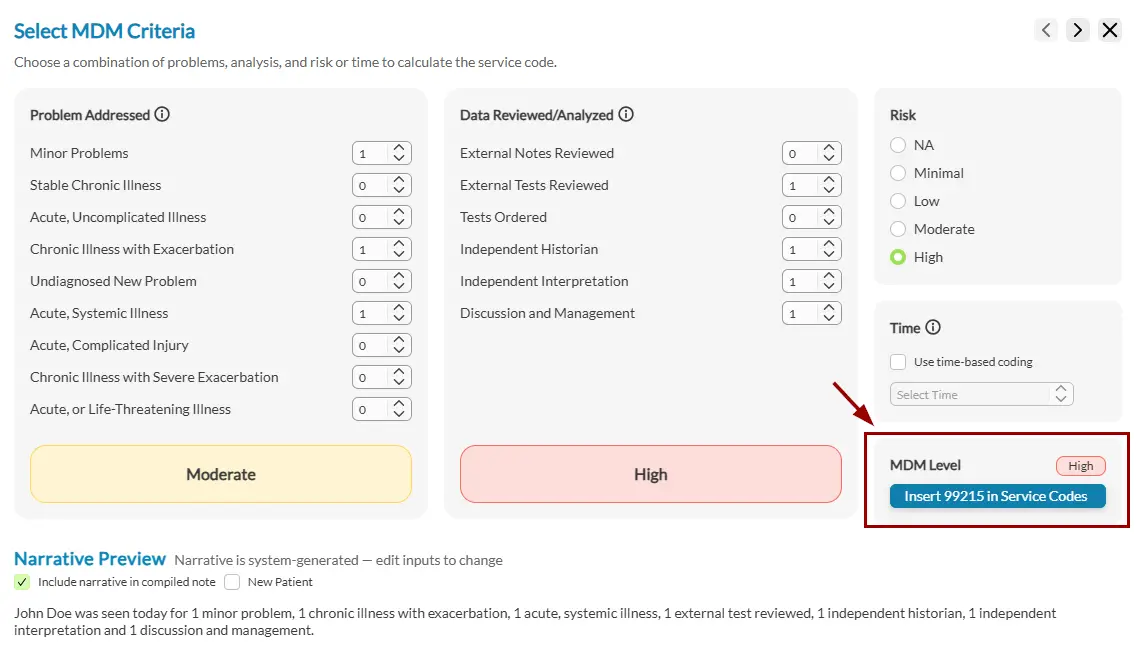
ICANotes automatic E&M coding matrix calculating CPT codes during psychiatric documentation

Most Behavioral Health Prescribers Are Leaving Money on the Table

Coding behavioral health E&M visits correctly is harder than it should be. When documentation does not clearly support Medical Decision Making complexity, even experienced prescribers can undercode, underbill, and understate the real intensity of care delivered.

CMS data shows that over 40% of outpatient behavioral health visits are coded below their actual MDM level. A 2023 MGMA benchmark found that up to 60% of psychotherapy with E&M codes are billed incorrectly due to time-versus-MDM confusion.

That means many prescribers are routinely undercoding — not out of negligence, but because translating complex clinical work into E&M levels is genuinely difficult without the right tools.

The cost is real. A practice seeing just 100 established patients per month could be leaving more than $30,000 in legitimate annual revenue uncollected each year — revenue that accurately reflects the care already delivered.

Undercoding also misrepresents patient acuity in your records, makes practice-level reporting less accurate, and fails to tell the true clinical story of the patients you are treating.

40%

of behavioral health outpatient visits are coded below their MDM level

CMS, 2022
60%

of E&M + psychotherapy claims are billed incorrectly due to time-versus-MDM confusion

MGMA, 2023
88%

of denied behavioral health claims stem from documentation errors, not fraud

OIG, 2022

What Undercoding Can Cost a Behavioral Health Practice

Even small coding gaps add up quickly. If a practice undercodes visits that should support a higher E&M level, the annual revenue loss can be substantial.

Monthly Visits
100
Avg. Missed Revenue Per Visit
$25
Estimated Annual Loss
$30,000+
Simple example:

100 established patient visits per month × $25 in missed reimbursement per visit × 12 months = $30,000 in lost annual revenue.

How ICANotes Automatic E&M Coding Works

ICANotes is the only behavioral health EHR with a built-in MDM coding matrix that calculates your E&M level in real time as you document — eliminating guesswork and helping protect you in an audit.

The MDM Coding Matrix — Live as You Chart

The Medical Decision Making (MDM) button is embedded directly at the start of every note. As you document your visit using ICANotes’ point-and-click templates, the system tracks three core MDM elements and calculates your CPT code automatically:

  • Problems Addressed — From minor situational issues to stable chronic conditions such as GAD, MDD, ADHD, PTSD, and bipolar disorder, to acute exacerbations and life-threatening presentations
  • Data Reviewed and Analyzed — External notes, labs, urine drug screens, imaging, genetic testing results, independent historian collateral, care coordination discussions, and independently interpreted tests
  • Risk of Complications — From low-risk medication monitoring to moderate-risk medication changes and safety planning, up to high-risk presentations including active suicidal ideation and potential hospitalization

As you select the elements that match your visit, the matrix updates your suggested CPT code in real time — 99212, 99213, 99214, or 99215.

MDM Documentation Surfaced at the Top of Every Note

When auditors review your notes, the first thing they see matters. ICANotes automatically places a structured MDM summary at the very top of every note — clearly documenting the problems addressed, data reviewed, and risk level that drove your coding decision.

This positions your documentation defensively from the first line, often eliminating the need for an auditor to read further. It’s the difference between a note that invites scrutiny and one that answers the question before it’s asked.

Time-Based Coding — When It’s the Right Call

When the MDM does not fully support a higher-level code but you have legitimately spent additional time providing care, ICANotes supports time-based E&M coding as well. The system accounts for total time on the date of service, helping you select the approach — MDM or time — that best represents the work you actually performed.

ICANotes also accounts for site of service including office, telehealth, hospital, and nursing home settings and automatically calculates the highest defensible code your documentation supports.

Psychotherapy Add-On Codes — Billed Correctly Every Time

When psychotherapy and an E&M visit are billed together, the E&M code must be selected based on MDM only — time no longer applies to the E&M portion. ICANotes handles this distinction automatically, ensuring your psychotherapy add-on codes such as 90833, 90836, and 90838 are paired correctly with your E&M level without adding compliance risk.

Audit-Ready Documentation, Built Into the Workflow

The OIG has found that 88% of denied behavioral health claims trace back to documentation errors — not fraud. That is a solvable problem, and it is exactly what ICANotes is designed to address.

Automatic E&M coding does more than help clinicians choose the right code. It helps ensure that the reasoning behind the code is clearly documented inside the note, where auditors and payers expect to see it.

What Auditors Look For — and How ICANotes Helps

These are some of the documentation patterns auditors commonly scrutinize during behavioral health claim reviews.

Consistent Time Entries

Billing the same session length every visit is a known red flag for auditors. ICANotes’ time tracking supports natural variation in session documentation.

Documentation That Matches the Code

The MDM matrix helps ensure your note contains the specific elements — problems, data, and risk — required to support the code billed.

Structured MDM Summary at Note Top

Auditors often stop reading when the MDM summary clearly justifies the level. ICANotes places that summary at the top of the note.

Double-Booking Safeguards

ICANotes includes group-level rules that can help prevent double-booking of Medicare and Medicaid patients — a common audit trigger when calendar records are reviewed.

Built for Behavioral Health Prescribers

Automatic E&M coding in ICANotes is designed for clinicians who prescribe and manage medications as part of mental health treatment.

01

Psychiatrists

Manage complex patient panels, medication changes, safety concerns, and high-acuity visits with documentation that supports the full complexity of psychiatric decision-making.

02

Psychiatric Nurse Practitioners

Support solo and group-practice PMHNP workflows with built-in coding guidance that helps align documentation, reimbursement, and defensible billing decisions.

03

Physician Assistants

Document medication management visits more confidently with coding support that reflects real-world behavioral health complexity and site-of-service variation.

04

Integrated Care Practices

Standardize E&M coding across prescribing clinicians while improving documentation consistency, audit readiness, and reimbursement accuracy across the organization.

Note: E&M codes such as 99212–99215 apply to prescribing clinicians. Non-prescribing clinicians such as LCSWs, LPCs, and LMFTs typically bill psychotherapy codes like 90832, 90834, and 90837. ICANotes supports accurate coding for both.

Why Behavioral Health Prescribers Choose ICANotes

ICANotes has been built specifically for behavioral health for nearly a decade — not adapted from a general-purpose EHR. That focus means every feature, including automatic coding, reflects the real complexity of psychiatric documentation.

If you do the work and the patient has the acuity level, you deserve to be paid for that.

October Boyles, DNP, MSN, BSN, RN
Chief Compliance Officer, ICANotes
Free Trial

Start Your Free ICANotes Trial

See how automatic E&M coding works inside a behavioral health EHR built specifically for psychiatrists and prescribing clinicians.

✓ Automatic E&M coding guidance
✓ Behavioral health-specific documentation
✓ No credit card required

Get started with a free trial and explore how ICANotes supports accurate coding, documentation, and reimbursement.

What Makes ICANotes Different

Behavioral health prescribers need more than generic coding support. They need documentation tools built around psychiatric care.

1

Behavioral Health-Specific by Design

ICANotes is not a general medical platform retrofitted for psychiatry. It is built specifically for behavioral health workflows, documentation, and reimbursement realities.

2

MDM Logic Built for Psychiatric Complexity

The coding matrix reflects behavioral health realities such as suicidality, PTSD exacerbations, bipolar instability, relapse risk, medication cross-tapering, and higher-acuity medication management.

3

Compliance Expertise Built Into the Workflow

Automatic coding was developed alongside real-world audit and compliance experience, helping clinicians support the billed level with documentation that stands up to scrutiny.

4

Designed to Capture the True Story of Care

Better coding is not just about reimbursement. It also means patient acuity, clinical reasoning, and treatment complexity are reflected more accurately in the record.

Common Questions About Automatic E&M Coding

Get quick answers to common questions about MDM coding, time-based coding, claim denials, and behavioral health documentation requirements.

Should I use MDM or time-based coding for my visits?

You should code based on the element that best represents the work performed. MDM reflects decision-making complexity — not how long you were with the patient. If your MDM supports a 99214, that code stands even if the visit was under 30 minutes. Time-based coding can be appropriate when the MDM does not fully support a higher-level code, but it requires a clear total time statement in the note.

What’s the difference between 99213 and 99214?

The difference comes down to MDM complexity. A 99213 typically reflects low-complexity decision-making, such as a stable chronic condition with limited data and no significant medication changes. A 99214 reflects moderate-complexity decision-making, such as an exacerbating chronic condition, medication changes with moderate risk, safety planning for passive suicidal ideation, or meaningful care coordination. ICANotes’ MDM matrix helps guide clinicians through these distinctions in real time.

Can I bill a 99214 if I always see complex patients?

Billing the same code for every visit is a known audit trigger. The correct code should reflect the actual MDM complexity of each individual encounter. ICANotes helps clinicians document and bill accurately for each visit, which supports appropriate reimbursement while reducing payer scrutiny.

Does automatic coding help reduce claim denials?

Yes. Many behavioral health claim denials stem from documentation that does not clearly support the billed code level. ICANotes places structured MDM documentation directly into the note so the elements needed to justify the code are clearly documented for every claim.

What counts toward the Data element of MDM?

More than many clinicians realize. External provider notes, lab results, urine drug screens, genetic testing, EKGs, independent historian collateral such as parent or caregiver input, care coordination discussions with other providers, and independent interpretation of test results may all count toward the Data element. ICANotes’ coding matrix helps prompt clinicians through these categories so important documentation is less likely to be missed.

Stop Undercoding. Start Getting Paid for the Work You Do.

ICANotes takes the guesswork out of E&M coding so you can document confidently, bill accurately, and keep your focus on patient care.

No commitment required. See how ICANotes’ automatic coding matrix works in a live, personalized walkthrough.