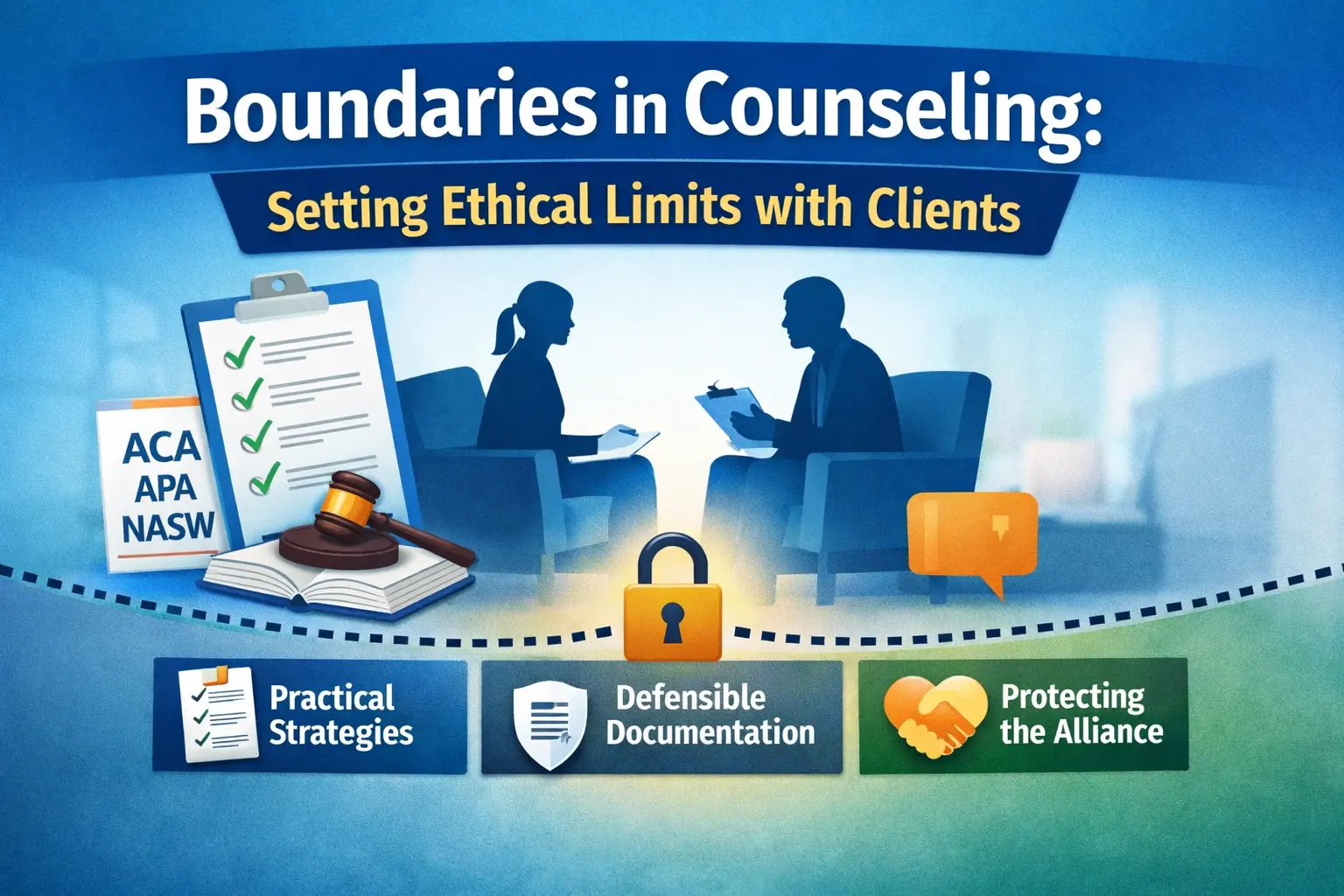
Boundaries in Counseling: Setting Ethical Therapist-Client Boundaries
Boundaries in counseling are essential to protecting both the therapeutic alliance and clinician sustainability. This guide explores therapist-client boundaries, setting boundaries in therapy without causing rupture, and how to distinguish flexibility from boundary drift. Featuring practical scripts, ethical decision-making frameworks, and defensible documentation guidance, this article helps clinicians maintain therapeutic boundaries in mental health while safeguarding their license and long-term career.


Sandy Crowley, Chief Marketing Officer
Last Updated: March 6, 2026
Written by: ICANotes Editorial Team
Featured expert: Don Morrison, LCSW

What You'll Learn
-
Define therapeutic boundaries in mental health and understand why they are ethically required — not optional.
-
Recognize the difference between boundary flexibility and boundary drift in therapy, and identify early warning signs of clinician burnout.
-
Set therapist-client boundaries clearly and compassionately without damaging the therapeutic alliance.
-
Navigate common boundary challenges in therapy, including after-hours communication, session extensions, social media requests, and dual relationships.
-
Use practical scripts for setting boundaries in therapy that reinforce care while maintaining structure.
-
Document boundary-related interactions defensibly, using objective language that stands up to audit scrutiny.
-
Apply an ethical decision-making framework to determine when to hold a boundary and when clinical flexibility is appropriate.
-
Protect both the therapist-client relationship and your professional license through consistent boundary setting in therapy.
Contents
- What Clinical Boundaries in Therapy Actually Are (and Aren't)
- Boundary Flexibility vs Boundary Drift: Knowing the Difference
- Common Boundary Challenges in the Therapist-Client Relationship
- Boundary Setting Scripts That Preserve the Therapeutic Alliance
- Repairing Ruptures After Boundary Setting
- Defensible Documentation for Boundary-Related Interactions
- How ICANotes Helps You Document Boundary Decisions
- The Ethical Decision Tree: When to Hold, When to Adjust
- Boundaries and Clinician Sustainability
- Getting Started: A Sustainable Approach
You were trained to give, to hold, and to contain. But somewhere between answering a client's tenth text message of the week and staying 20 minutes past the end of a session, something shifted. What started as flexibility quietly became something else — and now you're feeling the weight of it.
In this post: Clinical social worker Donald Morrison, LCSW breaks down why boundaries in counseling feel harder than ever, what boundary drift actually looks like, and how to set firm, compassionate limits — using practical scripts, a defensible documentation framework, and an ethical decision tree — without sacrificing the therapeutic relationship.
This post is based on ICANotes' webinar, "When 'Being Supportive' Becomes Too Much: Setting Boundaries With Clients."
Why Setting Boundaries in Therapy Feels Harder Than Ever
Boundaries in the therapeutic relationship have never been simple. But the current behavioral health landscape has added a new layer of complexity that most clinicians didn't anticipate when they started their careers.
In a recent ICANotes webinar, Donald Morrison, LCSW — a clinician, clinical supervisor, and adjunct faculty member at UNC Charlotte — laid out the forces conspiring to erode professional limits:
Constant digital access. When clients can text you from your Zoom link, email you through a portal, and find you on Facebook within minutes, the psychological signal is clear: you are always available. That expectation is nearly impossible to manage reactively.
Clinician shortages and caseload pressure. When practices are understaffed, the temptation is to compensate by being more available, more flexible, more accommodating. The short-term effect is goodwill. The long-term effect is burnout.
Fear of harming the therapeutic alliance. This is perhaps the most clinically significant barrier. Many therapists avoid enforcing limits because they genuinely worry that saying "no" will damage trust, invite anger, or cause the client to leave treatment. As Morrison noted during the webinar, that fear is valid — but it is also, in most cases, unfounded.
Crisis inflation. Clients experiencing intense emotional distress often perceive non-emergencies as crises — and clinicians, wired to respond to suffering, frequently treat them as such. Without clear distinctions between genuine safety concerns and emotional urgency, after-hours communication becomes the default.
Telehealth's blurred edges. When the therapist is working from home and the client is in their bedroom, the physical container that once helped define the therapeutic space has dissolved. Both parties are simultaneously in "home mode" and "clinical mode," and the lines between them can fade quickly.
“The only people who get upset about you setting boundaries are the ones who were benefiting from you having none.”
What Clinical Boundaries in Therapy Actually Are (and Aren't)
One of the most important reframes in Morrison's webinar was definitional: therapeutic boundaries are not punishments, not coldness, and not rejection. They are the structural container that makes therapeutic work possible.
Think of it this way. A session that ends on time, communication that stays within agreed-upon channels, and a relationship that remains clearly professional — these things don't diminish care. They protect it. They ensure that when a client walks into (or logs into) a session, they know what to expect, and they can trust the framework they're entering.
Ethical codes across behavioral health disciplines reflect this. The ACA Code of Ethics A.4.a emphasizes counselors' obligation to avoid harming clients — and burnout directly compromises the quality of care a clinician can provide. APA Ethical Principles 3.05 cautions psychologists to avoid relationships that could impair objectivity. The NASW Code of Ethics 1.06 requires social workers to be alert to conflicts of interest. Taken together, the message is unambiguous: setting ethical boundaries isn't just permitted — it's required.
Morrison puts it even more plainly: "Boundaries are nonnegotiable. They're how we take care of ourselves so we can keep taking care of our clients."
Boundary Flexibility vs. Boundary Drift: Knowing the Difference
Not all boundary adjustments are problematic. The therapeutic relationship is a human relationship, and skilled clinicians exercise judgment. The question isn't whether you ever make exceptions — it's whether those exceptions are intentional, clinically documented, and applied consistently.
That distinction separates boundary flexibility from boundary drift:
Boundary flexibility is intentional. You've assessed the clinical situation, determined that a departure from the standard approach serves the client's therapeutic goals, documented your rationale, and you'd make the same call with another client in similar circumstances. It's a clinical decision — not a people-pleasing one.
Boundary drift is reactive. It happens when discomfort drives decision-making: you extend the session because ending it feels unkind, you answer the late-night text because ignoring it feels cruel, you waive the cancellation fee because addressing it feels confrontational. Each individual accommodation seems reasonable. The cumulative pattern is where the risk lives.
Morrison shared a useful heuristic from the webinar's ethical decision tree: before making a boundary exception, ask yourself whether the decision is driven by clinical need or by convenience. If the honest answer is the latter, hold the boundary.
Common Boundary Challenges in the Therapist-Client Relationship
During the webinar, Morrison outlined the boundary situations clinicians encounter most frequently. They fall into three broad categories.
Communication Boundaries
After-hours texts, portal messages outside sessions, social media connection requests, email chains that escalate beyond administrative logistics — digital communication has made the therapeutic space permeable in ways that weren't possible a generation ago. Morrison's advice: address this explicitly at intake, before a pattern develops. Build expectations into your professional disclosure statement and your consent forms. Auto-replies that acknowledge receipt and clarify response windows can significantly reduce client anxiety without requiring you to be perpetually available.
On social media specifically: "We can't be friends with our clients, but we can be friendly. There's a big difference." Accepting a client's Facebook friend request isn't a minor informality. It's a role boundary violation that fundamentally changes the nature of the relationship — and potentially exposes you to situations that are difficult to undo.
Time and Structure Boundaries
The "doorknob confessional" is a nearly universal experience in outpatient therapy: the client who, with one hand on the door at the 52-minute mark, says the most clinically important thing of the session. Session overages, cancellation patterns, and crisis-versus-non-crisis distinctions all fall into this category.
October Boyles offered a particularly practical suggestion: include session time expectations explicitly in your initial consent language. Something as simple as "Sessions are 50 minutes. As we approach the end of the time, I will help us pause and continue to the next session unless there is a safety concern" — reviewed at intake — gives you permission to enforce the structure later without it feeling like a rupture.
Relationship Boundaries
Dual relationships, gift-giving, self-disclosure requests, and running into clients in the community are all relationship boundary territory. Morrison shared a candid example from his own clinical history: a home visit during which a client — whose Italian American cultural background made food a primary expression of welcome and care — insisted he stay for dinner. He used that example not as a cautionary tale but as an illustration of the clinical judgment required in these moments. Context matters. Cultural competence matters. The question isn't "what does the rule say?" but "what does this mean for this client's treatment, and can I defend that decision clinically?
Strengthen Your Boundaries Without Damaging the Alliance
Download The Ethical Boundaries Toolkit for Behavioral Health Clinicians and get everything you need to set, communicate, and document ethical therapeutic boundaries — adapted for real-world clinical practice. Includes the boundary script guide, defensible documentation template, digital communication policy, rupture repair framework, boundary drift self-assessment, and ethical decision tree.
Boundary-Setting Scripts That Preserve the Therapeutic Alliance
The fear of damaging rapport is real, but as Morrison noted repeatedly, it's usually the way boundaries are communicated — not the boundaries themselves — that creates rupture. The following scripts, drawn from the ICANotes Ethical Boundaries Toolkit, are designed to hold limits clearly while keeping the therapeutic relationship intact.
Standard reinforcement
“I care about your well-being, and our dedicated session time allows me to be most helpful to you. Let’s discuss this when we meet on [day].”
When safety needs clarification
“It sounds like you're struggling. Are you safe right now? If this is a crisis, please use the safety plan we created or contact [crisis resource]. I’ll see you at our scheduled time on [day].”
Closing on time
“We need to end on time so I can be fully present for you and my other clients. Let’s prioritize this topic at our next session.”
When a client sends a connection request
“To protect your confidentiality and our therapeutic work, I don’t connect with clients on social media.”
Returning to the Treatment Agreement
“I want to support you within the structure we agreed to in our treatment agreement. This helps me provide you with consistent, quality care.”
Notice the pattern across all of these scripts: they lead with care, explain the clinical purpose of the limit, and redirect toward the therapeutic work. None of them apologize for the boundary itself.
Repairing Ruptures After Boundary Setting
When a client reacts strongly to a limit — with frustration, withdrawal, or what Morrison calls "boundary activation" — the tendency for many clinicians is to over-apologize, soften the position, or remove the boundary altogether to restore harmony. All three responses reinforce the problem.
Instead, Morrison recommends a four-step repair framework that validates the client's experience while holding the clinical structure firm:
- Validate the emotion without reversing the boundary. "I can see this limit feels frustrating for you." Acknowledge what they're experiencing — this is not the same as agreeing that the boundary was wrong.
- Reaffirm care. Separate the limit from rejection. "I care about your progress and want to support you effectively." The message is: I'm not withdrawing from you. I'm structuring this relationship so I can show up for you consistently.
- Restate the therapeutic frame. "I maintain after-hours boundaries so I can be rested and fully present during our sessions." Give the boundary a clinical rationale, not just a policy rationale.
- Return to treatment goals. "Let's focus on what happened and how you managed it." Redirect toward the work. Often, a client's reaction to a boundary is itself clinically significant material — it connects to attachment patterns, distress tolerance, interpersonal schemas. Use it.
As Morrison put it bluntly in the webinar: "Boundaries don't create rupture. How they're communicated does."
For a deeper look at how these principles apply to one of the most boundary-challenging clinical populations, see our related post: Navigating Boundaries and Building Trust With BPD Clients.

Defensible Documentation for Boundary-Related Interactions
How you document boundary situations matters as much as how you handle them clinically. Notes that reflect your emotional state — even when that state is completely understandable — create audit exposure and, more importantly, don't accurately represent your clinical reasoning.
The documentation contrast below illustrates the difference between notes that create risk and notes that demonstrate sound clinical judgment:
“Client keeps texting me constantly and it's exhausting.”
“Client initiated 6 contacts between sessions, requesting reassurance. Reviewed communication expectations outlined in treatment agreement.”
“Session ran long because she was upset.”
“Session extended 15 minutes due to acute distress regarding relationship conflict. Reviewed time boundaries and developed plan for structured agenda next session.”
“Didn't want to upset client by enforcing fee policy.”
“Reviewed financial agreement per informed consent. Client expressed concern regarding payment schedule. Explored options within established policy.”
For a complete boundary-related note, Morrison and the ICANotes toolkit recommend a five-part documentation structure: the specific boundary situation, your clinical response and rationale, the client's observable reaction, the therapeutic impact, and your plan for monitoring or follow-up. This structure demonstrates clinical judgment, not just policy enforcement — and it holds up under audit scrutiny.
Before signing any boundary-related note, run through this quick checklist:
- Did I describe the behavior objectively?
- Did I document my clinical rationale?
- Did I avoid emotional or subjective language?
- Did I reference the relevant policy or treatment agreement?
- Would an external reviewer understand my decision-making?
If the answer to any of those questions is "no," revise before you sign.
How ICANotes Helps You Document Boundary Decisions With Confidence
Setting boundaries in counseling is only half the work. The other half is documenting those decisions clearly, objectively, and defensibly.
When boundary-related interactions aren’t documented properly, they can create unnecessary audit exposure, especially in cases involving:
-
After-hours communication
-
Session extensions
-
Fee enforcement
-
Crisis clarification
-
Dual relationship concerns
-
Patterned reassurance-seeking between sessions
ICANotes was built specifically for behavioral health clinicians, with documentation tools designed to support ethical, structured, and audit-ready care. With ICANotes, you can:
✔ Document boundary situations objectively
Structured note templates guide clinicians to record observable behavior, clinical rationale, client response, and treatment impact — rather than emotional reactions.
✔ Reinforce treatment agreements inside your notes
Menu-driven content makes it easy to reference informed consent, communication policies, and financial agreements directly within progress documentation.
✔ Maintain consistency across your caseload
Standardized workflows reduce reactive note-writing and help ensure boundary decisions are documented consistently and defensibly.
✔ Protect your license and your time
Clear, structured documentation reduces audit risk and minimizes the cognitive load of figuring out “how to word this” after a difficult interaction.
Boundary maintenance isn’t just about protecting the therapeutic alliance — it’s about protecting your professional integrity and long-term sustainability.
ICANotes gives you a clinical documentation framework that supports both.
Ready to strengthen your documentation?
If you want documentation that supports ethical decision-making, reinforces therapeutic boundaries, and stands up to scrutiny, start your 30-day free trial of ICANotes.

Start Your 30-Day Free Trial
Experience the most intuitive, clinically robust EHR designed for behavioral health professionals, built to streamline documentation, improve compliance, and enhance patient care.
- Complete Notes in Minutes - Purpose-built for behavioral health charting
- Always Audit-Ready – Structured documentation that meets payer requirements
- Keep Your Schedule Full – Automated reminders reduce costly no-shows
- Engage Clients Seamlessly – Secure portal for forms, messages, and payments
- HIPAA-Compliant Telehealth built into your workflow

The Ethical Decision Tree: When to Hold, When to Adjust
When facing a boundary decision, ask yourself:
- Is safety compromised?
- Is this driven by clinical need — or by my discomfort?
- Do I have documented clinical rationale for an exception?
- Would I apply this exception consistently across clients?
- Would I feel confident defending this decision in an audit?
If most answers point to clinical necessity, consider flexibility — with documentation. If most answers reflect your own discomfort or the client's convenience, hold the boundary.
Hold the boundary when: safety is not at risk, the request is driven by convenience rather than need, the pattern suggests dependency or role confusion, or making an exception would create inequity across your caseload.
Consider flexibility when: there is documented clinical rationale, a temporary crisis warrants it, cultural or accessibility factors are present, or the therapeutic alliance would be meaningfully strengthened in a way that serves treatment goals.
Boundaries and Clinician Sustainability: The Burnout Connection
There's a reason this topic keeps surfacing at mental health conferences and in clinical supervision. The connection between boundary drift and burnout isn't theoretical. When clinicians absorb excessive demands without structural protection, the consequences are predictable: compassion fatigue accelerates, resentment toward clients builds, decision-making becomes reactive rather than intentional, and the quality of care declines for everyone on the caseload.
Clear boundaries reverse that cycle. When you're not answering non-urgent texts at 10 PM, you're more present at 2 PM the next day. When you end sessions on time, the client who comes after receives the same quality of attention as the client who just left. The caseload stays sustainable. Career longevity increases.
As the ICANotes Ethical Boundaries Toolkit puts it: Protecting your energy, clarity, and ethical footing is not selfish. It is how you remain capable of helping.
Boundary maintenance was found to be the second most frequently reported ethical dilemma among practicing psychologists in a major survey — trailing only confidentiality. And the consequences of boundary violations are among the most serious a clinician can face, up to and including license revocation. This is not a minor topic. It is a career-defining one.

Frequently Asked Questions
Getting Started: A Sustainable Approach
Morrison's parting advice for clinicians who feel overwhelmed by all of this was characteristically practical: don't try to overhaul everything at once. Choose one script to practice this week. Make one documentation upgrade in your next boundary-related note. Revisit one policy in your intake forms. Sustainable boundary practice is built through consistency, not through sudden rigidity.
And when you face moments of doubt — the guilt about setting a limit, the fear of damaging rapport, the pressure to overextend — return to what the research and the ethical codes are clear about: your clarity protects your clients, and your consistency protects your career.
Related Posts






Donald Morrison
MSW, LCSW
About the Featured Expert
Donald Morrison graduated from UNC Charlotte in 2004. He has since worked as a school-based therapist, inpatient social work supervisor and outpatient clinician. Donald currently works in private practice, and he is also an adjunct faculty member at the UNC Charlotte School of Social Work. In addition, Donald serves as a clinical supervisor to LCSW associates, and he regularly presents at area mental health conferences and seminars.