
Blog > Treatment Strategies > Spousification vs Parentification: Understanding Childhood Role Reversal
Spousification vs Parentification: Key Differences, Symptoms, and Clinical Impact
Role confusion in childhood, through spousification or parentification, can have lasting effects on attachment, self-worth, and adult relationships. This article explores how these dynamics develop, their psychological consequences, and evidence-based clinical strategies to help spousified and parentified adults rebuild healthy boundaries and reclaim identity beyond caregiving roles.


Last Updated: December 26, 2025


What You'll Learn
-
The key differences between parentification and spousification and how each form of childhood role reversal develops
-
How parentification trauma and spousification affect emotional, relational, and identity development
-
The difference between instrumental and emotional parentification and their long-term psychological outcomes
-
Common parentification symptoms and signs of spousification seen in clinical practice
-
How childhood role reversal shapes adult attachment patterns and caregiving behaviors
-
How family systems theory informs assessment and treatment of parentification and spousification
-
Practical therapeutic goals for restoring boundaries and healing attachment injuries
Contents
-
Understanding Parentification and Spousification in Childhood
- Why These Dynamics Develop
- Parentification and Spousification Symptoms Across the Lifespan
- Clinical Considerations for Treatment
- Treatment Goals: Boundary Restoration
- Conclusion: Understanding Spousification and Parentification in Childhood Role Reversal
- Key Takeaways: Clinical Insights on Parentification and Spousification
- FAQs: Parentification vs Spousification in Childhood and Adulthood
- How ICANotes Supports Documentation for Spousification and Parentification Treatment
Understanding Parentification and Spousification in Childhood
What is Spousification?
Spousification occurs when a parent treats a child as a surrogate spouse or romantic partner. This dynamic dissolves healthy boundaries as the child fulfills emotional needs typically met by an adult partner. Sometimes referred to as “spouse-focused parentification” or “surrogate spouse syndrome,” spousification involves parents who rely on their children for emotional validation, companionship, or comfort during stress or loneliness.
Mother-son spousification occurs more frequently than father-daughter spousification [5]. It often emerges after divorce, separation, or emotional withdrawal in a marriage, when a parent unconsciously turns to their child for support and intimacy [2].
What is Parentification?
Parentification represents a broader form of role reversal between parent and child. It occurs when children take on developmentally inappropriate responsibilities that exceed their emotional or cognitive capacity [2]. There are two types:
- Instrumental parentification: children manage practical tasks such as cooking, cleaning, managing finances, or caring for siblings [9].
- Emotional parentification: children tend to the psychological and emotional needs of family members, which may include becoming a parent’s confidant, elevating silblings’ self-esteem, or promoting family harmony [2].
Healthy responsibility can build confidence, but parentification becomes harmful when it replaces normal caregiving and emotional nurturing from the parent.
Parentification vs Spousification: Key Differences in Roles, Boundaries, and Emotional Impact
The primary distinction lies in who the child is serving and how the role manifests. Parentification is broad — children may parent their parents or siblings — while spousification specifically mirrors a marital relationship [5]. Spousification typically includes inappropriate expectations for the child to be the parent’s emotional partner, “date” for events, or listener to adult issues like romantic problems.
Parentification can include both instrumental and emotional tasks, but spousification focuses exclusively on emotional and relational dynamics that mimic adult intimacy [12].
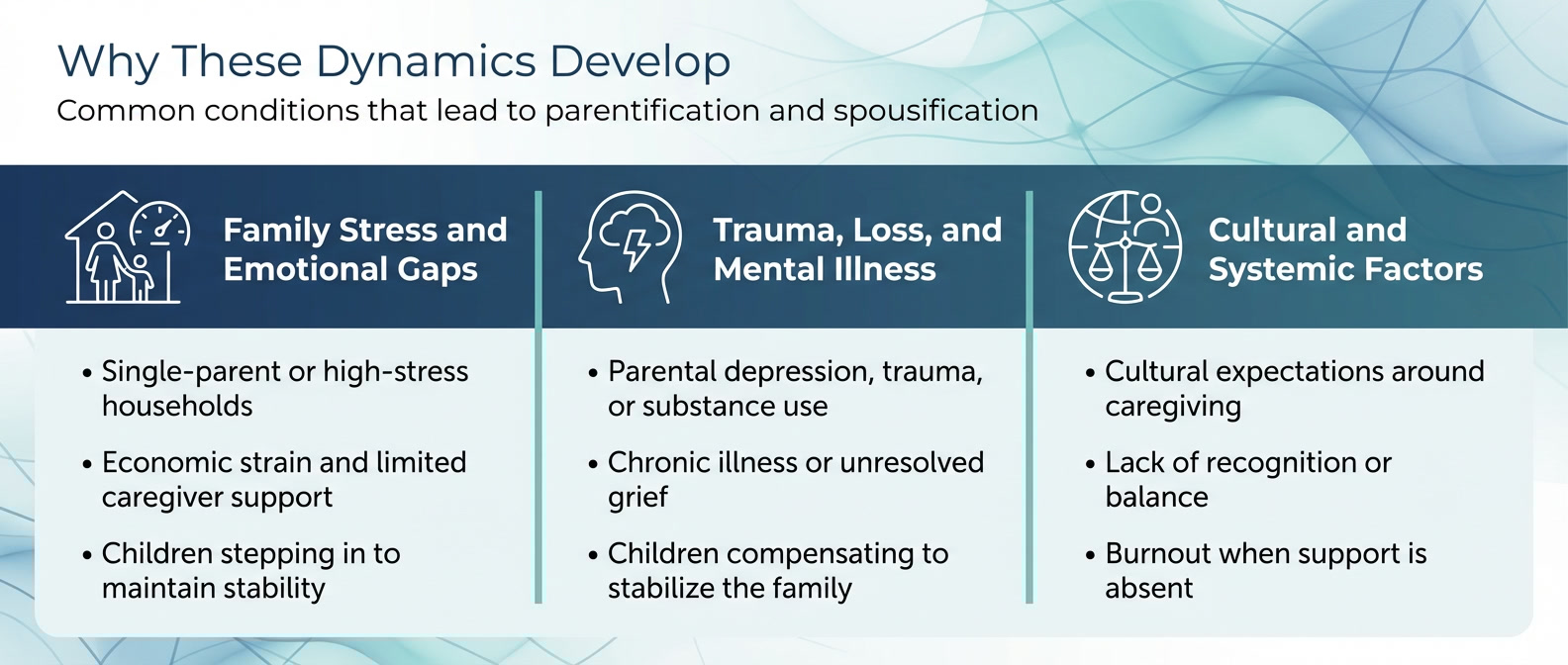
Why These Dynamics Develop
Parentification and spousification develop through complex interactions of family circumstances, psychological factors, and broader societal influences. Understanding these origins helps clinicians identify at-risk families and develop targeted interventions.
Emotional Voids in Single-Parent or High-Stress Households
Children in single-parent or economically strained households often step into adult roles to maintain stability. When a parent lacks support, emotionally or financially, the child may provide companionship, reassurance, or practical help. Over time, this creates role confusion that can evolve into parentification or spousification.
Children in single-parent households often compensate for an absent spouse's responsibilities [5]. This dynamic becomes particularly evident where economic pressures force parents to work multiple jobs, leaving limited energy for household tasks [5]. Data from high-risk samples reveals that 51% of affected families were single-parent households. Moreover, 61% of these families had incomes below 200% of the federal poverty level [6].
The economic burden creates a vacuum where children step in to maintain family functioning. Rather than receiving adequate nurturing, these children become sources of emotional support and practical assistance for overwhelmed caregivers.
The Role of Trauma, Loss, and Mental Illness
Parental depression, trauma, or substance abuse increase the risk of parentification [5]. In such families, children often compensate by caregiving or emotional caretaking to preserve family stability. This creates parentification trauma, where a child’s emotional development is stunted by excessive responsibility and suppressed needs.
Children in families where parents experience mental health challenges or chronic illness also often assume caregiving roles to stabilize the family system [7]. Following traumatic events, families must adapt to survive, sometimes resulting in children taking on inappropriate responsibilities [8]. Parents struggling with their own unresolved trauma may unconsciously recreate similar dynamics with their children [2]. Family members experiencing a loved one's mental illness often report "caregiver burden," taking on extra tasks and experiencing increased stress, frustration, and fatigue [9].
Cultural and Systemic Contributors
Cultural values influence whether caregiving is adaptive or harmful. In some collectivist cultures, moderate parentification may build resilience, empathy, and social competence. However, without proper recognition or balance, even culturally sanctioned caregiving can lead to burnout and shame.
Treating Spousification or Parentification in Therapy?
Download our free Spousification & Parentification Clinical Toolkit — including assessment checklists, treatment planning language, documentation examples, and a trauma-informed client handout on Childhood Role Reversal.
Designed for behavioral health clinicians.
Parentification and Spousification Symptoms Across the Lifespan
Children exposed to role confusion follow distinct developmental trajectories that persist into adulthood. Understanding these outcomes helps you design targeted therapeutic interventions.
Spousification Creates Emotional Burden and Identity Confusion
Spousified children carry inappropriate emotional burdens that distort identity formation. This role reversal dissolves critical psychological boundaries needed for healthy development [10]. The ongoing stress actually changes brain structure—shrinking the hippocampus, which regulates memory, emotion, and stress management [11].
These children become overly attuned to others' emotional states while disconnecting from their own needs. Many report feeling "robbed of their childhood" and experience profound confusion about their identity and role [12]. Children with spousification typically struggle with the separation-individuation phase described by Mahler, which is essential for developing a distinct sense of self [10]. This pattern interferes with self-differentiation and can cause boundary difficulties, anxiety, or relationship dependency later in life.
Instrumental vs Emotional Parentification: Different Outcomes
Research indicates distinct developmental trajectories between instrumental and emotional parentification. Instrumental parentification (performing household duties) can foster resilience but may still result in chronic stress, underemployment, or health problems in adulthood [12]. Emotional parentification, however, correlates strongly with attachment disruption [13], anxiety, and depression — especially when children are expected to manage a parent’s psychological distress [14].
Adult Relationship Patterns After Childhood Spousification and Parentification
Parentified adults who experienced childhood spousification often become compulsive caregivers or “fixers” in relationships [15]. They may attract emotionally unavailable partners, struggle to ask for help, or equate love with self-sacrifice [1]. These patterns can lead to burnout, co-dependency, and difficulty maintaining equal partnerships [3]. Clinically, you’ll observe heightened anxiety (specifically regarding caring for others, compulsive overworking, and difficulty functioning independently [11].
Internalized Roles Reshape Self-Worth
The internal message, “I am only valuable when I care for others,” drives chronic guilt and low self-esteem [1]. Over time, this becomes part of identity. In therapy, clients may show people-pleasing, perfectionism, and emotional suppression, often linked to deep-seated shame from early parentification trauma [17].
Clinical Considerations for Treatment
Effective treatment for spousification and parentification starts with accurate clinical identification. These dynamics manifest subtly through behavioral patterns and relational themes rather than obvious physical symptoms.
Recognizing Signs of Role Confusion
Clinical identification of parentification symptoms requires vigilance for specific indicators. Your clients often report having received age-inappropriate responsibilities, consistent feelings of being overly responsible, and involvement in parental conflicts [18]. Many describe difficulty with relaxation, excessive pride in being "mature," and distrust of support offers.
Watch for these key patterns during sessions:
- Excessive caregiving behavior toward others
- Hypervigilance about others' emotions
Historical patterns of emotional suppression to accommodate others' needs [19]
Adaptive vs Maladaptive Caregiving Roles
Not all caregiving behaviors signal pathology. The critical distinction lies in developmental appropriateness and adequate support. Caregiving becomes maladaptive when tasks exceed developmental capacity or when children receive insufficient support [2]. Cultural context matters significantly — in some communities, children taking on culturally appropriate roles with recognition may experience positive outcomes [4].
Examine these factors to differentiate:
- Duration: time-limited versus chronic expectations
- Recognition: appreciated versus simply expected
- Developmental match: appropriate versus excessive for age
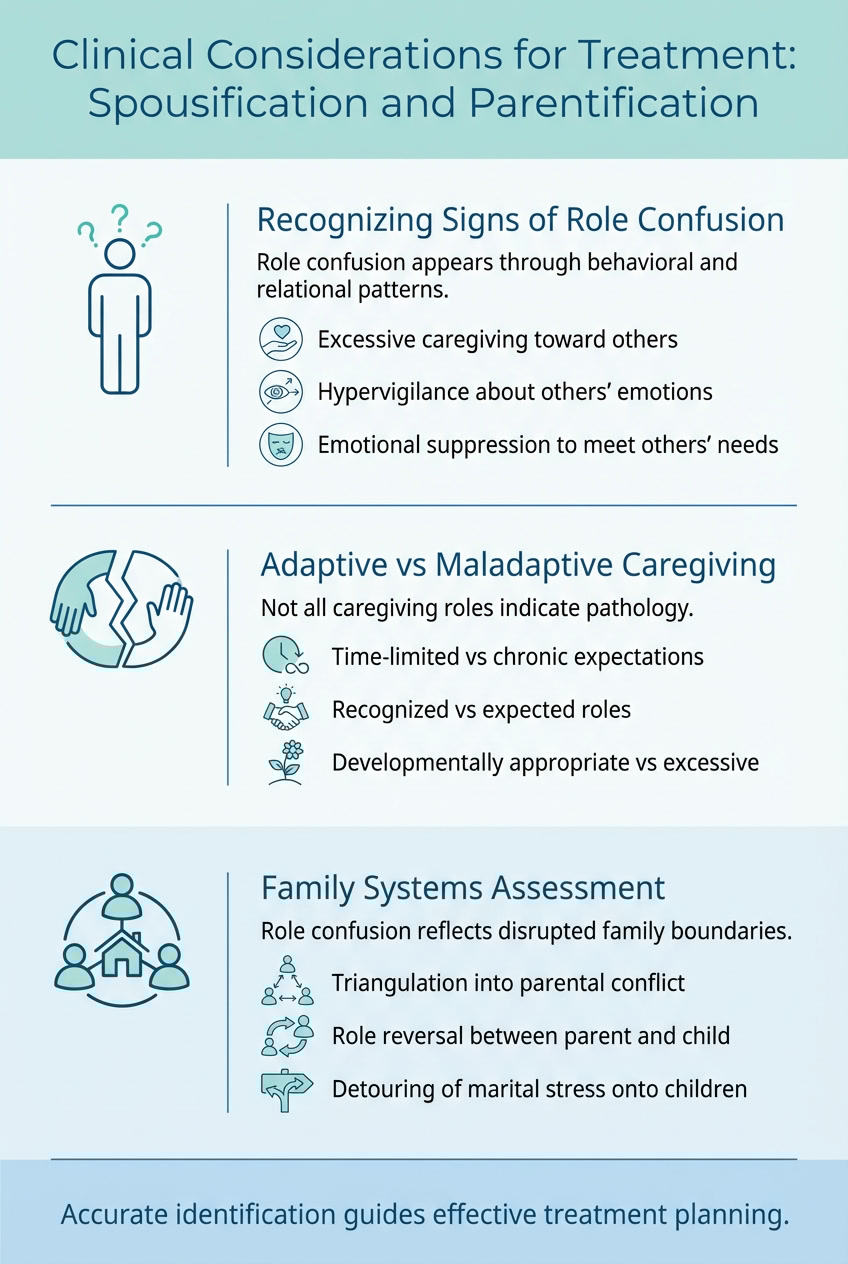
Family Systems Assessment Framework
Family systems theory provides a valuable framework for understanding role confusion. This approach views individual functioning as determined by one's position within the family system rather than solely intrapsychic factors [20]. Spousification represents boundary dissolution within the family hierarchy.
Key assessment concepts include:
- Triangulation: child drawn into parental conflict
- Role Reversal: children parenting their parents
- Detouring: marital problems projected onto children [20]
Treatment Goals: Boundary Restoration
Primary treatment objectives include establishing appropriate boundaries and restructuring family roles. Help your clients understand the relationship between access and responsibility — to what degree someone has access to them should match their level of responsibility [21].
Boundary work requires teaching clients to:
- Identify their own needs
- Communicate effectively
Implement consequences for boundary violations [22]
Working with Adult Survivors
Adult survivors require specialized interventions. Begin treatment by validating their experiences — acknowledging that parentification or spousification constitutes a form of emotional abuse helps normalize their struggles [19]. Prioritize attachment-focused therapy to heal relationship patterns and cognitive restructuring to address internalized beliefs about self-worth [19].
Core therapeutic goals include developing healthy boundaries, recognizing emotional needs, and practicing self-care without guilt. Adult clients typically benefit from grief work addressing childhood losses and identity exploration beyond caretaking roles.
Conclusion: Understanding Spousification and Parentification in Childhood Role Reversal
You now understand the critical distinctions between spousification and parentification that shape effective clinical intervention. Parentification represents the broader category of role confusion where children assume adult responsibilities, while spousification specifically refers to children fulfilling spouse-like emotional functions. This distinction directly influences your assessment and treatment planning approaches.
Cultural context plays a vital role in determining whether certain caregiving behaviors represent pathology or culturally appropriate responsibilities. The long-term consequences extend well into adulthood, affecting attachment styles, boundary formation, and self-concept development. Your therapeutic interventions must address not only presenting symptoms but also the underlying relational templates formed during critical developmental periods.
Family systems theory provides a valuable framework for conceptualizing these dynamics. Rather than viewing role confusion as individual pathology, this approach examines how family structure and functioning contribute to boundary dissolution. Treatment may involve family members when appropriate, though individual therapy often proves necessary for adult survivors.
Accurate clinical identification remains your first step toward helping clients heal from parentification trauma or spousification. Signs such as excessive caregiving behavior, hypervigilance about others' emotions, and historical patterns of emotional suppression warrant further exploration. Once you establish a clear clinical picture, you can help clients differentiate between healthy responsibilities and inappropriate role expectations.
The recovery process involves validating clients' experiences, fostering appropriate boundaries, and facilitating grief work around childhood losses. This therapeutic journey allows clients to develop healthier relational patterns and reclaim aspects of identity beyond their caregiving roles. Those who experienced spousification or parentification can build relationships based on mutuality rather than unconscious reenactments of childhood dynamics.
Your awareness of these distinctions enables you to provide more precise, effective interventions tailored to each client's unique experience of role confusion. Focus on what truly matters, helping clients move toward healthier functioning, regardless of whether their presenting concerns initially appear connected to childhood role reversals.
Key Takeaways: Clinical Insights on Parentification and Spousification
Understanding the distinction between spousification and parentification is crucial for effective therapeutic intervention and helping clients heal from childhood role confusion.
- Parentification and spousification are forms of childhood role reversal. Spousification involves children fulfilling spouse-like emotional roles, while parentification encompasses broader adult responsibilities including both instrumental tasks and emotional caregiving
- Both dynamics create lasting developmental impacts - spousification causes identity confusion and boundary issues, while emotional parentification typically produces more severe psychological outcomes than instrumental forms
- Clinical identification requires recognizing subtle behavioral patterns such as excessive caregiving, hypervigilance about others' emotions, and difficulty with relaxation or accepting support
- Family systems theory provides the optimal assessment framework by examining triangulation, role reversal, and boundary dissolution rather than viewing issues as individual pathology
- Treatment must focus on boundary restoration and identity work - helping adult survivors validate their experiences, develop healthy boundaries, and explore identity beyond caregiving roles
These dynamics often stem from single-parent households, parental mental illness, or economic stress, making early identification and intervention essential for preventing long-term relational difficulties and attachment issues in adulthood.

Frequently Asked Questions: Parentification vs Spousification in Childhood and Adulthood
How ICANotes Supports Documentation for Spousification and Parentification Treatment
Accurate documentation is essential when treating clients affected by spousification or parentification trauma. Clinicians must capture role-related family dynamics, emotional boundaries, and treatment goals clearly to ensure compliance, continuity of care, and insurance reimbursement.ICANotes simplifies this process with:
- Family Systems Templates: Structured fields help clinicians document relational roles, boundary violations, and attachment disruptions using language consistent with family systems theory.
- Customizable Progress Notes: Easily record parentification symptoms such as excessive caregiving, anxiety, or hypervigilance, and link them to treatment goals focused on boundary restoration and self-identity.
- Treatment Planning Tools: ICANotes allows clinicians to align interventions, like attachment-based therapy or cognitive restructuring, with measurable objectives and medical necessity standards.
- Secure and Compliant Records: HIPAA-compliant documentation ensures sensitive family details and trauma narratives are protected while maintaining audit-ready completeness.
- AI-Assisted Note Drafting: The AI Ambient Listening Scribe transcribes and summarizes therapy sessions accurately, capturing nuances in discussions around family roles, emotional boundaries, and self-concept.
By using ICANotes, clinicians can efficiently translate complex relational patterns into clear, clinically precise documentation that supports both therapeutic outcomes and reimbursement. Start a free trial of ICANotes to explore family systems templates and trauma-informed documentation tools designed specifically for behavioral health clinicians.

Start Your 30-Day Free Trial
Experience the most intuitive, clinically robust EHR designed for behavioral health professionals, built to streamline documentation, improve compliance, and enhance patient care.
- Complete Notes in Minutes - Purpose-built for behavioral health charting
- Always Audit-Ready – Structured documentation that meets payer requirements
- Keep Your Schedule Full – Automated reminders reduce costly no-shows
- Engage Clients Seamlessly – Secure portal for forms, messages, and payments
- HIPAA-Compliant Telehealth built into your workflow

Related Posts






Dr. October Boyles
DNP, MSN, BSN, RN
About the Author
Dr. October Boyles is a behavioral health expert and clinical leader with extensive expertise in nursing, compliance, and healthcare operations. With a Doctor of Nursing Practice (DNP) and advanced degrees in nursing, she specializes in evidence-based practices, EHR optimization, and improving outcomes in behavioral health settings. Dr. Boyles is passionate about empowering clinicians with the tools and strategies needed to deliver high-quality, patient-centered care.