Mental Health & Behavioral Health Assessment Tools
ICANotes gives behavioral health clinicians instant access to more than 100 evidence-based mental health assessment tools and behavioral health rating scales — all built directly into the EHR. No third-party apps. No paper forms to scan. No toggling between systems. Every completed assessment links automatically to the patient's chart, supporting better clinical decisions, stronger documentation, and audit-ready compliance.
Why Behavioral Health Practices Choose Built-In Assessment Software
Most EHR platforms treat assessments as an afterthought — something to print, complete by hand, scan back in, and manually re-enter. ICANotes was designed differently. Our behavioral health assessment tools are native to the charting workflow, which means:
- Clinicians complete standardized assessments in seconds, directly inside the patient chart
- Results are linked to progress notes, treatment plans, and outcome tracking
- All 100+ tools are evidence-based, validated, and available at no additional cost
- Administrators gain audit-ready documentation that satisfies Joint Commission, CARF, Medicare, Medicaid, and MIPS requirements
- Practices reduce documentation time — the original reason ICANotes was built
Start 30-Day Free Trial
No credit card required!
Behavioral Assessment Tools Built Into Every Patient Chart
ICANotes includes over 100 built-in mental health assessment tools and behavioral health rating scales, allowing clinicians to administer standardized instruments without leaving the EHR. This comprehensive library of behavioral health assessment tools and rating scales support screening, diagnosis, treatment planning, and outcomes monitoring across the most common mental health and substance use conditions. Clinicians can administer standardized assessments directly within the patient record and track changes in symptoms over time.
Built-in assessments support evaluation of:
-
Depression and mood disorders
-
Anxiety and trauma-related disorders
-
ADHD and attention-related conditions
-
Substance use and addiction disorders
-
Suicide risk and safety planning
-
Child and adolescent behavioral health concerns
-
Family functioning and psychosocial stressors
-
Recovery progress and treatment outcomes
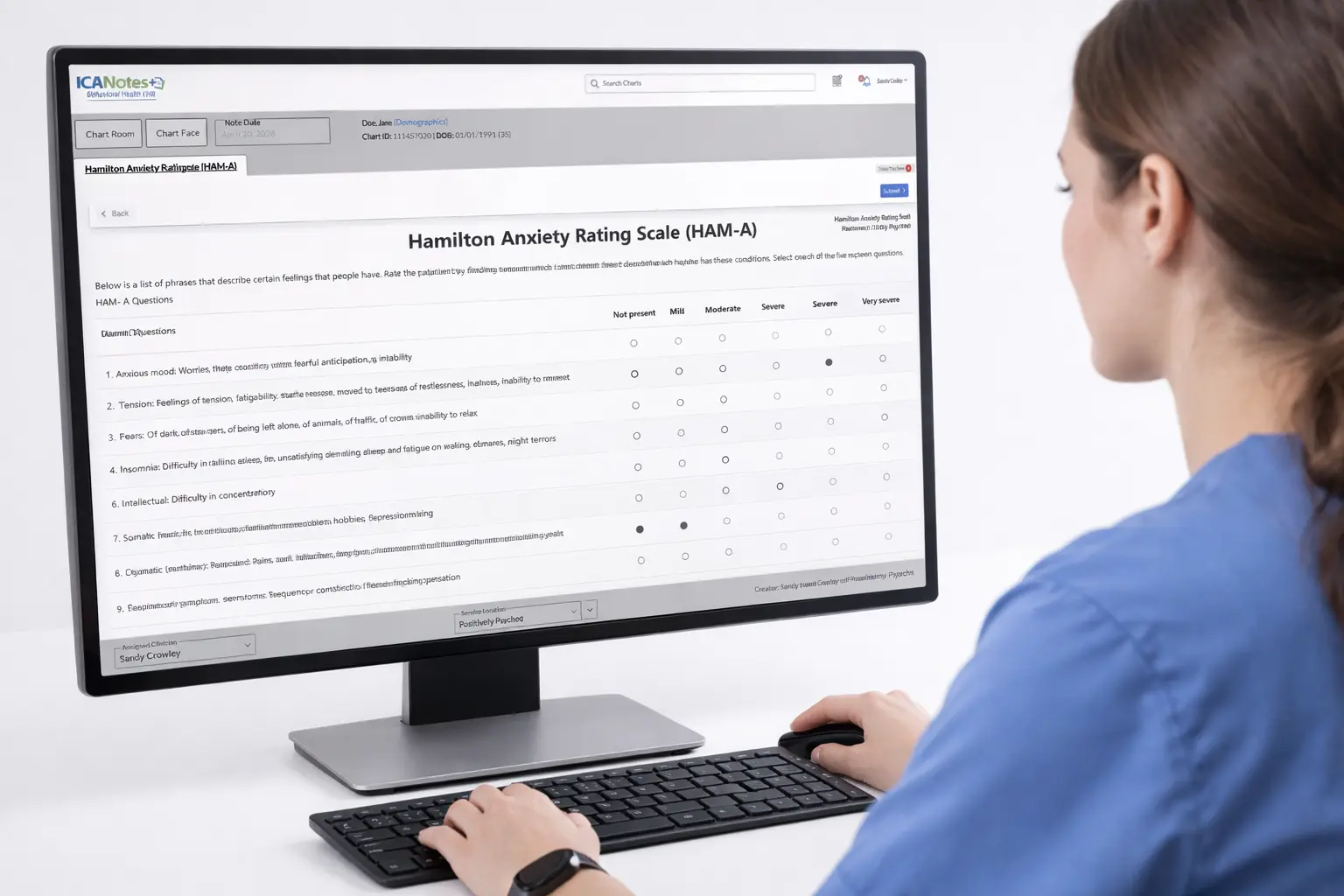
Adult Mental Health & Behavioral Health Assessment Tools
ICANotes includes a wide range of built-in adult behavioral health assessment tools and rating scales to support screening, diagnosis, risk evaluation, substance use treatment, and outcomes tracking directly within the patient record.
Core Behavioral Health Assessments
- 1915(i) Independent Behavioral Health Assessment
- ANSA: Adult Needs and Strengths Assessment
- FARS: Functional Assessment Rating Scale
- ORAS-CST: Ohio Risk Assessment
Depression Screening Tools
- CES: Center for Epidemiologic Studies Depression Scale
- Columbia Depression Scale
- DASS-21: Depression Anxiety Stress Scale
- DASS-42: Depression Anxiety Stress Scale
- GDS: Geriatric Depression Scale
- HAM-D: Hamilton Depression Rating Scale
- MDI: Major Depression Inventory
- PHQ-9: Patient Health Questionnaire
- QIDS-C: Quick Inventory of Depressive Symptomatology
- Zung Self-Rating Depression Scale
Anxiety, Stress & Worry
- GAD-7: Generalized Anxiety Disorder Screener
- HAM-A: Hamilton Anxiety Rating Scale
- Kessler Psychological Distress Scale
- PSWQ: Penn State Worry Questionnaire
- Zung Anxiety Scale
Bipolar, Mania & ADHD
- ASRS: Adult ADHD Self-Report Scale
- BSDS: Bipolar Spectrum Diagnostic Scale
- MDQ: Mood Disorder Questionnaire
- Wender Utah Rating Scale
- YMRS: Young Mania Rating Scale
Trauma, Suicide Risk & Safety
- ACE: Adverse Childhood Experience Questionnaire
- C-SSRS: Inpatient Setting Discharge Screener
- PCL-5: PTSD Checklist
- SAFE-T Protocol with C-SSRS-Recent
Substance Use Screening
- ASI: Addiction Severity Index
- AUDIT-C: Alcohol Use Disorders Identification Test
- CAGE: Substance Abuse Screening Tool
- DAST-10: Drug Abuse Screening Test
- GAIN Short Screener
- MAST: Michigan Alcohol Screening Test
- SOCRATES 8A: Personal Drinking Questionnaire
- TCU Drug Screen V
Withdrawal & Recovery Support
- CIWA-AR: Clinical Institute Withdrawal Assessment for Alcohol
- CIWA-b: Benzodiazepine Withdrawal Scale
- COWS: Clinical Opiate Withdrawal Scale
- URICA: Change Assessment Scale — Alcohol
- URICA: Change Assessment Scale — Drug
- URICA: Change Assessment Scale — Psych
Family, Functioning & Well-Being
- Eating Disorder Diagnosis Scale
- Edmundson Fall Assessment
- FAD: McMaster Family Assessment Device
- MFQ-Parent: Mood and Feelings Questionnaire
- MSI: Marital Status Inventory
- Parental Stress Scale
- Satisfaction with Life Scale
- South Oaks Gambling Screen Assessment
- SPANE: Scale of Positive and Negative Experience
- Wahler Self-Description Inventory
ICANotes also supports pediatric and adolescent behavioral health workflows with validated tools designed for developmental, caregiver-report, and school-age screening needs.
Child & Adolescent Behavioral Health Assessment Tools
ICANotes includes built-in behavioral health assessment tools for children and adolescents to support age-appropriate screening, trauma evaluation, depression and anxiety monitoring, ADHD assessment, substance use screening, and broader functional assessment directly within the patient chart.
Core Child Behavioral Health Assessments
- 1915(c) Independent Behavioral Health Assessment
- CANS: Child and Adolescent Needs and Strengths
- CFARS: Children's Functional Assessment Rating Scale
- Children's Uniform Mental Health Assessment
- PSC: Pediatric Symptom Checklist
Depression & Mood Tools
- Columbia Depression Scale — Youth (4 weeks)
- Columbia Depression Scale — Youth (year)
- MFQ-Child: Mood and Feelings Questionnaire
- PHQ-A: Patient Health Questionnaire Adolescent
Anxiety Screening
- RCADS: Revised Children's Anxiety and Depression Scale
- RCADS-P: Revised Children's Anxiety and Depression Scale — Parent
- SCARED: Screen for Child Anxiety-Related Disorders — Parent
Trauma & PTSD Assessments
- CATS: Child & Adolescent Trauma Screen — Caregiver 3–6
- CATS: Child & Adolescent Trauma Screen — Caregiver 7–17
- CPSS: Child PTSD Symptom Scale
- TESI-C: Traumatic Events Screening Inventory for Children
ADHD & Attention Tools
- NICHQ Vanderbilt Parent Assessment
- NICHQ Vanderbilt Parent Follow-Up
Substance Use & Risk Behaviors
- CRAFFT Screening Test
- POSIT: Problem Oriented Screening Instrument for Teenagers
- RAPI: Rutgers Alcohol Problem Index
Mental Health Assessment Tools Included in ICANotes
ICANotes includes more than 150 built-in mental health assessment tools and rating scales used across behavioral health. These instruments support screening, diagnosis, treatment planning, and outcomes measurement directly within the patient record.
ANSA – Adult Needs and Strengths Assessment
ASI – Addiction Severity Index
ASRS – Adult ADHD Self-Report Scale
AUDIT-C – Alcohol Use Disorders Identification Test
BSDS – Bipolar Spectrum Diagnostic Scale
CAGE – Substance Abuse Screening Tool
CATS – Child & Adolescent Trauma Screen
CES – Center for Epidemiologic Studies Depression Scale
CIWA-AR – Clinical Institute Withdrawal Assessment
COWS – Clinical Opiate Withdrawal Scale
C-SSRS – Columbia Suicide Severity Rating Scale
CRAFFT – Adolescent Substance Use Screening
DASS-21 – Depression Anxiety Stress Scale
DAST-10 – Drug Abuse Screening Test
GAD-7 – Generalized Anxiety Disorder Screener
GAIN Short Screener
HAM-A – Hamilton Anxiety Rating Scale
HAM-D – Hamilton Depression Rating Scale
MAST – Michigan Alcohol Screening Test
MDQ – Mood Disorder Questionnaire
PHQ-9 – Patient Health Questionnaire
PCL-5 – PTSD Checklist
PSC – Pediatric Symptom Checklist
RCADS – Revised Children's Anxiety and Depression Scale
SCARED – Screen for Child Anxiety Related Disorders
SOCRATES – Alcohol Readiness Assessment
TCU Drug Screen V
URICA – Change Assessment Scale
YMRS – Young Mania Rating Scale
Zung Anxiety Scale
Zung Depression Scale
What are Mental Health Assessment Tools?
Mental health assessment tools are standardized instruments — questionnaires, rating scales, checklists, and structured interviews — that clinicians use to evaluate symptoms, measure severity, track change over time, and support diagnostic formulation. They differ from screening tools, which cast a wider net to identify potential problems, in that assessments typically focus on a specific disorder's nature and severity.
The strongest mental health assessment tools share four key qualities:
Reliability
Produces consistent results across administrations.
Validity
Measures what it claims to measure and distinguishes individuals with a condition from those without it.
Sensitivity
Accurately identifies individuals who have the condition.
Specificity
Accurately identifies individuals who do not have the condition.
Behavioral Health Outcome Measurement: Track Progress, Prove Value
Payers, accreditors, and value-based care contracts increasingly require practices to demonstrate clinical outcomes — not just document encounters. ICANotes supports behavioral health outcome measurement by linking repeated assessments to the same patient over time, making it easy to show symptom trajectory, treatment response, and goal attainment across the episode of care.
When assessments are embedded in the EHR, clinicians are more likely to use them consistently — and consistent use generates the longitudinal data that supports value-based reimbursement, accreditation surveys, and quality improvement initiatives.
Whether you're tracking PHQ-9 scores across a depression treatment episode, monitoring YMRS scores in a bipolar patient, or completing quarterly CANS for a Medicaid waiver program, ICANotes keeps the data where it belongs — in the chart, tied to the clinical narrative.
Screening Tools vs. Assessment Tools: Understanding the Difference
Both screening and assessment instruments play essential roles in behavioral health care — but they serve different purposes at different points in the clinical process.
Screening Tools
Broader in scope and used early to identify potential problem areas across a range of conditions. These tools are designed to be quick and easy to administer.
Examples: GAD-7 for anxiety, PHQ-9 for depression, CRAFFT for adolescent substance use.
Assessment Tools
Focused on a specific condition and typically used after screening to determine the presence, nature, and severity of a disorder. These instruments provide more detailed clinical information.
Examples: BSDS for bipolar spectrum disorders, PCL-5 for PTSD, and DAST-10 for drug abuse.
ICANotes includes both types, giving your team the right instrument at every stage of the clinical encounter — from initial intake through discharge and follow-up.
Compliance and Accreditation Benefits
Built-in mental health and behavioral health assessment tools don't just save time — they protect your practice. ICANotes assessment documentation supports:
- Joint Commission standards requiring documented, standardized assessment processes
- CARF accreditation requirements for outcomes-oriented service delivery
- Medicare and Medicaid documentation requirements for behavioral health services
- MIPS quality reporting for behavioral health measures
- State Medicaid waiver programs requiring CANS, ANSA, FARS, CFARS, and 1915(i)/(c) assessments
ICANotes is EHR software that actually thinks like a clinician — because it was co-founded by one. Since 1999, we've built our platform around the real documentation needs of behavioral health professionals.
Ideal for Every Behavioral Health Setting
ICANotes assessment tools are used across the full continuum of behavioral health care, including:
- Psychiatry practices (outpatient, inpatient, and partial hospitalization)
- Individual, group, and couples therapy
- Substance abuse treatment and dual-diagnosis programs
- Integrated care and primary care behavioral health
- Community mental health centers and Medicaid waiver programs
- Residential and inpatient behavioral health facilities
Download the Behavioral Health Assessments Guide
Get a practical guide to commonly used behavioral health screening and assessment tools, plus reference help for choosing instruments used across anxiety, mood, trauma, substance use, and more.
- Common tools organized by clinical use
- Examples across adult and adolescent care
- Guidance on screening and assessment selection
- Quick reference for busy clinicians
Get the guide instantly — enter your email below.

Frequently Asked Questions: Behavioral Health Assessment Tools
Ready to Add 100+ Behavioral Health Assessment Tools to Your EHR?
Stop managing assessments on paper or in disconnected systems. With ICANotes, every validated rating scale and behavioral health outcome measurement tool your practice needs is already built in — linked to patient records, ready to use on day one.