How to Bill for Couples Therapy: CPT Codes 90847 & 90846 Explained
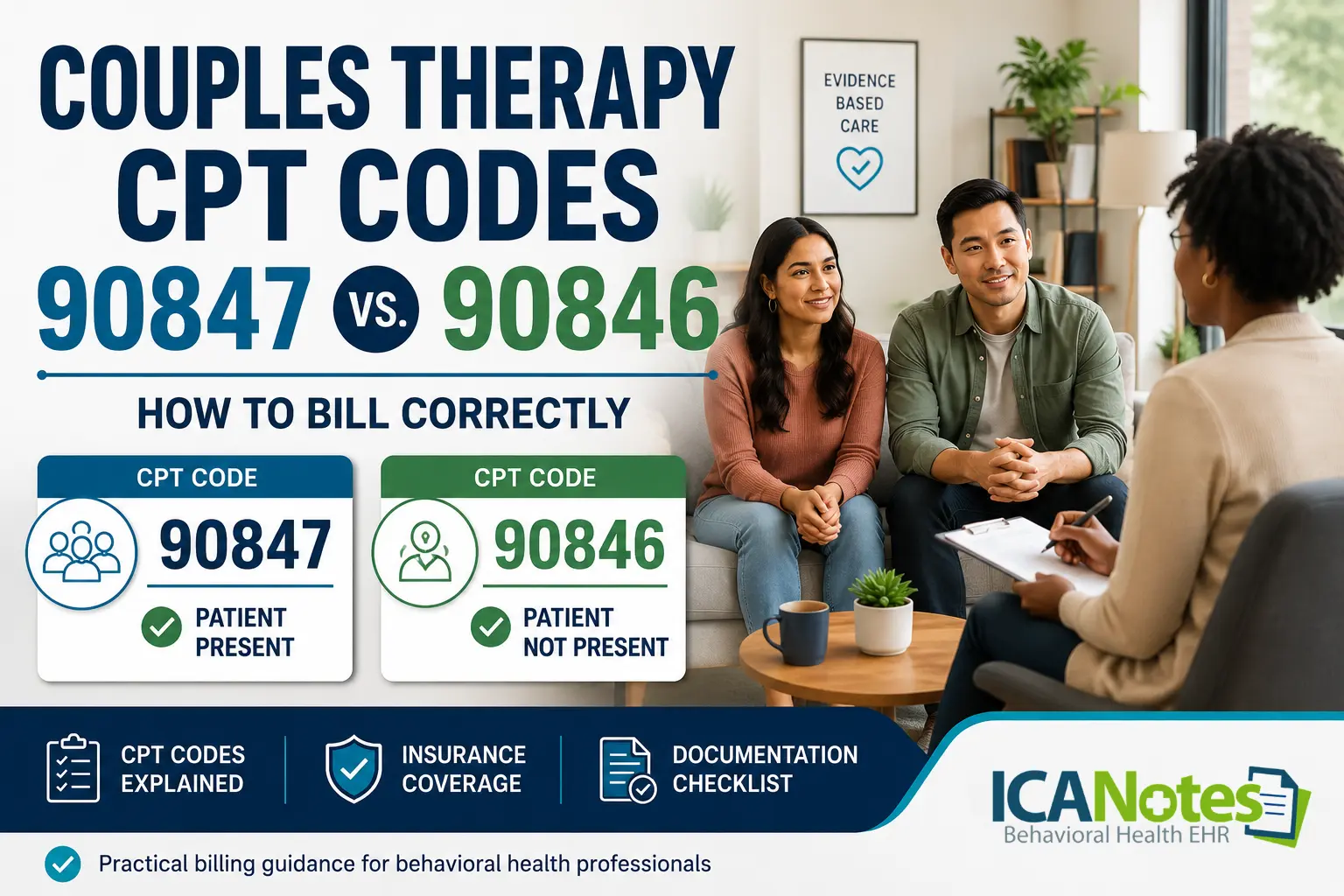
Billing for couples therapy can be challenging because insurers have specific rules for CPT codes, diagnosis selection, and documentation. The primary couples therapy CPT codes are 90847 (family psychotherapy with patient present) and 90846 (family psychotherapy without patient present), and choosing the wrong code can lead to denied claims. This guide explains how to bill couples therapy correctly, including when to use CPT codes 90847 and 90846, which diagnosis codes qualify for reimbursement, how insurance coverage works, and the most common billing mistakes behavioral health providers should avoid.


Last Updated: June 21, 2026
What You'll Learn
- Which CPT codes (90847 and 90846) to use for couples therapy sessions
- How to choose the identified patient and document medical necessity
- Which diagnosis codes qualify for insurance reimbursement
- Documentation requirements for CPT code 90847 and how to support successful claims
- How to avoid common billing mistakes, claim denials, and reimbursement issues
Contents
- CPT Codes for Couples Therapy: 90847 vs. 90846
- Diagnosis Codes for Couples Therapy
- How to Bill Couples Therapy to Insurance
- Documentation Requirements for CPT Code 90847
- CPT Code 90847: Time and Reimbursement Requirements
- 5 Common Couples Therapy Billing Mistakes That Lead to Claim Denials
- How ICANotes Supports Couples Therapy Billing
- FAQ: Couples Therapy Billing
Quick Answers
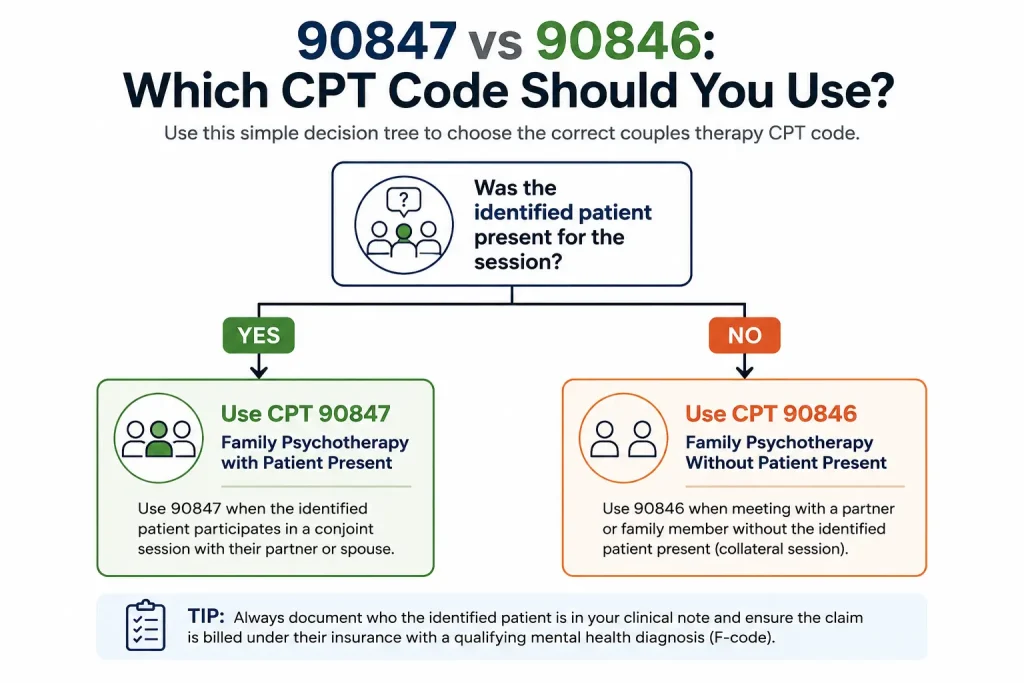
Use CPT code 90847 when the identified patient participates in the couples therapy session. Use CPT code 90846 when meeting with a partner or family member without the identified patient present. To bill insurance, the identified patient must have a qualifying DSM-5 mental health diagnosis; relationship problems alone, such as Z63.0, are generally not reimbursable.
CPT Codes for Couples Therapy: 90847 vs 90846
The two CPT codes used for couples and family therapy sessions are:
| CPT Code | Description | Patient Present? | When to Use |
|---|---|---|---|
| 90847 | Family psychotherapy with patient present | Yes | Use when the identified patient participates in the couples or family therapy session. |
| 90846 | Family psychotherapy without patient present | No | Use for a collateral session with a partner or family member when the identified patient is not present. |
CPT Code 90847: Family Psychotherapy with Patient Present
CPT code 90847 is the standard billing code for couples therapy when the identified patient participates in the session. The AMA defines 90847 as family psychotherapy (conjoint psychotherapy) with patient present, with a typical session time of 50 minutes or longer.
In practice, this means:
- The identified patient (the person carrying the mental health diagnosis) must be present
- The session involves therapeutic work with the couple or family as a unit
- The session must be medically necessary, tied to the identified patient's diagnosis
- Documentation must reflect the therapeutic goals for the identified patient, not just relationship issues
CPT Code 90846: Family Psychotherapy Without Patient Present
CPT code 90846 covers collateral sessions — where you meet with a spouse, partner, or family member without the identified patient. This is appropriate when:
- You are gathering history or collateral information from a partner
- You are providing psychoeducation to a family member about the patient's condition
- The identified patient cannot attend but the session remains clinically necessary
Note: 90846 reimbursement rates are typically lower than 90847. Many payers also require documentation justifying why the patient was not present.
Can You Bill 90837 and 90847 on the Same Day?
This is a common question. In most cases, you cannot bill 90837 (individual psychotherapy, 60 min) and 90847 (family psychotherapy with patient present) on the same date of service for the same patient. Most payers consider these mutually exclusive on the same day. However, some payers may allow it with a modifier if the sessions were separate, distinct encounters. Always verify your specific payer’s policy before billing both codes on the same date.
Can You Bill 90846 and 90847 on the Same Day?
Billing 90846 and 90847 together on the same date is generally not accepted. These codes represent distinct clinical scenarios (patient present vs. not present) and typically cannot both apply to the same clinical encounter. If you conduct two truly separate encounters on the same day, documentation must clearly differentiate them and payer-specific rules still apply.
Get the Couples Therapy Billing Quick-Reference Card
Keep CPT codes, diagnosis rules, documentation requirements, and common denial fixes handy when billing couples therapy sessions.
- 90847 vs. 90846 CPT code comparison
- Common ICD-10 diagnosis codes and Z-code guidance
- Pre-session billing checklist
- Session documentation checklist
- Common denial reasons and fixes
Download the one-page reference card and use it as a quick desk guide before submitting couples therapy claims.
Download the Free Card
Get instant access to the Couples Therapy Billing Quick-Reference Card.
Diagnosis Codes for Couples Therapy
One of the most critical — and most misunderstood — aspects of billing couples therapy is the diagnosis requirement. Insurance does not reimburse for relationship problems alone. To bill for couples therapy, you must identify a DSM-5 mental health condition in the identified patient.
ICD-10 Diagnosis Codes Commonly Used for Couples Therapy
The following ICD-10 codes appear most frequently in couples therapy billing:
| ICD-10 Code | Description | Billing Note |
|---|---|---|
| F32.1 | Major depressive disorder, single episode, moderate | May support couples therapy when symptoms affect relationship functioning. |
| F41.1 | Generalized anxiety disorder | Use when anxiety symptoms are clinically tied to couples treatment goals. |
| F43.10 | Post-traumatic stress disorder, unspecified | May apply when trauma symptoms affect intimacy, communication, or functioning. |
| F10.10 | Alcohol use disorder, mild | Use when substance use affects the identified patient’s relationship or treatment goals. |
| Z63.0 | Problems in relationship with spouse or partner | Secondary code only. Do not use as the primary diagnosis for insurance reimbursement. |
| Z63.8 | Other specified problems related to primary support group | Supplemental context code only. Pair with a qualifying primary mental health diagnosis. |
Is Z63.0 a Billable Code?
Z63.0 (problems in relationship with spouse or partner) is a valid ICD-10 code but is not sufficient on its own for insurance billing. Z codes are supplemental codes that describe circumstances, not diagnoses. Most payers require a primary mental health diagnosis (an F code) as the first-listed diagnosis. Z63.0 can be listed as a secondary code to provide clinical context, but it cannot carry the claim alone.
What Diagnosis to Use for Couples Therapy
The identified patient’s documented mental health condition drives the diagnosis code selection. Common clinical presentations that make couples therapy medically necessary include:
- Depression or anxiety that is significantly impacting the relationship
- PTSD or trauma history affecting intimacy and communication
- Substance use disorder affecting relationship functioning
- Attachment disorders or personality disorders impacting relational patterns
Document clearly in your treatment plan how couples therapy is a necessary component of treatment for the identified patient’s condition. The therapeutic goals should reference the individual diagnosis, not just the relationship dynamic.
How to Bill Couples Therapy to Insurance
Couples therapy billing follows the same general workflow as individual therapy billing, but with a few important differences that can cause claims to deny if you’re not prepared.
Who is the Identified Patient?
In couples therapy, one partner is designated as the identified patient — the individual carrying the mental health diagnosis. This is the person whose insurance is billed and whose clinical record drives the treatment. Both partners participate in sessions, but the claim is filed under the identified patient’s name, insurance, and diagnosis.
Does Insurance Cover Couples Therapy?
Whether insurance covers couples therapy depends on the payer, the plan, and how the treatment is documented. Here’s what you need to know:
- Most commercial insurers will cover couples therapy sessions billed under 90847 when medically necessary for a diagnosable mental health condition
- Medicare does not cover couples therapy as a standalone relationship service, but may cover 90847 when documented as medically necessary for an individual beneficiary’s mental health treatment
- Medicaid coverage varies significantly by state — always verify with the specific state plan
- EAP (Employee Assistance Program) benefits may cover a set number of couples sessions regardless of diagnosis
The single biggest factor in insurance coverage for couples therapy is documentation. If the clinical record does not clearly support medical necessity for the identified patient’s diagnosis, the claim is at risk for denial.

Whose Insurance Do You Bill for Couples Therapy?
You bill the insurance of the identified patient — the person carrying the mental health diagnosis. You do not bill both partners’ insurance for the same session. If both partners have separate insurers and both are actively being treated (a less common clinical structure), you would need to evaluate each person’s coverage and documentation separately.
Does Insurance Cover Both People in Couples Therapy?
No. Couples therapy is billed as a single service under one identified patient. The partner attending the session is not separately billed or separately reimbursed. Insurance is billed for the clinical service provided to the identified patient, which involves couples work as the treatment modality.

Billing Examples & Scenarios
Example 1: IP Present
Becky has been in therapy for depression. Her partner attends sessions to support her. You bill 90847, with Becky listed as the IP.
Example 2: Partner Attends Alone
Becky’s partner meets with you to learn how to support her. You bill 90846, because the IP is not present.
Example 3: Separate Individual Session
You see Becky individually for a 45-minute session. You bill 90834, using her depression diagnosis.
Documentation Requirements for CPT Code 90847
Accurate documentation is essential when billing CPT code 90847. Because couples therapy involves multiple participants but is billed under a single identified patient, insurers expect the clinical record to clearly demonstrate medical necessity and show how the session supports treatment of the identified patient's mental health condition.
When documenting a 90847 session, be sure to include:
- The date of service and session start and end times
- The names of all participants present during the session
- The identified patient's diagnosis and relevant symptoms
- The therapeutic interventions used during the session
- How relationship dynamics are affecting the identified patient's diagnosis or treatment goals
- Progress made toward the identified patient's treatment plan objectives
- A clear statement of medical necessity linking the couples session to the patient's mental health treatment
- The plan for future treatment or follow-up sessions
Example Medical Necessity Statement
"Couples therapy session conducted to address communication patterns and relationship conflict contributing to the identified patient's symptoms of major depressive disorder. Interventions focused on improving communication skills, reducing interpersonal stressors, and supporting treatment plan goals related to symptom reduction and improved functioning."
Couples Therapy Documentation Checklist
Before submitting a claim for CPT code 90847, confirm that your note answers the following questions:
✓ Was the identified patient present during the session?
✓ Is there a documented DSM-5/ICD-10 mental health diagnosis supporting treatment?
✓ Does the note explain why couples therapy is medically necessary for the identified patient?
✓ Are interventions, progress, and treatment goals clearly documented?
✓ Does the record support the CPT code billed?
Thorough documentation not only supports reimbursement but also helps reduce audit risk and claim denials by demonstrating that the session was clinically necessary and directly related to treatment of the identified patient's condition.
CPT Code 90847: Time and Reimbursement Requirements
How Long Is a 90847 Session?
CPT code 90847 does not carry a strict time requirement the way some other psychotherapy codes do, but the typical session length is 50 minutes or more. Unlike 90837 (individual therapy, 60 min) or 90834 (individual therapy, 45 min), which have defined time thresholds, 90847 is not time-based in the same way. Document the actual session time in your notes.
90847 Reimbursement Rates
Reimbursement for CPT 90847 varies by payer, geographic location, and provider type. As a general reference:
- Medicare 2024 national average for 90847: approximately $110–$130 (varies by locality)
- Commercial payer rates are typically higher and negotiated through your contract
- 90847 generally reimburses at a slightly lower rate than 90837 (individual therapy, 60 min) with most payers
Always verify current rates with your specific payers and check your remittance advice after initial claims to confirm what you’re being paid for these codes.
90847 vs. 90846: Which Code to Use?
Use 90847 when the identified patient is present in the session. Use 90846 when you meet with a collateral (partner, family member) without the identified patient. The clinical record should make clear who was present and what the therapeutic purpose of the session was.
5 Common Couples Therapy Billing Mistakes That Lead to Claim Denials
These are the most frequent errors that lead to denials or compliance issues in couples therapy billing:
1. Billing Without a Diagnosable Mental Health Condition
Using Z63.0 alone, or billing for relationship counseling without an F-code diagnosis, will typically result in denial. Insurance requires a mental health diagnosis—not a life circumstance or relationship problem.
2. Using the Wrong CPT Code
Billing 90847 when the identified patient was not present, or using individual therapy codes (90837, 90834) for couples sessions, creates a documentation and coding mismatch that can increase audit risk.
3. Failing to Designate an Identified Patient
Both partners may attend the session, but only one is the identified patient for billing purposes. If this is not clearly documented, the clinical record may not support the claim.
4. Not Verifying Payer-Specific Rules
Some payers impose additional requirements for couples therapy, including prior authorization, documentation standards, or session limits. Always verify benefits before the first session.
5. Billing Multiple Codes on the Same Day Without Medical Necessity
Attempting to bill 90847 and 90846, or 90837 and 90847, on the same date without clear clinical justification for separate encounters can lead to audits, denials, and reimbursement issues.
Even when clinicians use the correct couples therapy CPT code, claims can still be denied due to diagnosis, documentation, authorization, or billing errors. The table below highlights the most common couples therapy claim denials and practical strategies to help prevent them.
Key Takeaways
✅ Use 90847 when the identified patient is present
✅ Use 90846 when meeting with a partner or family member without the patient
✅ Bill only the identified patient's insurance
✅ Use an F-code diagnosis as primary
✅ Z63.0 should be secondary only
How ICANotes Supports Couples Therapy Billing
Accurate couples therapy documentation starts with clinical notes. ICANotes is a behavioral health EHR built specifically for mental health and substance use providers — which means it supports the documentation workflows that couples therapy billing requires.
- Specialty-specific note templates that capture the clinical elements required for 90847 and 90846 billing
- Treatment plan tools that tie diagnosis to therapeutic goals, supporting medical necessity documentation
- Built-in billing workflows designed for behavioral health practices
- Support for multi-clinician practices where couples therapy and individual therapy are both provided
Want to see how ICANotes handles couples and family therapy documentation? Schedule a demo and explore how ICANotes supports accurate billing for couples therapy.
Simplify Couples Therapy Documentation & Billing
Whether you're billing 90847, 90846, or documenting medical necessity for couples therapy, ICANotes helps behavioral health clinicians create compliant notes faster and reduce claim denials.
- Behavioral health-specific note templates
- Built-in treatment planning and diagnosis tools
- Documentation designed to support medical necessity
- Integrated billing workflows for mental health practices
- Unlimited support and onboarding assistance
Start your free 30-day trial today—no credit card required.
Start Your Free Trial
Explore ICANotes and see how easy behavioral health documentation can be.
Frequently Asked Questions About Couples Therapy Billing
What is the CPT code for couples therapy?
+
The CPT code for couples therapy is 90847 (family psychotherapy with patient present). This code is used when the identified patient participates in a conjoint session with their partner or spouse. If the session is with a partner or family member without the identified patient present, use 90846.
What is the CPT code for 60-minute couples therapy?
+
Most couples therapy sessions are billed using CPT code 90847 when the identified patient is present, regardless of whether the session lasts approximately 50 or 60 minutes. Always verify payer-specific requirements and document actual session time.
Is couples therapy covered by insurance?
+
Couples therapy may be covered by insurance when it is medically necessary for a diagnosable mental health condition and the identified patient has a covered mental health benefit. Coverage varies by payer and plan. Most commercial insurers will cover 90847 with appropriate documentation. Medicare does not cover couples therapy as a standalone relationship service but may cover it when medically necessary. Always verify benefits before the first session.
What diagnosis code do you use for couples therapy?
+
Couples therapy must be billed with a primary mental health diagnosis, usually an F-code in ICD-10, for the identified patient. Common codes include F32.x for depression, F41.1 for generalized anxiety, F43.10 for PTSD, and substance use disorder codes. Z63.0 may be used as a secondary code but cannot stand alone as the primary diagnosis.
Can you bill 90847 and 90837 on the same day?
+
Generally, no. Most payers do not allow 90847 and 90837 to be billed on the same date of service for the same patient. Some payers may allow it with a modifier if two clearly separate and distinct encounters occurred. Always verify your specific payer policy.
Whose insurance do you bill for couples therapy?
+
You bill the insurance of the identified patient — the individual carrying the mental health diagnosis. Couples therapy is not billed separately to both partners’ insurance plans.
Does Medicare cover couples therapy?
+
Medicare generally does not cover couples therapy as a relationship service. However, Medicare may cover 90847 when the session is medically necessary for the beneficiary’s mental health treatment and the clinical documentation supports this. Verify with the specific Medicare Administrative Contractor for your region.
What is the difference between CPT code 90847 and 90846?
+
CPT code 90847 is used when the identified patient attends the session. CPT code 90846 is used for collateral sessions where you meet with a partner or family member without the identified patient. 90847 typically reimburses at a higher rate.
Recent Posts




Racheal Morris
RHIT, RCM Account Manager
About the Author
Racheal Morris is a certified medical coder and biller with over 15 years of experience in behavioral health settings. As an RCM Account Manager at ICANotes, she ensures that our customers' billing, claims, and reimbursement processes run smoothly, efficiently, and compliantly — and that revenue is maximized with minimal delays or denials.